
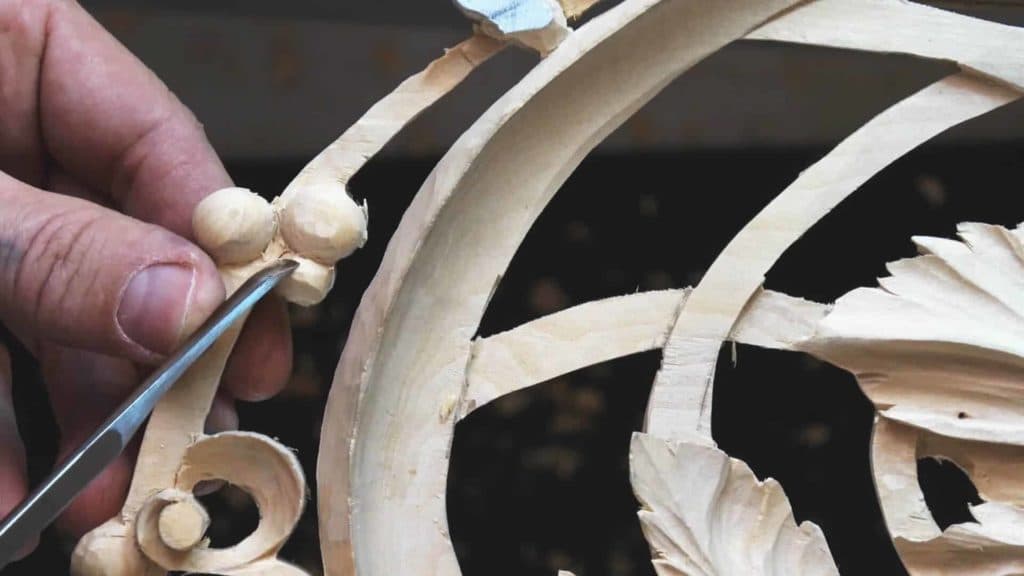
Alexander Grabovetskiy, woodcarver, School of Woodcarving · Published 2018
Is wood carving a trade, a craft, or an art?
Quick answer: Wood carving is a trade, a craft and an art, and in lesson 24 of the Hashemi course I said it could be all three. Sweden taught it the hobby way, so a craft. Russia taught it as a skill you could make money with, a paid trade. Brush marks stay on a painter's canvas, and I love tool marks.
Wood carving is a craft, a trade and an art, all three of them. In one of my workshops I asked people that very question. People do have different opinions. My own answer came in lesson 24 of the Hashemi course, while I worked on two small berries, and it was simple. It could be all.
Have you ever stood close to a painting and seen the brush marks? And a good photo of a place just as pretty? Same scene, two very different things. That difference is most of my answer, and I gave it on camera with a V tool in my hand and the limewood panel from lesson 1 on the bench.

Trade, craft or art in five short lines
- Craft is the Sweden answer, where they taught it for a hobby.
- In Russia it was a trade, a paid skill.
- Art comes in because a fine artist leaves his marks with the brush, and the same applies to this work.
- The tools and the setup have not changed in 2,000 years, not really.
- Machines can't undercut like this yet, though maybe some day.
Why would anyone call it a craft?
Sweden was my first example. Not the 18th or 19th century, I said, but even just the 20th century, different countries in Europe had a different approach to wood carving. In Sweden and some other countries it was more like a hobby, I would say. They would teach you that type of work as a hobby, and then it would be just a craft. And some of those people actually reach the level of art.

When I go to teach in person, let's say in Florida, most of the people are in their 50s and 60s. Those people know they are in the second part of life. And they know they have to do something with the brain, to stir it up. In a questions and answers video I said a carving hobby trains you to work in 3D, in a three-dimensional world. In my opinion, it beats all the TV shows.

Where does the trade answer come from?
Russia is the other half of my answer, since there wood carving used to be considered a skill which you can make money with. So that would be a trade, a paid trade. And the approach to teaching it was a little different. It was more than a craft and a feel-good time in the evening, when you sit down and carve something.
I started in Russia myself, at 16, as the only apprentice of a fine art master. The story is on let me introduce myself.
A trade has customers, and I talked about them too. Some customers do understand and some customers completely don't, and I have to explain to them. So this trade, if I can call wood carving a trade, is a really ancient trade.

In the Greek acroterion course I called it probably one of the oldest trades on planet Earth that doesn't change a lot, compared with other woodworking skills, where machinery advances even more every year.
Side by side, the three words look like this in my own words.
| The word | Where I put it on camera that day | What else I said |
|---|---|---|
| A craft | In Sweden it was taught as a hobby | Some reached real art |
| A trade | In Russia it was a skill for money | Taught a different way |
| An art | A painter leaves brush marks, same for carving | I love tool marks |
| All three | Asked in a workshop, people had different opinions | Craft, art and trade |
What makes a carving art?
Marks, the way I see it, and I know I said it before. In lesson 24 I said it again. Take photography. Find a really good location and make a beautiful picture with your camera, and it's art itself, actually. Not too many photographers understand all the laws of composition, still quite few, and good photography can sell for really good money.

Now send a fine artist to the same location, same setup, same beautiful scene. He takes a brush and starts painting, and it takes him much longer than snapping a photo, even if the photographer spends time in Photoshop or Lightroom. Two different outcomes, a picture against a fine art canvas. If the artist is really good, he can sell that same scene for much more.
The fine artist leaves his marks, the brush marks and so on, and it's considered a piece of art. Same applies to this type of work. If you are just after form and composition, you could get there much quicker with sandpaper, smooth and really shiny, and you should be fine. For me, I really love those tool marks.

I put it another way on the furniture panel design course. A photo, a film or a painting on a canvas is a two-dimensional world. In wood carving there is a three-dimensional world, and it depends how deep your chisel is going to travel, how you create the shadow and how the light is going to hit.
In that questions and answers video I said wood carving, it's the ability to think in a three-dimensional world, to see what two-dimensional people don't see. Don't get me wrong, though. Every human being is able to develop that ability, because we have the same brains. I believe we were created by the same God.
Should you sand the tool marks off?
There is nothing wrong with sanding, I said, it's just a different culture and different traditions. Some of my customers actually ask me if I can make it really smooth and sand it, and they even paint over my carving. Yeah, what can you do. Some people just don't get it. But as long as they pay, I'm okay with that. Honestly, my opinion, it looks better with tool marks.

Light sanding with the Dutch reed should be fine, though, because Dutch reed really doesn't take out those ridges. It just makes it smoother. I had mentioned it in other workshops, and in lesson 18 I said it is what you would use if you were working in the 17th century. Botanists call the plant Equisetum hyemale.
Can a CNC machine or a 3D printer carve this?
Not this kind of carving, not yet. There's no way to speed it up if you really want a hand-carved product. Yes, there are CNC machines, computerized routers, but they are limited. No CNC machine on planet Earth can do the complicated carving we were doing right then, and there's no way a machine can undercut. Maybe there's going to be some day.

In the Greek acroterion lessons I said you can do a lot of details on CNCs, but not all, of course, and even a five-axis machine has its limitation. For the Grinling Gibbons style, with how deep everything goes, there's no CNC invented yet. Just a human hand. That's the most advanced tool you have.
A 3D printer, yes, can print in different materials, and that's probably the future of art, I would say. If you are just after form and shape, a 3D printer will work for you. But for art and beautiful movements, a piece like a diamond with all its ridges and tool marks, it's not going to work.

A printed piece is not going to be the same, I said on the Corinthian acanthus course, and it lacks the most important part, the human touch. When you see marks, a human hand did it, not the machine. Machine carving looks more plasticky. Some customers expect to pay what they would pay for a CNC piece. A really complicated piece might take a week on a CNC, design and files included, with the machine running 20 hours or longer. By hand, the same piece would take probably at least one month, and look a lot better. Hand work is a hand work.
How old is this trade?
Really ancient. It takes the same tools as 2,000 years ago. Same setup, same thought process. You still have to develop three-dimensional thinking. The only difference is who's better, the ancient woodcarver or me. Or you, in this case.

I went further on the Greek acroterion. A piece takes exactly the same time it would have taken a woodcarver 200 years ago, or 500, or 1,000. You can't make it quicker. Try, and you can make a mistake that way. We live in a society of quick and cheap, and I don't think it's right. They didn't have Festool clamps, of course, but it's not that critical. You could use just old bench blocks.
In lesson 24 I also talked about the person in the Bible who built the Ark of the Covenant. I don't mean Noah and the big ark. He was a woodcarver and a stonecarver, and he worked with all types of material. And it says God filled him with wisdom, knowledge and understanding. The Bible names him Bezalel, in the Book of Exodus.
But I would probably add patience. Believe me, you have to work for a long time in one area, and there is patience involved in that. It really builds your character. So that is not a trade for people who want to get something done quickly.

What was on the bench while I talked?
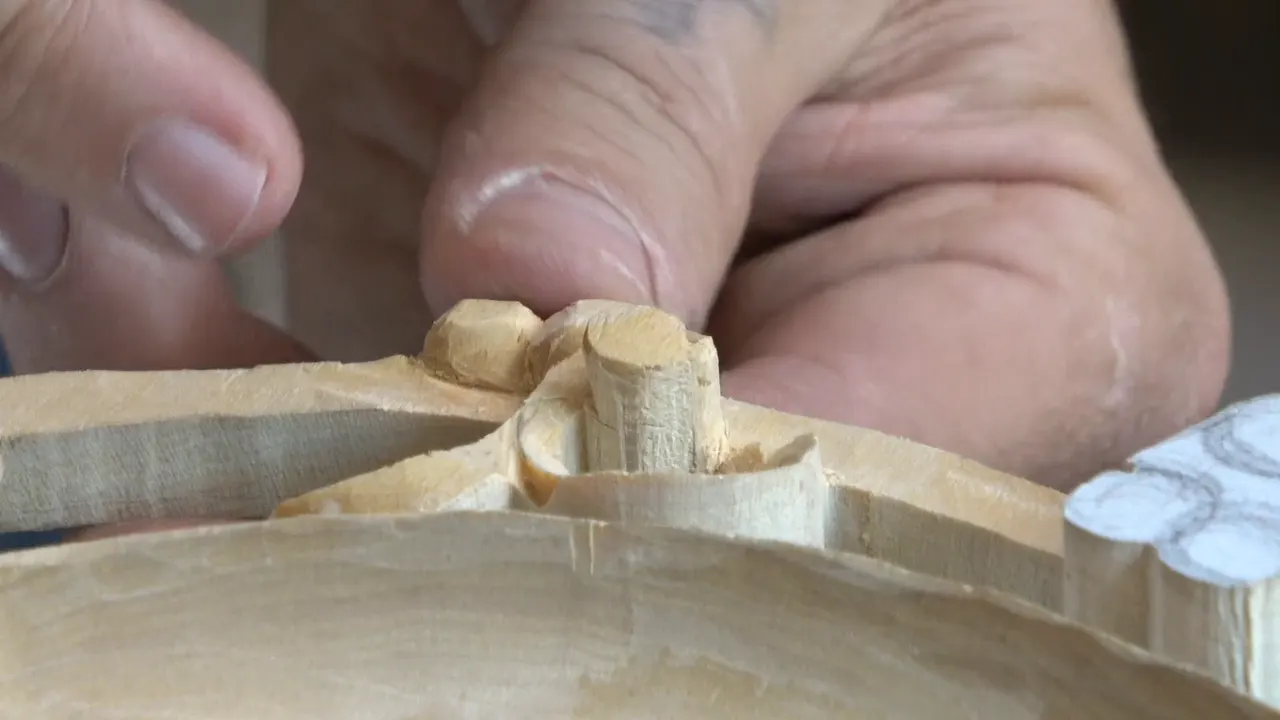
Two berries first, and then three more. I was using a number 4 at 10 millimeters (3/8 in) to make those berries, and a V tool to clean around them, then a number 5. The berries looked too big, so I had to take wood off the opposite side to make them a little smaller. That's a challenging location, because of the end grain.
By the way, I could use just a knife there, I said. A knife is actually an excellent tool for any type of carving, and quicker. Then came a number 7, about 10 millimeters, to make them more round, and the number 16 V tool again to clean between them. They have to look separated, never like they are the same. With the number 7 I had to undercut one side, and then refine with the number 5.

And they don't have to be perfectly round. Like in nature, a berry looks round, but when you look closer it's not really round, and you can find all types of forms. That number 7 is 10 millimeters or three-eighths, a little bigger than 10 millimeters.
Then I moved on to three berries that looked too high to me, so I had to lower them. They just didn't look right. That area is really fragile, a kind of weak area, and the smaller tool is safer, so I went to a number 5, a quarter inch (6 mm). Then, I said, I would re-establish them and make a channel between, first with a V tool, then a small gouge, an eighth of an inch (3 mm) or even smaller.

You can see what I'm doing with my pinky. I place it right below and create a support, because I can't press too much. It comes naturally. When I'm attacking from the other side, I place the whole hand on the bottom.
Why does every pass have to slice?
I was using a number 7 at 5/8 of an inch (16 mm), and I said I probably should use a knife first. Even if my tools are really sharp, I can't take too much material at once. And I'm always making my cuts slicing cuts, not just pushing. That would be a big mistake.
A long bevel helps. Almost all of my tools have a long, long bevel, and a brand-new tool usually comes with a really short one. The one with a shorter bevel I use more for the mallet, and for harder woods like oak. Carving by hand, I use the long bevel pretty much everywhere, actually on oak also. With a really low bevel it's a lot easier to slice through the fibers. A lot less resistance.

This spot is weak too. Be really careful, and don't press too much. And slicing, slicing, and slicing. That's the secret.
Please use your V tool as much as you can, because you're making relief cuts. The V tool is almost the number one tool on your workbench. Some people think it's the hardest to sharpen. It's not necessarily true, and you can train yourself to sharpen it, once you know the right combination.
What I mean by that is my lock at the gym. It's a combination lock, and there are certain numbers, one set first, a second set second and a third set third. You could know all the numbers, but get the wrong combination and you screwed up. Same with the V tool, and pretty much every other tool too.

The whole Hashemi panel comes out of the limewood lesson by lesson, and all of it is inside tuition at the school. Craft, art or trade, those berries still needed a number 4, a V tool and some patience.
How it's done
- Rough the berries with a #4. A number 4 gouge, 10 mm (3/8 in), gives the first round shape. Clean around each one with the V tool.
- Separate them. Run the #16 V tool between neighbors until each berry looks like its own. Undercut one side with the #7.
- Lower any berry that sits higher than the rest. Too high looks wrong. Take it down with a smaller tool, a #5 at 6 mm (1/4 in), since the smaller tool is safer where the area is weak and fragile.
- Prop the work with your pinky. Set it right below the part you carve, so there is support under it and the pressure stays light.
- Slice every pass. Just pushing is the big mistake. A long, low bevel goes through the fibers with a lot less resistance.
Frequently asked questions
Can a CNC machine carve like a human hand?
Some carving, yes, and a lot of details, but not all. I said in this lesson that no CNC on planet Earth can do the complicated carving we were doing, and no machine can undercut, at least not yet. Even a five-axis machine still has a big limitation.
Will 3D printing replace wood carving?
For form and shape, a 3D printer will work for you, and it prints in different materials. But it won't work for art and beautiful movements, with all the ridges and tool marks. On another course I added what it lacks, the human touch.
What does Dutch reed do to tool marks?
Very little to the marks themselves. A light sanding with it is okay, I said, because Dutch reed really doesn't take out those ridges. Dried, it is what a carver would use in the 17th century to work on edges, and it just makes the wood smoother.
What to carve next