
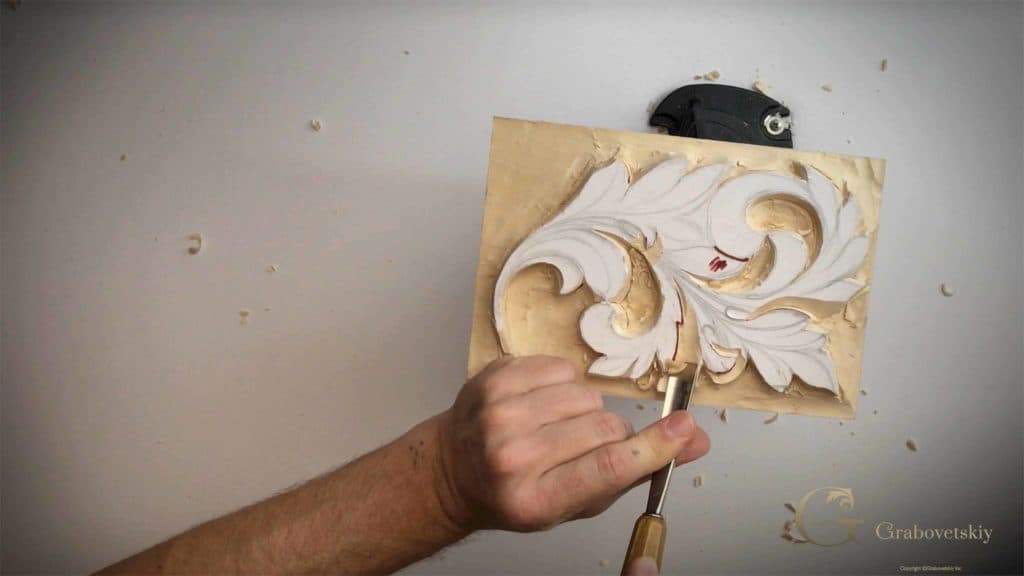
Alexander Grabovetskiy, woodcarver, School of Woodcarving · Published 2017
What are the eye and the pipe on an acanthus leaf?
Quick answer: The eye is the small opening a drawing leaves between two lobes of an acanthus leaf, and the pipe is the raised channel travelling from that eye toward the centre line. Eyes drop the whole way to the background. Pipes finish standing above every surface they cross.
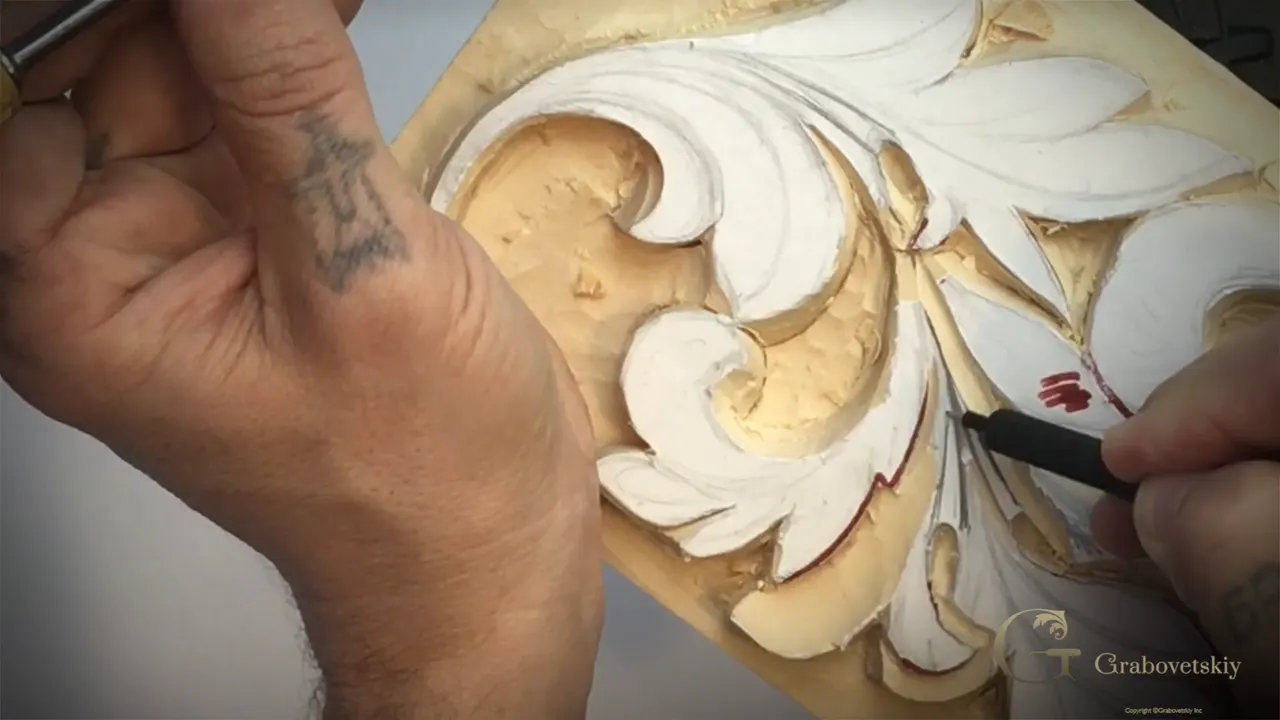
Every pipe on this leaf has to arrive at the centre line. It starts at an eye, it travels across whatever lies in its path, and when the surrounding wood drops away the pipe is what stays standing. Get that one relationship right and the leaf stops looking like a drawing.

Three sessions have gone into this leaf and not one surface on it is finished. Today is where that changes. The eyes open. Pipes appear where there was flat wood, and the board finally starts behaving like a plant.
Also the day I stop the camera to strop a tool, which tells you something about how fine these passes are.
Key takeaways
- Eyes go to the ground.
- Each pipe runs from its eye to the centre line, and it finishes higher than every surface along the way.
- An eleven belongs with the veiners.
- One wing of that veiner follows the grain and the other fights it, so aim each pass to put the clean wall on the side that will still be visible when the leaf is done.
- Slice, never push.
- Brace with the little finger where there is room.

Where does an eye actually sit?
In the gap the drawing leaves between two lobes. On this acanthus there are several, one of them so small I ended up calling it a micro pipe eye, and the rest a comfortable size. They are not decoration. An eye is the hole the light goes into, and without them a carved leaf reads as one flat blob however well you shape the rest.
How far down does an eye go?
All the way to the ground, every time. Half an eye is worse than none, since a shallow pocket fills with shadow that has nothing behind it and the trick stops working. Drive clear to the floor you established in the setting in lesson and stop dead there.

Which tool opens an eye fastest?
A chip knife, then a small sweep behind it. The knife goes in from two directions and lifts most of the material out in seconds, especially on the tiny eyes where a tool has no room to turn. Afterwards the 3mm eleven rounds that pocket out properly. Any small sweep does that second job, a nine or even an eight, as long as it fits.

What does the marking on the shaft mean?
Sweep first, width second. Mine reads 11/3, which is a number 11 sweep three millimetres across, and once you can read that you can buy tools from a catalogue without holding them. The tools course covers the whole numbering, and it is worth an hour of anybody's evening.
Why is a number 11 not a gouge?
A gouge stops at nine. Look along the edge of a nine and you are looking at exactly half a circle, which means you can plant it, rotate it, and carve a perfect round hole. Past that point the wings climb higher than half round and the shape turns into a U. That is a veiner, in both the UK and the European pattern, and the eleven in my hand is one.
Carvers call everything a gouge in conversation and it does no harm. The distinction matters the moment you try to carve a circle with a veiner and cannot work out why the hole is oval.

What happens to the grain under a veiner?
Two things at once, in opposite directions. A U shaped tool has a wall on each side of its trench, and as it travels one of those walls is running along the grain while the other runs against it. One comes out glassy. The other comes out furry, and no amount of sharpening changes that.

Which side of the trench gets the clean wall?
The side that will still be there at the end. My pipe lives on the left of one pass and the right of the next, because the grain direction changes as the design curves, and I turn the panel or come in from the opposite end so the good wall always lands on the pipe. Work out which side is clean before you travel, and you carve that trench once instead of twice.

Where does a pipe have to finish?
At the centre line, without exception. Find that line on the drawing, put the tool just to one side of it, and make the longest single pass you can manage. Long passes look better than short ones joined together, and on a curve they are the only way to keep the channel flowing.

What do two pipes do when they meet?
They build a V, and that V is a feature. Two of them converge near the middle of this leaf, and the wedge of wood between them has to stay up while I carve everything else down. Take it by accident and there is nothing to put back.
How do you decide which plane drops?
By looking at the drawing and asking which thing is in front. A leaf cannot be a flat surface with lines scratched into it. Parts have to sit forward, parts have to fall back, and the order is decided by what overlaps what, which you settled with a marker in the last lesson. The middle of my leaf rides higher than its edges. Each pipe rides higher than the leaf beneath it.
Why pick the same seven again?
Partly laziness and partly geometry. That 14mm seven was already lying on the bench from the ground work, and when I held it against the pattern its curve matched a section of the outline exactly. One tool doing two jobs is worth more than a perfect tool you have to go and find. My smaller work today went to a five millimetre nine and a seven millimetre eight, both picked the same way.
Does the pencil come back out?
Constantly. Lowering a plane wipes out the line that told you where the plane ended, so before a detail disappears under the tool I redraw it. My lines are a mess at this stage and I do not care, since they are guides rather than the finished edges, and they get put back properly before anything fine happens.
There is one line on this leaf I still call the marriage line, if that is even a name for it. Where two leaves marry and the surface has to decide which one wins.
What is a carver's cut?
A pass entering at one corner of the sweep and leaving by the other. Start at the right hand corner, travel, finish at the left, and the edge has sliced the fibres instead of shoving them. Some people call it a carver's cut, which seems fair enough. Every pass in this lesson is that shape, and if the video looks like I am being gentle, gentle is the point.
Why brace with the little finger?
Working with the grain invites you to push too hard. The tool slides easily, the shaving comes off sweetly, and then the section you were shaping flies across the shop. Whenever a gap in the design gives me somewhere to put it, my pinky goes down on the wood as a brake, and the rest of the movement comes out of the muscles in my hand.
Anyone carving Grinling Gibbons style work learns this or stops carving. Those details are almost weightless, like air, and a heavy hand ends them.
How small can a pipe get?
Barely wider than the tool that carves it. One on this leaf is so small I had to come at it from both sides with the smallest veiner I own just to make it read at all. Tiny does not mean unimportant. A pipe that vanishes leaves an eye with nowhere to go, and the eye then reads as a mistake instead of a feature.

What makes this leaf read as Greek?
The curl, and the fact that I am protecting it. That raised section in the middle is the focal point of a Greek acanthus, because curls and curvatures were what Greek carvers added to the form they inherited. Corinthian work has none of it. Keep the curl standing above its neighbours and the leaf announces its period from across a room.

How the planes stack up
| Element | Height | Tool | Watch for |
|---|---|---|---|
| Eye | Right to the ground and not a shaving lower | A 3mm eleven, with the knife going in first | Dropping below the floor by mistake |
| Pipe | Proud of its whole route | The eleven again, then a 7mm eight to clean | Losing it when you lower the leaf around it |
| Middle of the leaf | Above the edges on either side of it | Seven | Flattening the crown by taking too much off the sides |
| Outer lobes | Stepped down | Seven, and a knife where it will not reach | Grain tearing out under a fragile neck |
| Background | The floor | Whatever is already in your hand | Nothing goes lower |
Was the glue worth nine dollars?
Worth every cent, and I did not expect to say that about a can of spray. Spray mount is the glue holding my paper pattern to this block, and unlike the commercial stuff I used for years it leaves nothing behind on the edges. The paper peels. The tools stay clean. A can runs about nine dollars, which felt steep in the shop and works out at pennies a project, since one lasts a couple of years depending what you carve.
Fine spray, no mess anywhere on the bench. Small thing, and it changed how I start every panel.

Does a veiner need stropping mid lesson?
Mine did, and I stopped the camera to do it. A veiner spends its whole life carving two walls at once, so the edge takes a beating from both sides, and the moment a pipe starts fuzzing instead of gleaming the tool is telling you something. Thirty seconds on the strop and I am back at the bench, and the next pass comes off the pipe like a shaving of soap.
People treat sharpening as a thing you do at the start of a session. It belongs in the middle of one.

What holds a small section down
Very little, once you have carved around three sides of it. That is the situation on half this panel by the end of the afternoon, and the wood knows it even when you do not. Approach a weak section from the direction that pushes it against its own support, keep the passes short, and put a finger on it if a finger will fit.
Snapping a lobe at this stage costs you an hour of patching and a day of bad temper. Snapping one after the undercutting costs the panel.

What is left after today
Refining, then undercutting. The eyes get opened out properly, then each pipe takes its final section, and after that every plane I roughed in today comes up to a surface somebody could run a thumb over. None of that can start until the planes are right, which is why a whole lesson goes on shapes that will all be carved again.

Where this sits in the tradition
Both elements belong to every acanthus ever carved. Roman work uses them, Byzantine work stacks them into layers, and every later carver who touched the form kept both of them. Learn both elements on one leaf and you hold the key to the whole ornamental vocabulary.

What the wood is doing while you work
Limewood forgives a great deal. Tilia has a fine even grain with very little figure to fight you, which is exactly why Gibbons carved his relief work in it and why it is still on my bench. Try these same passes in a construction offcut and the pipes will tear out and you will blame yourself.

How hard should you press
Less than you think, more often than you think. Depth arrives through repetition rather than force, and a tool driven hard will find the weakest fibre in the board and follow it. I go over the same pipe several times, taking a little on each pass, and the last one lands exactly where I wanted the first one to land, which is the whole trick of it.

Sharpen before you start, then read your drawing until you know which plane is in front of which. A sharp edge is the whole difference between a pipe that gleams and a pipe that fuzzes, and the design decides everything a tool cannot. The rest of this course is waiting behind one door. Shall we carve?

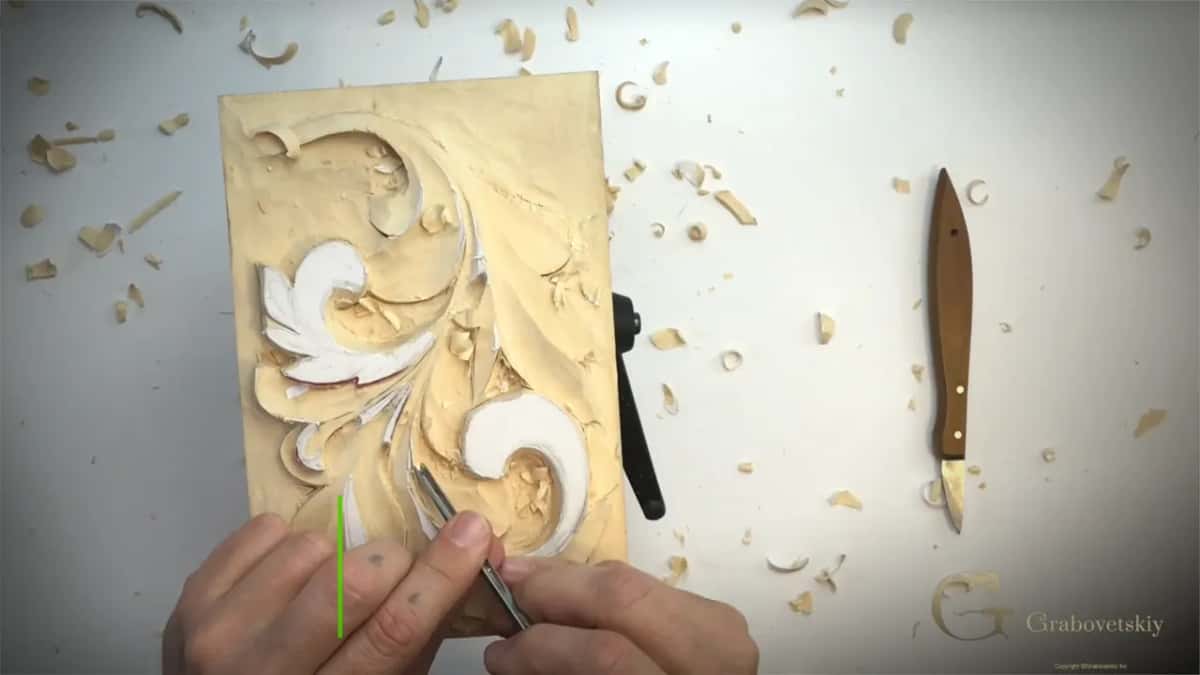
How it's done
- Mark every eye. Find them on the pasted drawing before a tool goes near the panel. Several on a leaf this size, and one of them is tiny.
- Open the eyes with a knife. Two angled passes lift most of the material out, faster than any sweep will manage in a pocket that narrow.
- Round them with a small sweep. The 3mm eleven, or a nine, or an eight. Down to the floor and not a shaving past it.
- Trace the centre line. Each channel has to reach it, so the line goes on the wood before the first one is carved.
- Read the grain before each pipe. One wall of the trench comes out clean and the other torn. Put the clean one on the side you will still see.
- Run the pipes in long passes. Enter on one wing of the sweep, leave by the far side, and cover as much of the channel as your hand allows in one travel.
- Drop the planes around them. A 14mm seven takes the leaf down on either side until the pipe is standing proud of everything it crosses.
- Redraw what you lose. Pencil the line back the moment a plane swallows it. Rough guides now, proper edges later.
Frequently asked questions
What separates a veiner from a gouge?
Depth of sweep. A gouge runs up to number nine, where the edge forms exactly half a circle and can be rotated to carve a perfect round. Anything deeper than that has wings above half round, making a U rather than an arc, and the trade calls it a veiner.
How deep does an acanthus eye go?
Clear to the background, level with the floor around the leaf. A shallow eye collects shadow with no depth behind it, and the effect the eye exists to create simply fails.
Which gouge should open the eyes?
Three millimetres of number 11 handles the smallest ones, and a nine or an eight will do the larger pockets. Width matters more than sweep number here, since the tool has to turn inside the space.
What to carve next