
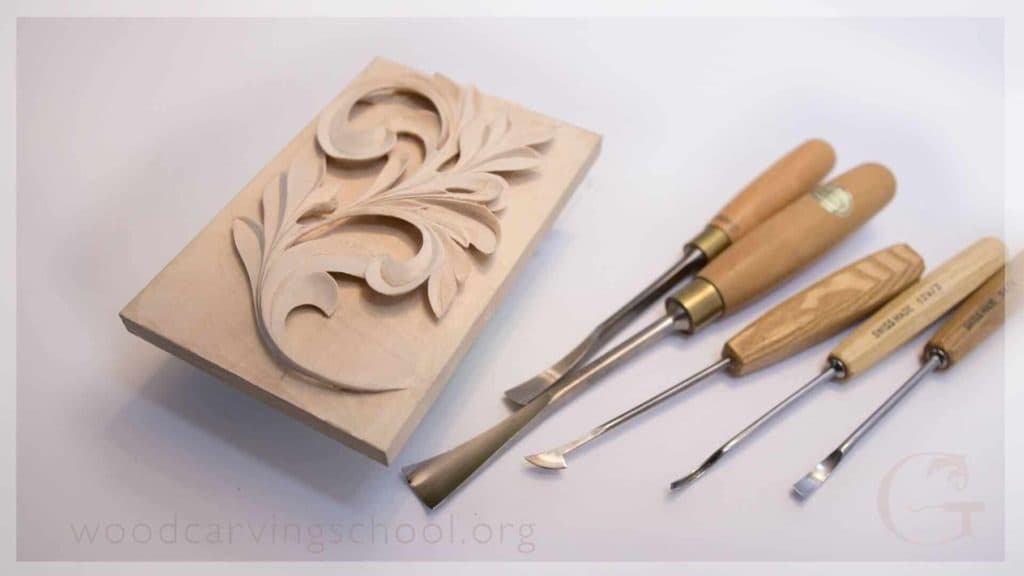
Alexander Grabovetskiy, woodcarver, School of Woodcarving · Published 2017
What is the difference between a Corinthian and a Greek acanthus leaf?
Quick answer: The difference between a Corinthian and a Greek acanthus leaf is the curl. The Corinthian runs in straight lines, every point sharp, with no curls and only a few divisions. The Greek keeps the same skeleton, brings in a swirl or volute movement with an S on each end, and shows a V cut inside every lobe.
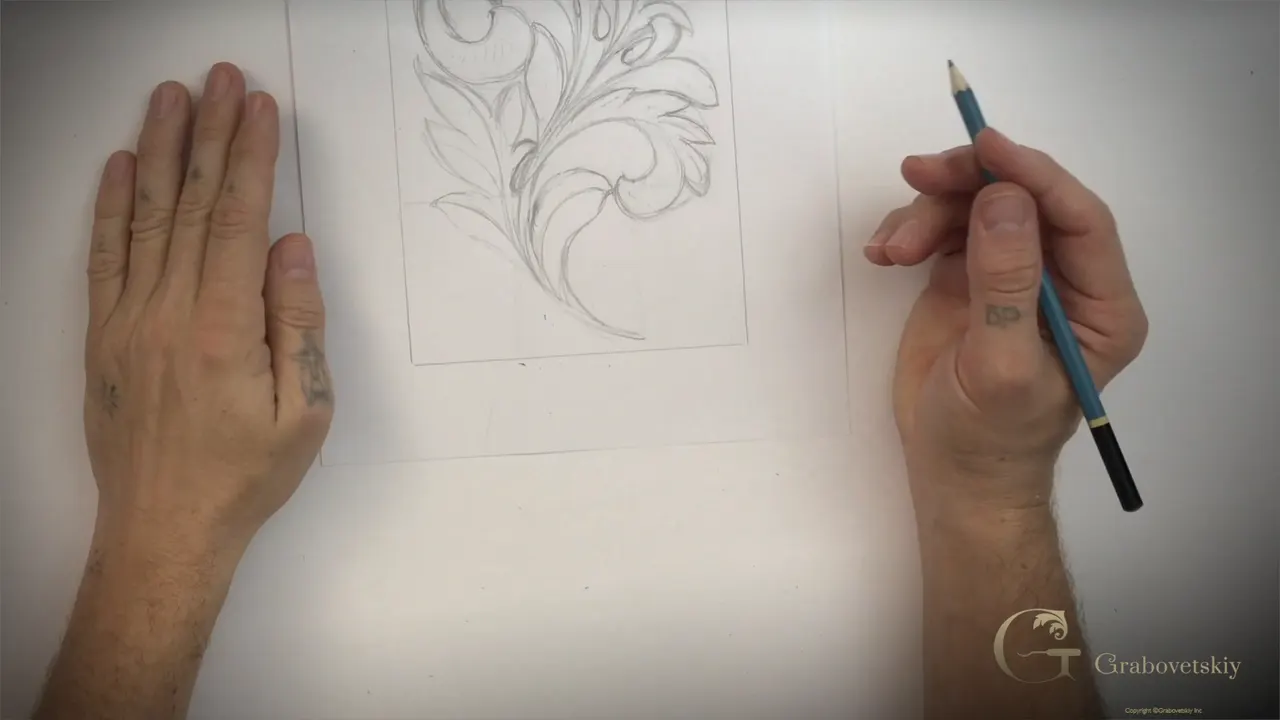
The main difference between the Corinthian and the Greek acanthus is the curl. The Corinthian is somewhat simple, with straight lines, not too many curves and not too many divisions. With the Greek one I bring in curls, a swirl or volute movement, and on camera I say that's the biggest difference between the two, the true Greek from mainland Greece, I would say.
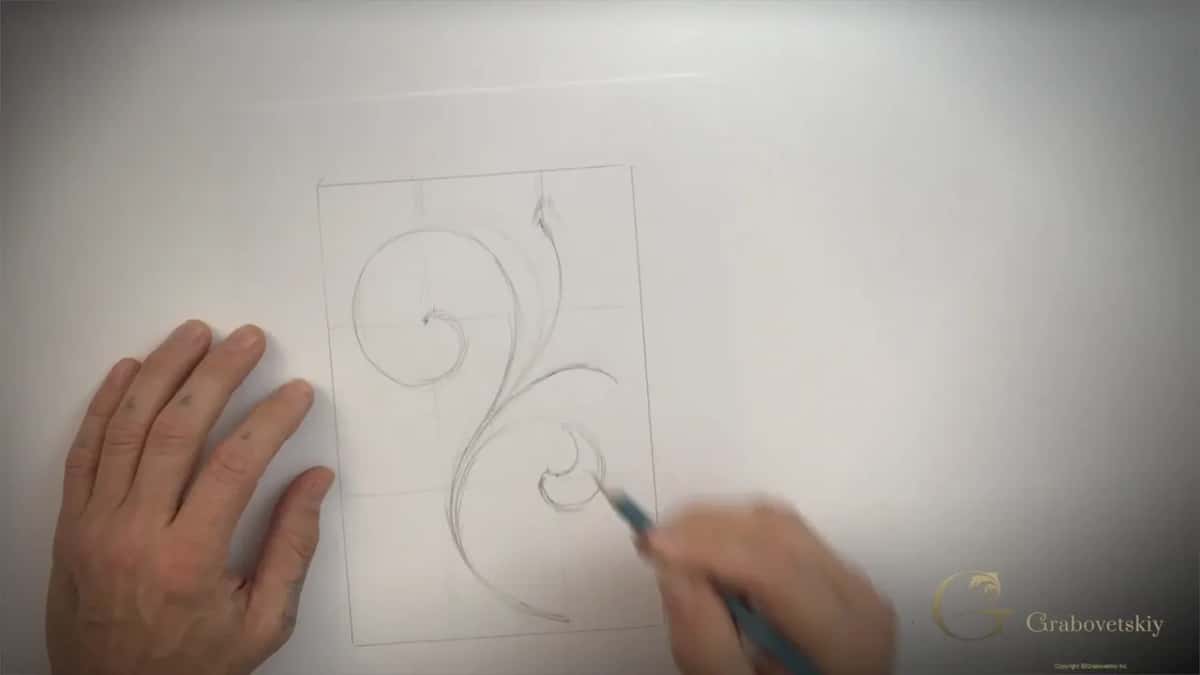
Do you have a pencil and a sheet of paper? Can you trace around a block of wood? Then you can draw this leaf with me, because all three parts of lesson 1 are drawing, and the wood stays clean until lesson 2.
Acanthus is the most common leaf in wood carving and in architecture, and I put it in almost all of my carvings. I said that at the start of my Corinthian course, where I also said we would carve the leaf as a historical progression. You will see what changes in the second step and how I put it on paper.
The two leaves in six lines
- Corinthian lines run straight, with sharp points and no curls.
- My Greek leaf keeps the three main movements and the five subdivisions of the Corinthian, and then it brings in curls.
- I call the curl a volute movement.
- Inside each Greek lobe sits something like a V cut.
- Same size block, but this leaf goes deeper than the Corinthian.
- Before any division I draw the outside border of the whole leaf, and it looks like a boat.
What does the Corinthian acanthus leaf look like beside the Greek?
Straight and plain, with sharp points. I open lesson 1 with the Corinthian leaf we just finished in my hands, and I tell you it is probably one of the most ancient forms of acanthus. On it you would have just three straight divisions, and everything would be just straight.
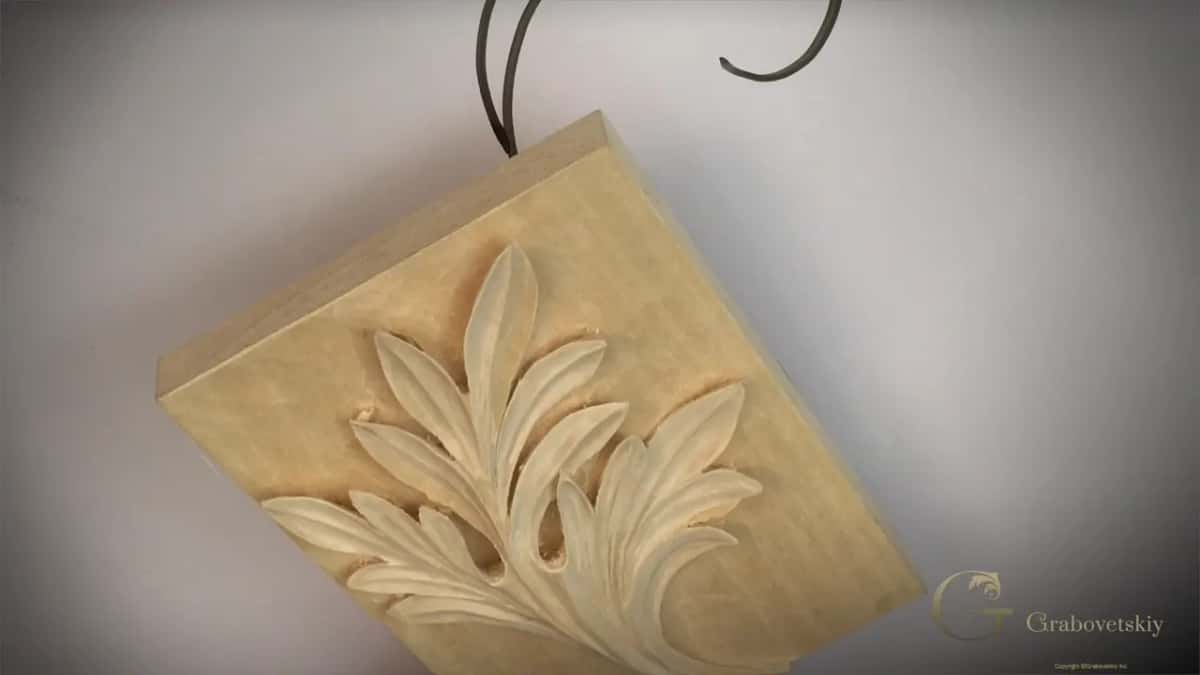
In the first Corinthian lesson the rules are short. Every edge ends in a really sharp point, and you always find that point on this type. There are no curls at all. Inside every leaf there is an incut, a concave, so the shadow falls inside, and I add that on other types we will do some curls and some volutes and some really complicated stuff.
We carve that leaf as a really deep relief, the same idea as my grape carving, and the only tools are carving gouges and a chisel.
Is the Greek curl a true volute?
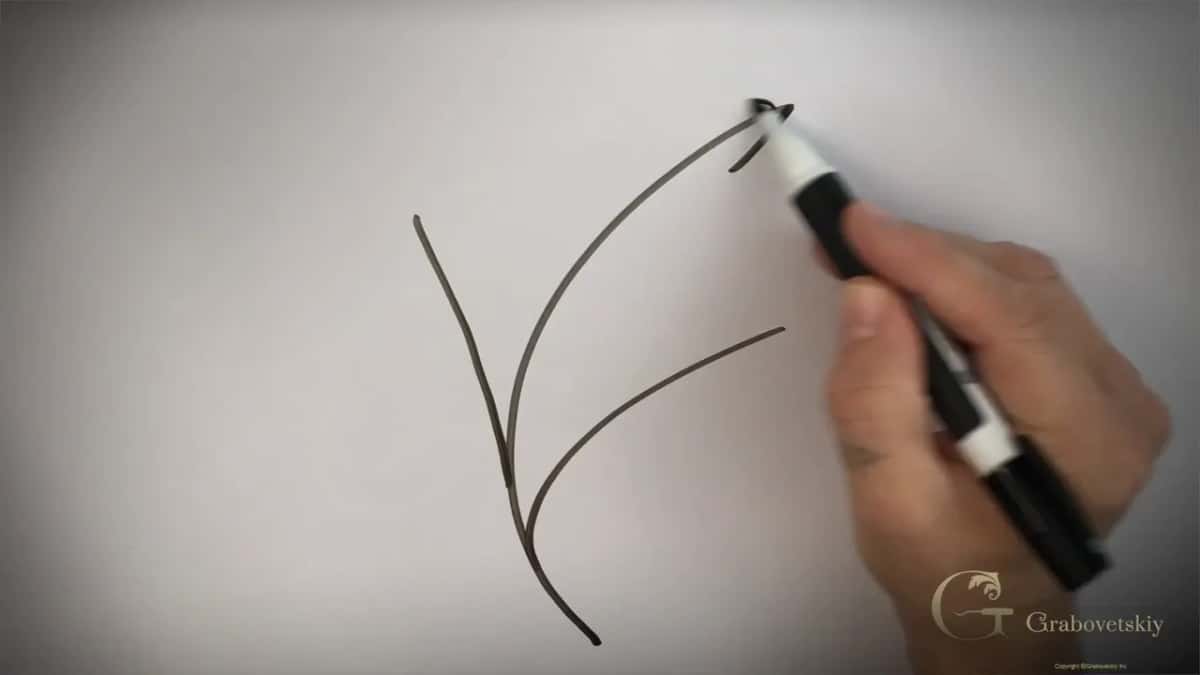
Close, but I say not yet. When I start the first curl I say I'm not sure you can call it a curl, and probably the better way to describe it is a volute movement. Early in part 2 I add that it was just the introduction of those volute movements, but it's still not a true volute yet.
Wikipedia describes a volute as a spiral, scroll-like ornament, the base of the Ionic order, found in the capital of the Ionic column.
Where did the Greek acanthus come from?
I can only give you what I say on camera, and I say it with care. The next development of acanthus leaf, I say, happened actually in Greece. Although the Corinthian somewhat also belongs to Greek culture, it's early Greek culture, and the one we draw now is still a little later.
Back in the Corinthian course I put it another way. There are two types of Greek acanthus, and the first, the most ancient one found, is the Corinthian. Later in that lesson, while I draw it, I take some of that back. Calling it the most ancient might not be absolutely 100% truth, because Egyptian drawings were found from before it, where acanthus was also a decoration.
There's an old story in that course too, about an architect who saw an acanthus growing around a basket on a young girl's grave in Corinth. I tell it and say I don't know if it's a tale or true history. Wikipedia's page on the Corinthian order gives the source as Vitruvius, who credits the sculptor Callimachus, and dates the earliest Corinthian capitals to around 420 BC.
Looking back from my Byzantine course, in lesson 3, I put the order in a few words. After Corinthian, there was a Greek. They got the movement, a curvature, first, and the Byzantine carvers took it to the extreme, with curvature in three dimensions.
What do the two leaves share, and where do they differ?
They share a skeleton and part ways at the curls and inside the leaves.
| Feature | Corinthian | Greek |
|---|---|---|
| Line of leaf | Straight, plain | Curls brought in, a volute movement starting |
| Main movements drawn | Three, straight | Three main movements, the same as before |
| Small divisions counted | Five points | Five, and the main curl is one |
| Ends of lobes | Sharp points | An S movement drawn on each end |
| Inside each lobe | Concave incut | A V cut, concave on both sides |
| Depth on block | Less deep | Deeper, about 5/8 in (16 mm) down |
How do you set up the block and the paper?
Same block first, then a sheet of paper. I take exactly the same size block as the Corinthian, exactly the same piece of wood, and in the Corinthian lesson that block is about 5.5 by 8 inches (140 by 203 mm). It's actually 5 7/16, I say there, but 5.5 will do.
I could just draw on the piece of wood itself, and that would probably be sufficient. I go the old way instead, the way we did before, and place my block on a piece of paper and trace it, so the drawing is the size of my wood block.
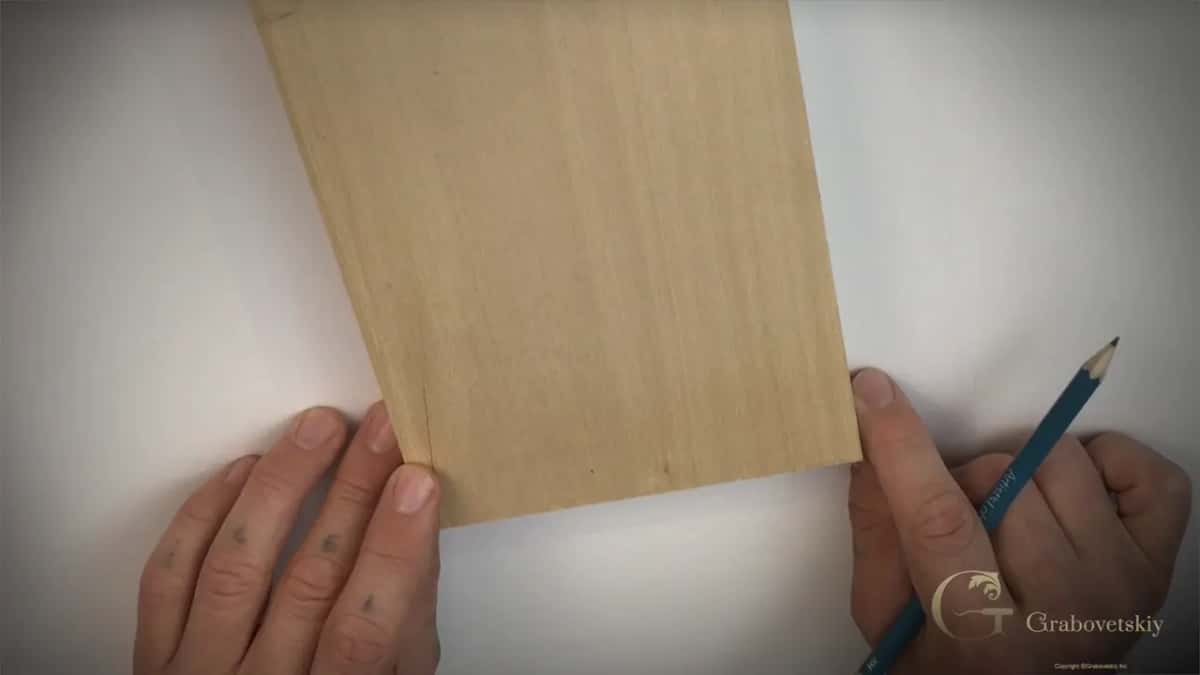
This leaf is going to be deeper. I take the block maybe 5/8 of an inch down (16 mm), like halfway of what I have. Lesson 2 has the full numbers, about one inch and an eighth (29 mm) of block and about five-eighths down, and I say I'm just eyeballing, but I'm really accurate, I know for sure.
That lesson also has the drawing glued right on top of the wood with photo mount glue, available probably everywhere, or in any craft store. The wood is lime. In lesson 5 I say I was using just lime wood, like what we're using right now, and that some people call it a queen of the woods. Lime is one name for Tilia, a tree Wikipedia says is also called linden.
Why divide the paper in three?
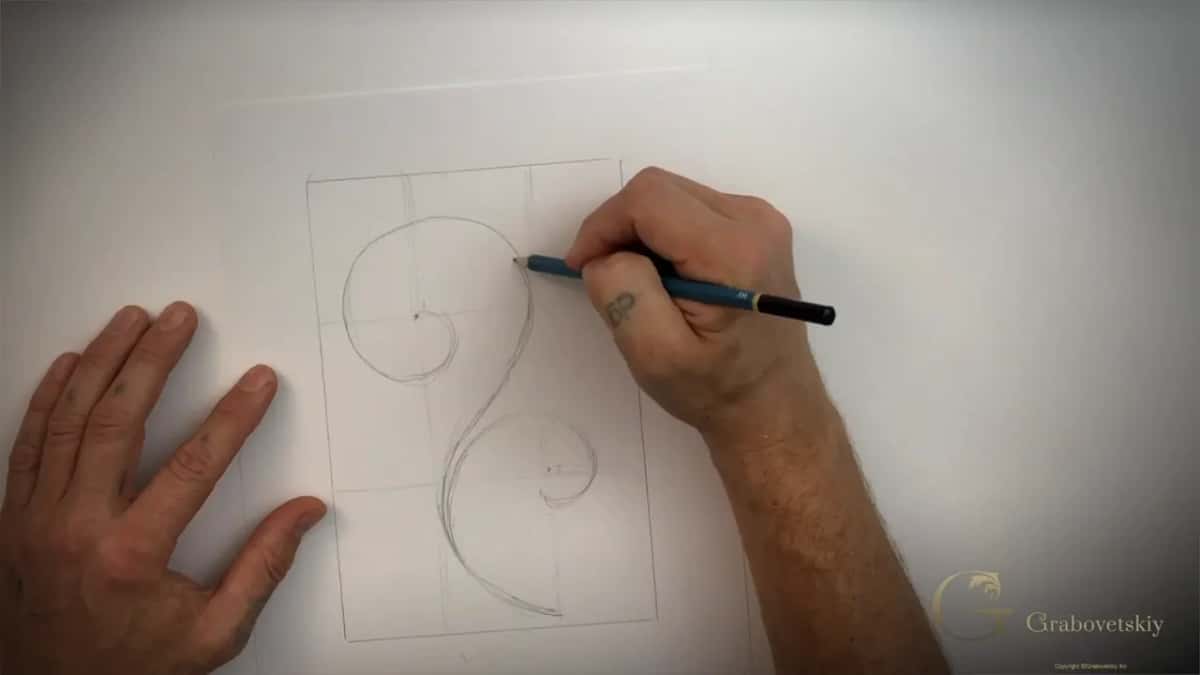
To find your golden point the easy way. During the Greek period, I say, you can probably see some laws or rules introduced to the arts and to composition, and the golden ratio started developing even more. I don't go too deep in it, but if you know, the golden rule is just like a swirl.
The easiest way to find it, approximately, is to take your paper and divide it in three parts. I don't have to do that. It is not accurate, and it is not the true golden ratio. It's a more mathematical way, I say.
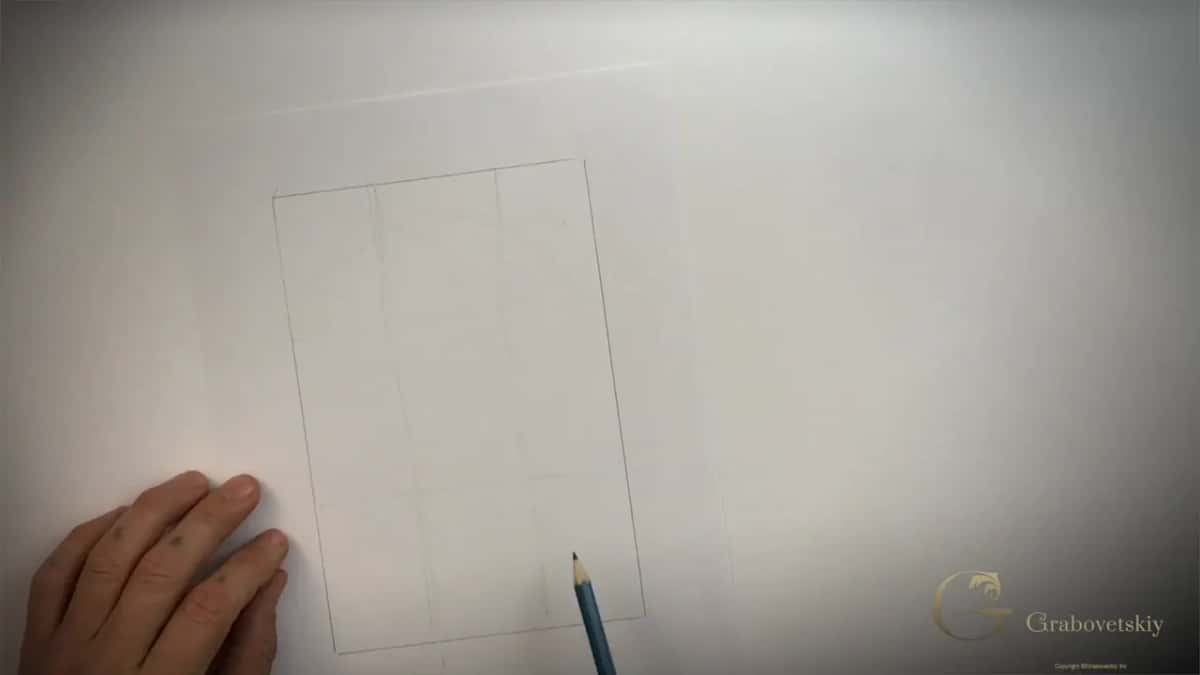
Divided like that, the sheet gives me two main points. The first is where my eye is going to look, and the second is my number two point. Painters and photographers know the same split as the rule of thirds, a grid of nine equal parts made by two lines each way.
How do you draw the main flow?
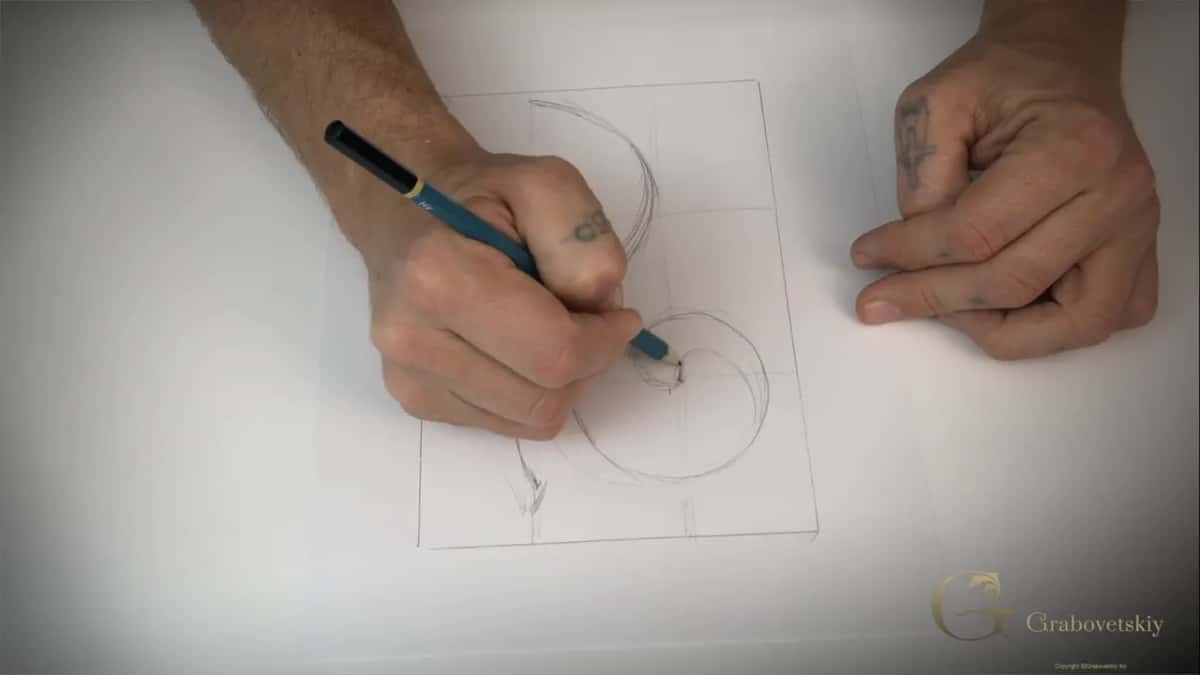
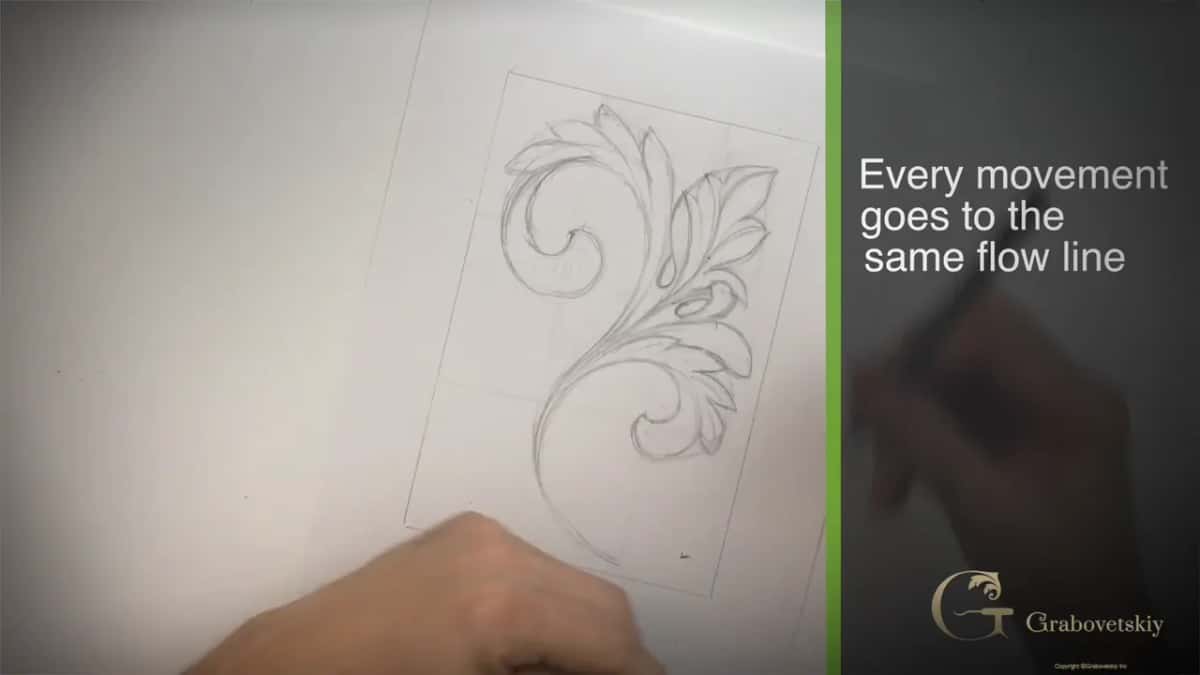
One curl first, then the line everything follows. I start the first curl the way I did on the other leaf, and that becomes the main flow. And it's really important to understand what flow is. Every leaf, every section of this acanthus, is going to go toward the center line of this flow.
I kind of don't like the movement in one spot. So I fix it, and reduce one part. One of the leaves points and finishes where I want it, although I could probably go higher. The flow of that leaf should repeat the main movement, so I move it that way, even though I tell you I don't really like how it looks.
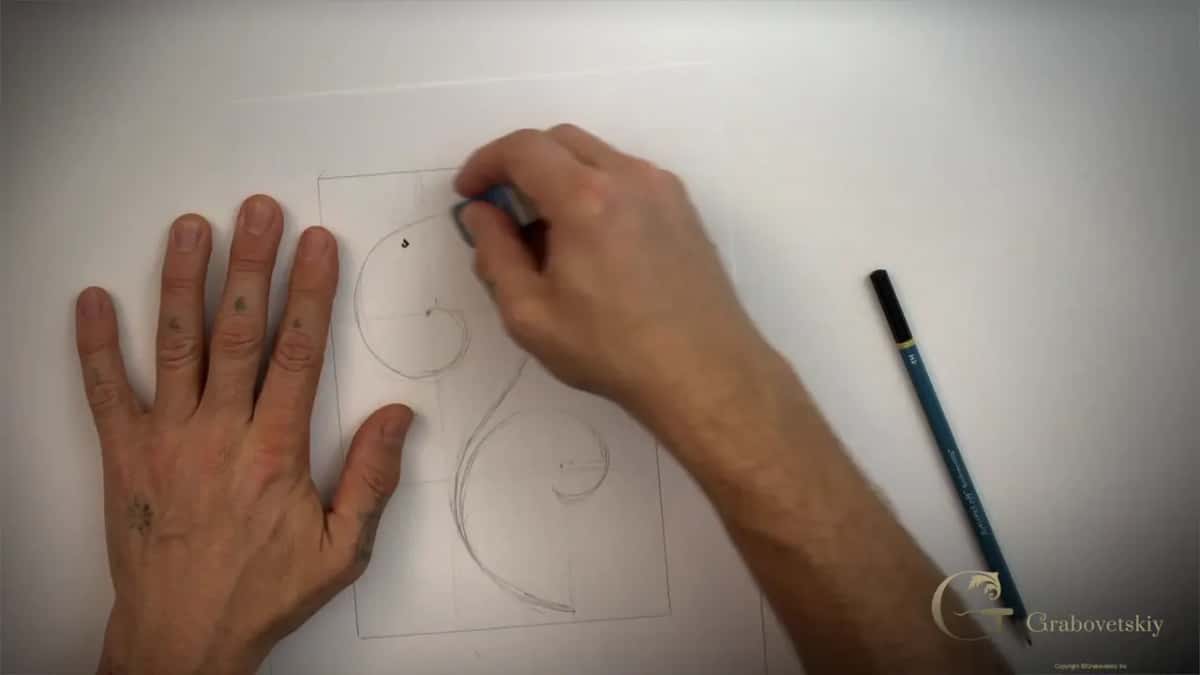
The captions in the video say it too. One reads follow flow lines and outside borders, and a later one asks for every movement on a single flow line.
Why draw the outside border before dividing?
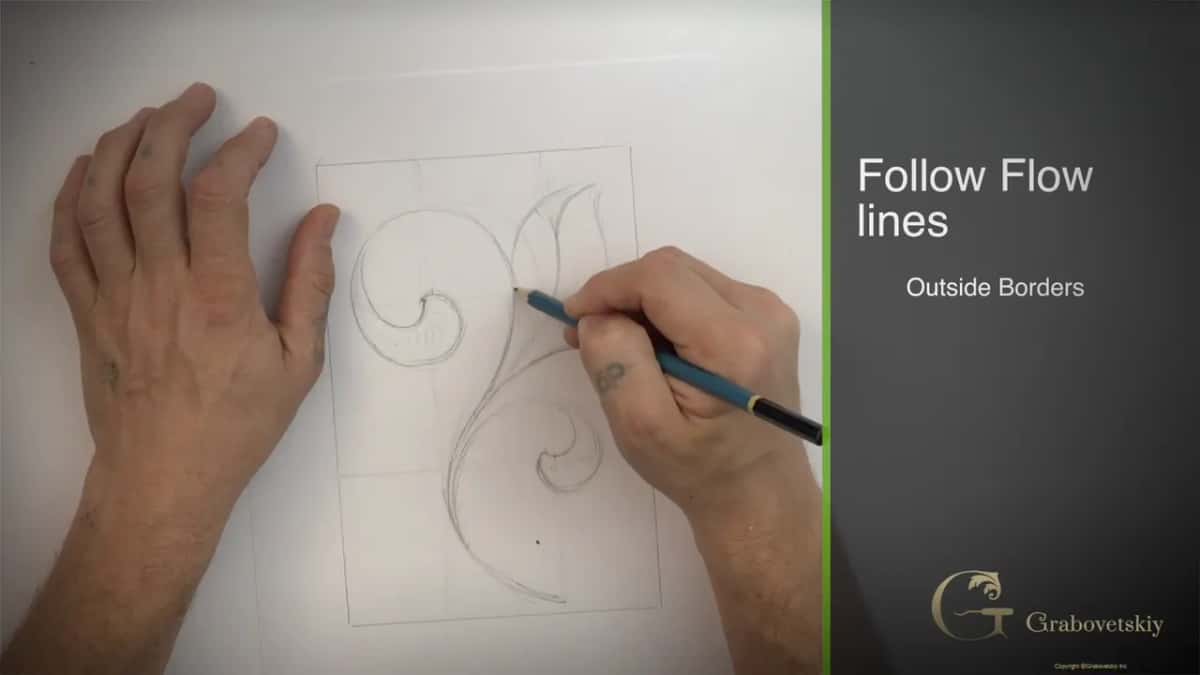
To see the whole leaf at once. Before my main divisions I draw the main movement and the outside borders, just to see visually how it's going to look all together. It looks like a boat somewhat, or a big leaf.
Next I subdivide along the flow line and don't go farther than the boundary line I just drew. Each new division repeats the flow line of the one before, and every center line heads for the center flow. One of mine is not flowing really nicely, so I fix it.
How many subdivisions does each section get?
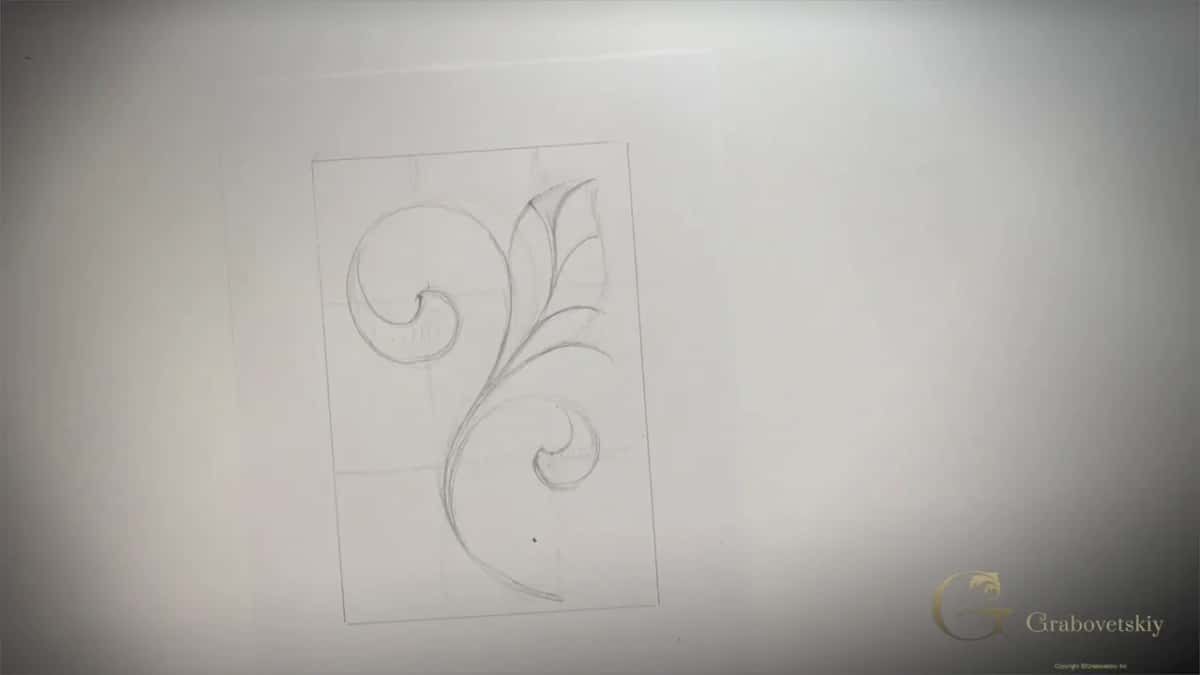
Five, most of the time. It's not necessarily a true rule of five subdivisions, I say, but on ancient forms, most of the time, five is what was found. Just a common five, one, two, three, four, five.
One section can't take five the plain way. Right above the curl there is a detail that was really common on a Greek leaf, so the main curl counts as division number one, and the four that are left spread through that section.
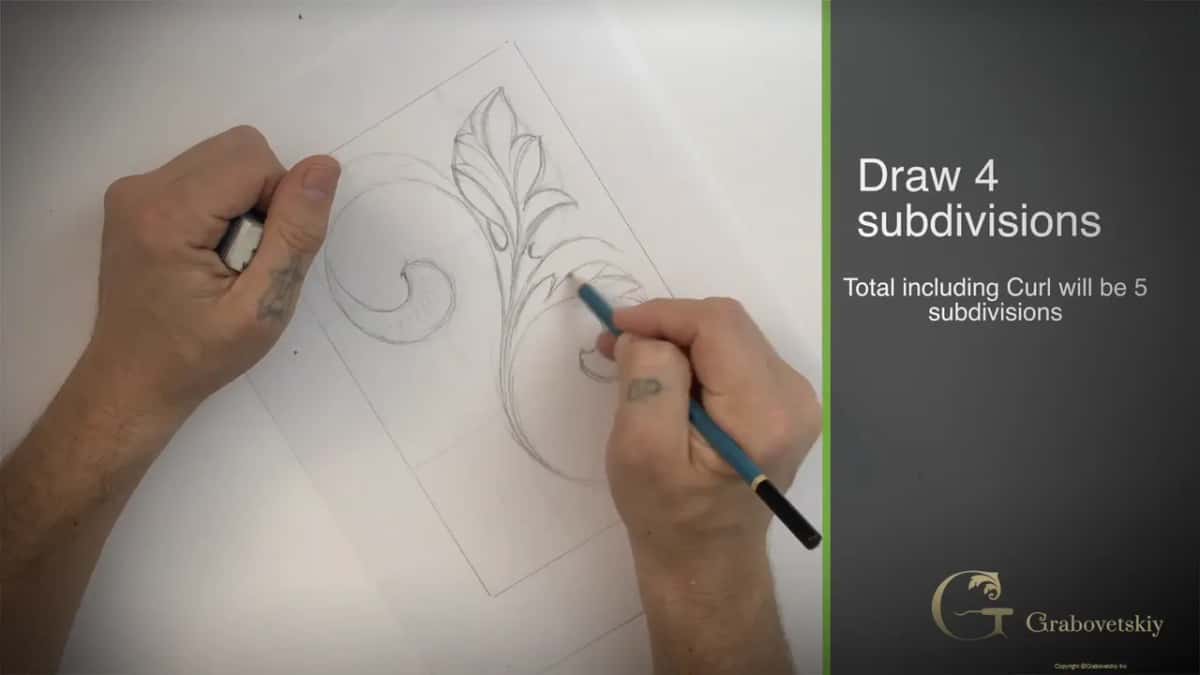
Then I run out of room. I didn't leave enough space for number four, but if I want to be accurate historically, I follow this rule, so I move one a little farther and fit four and five. The caption on screen spells it out, draw four subdivisions, and the total including the curl will be five.
In part 3 it happens again. That would be number one, I say, and we still have to fill four more, and I move one even closer before it looks much, much better.
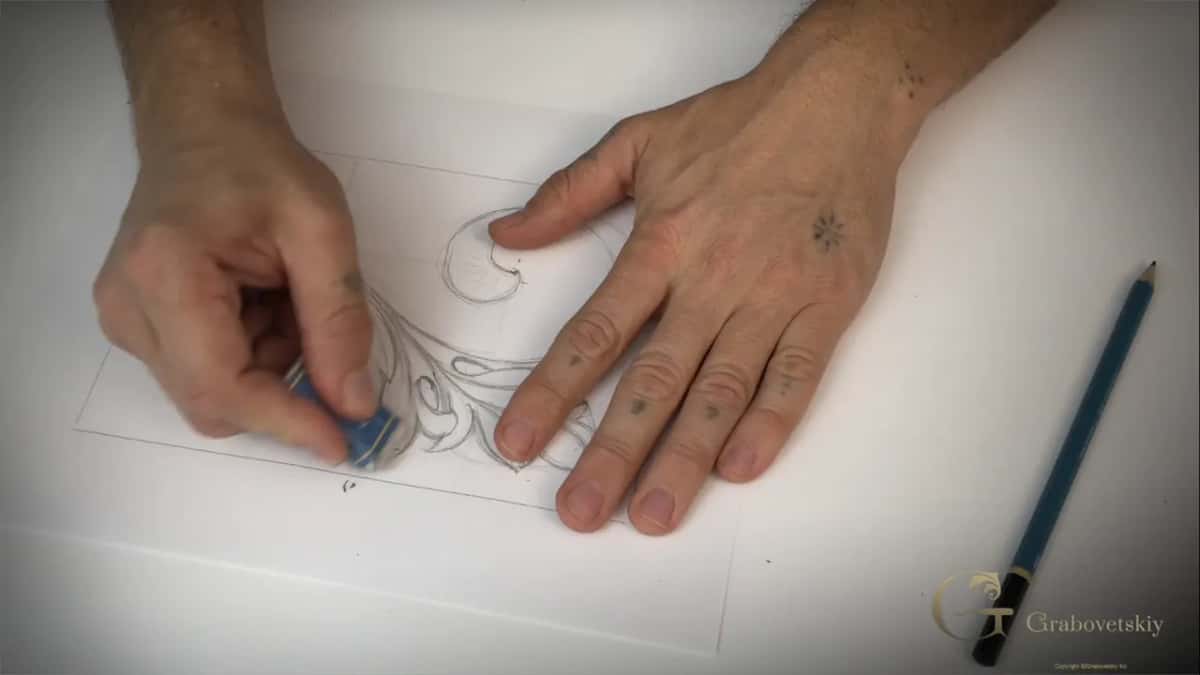
Same count on my Corinthian. There I subdivide into five sharp points, and all of those elements reach the center line, or the main movement.
Does the Greek leaf keep a ridge inside each lobe?
Mostly it shows a V. On a Greek style leaf, inside the leaf, you will still see something like a V cut, concave on both sides, if you want to be accurate to the historical Greek style.
Carving it in lesson 5, I compare the two. On the Corinthian, what we did, we left some higher ridge on the inside of the leaves. A lot of times on the Greek leaf there is absolutely no ridge, just a pure V cut. But you could, and it would still be authentic to leave a ridge inside.
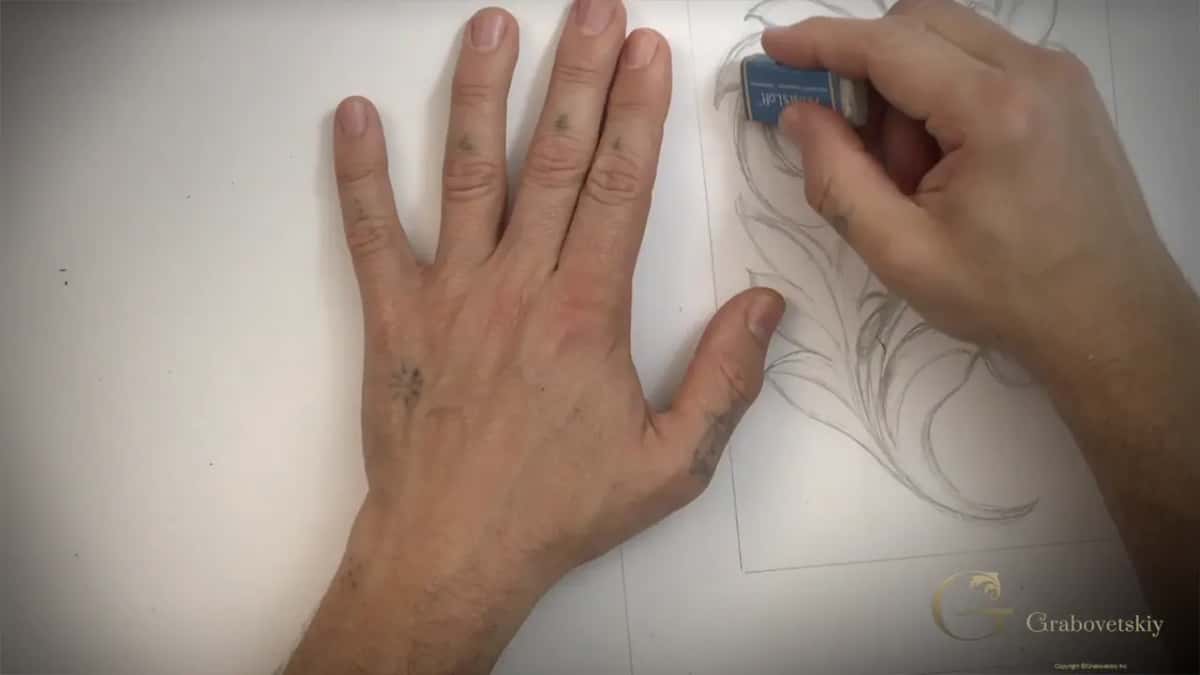
After that I make it deeper and go all the way in. Depending on how the light hits, I can see a ridge left on one side, and I don't want to see too many lines, so I take a knife and refine that side until the ridge disappears.
Where do the eyes and pipes go on the Greek leaf?
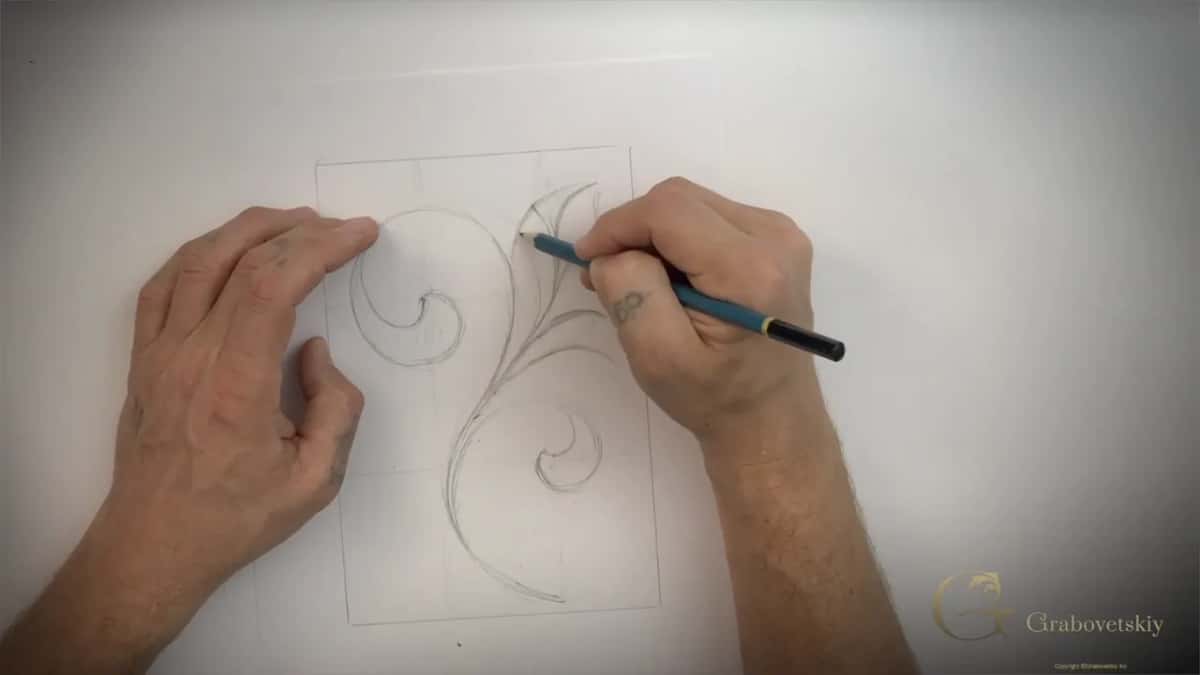
The same way as on the Corinthian. Acanthus is all about pipes and eyes, I say. If you remember the Corinthian, there is a pipe and an eye. My Corinthian lesson explains that the eye always plays between the main movements and is like a hole through. The pipe is a raised part. It's convex, with a concave on each side, and it runs to the center line every time.
On the Greek drawing I place one eye and say I think that is actually an excellent spot for the eye, then another one. In part 3 a micro eye goes into one section, another eye follows, and I move one so it looks better. Then I define the pipes. They must go to the main flow line.
What are the last touches?
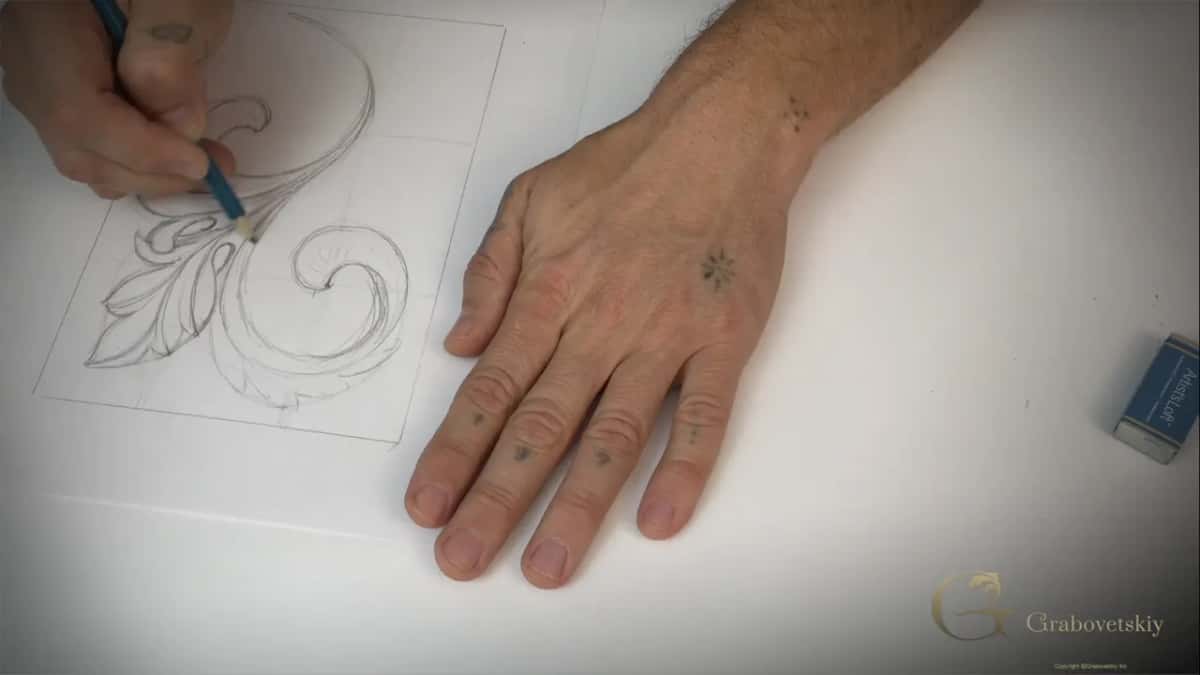
Small curls, and an S on each end. I make a small curl overlapping one section, then say maybe it's too much, and keep one single one. The introduction of those curls, I say, happened only in the Greek style, which you didn't see before in the Corinthian.
On all of them I make an S movement at the ends.
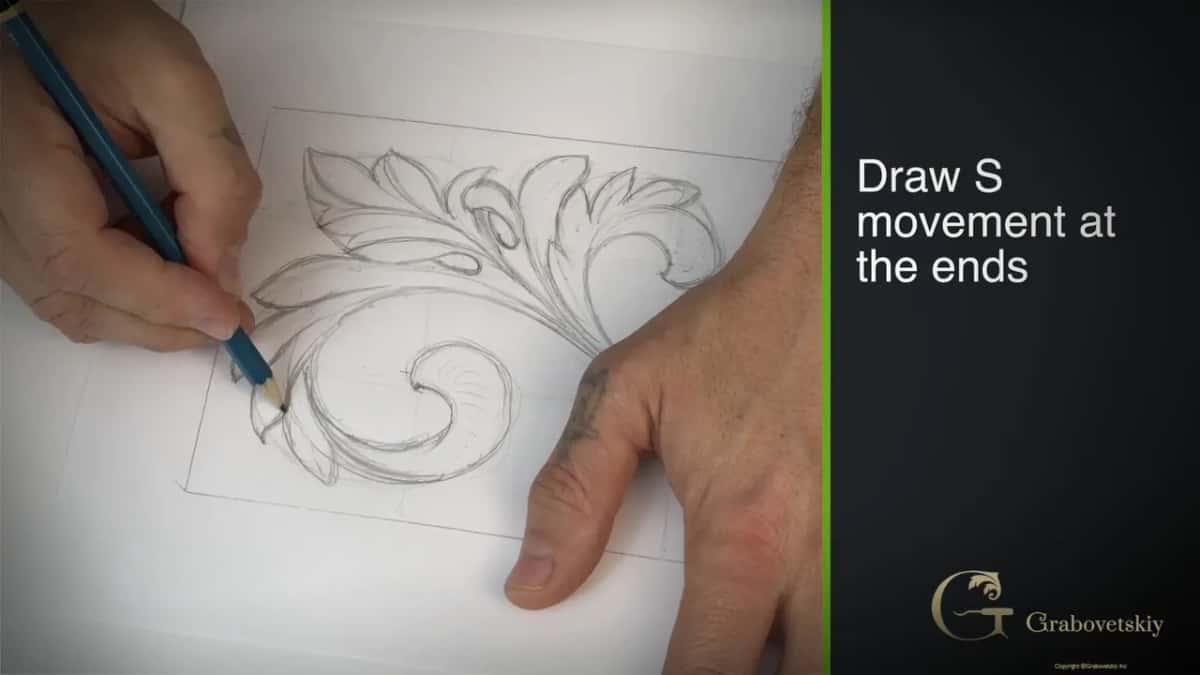
Not every idea stays. At one spot I start one more and say I don't need to do that. Right at the end I say I kind of like it, and then add just one more curl.
Why leave out micro pipes and micro eyes?
They came later in history. Later on, when they developed acanthus leaves, they introduced micro pipes and eyes, and you could draw them. I'm not going to. It's not going to be authentic to the true Greek acanthus, and so that is an ancient Greek.
I know it may look not that simple. In ancient Greece they kept it somewhat simple, though, and later you will see really complicated acanthus leaves with more subdivisions, and then you'll understand why I call this one still a simple one.
I teach acanthus as a progression, starting with probably the most ancient one and moving toward more complicated ones, and believe me, it's a good idea. In an October 2020 livestream I count where we are. We carved three styles online, Corinthian, Greek and Roman, with Byzantine and Italian still to come.
The depth comes back too. In lesson 9 I say this carving is a little deeper than the Corinthian, so you'll see some really nice effects when we deep undercut.
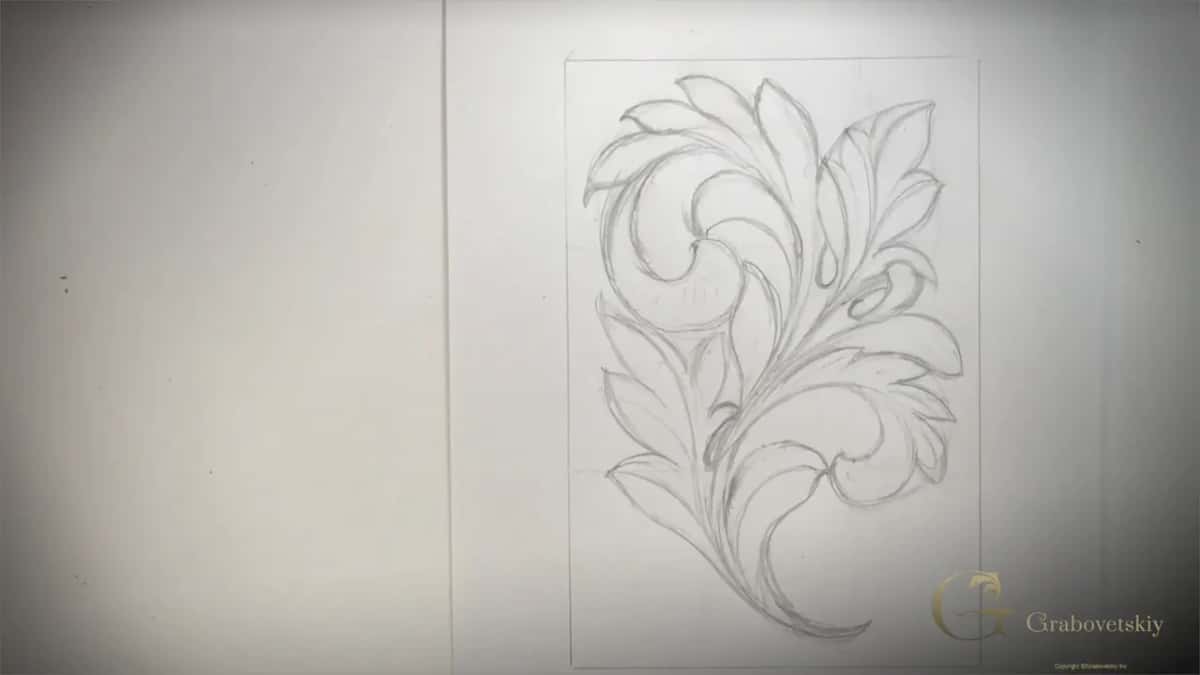
Every lesson of this Greek acanthus course is open with tuition, the drawing first and the carving after it, starting in lesson 2.
How it's done
- Trace the block. Set the block on a sheet and draw around it, so the paper matches the wood.
- Plan the depth. Plan on dropping roughly 5/8 inch (16 mm), near halfway into a block about 1 1/8 inch (29 mm) thick.
- Split the sheet in three. Mark three parts and you get two points to work from, one of them where your eye will look.
- Start the curl and the main flow. Draw one volute movement first. Every section after it heads to the center line of that flow.
- Outline the whole leaf. Get the border of the whole leaf down before any division, then stay inside that line.
- Divide in five. Where the big curl sits, count it as division one. If number four has no room, move one over and squeeze four and five in.
- Eyes, pipes and S ends. Place the eyes, make each pipe reach the main flow line, and finish every end with an S movement.
Frequently asked questions
Is the Corinthian acanthus Greek too?
On camera I say it somewhat also belongs to Greek culture, but early Greek. The leaf I draw in lesson 1 came a little later, from mainland Greece, I would say. In my Corinthian course I add that every style still stands for one leaf, the acanthus plant.
Do you need the golden ratio to draw an acanthus?
You don't. Splitting the paper in three is my quick, approximate way to find two main points, and I tell you plainly I don't have to do it. I also say it is not the true golden ratio, only a more mathematical way of getting near it.
Can you draw the leaf straight onto the wood?
You can, and I say it would probably be sufficient. I still go the old way and trace the block on paper, then in lesson 2 that drawing goes on top of the wood with photo mount glue. Along the way I fix and move lines several times.
What to carve next