

Alexander Grabovetskiy, woodcarver, School of Woodcarving · Published 2022
How do you carve a small flower in relief?
Quick answer: A small carved flower is built petal by petal, and each petal comes down to four cuts. A concave on each side of a raised centre, one more running toward the middle of the flower, and a wavy edge instead of a straight one. Everything after that is detail.
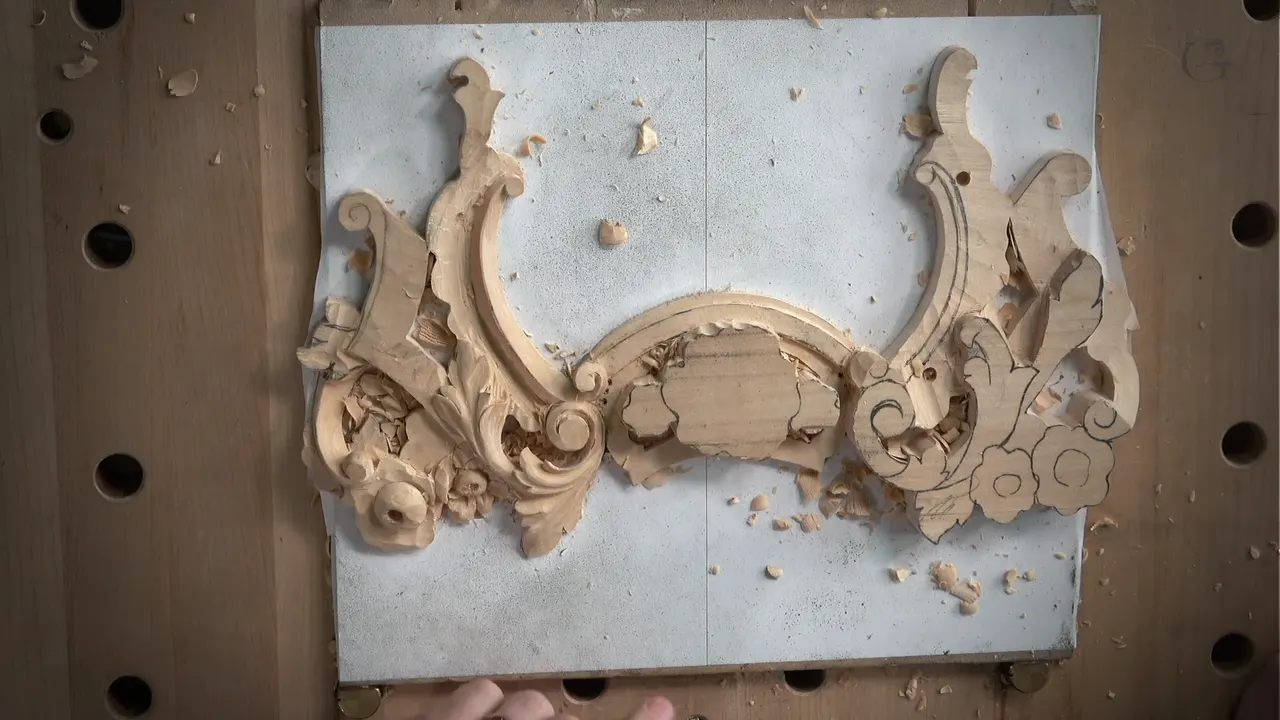
Every petal here reduces to four cuts. Hollow one side, hollow the other, leave the centre standing between them, then take one more hollow heading in toward the flower's centre. Do that five times and you have a flower. Everything after it is decoration you choose to add.
This workshop is the one where the panel stops being architecture and starts being a garden. Two small flowers go in, each tilting the opposite way, and each has to sit under an acanthus arm and over the ground where the molding will run.
I should say at the start that I lost some of the footage. It happens. The file I went looking for was corrupted, so the opening of this workshop is me explaining what I had already done rather than showing it, and I would rather tell you that than pretend.
There is also a piece broken off one petal in here, by me, on camera. I left that in too.
Key takeaways
- A petal is four cuts. Hollow, hollow, the raised centre they leave between them, plus one aimed at the flower's heart.
- Five petals, and the fifth rides across the leaf below it.
- Present the tool to the surface you are cutting rather than to the bench, or a plug cut comes out lopsided.
- Nothing straight. Every separation and every edge wants a wave in it.
- About one millimetre of wall is all I leave at the petal edge here.
- Rushing costs more than it saves, and I can prove that with a photograph of the piece I snapped off.
Why does the tool follow the tilt and not the bench?
Each flower tilts, and the holes at their centres have to look round when you stand in front of the panel. Present a gouge level with the bench and it enters a leaning surface at an angle, which opens an oval and not a circle.
So I hold it perpendicular to the leaning face itself. One flower leans one way, the other leans the opposite way, and the tool swings round accordingly for each.
Both holes went in as plug cuts about a quarter inch deep. The first took a number nine at a quarter inch, the second the same tool at an eighth, and the difference is nothing more than which one fitted.
What does one petal actually consist of?
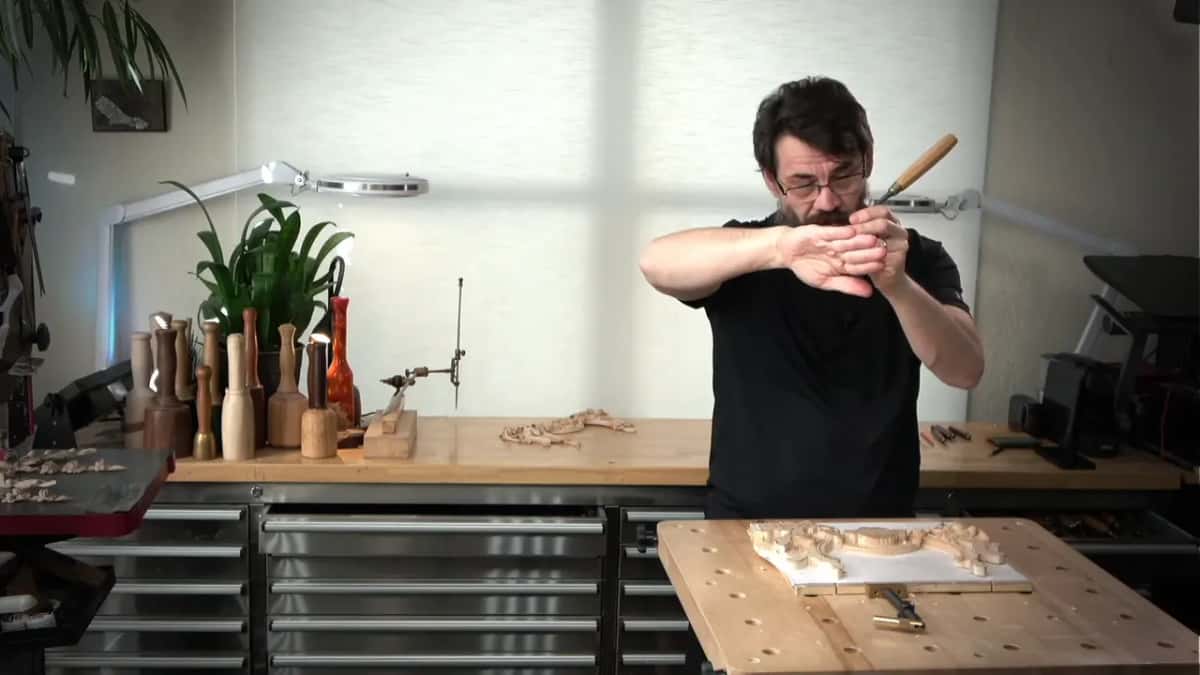
Look at a petal head on and the surface does three things across its width. It falls, it rises, it falls again. Hollow, then bulge, then hollow, which by now you will recognise as the anatomy the relief leaves already use.
Turn the petal and the same pattern appears running the other way. A bulge travels in toward the middle, with a hollow either side of it and a further hollow aimed the same way.
That makes four cuts. One, two, three, four, and the petal exists. After that you may spend as long as you like making it beautiful with smaller tools, but the shape is already there.
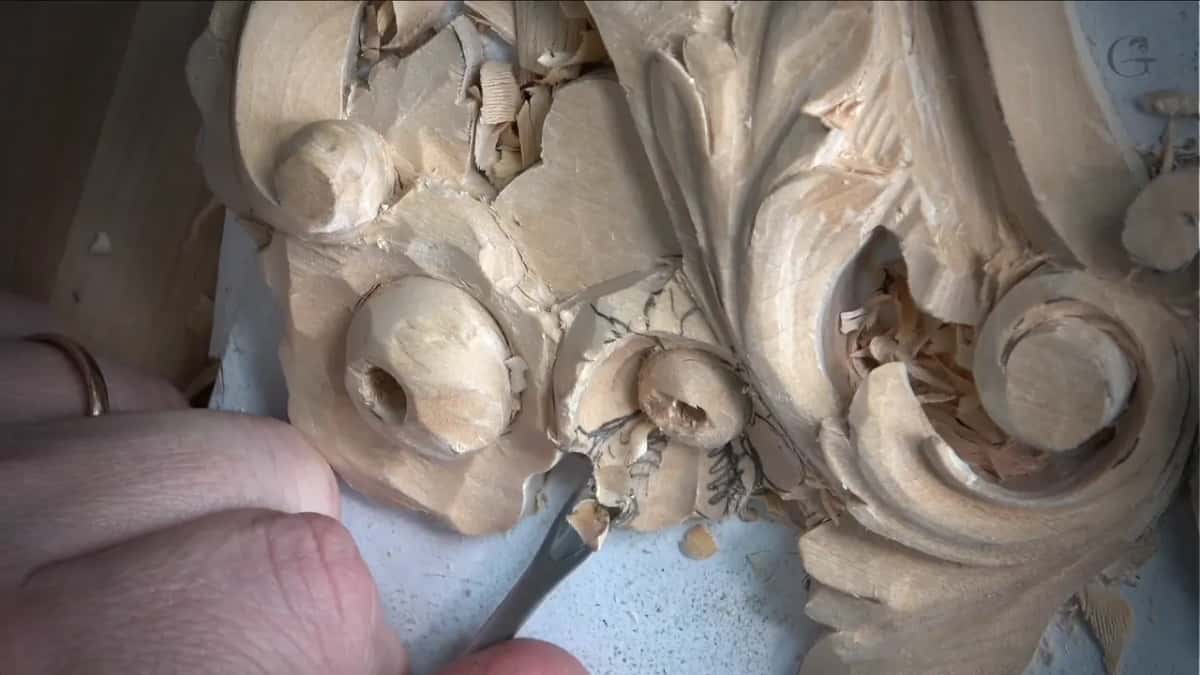
The outside of a petal gets the same treatment as the inside. Hollow, bulge, hollow once more, kept small, and the result is what makes the thing read as alive rather than stamped. The same trick has worked at any scale in sculpture for a very long time.
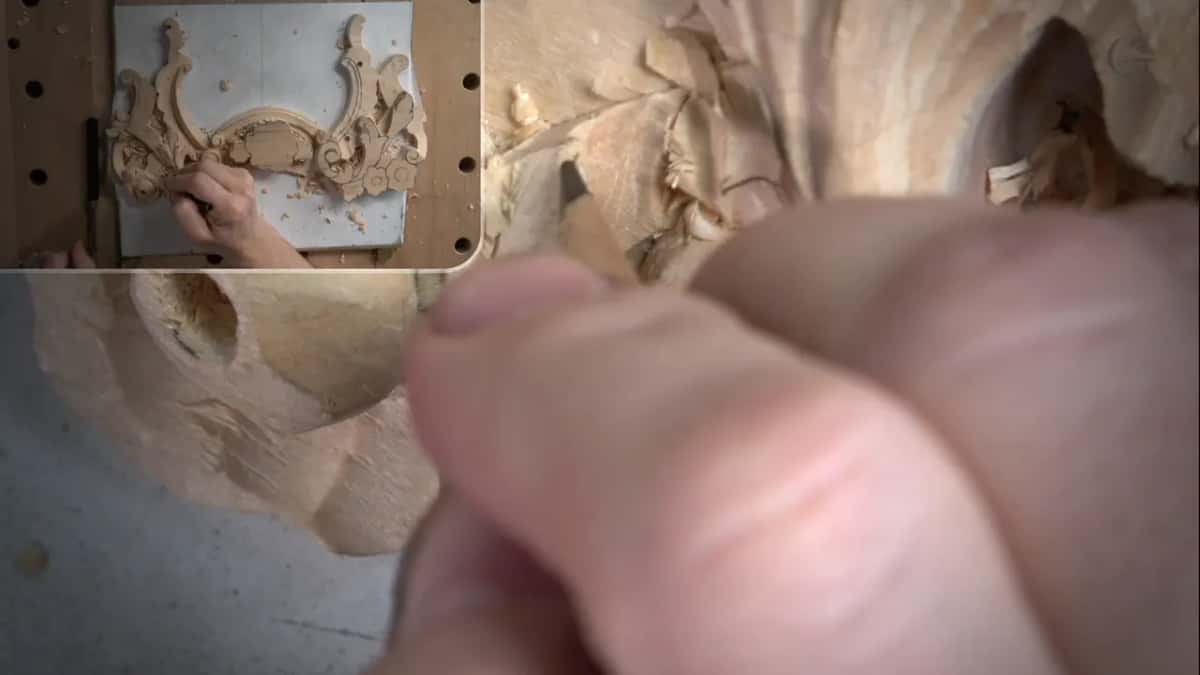
How many petals, and where does the fifth one go?
Five, and the fifth climbs right over the acanthus movement beneath it. Doing that stitches the flower into the rest of the panel instead of leaving it sitting on top like a badge.
Separating them early makes everything easier. Once the divisions are in you can finally see what you are looking at, and until then a flower is a lump with a hole in it.

What is the flute of a gouge?
The groove running down the middle of the blade. On a veiner it is the V itself; on a gouge it is the hollow, and knowing the word matters because of how the tool then gets placed.
To slip one petal beneath another I turn the flute away from the line and start digging underneath it. A one millimetre veiner opens the cut, then half a millimetre goes back over the same path and takes it deeper, which is where the shadow comes from.
Deep and narrow beats wide and shallow every time here. What you want is darkness in a line, not a trench.
What happens if you press too hard?
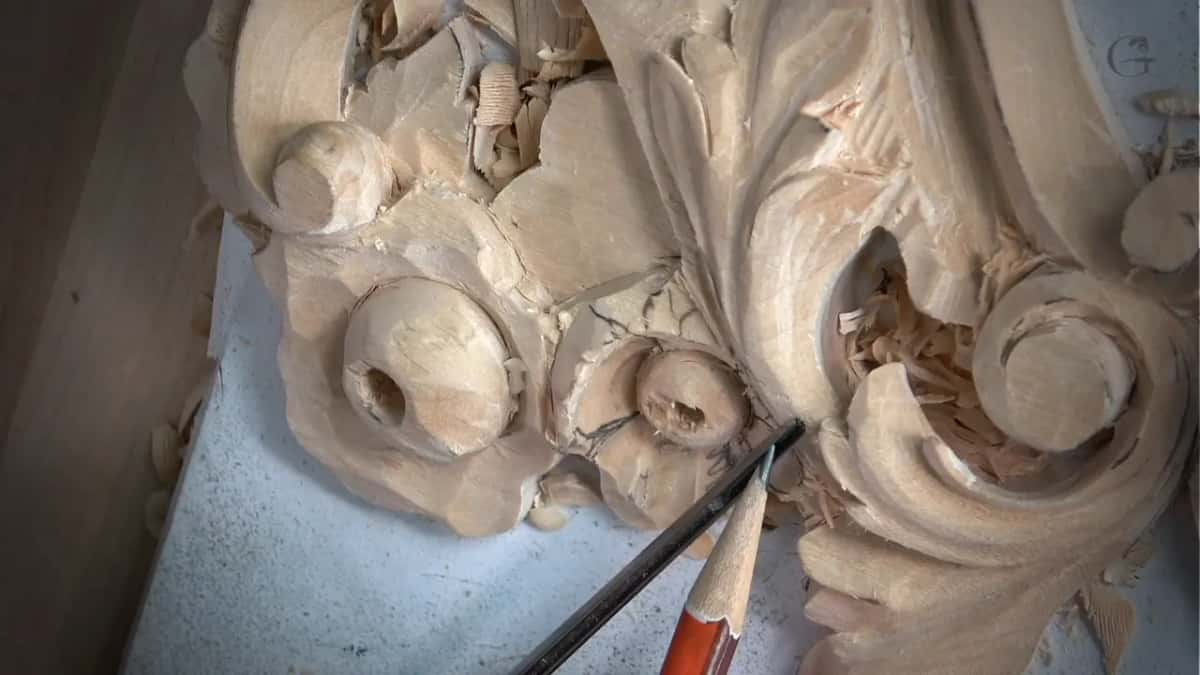
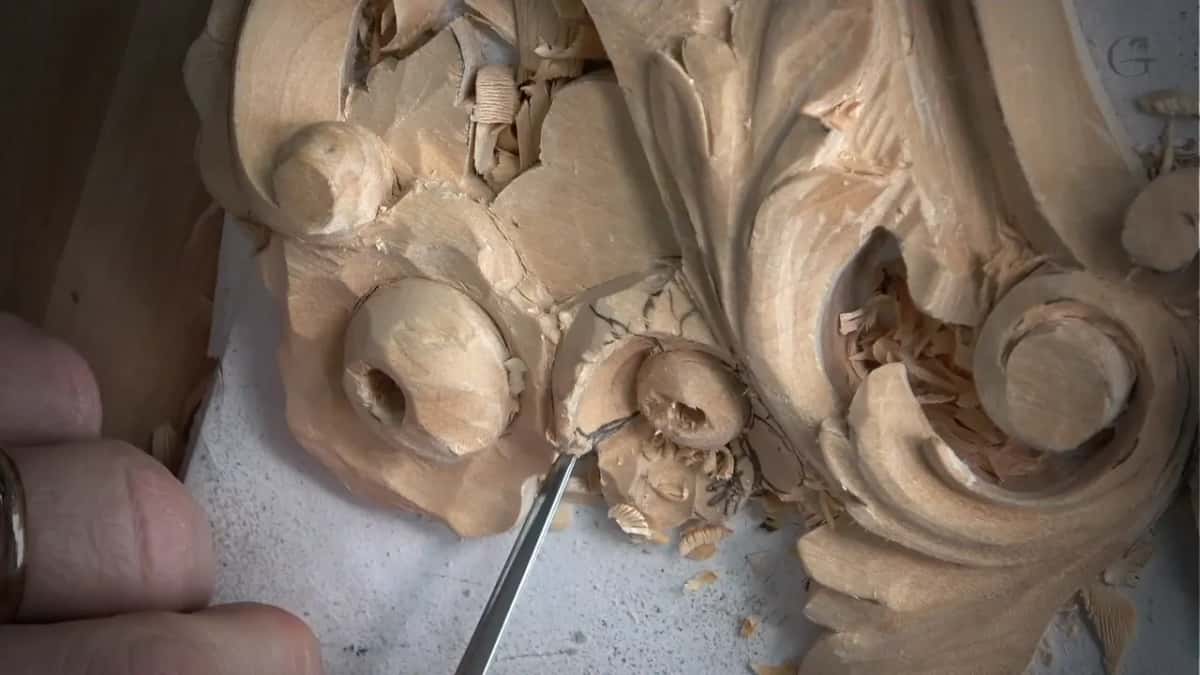
A piece comes off. Mine did, off the edge of a petal. The honest cause was not the wood and not the tool. It was hurry. This is a real production piece, I had spent the morning on the phone, and a clock was running somewhere in my head.
I could have glued it back. Plenty of material was left underneath, so instead I carried on and reshaped around the loss, which turned out fine.
It is always a good idea not to rush. I say that on the recording, having just demonstrated the alternative.

The repair, if you can call it that, meant switching to a second number six of the same width but with a much longer bevel. A long bevel digs into a hollow where a steep one skates. Same size, same number, completely different behaviour.
How does a curl get carved into a petal?
Everything behind it gets taken away. The curl on this flower flips up and almost over, and the only way to make that read is to excavate underneath, which began with a three millimetre veiner and finished with something smaller again.
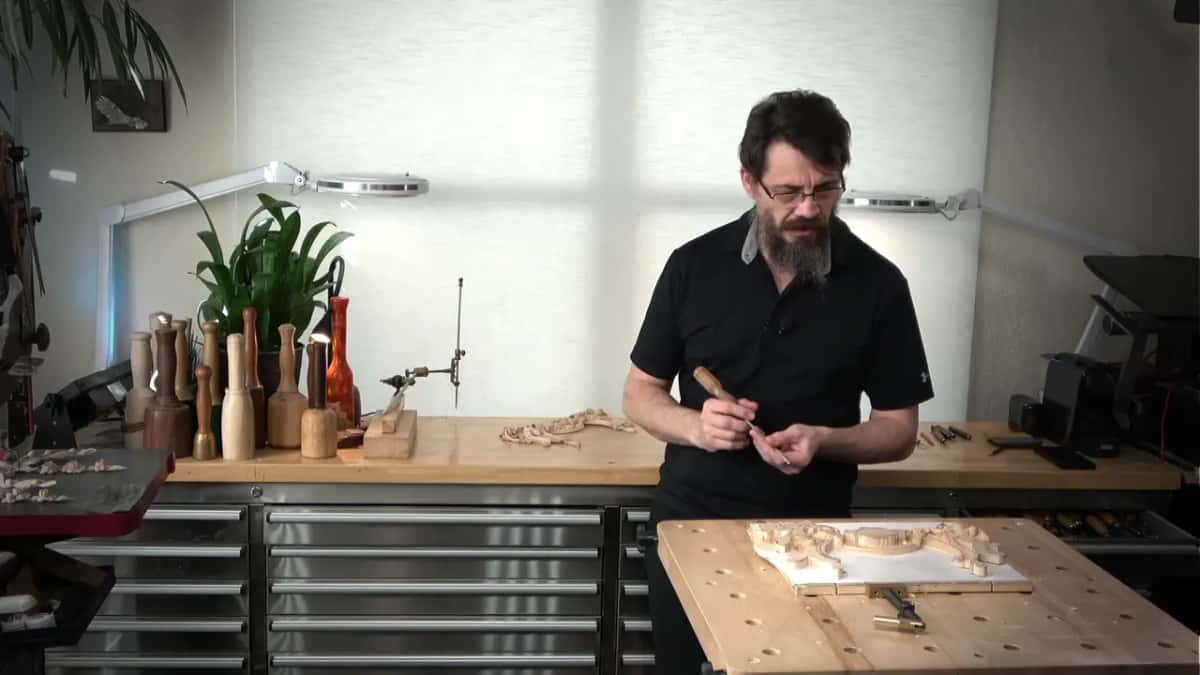
Judgement comes in at the size. My first attempt left a curl bigger than the design wanted, so I dropped to a quarter inch tool and kept less of it standing. Viewed from the side there was still plenty of wood.
A flatter gouge follows that, a number six at ten millimetres, travelling round the roundness rather than straight at it. Then a back bent removes the ridges and leaves a convex where a facet used to be, and a small knife finishes the job.
Can two flowers touch each other?
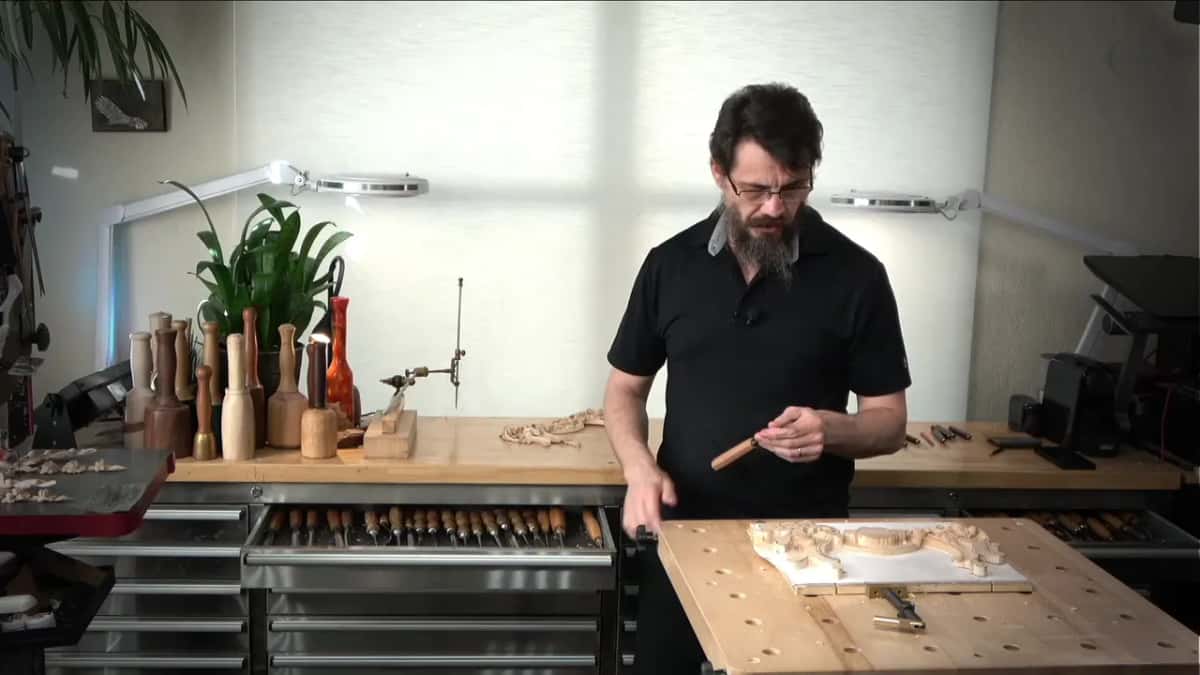
They can, and arranging it is worth the trouble. The flower to the left has a petal that can be brought right underneath a petal of this one, so the pair interlock instead of standing beside each other as separate objects.
Which is why the space between them stayed uncut. Clear everything out early and the option is gone, leaving two flowers on a board rather than a group of them.
That logic runs through the entire panel. One thing passes under another, that one rides over a third, and what anybody looking at it reads is depth instead of a list of shapes.
Why must nothing be left straight?
A straight line inside a flower announces that whoever made it was not paying attention. Every separation, every petal edge and every division across the centre wants movement in it. Call it a wave or an arabesque, whichever word suits you.
Twice in this workshop I cut a separation, looked at it, decided it read as a straight line and went back in with a number five to put movement into it. Neither time did the wood object.
How far you push that is your own business. Exaggerate the waves if you like. Leaving them out is the only mistake available here.

| Where on the flower | What sort of cut it is, and how far down it goes | The tool that did the work |
|---|---|---|
| The petal face | Concave, convex, concave, plus one aimed inward | Number nine at a quarter inch first, and then a five wherever a wave was wanted |
| Where one petal slips beneath its neighbour | Two passes, and the second one goes deeper with a finer tool | The smallest veiner on my bench, its flute pointed clear of the line |
| The hole at the centre | Quarter inch | A number nine plug cut, taken at right angles to the tilt and not to the bench |
| Wall where a petal ends | About a millimetre, and no deeper, because more would fight the acanthus behind it | Whatever was already in my hand |
| The centre | Divided into five | A number five, then a number three at an eighth of an inch for the fine work |
How small do the tools get?
One millimetre, and sometimes less. I keep a set of Dockyard tools for exactly this, tiny things where the handle is thicker than anything they will ever cut, and one of them is labelled 1.5 millimetres while measuring considerably under that.
A small spoon gouge, three millimetres, cleans inside the petals. Later a number eight at a millimetre and a half goes round the centre hole.
None of that is precious equipment. What it is, is the only thing that fits.

Is a magnifier necessary at this size?
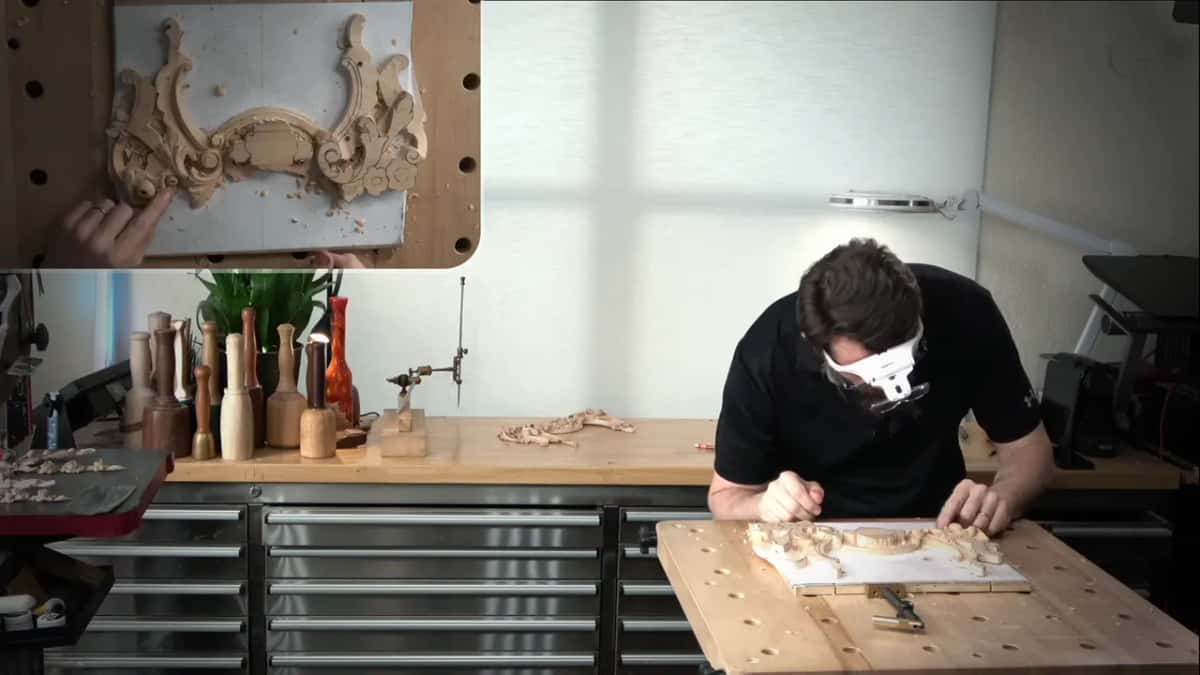
I use one, and I am not embarrassed about it. A set of magnifying lenses goes straight over my own glasses, the lenses swap out in seconds, and they came off Amazon for very little money.
Without them I end up pushing my face down toward the work, which is both uncomfortable and a good way to get your head into the camera. With them on, the petal I am cutting is actually visible to me.
How do you know a gouge is sharp enough?
Cut end grain and look behind the edge. The grain around one side of this flower runs straight into the tool, and a blade with any dullness in it leaves trails across that surface.
Mine left none. That is the whole test, and it is quicker than any of the other ways people check.
Halfway through I stopped and stropped anyway. Leather and Mirror Paste, a product by Trend, a handful of passes, and back to work with maybe forty seconds gone.

How much wall is left where a petal ends?
One millimetre, no more. I could go deeper and the shadow would be stronger, though going deeper here would start causing trouble for the acanthus movement running behind, and that movement matters more than this shadow does.
Shadow can be bought another way instead. A deeper hollow at the flower's centre throws shadow without touching anything structural, so that is where I spent the depth.
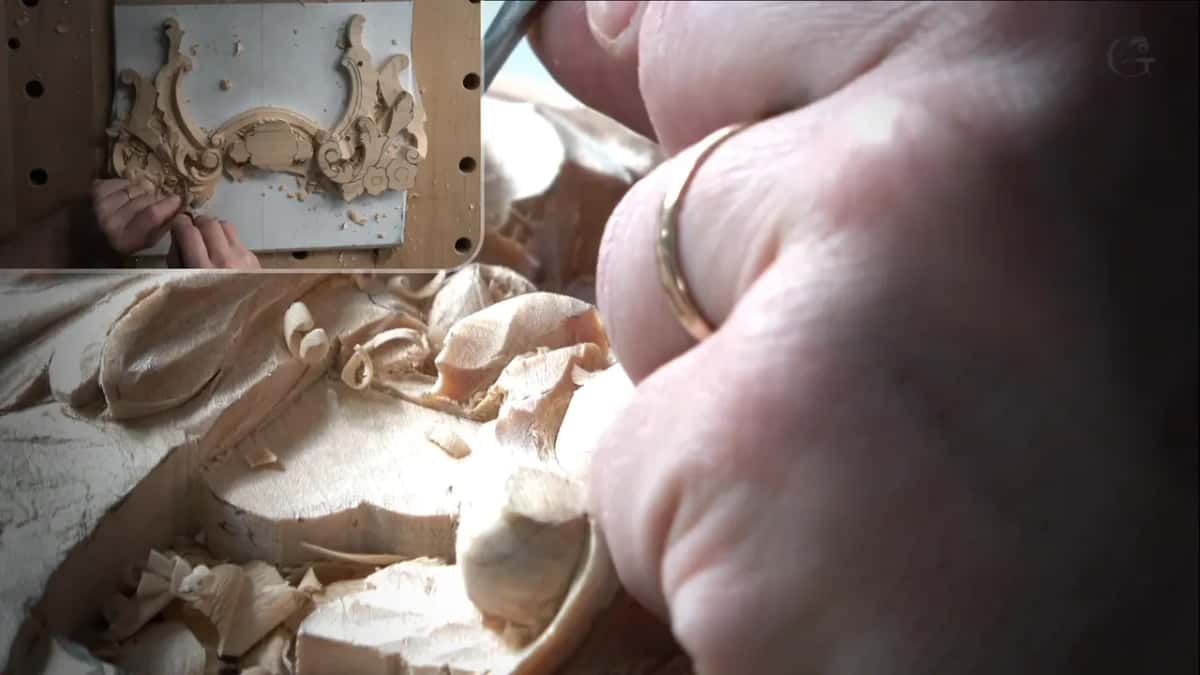

How round should the hole in the middle be?
Less round than a drill would make it. Once the sphere at the centre was reshaped I went back and reopened the hole with an eighth inch number nine, and the first thing I noticed was how mechanical a true circle looks.
So waviness goes into the opening as well. Different number eights and nines, a few of them kept close to hand, working small hollows and bulges round the rim until the circle stops being a circle.
Nature has no compasses, and neither should the middle of a carved flower.

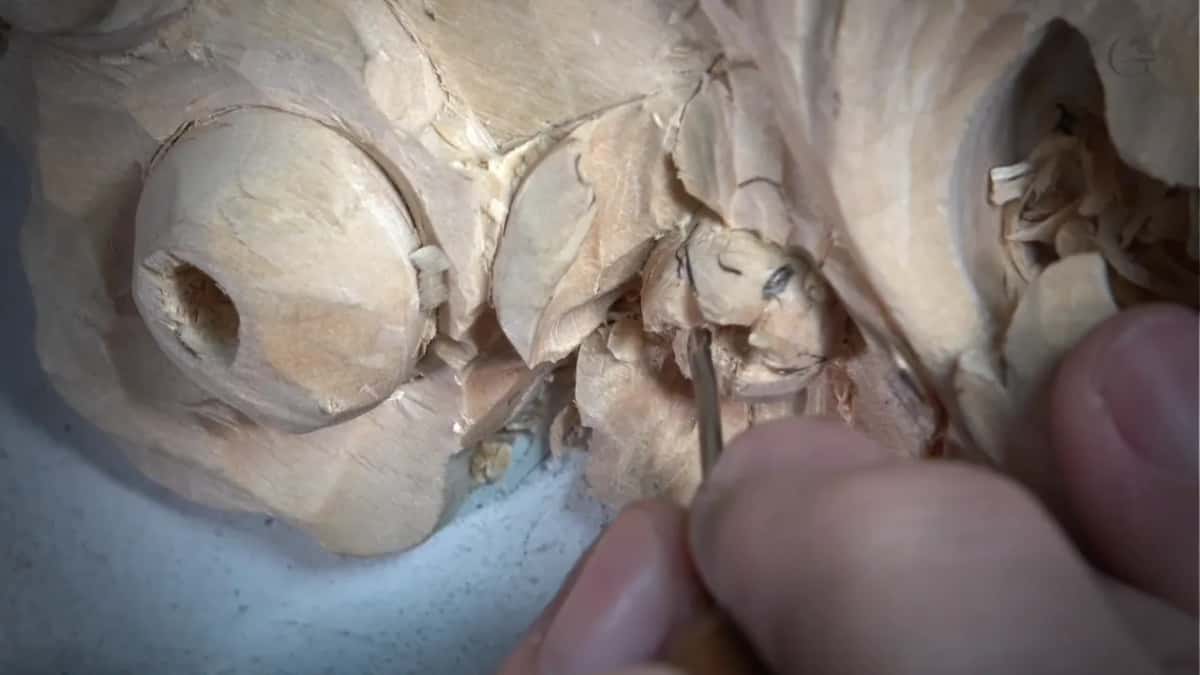
How long can one flower take?
All day, if you let it. I said exactly that while working on the centre section, and I meant it as a warning as much as an invitation.
These particular flowers are small. On a larger piece the same middle section can carry an extraordinary amount of work, and the limit is your own appetite rather than anything the wood imposes.
Here I stopped when the movements were in. Cleaning went on afterwards, off camera, because watching somebody blend facets for twenty minutes teaches nobody anything.

By the end the flower reads as a flower from above, one petal tucks under its neighbour, another sits across the acanthus, and the broken edge has disappeared into a shape nobody would guess had been repaired. Also there is a volute still waiting, and a molding, and a good deal of ornament beyond that.
Seventh of fourteen, this one. Workshop six shapes the acanthus leaf the flower has to sit against, and workshop five handles the crossings. Workshop eight carves the molding itself. Earlier on, workshop one outlines, workshop two grounds the background, workshop three builds the volute and workshop four puts everything at a measured depth. The course runs the whole panel. Depth transfer has a workshop of its own and gouges are chosen there, while a dull edge tears end grain, so sharpening comes first. Leaves and scrolls fill acanthus over moldings and modern acanthus, this panel belongs to the Venice Room, and why any of it moves the way it does sits in the design course.
You have five petals to find and four cuts to put in each of them. Access to the school puts the rest of the panel in front of you.
How it's done
- Open the centre hole to match the tilt. Both flowers lean, so swing the gouge until it meets that leaning face at ninety degrees. A plug cut about a quarter inch deep. Aim it at the bench instead and you get an oval.
- Split the flower into five. Draw all the divisions before cutting any of them, and let the fifth one ride over the leaf below. Until those lines exist the whole thing is a lump with a hole in it.
- Put four cuts into each petal. Hollow, hollow, the raised strip they leave, and one more heading for the middle. Repeat the pattern on the outside too, smaller.
- Turn the flute away and dig under. One pass at a millimetre, then half of one along the identical path. Narrow and deep buys darkness. Wide and shallow buys a trench nobody wanted.
- Bend every line you drew. Any separation reading as straight goes back under a five until it waves. Exaggerate them if that suits you, since leaving them out is the only genuinely wrong answer here.
- Break the circle in the middle. Reopen the hole, then work small bulges and hollows around its rim with eights and nines until nothing about it looks turned on a lathe.
Frequently asked questions
Do you really need tiny tools for a flower this size?
For the last of it, yes. Something a millimetre wide is the only thing that fits inside a petal on a flower this small, and forcing a bigger one in there damages what you have already cut. The bulk of the shaping still happens with ordinary quarter inch tools.
What do you do when a piece breaks off?
Decide whether you need it. Mine broke because I was pushing too hard in a hurry, and there was enough wood underneath that reshaping around the loss cost nothing. Glue it back when the shape genuinely depends on it, and otherwise carry on.
Why does bevel length matter on two gouges of the same size?
It changes where the tool can reach. A long bevel lets the edge drop into a hollow and keep cutting, while a steep one lifts the handle and skates. Same number, same width, and they behave nothing alike once the surface curves away.