
Alexander Grabovetskiy, woodcarver, School of Woodcarving · Published 2018
How do you fit Tormek jigs to a Work Sharp?
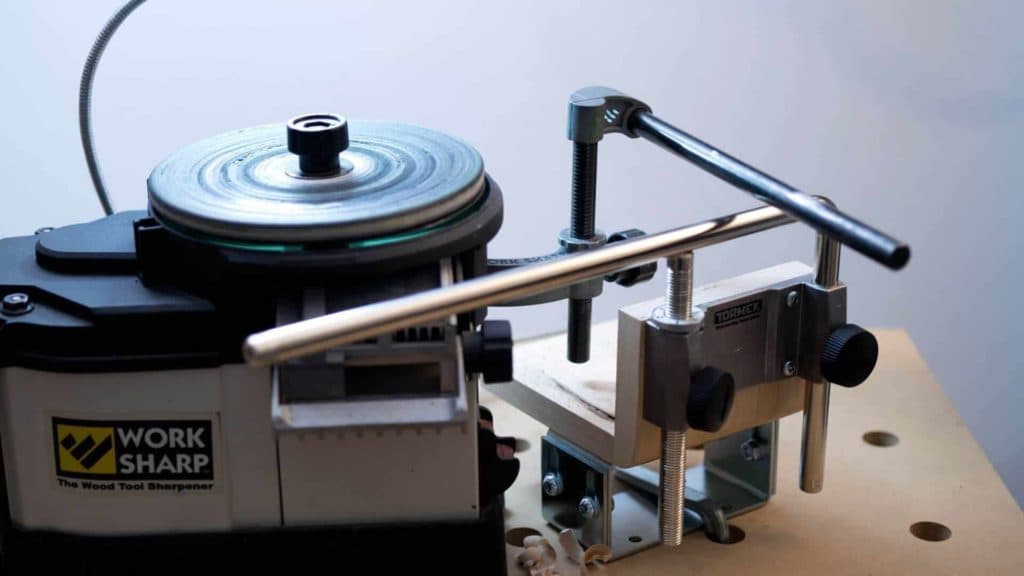
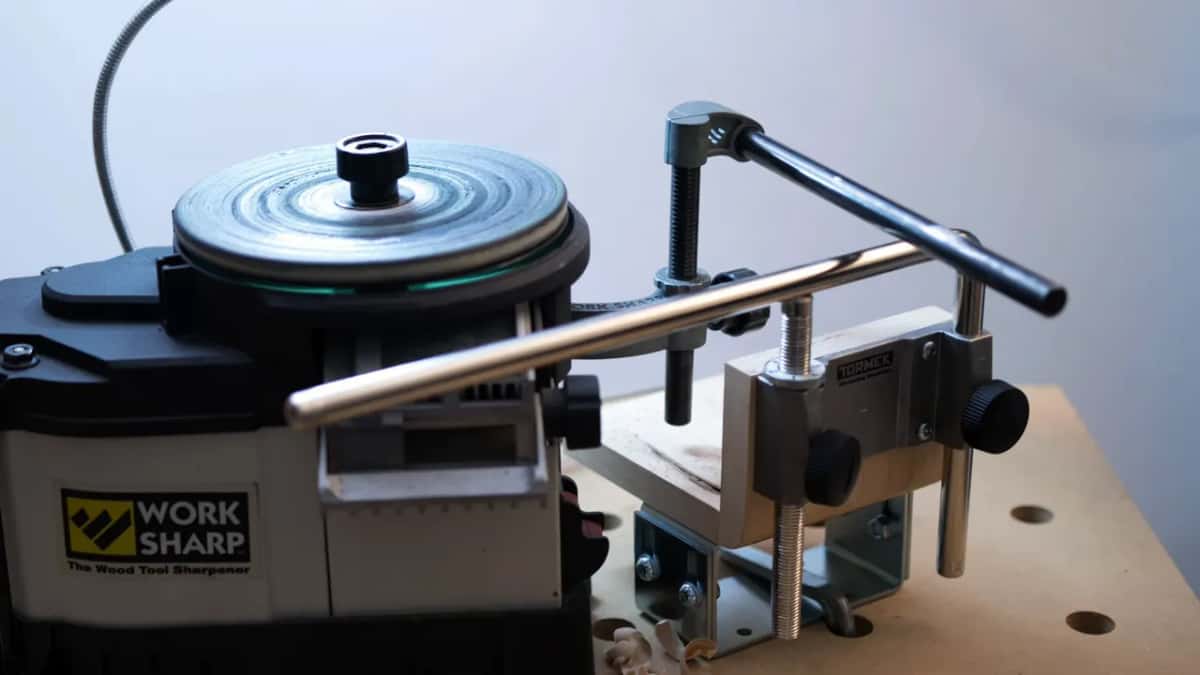
Quick answer: Fitting Tormek jigs to a Work Sharp is a job for a bar the jigs can ride on. Work Sharp once sold one, but late in 2017 we found out they didn't make it anymore. So I bought Tormek's mount for a bench grinder, attached it to a leftover dovetail piece, and clamped that to my table.

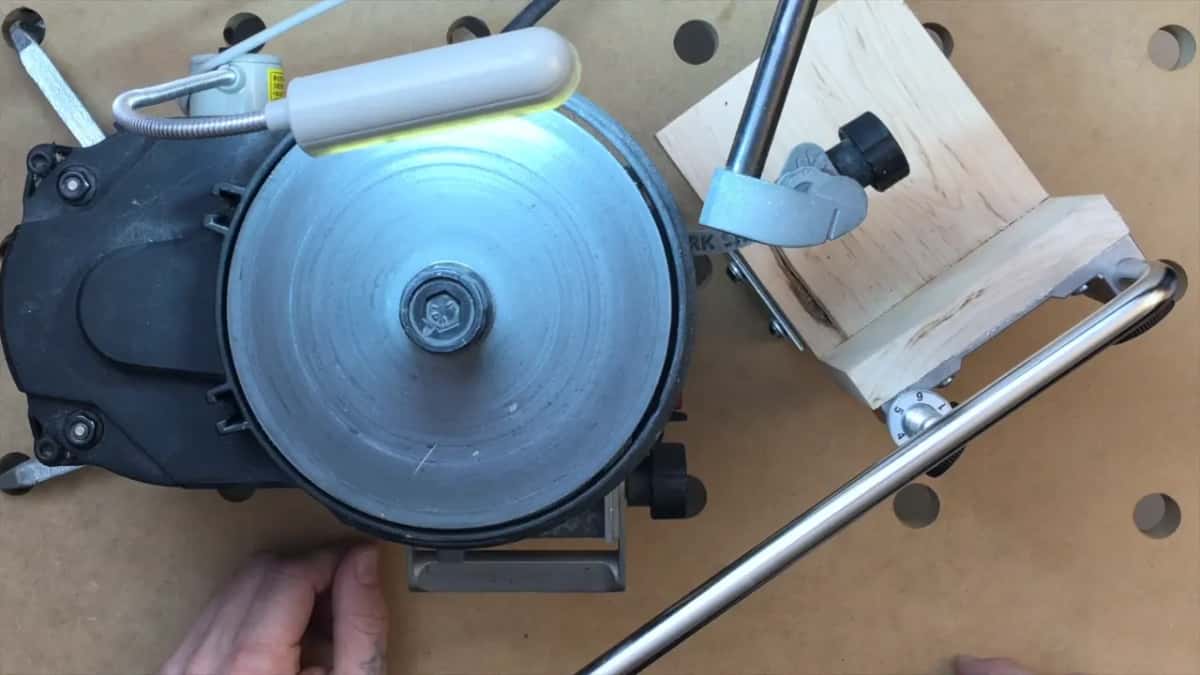
A Tormek bar mount for the Work Sharp is Tormek's own mount for a bench grinder, attached to a wood block and clamped to the table, so the Tormek jigs can ride over the flat Work Sharp disc. Work Sharp used to make a bar for this. They don't make that part anymore, and that is the problem. So I made my own.
My favorite setup for sharpening is the Work Sharp, as of now at least, and I tried different ones. I do have a Koch system, a Tormek system, and one more system besides those two. They are good machines and nothing is wrong with any of them. I still reach for the Work Sharp.
If you own Tormek jigs and you like that flat disc, you can keep every jig you have. This page shows the mount I made, where its wood came from, and why I'd rather have it than the old bar.
The Tormek bar story, short
- The Work Sharp has a flat surface, so it doesn't create any concave.
- On a Tormek wheel the bevel comes out hollow, with a weaker point.
- With a Tormek you get two grits. This machine gives you as many as you care to buy paper for.
- My fix was a Tormek grinder mount attached to the dovetail block, with a clamp holding it to my table.
- Homemade turns out better. It raises, it lowers, and it moves to other machines.
What happened to the Work Sharp bar?
The older machines had one, and I still own an older model. You could buy that bar separately as an attachment, and it received the Tormek jigs.
Back in the spoon gouge lesson I called that bar probably the wisest decision for this machine. That way I can use all my Tormek jigs.
Then, late in 2017, we found out Work Sharp didn't make those bars anymore. That created a problem for some of you.
I came back to it in the micro tools lesson. The machine used to have a bar attachment, they don't make that part anymore, but Tormek has a solution, and I sent people to this lesson for it.
What was the old bar like?
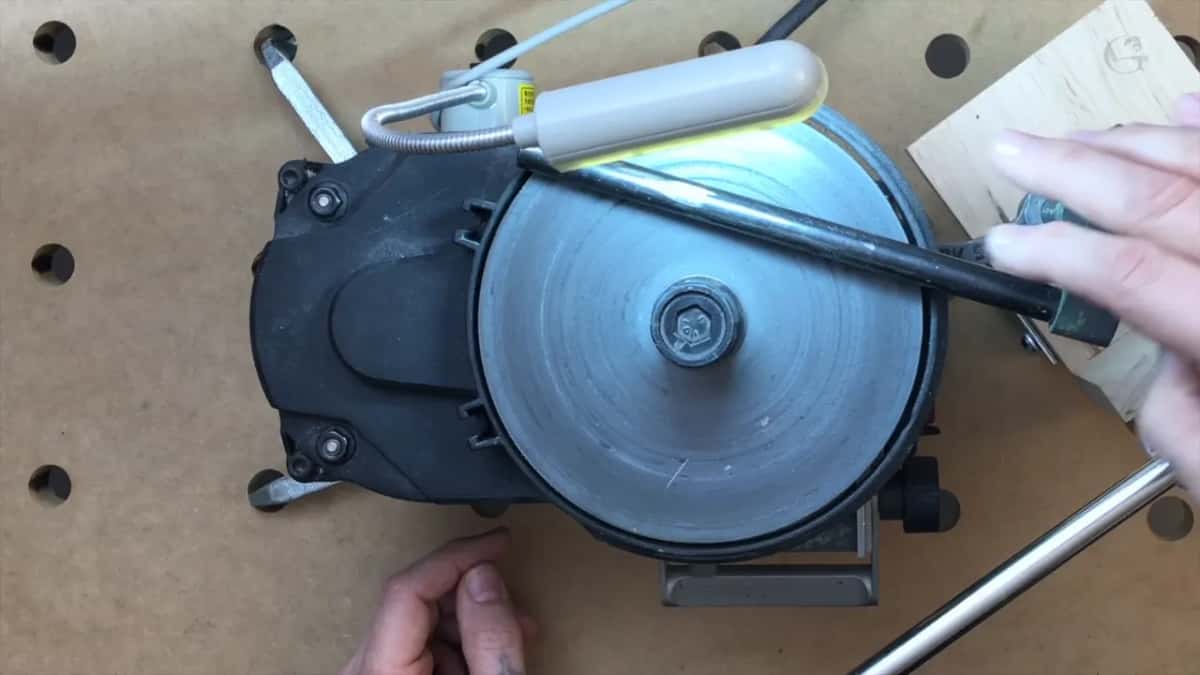
A few people noticed that bar is somewhat flimsy. It's shaky. It doesn't stay as solid as on a Tormek machine, because a Tormek has a double bar standing on two legs, and the Work Sharp one is only single.
There are two screws on the back side of the machine you can adjust to bring it close to flat. A little fluctuation doesn't bug me.
That is the main reason I don't use the Work Sharp for my plane irons, and my flat carpenter's chisels I do only by hand. For carving tools, that bit of flimsiness is absolutely no problem, no matter how complicated the tool.
I stand at approximately the same place and just rotate my tool. As long as I stay pretty much in one position, it has never been a problem for me.
The large gouge lesson is where I said I could epoxy that bar down or weld it and make it unmovable. But I actually like the flimsiness. On some tools it lets me go downhill, so working at one end the bevel comes out lower, a really low angle, and as I move up it lifts the tool and makes a micro bevel right at the edge.
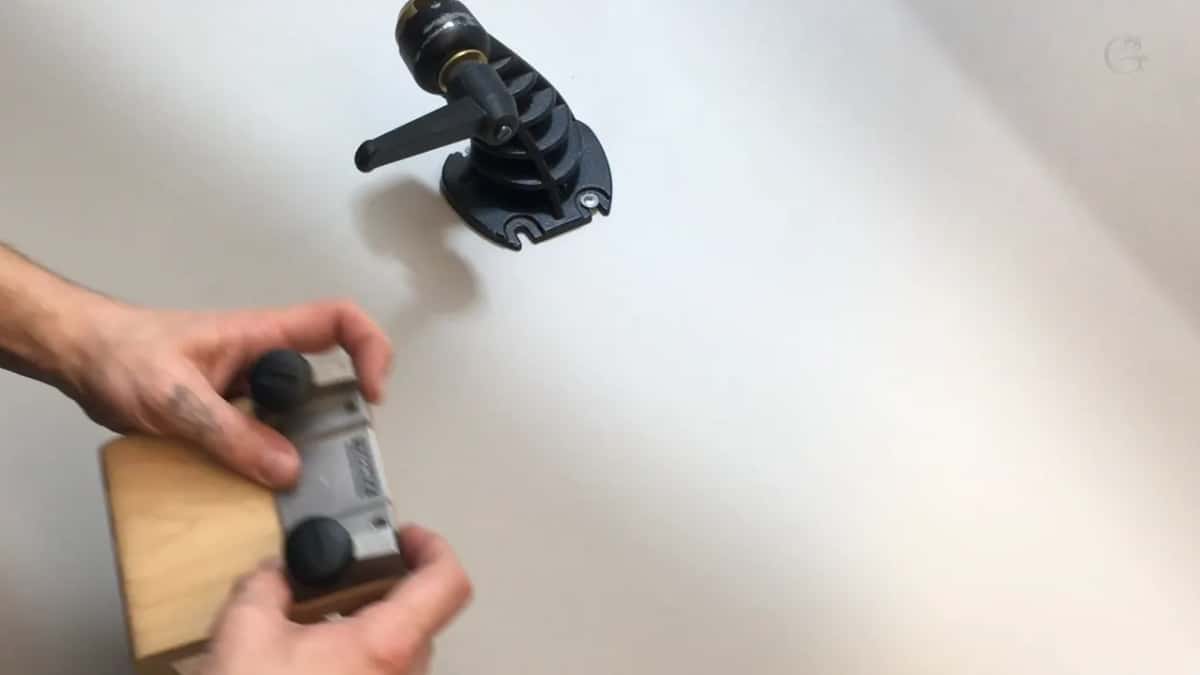
The part I bought from Tormek
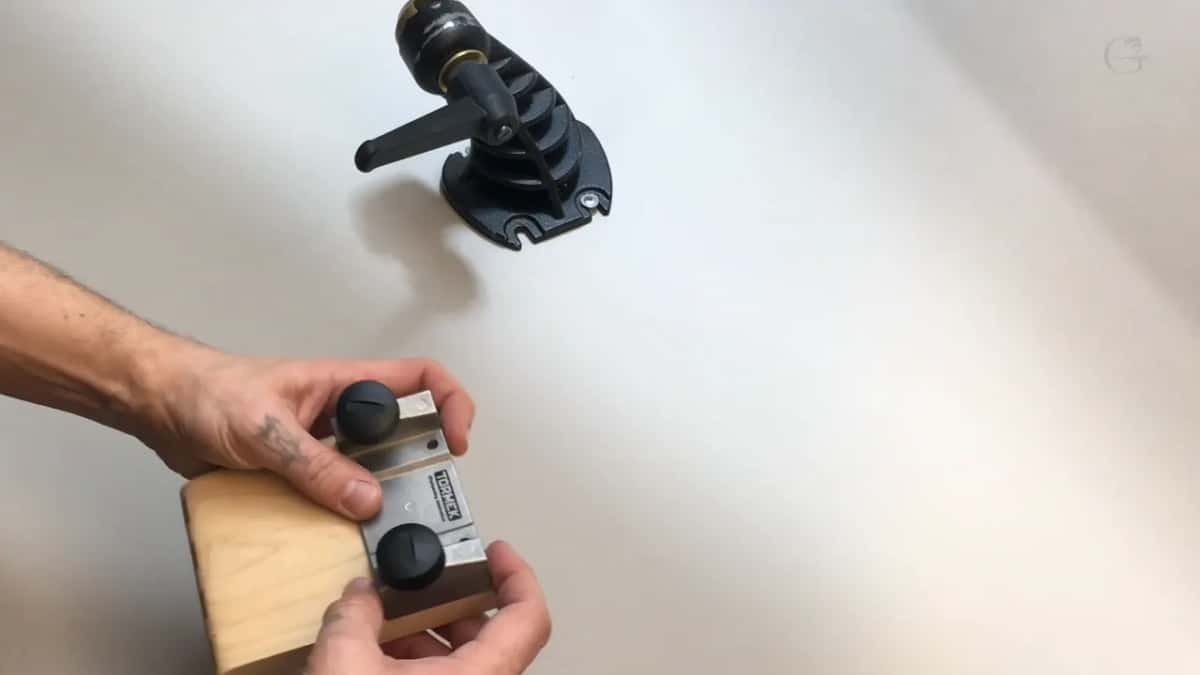
What I did was buy the bar Tormek sells for a bench grinder. Then I made the mounting myself, so that it adjusts and so that I can move it.
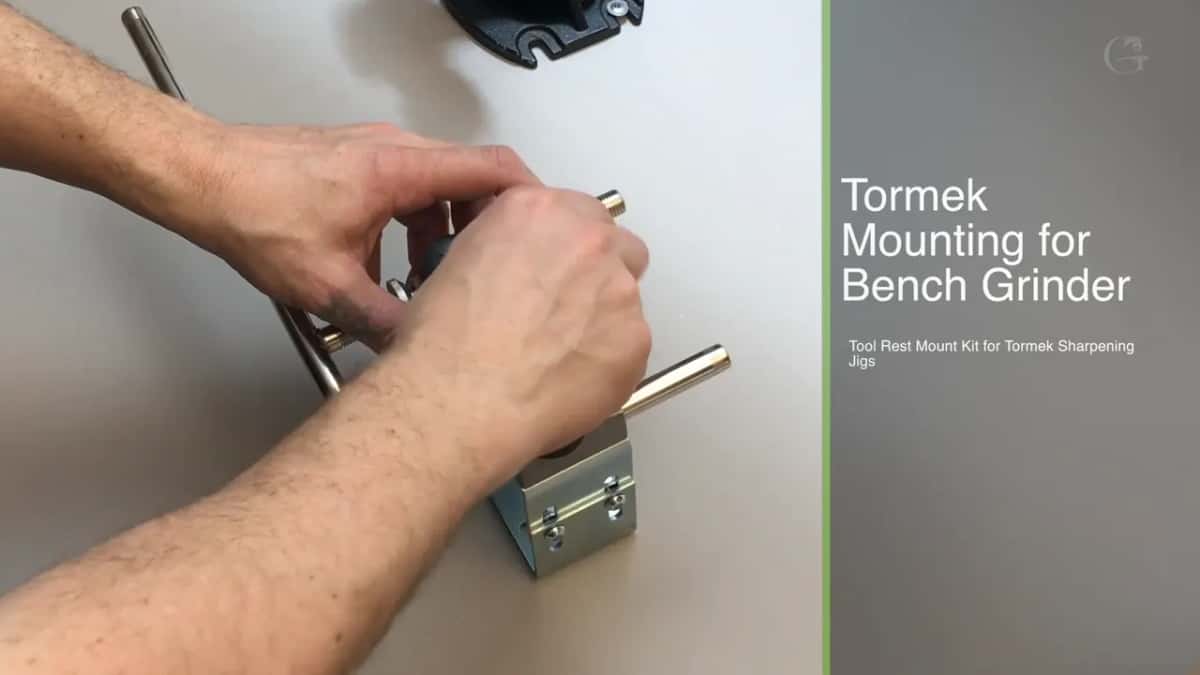
The caption in the video names the part. Tormek Mounting for Bench Grinder, a tool rest mount kit for Tormek sharpening jigs. That is how Tormek offers it, for its jigs on a bench grinder. The wood block, and the idea of setting it beside a Work Sharp, are my own.
Where did the wood come from?
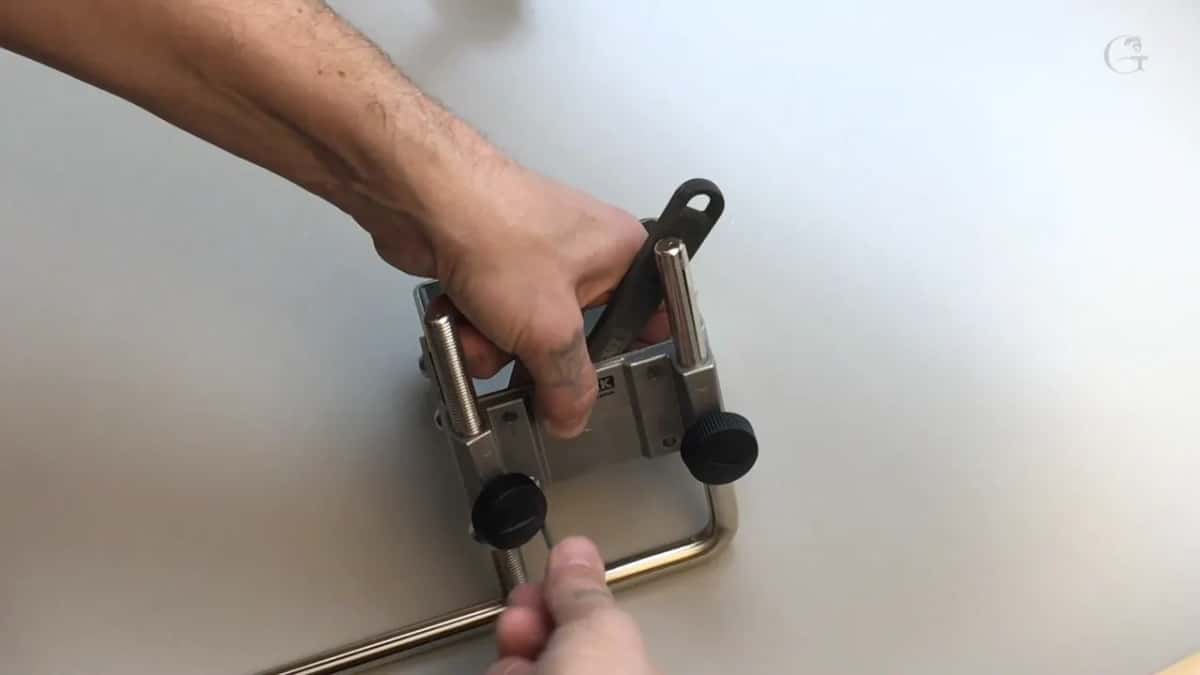
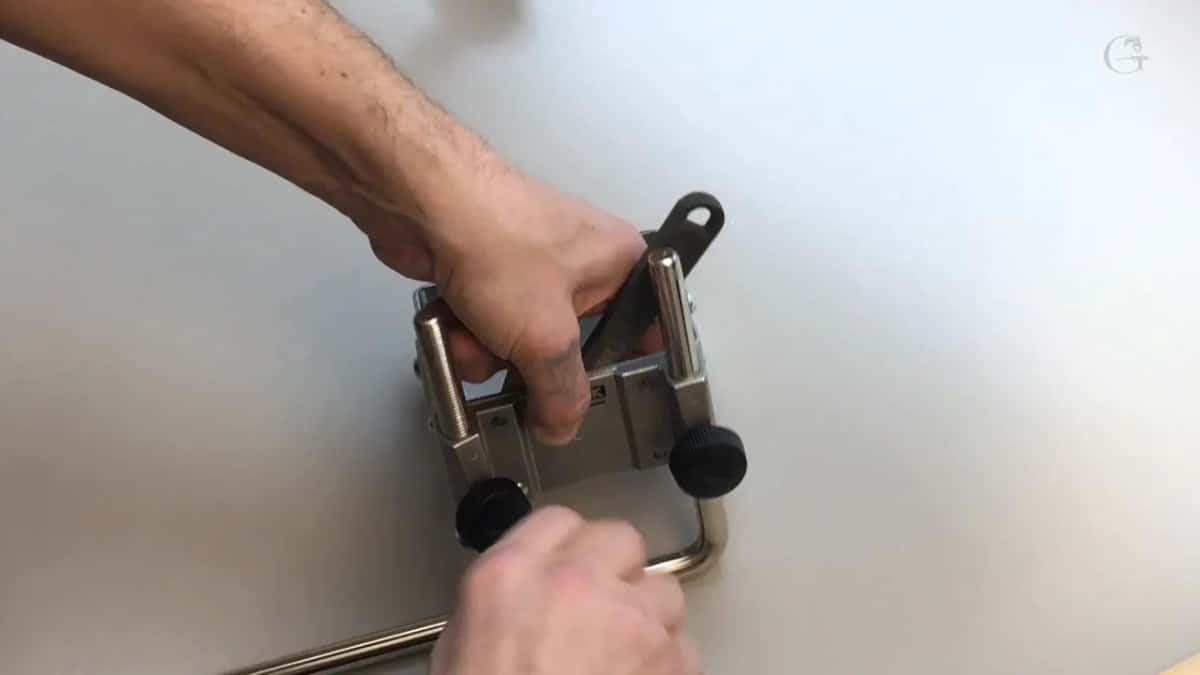
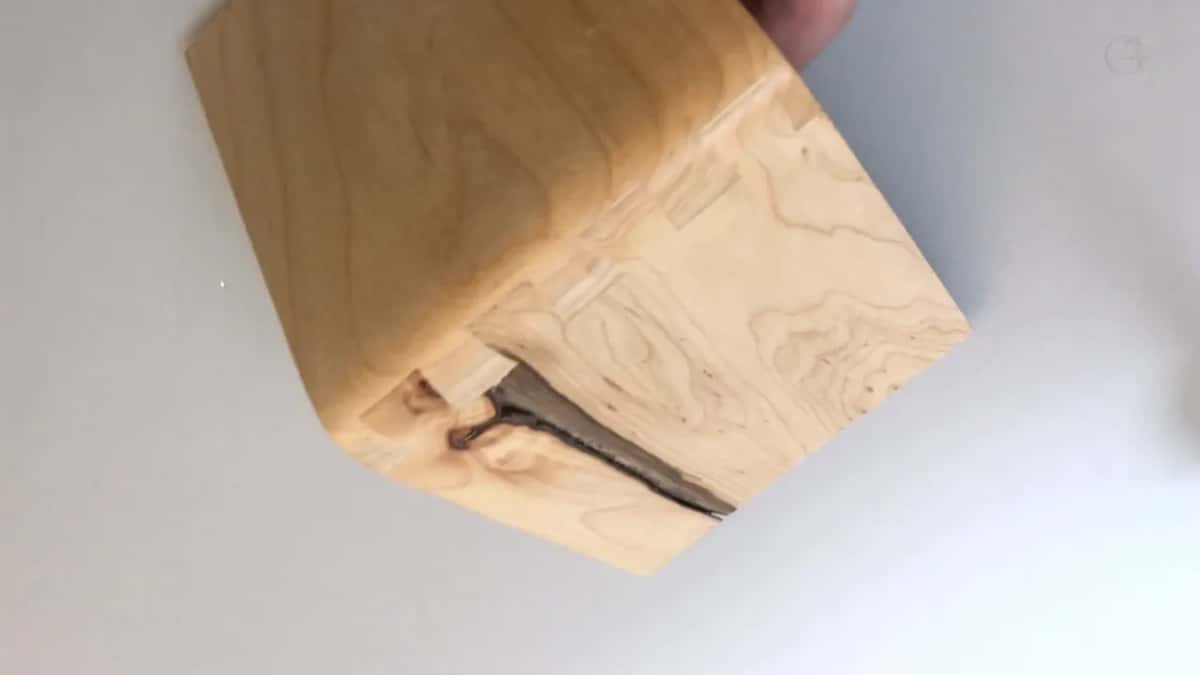
I found a dovetailed piece. That piece is what I used to set up my jig for making dovetails, and when I set up the jig I liked how it worked, so I just kept the piece.
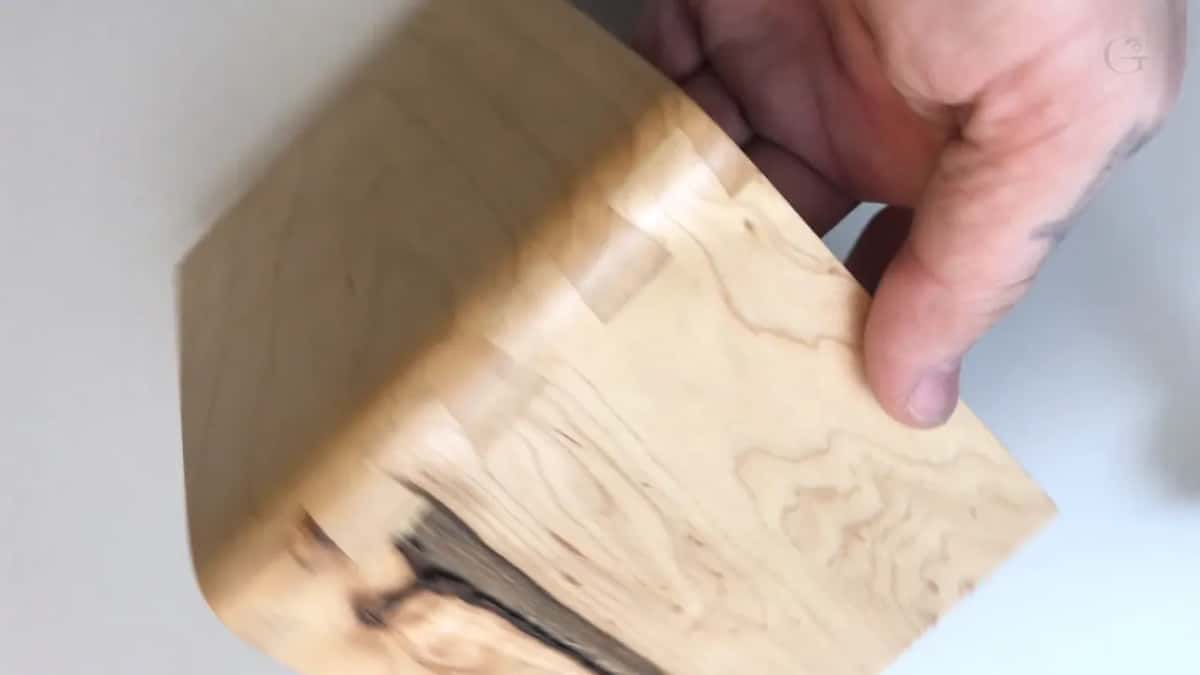
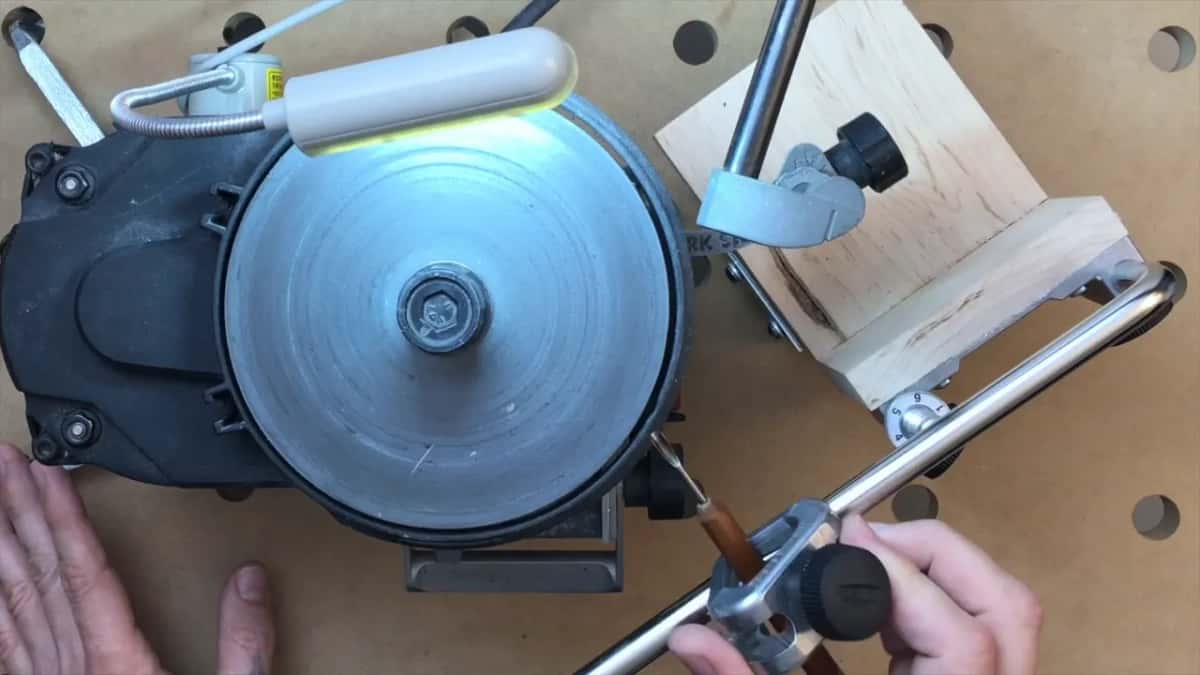
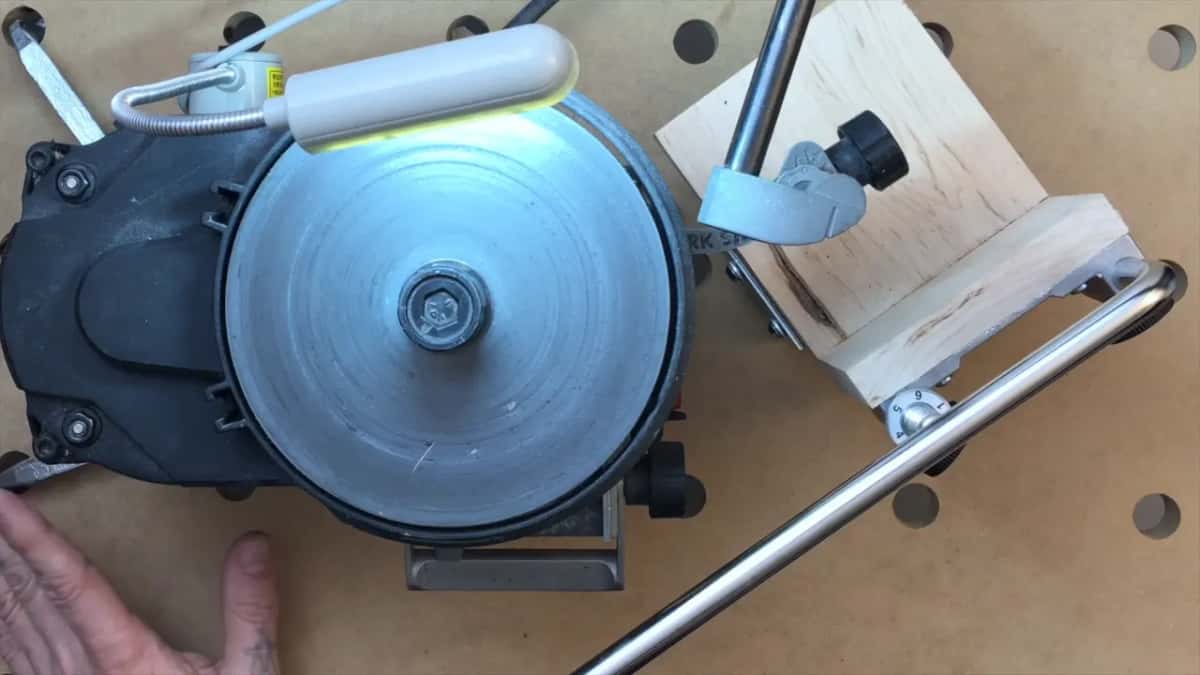
That dovetailed block is what my Tormek bar is now attached to. I'm not sure if I'm clear or not. So the bar sits on that piece, and the piece is what I clamp to my table.
The title of the lesson calls the whole thing an L-bracket.
Why is the homemade mount better than the old bar?
There is no limit at all now. I can carry it over to the Work Sharp, or to the Koch machine, or to another grinder, and it still works fine. It raises and it lowers.
That's actually even better. The old attachment stayed on one machine, and this one goes on pretty much any of them.
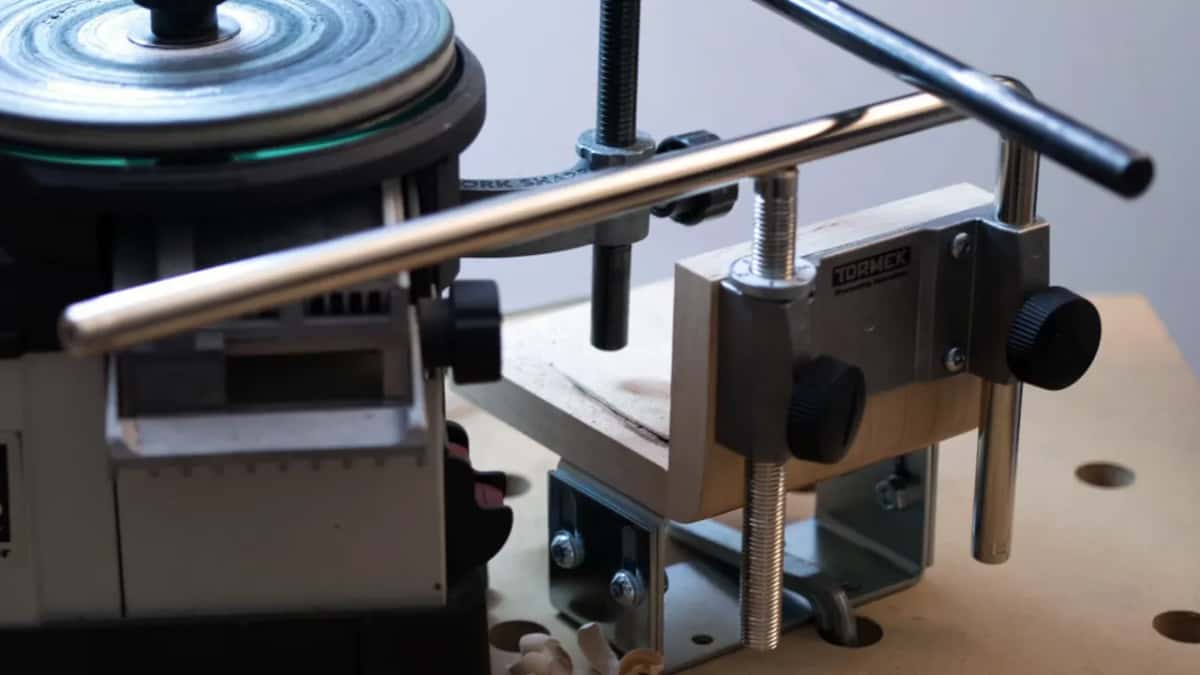
Setting up for the skew bent gouge, I found it adjusts a lot better than the original Work Sharp tool bar. You can micro adjust it if you need to.
Then I use my normal jigs, whatever jig I want.
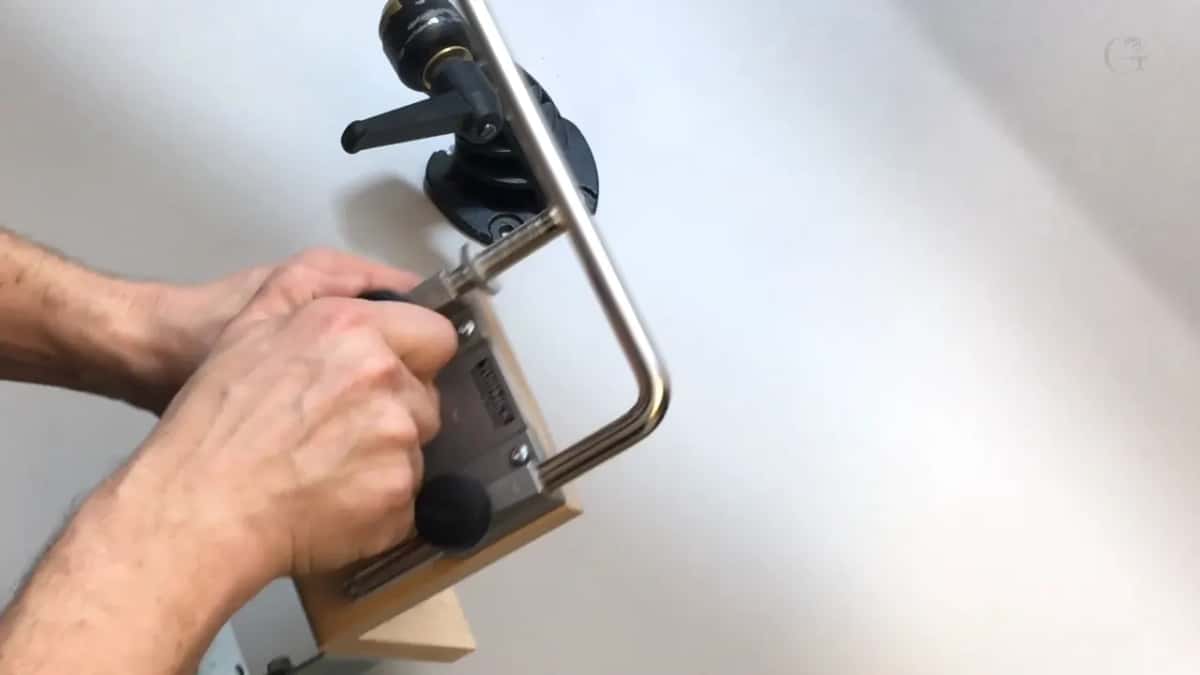
Which Tormek jigs ride on it?
I really like those jigs. It's just genius guys who invented those jigs, and I love it. Mine is a Tormek 2000, I have had it probably from day one, and when they came out with this idea I bought all the jigs, whatever attachments they had.
The spoon gouge got the SVD-186. It's kind of a complicated piece, but it's a beautiful jig, and even the older model I have works really fine. It has a place at the front for your gouge and a cylinder to get on the bar.
That jig carries a marking from zero to five on its side, with an arrow. Set to zero, it's for straight gouges. Move it slightly forward and it creates the bevel as a fingernail, and you can go extreme. For the skew gouge I lined it up with zero to get the true straight edge, with no fingernail at all.
For a huge #7 by Pfeil, among the biggest gouges I have, I used the SVS-50 multi-jig. It comes with two parts, the second one for skewed chisels, and for that big gouge I used just the main body, tightened so it sits perpendicular to the tool.
The SVS-32 is among the most useful jigs for me, for multiple tools, and I used it on the back bent gouge. In the V-tool lesson I said it like this. I love this machine because I can get an attachment, an arm, that receives all the Tormek tools, and it's adjustable.
Why not just sharpen on the Tormek?
I have had a Tormek for many years, and it's one of the best machines for wet grinding. But for me it has some limitations.
Number one, it's a wheel. Place your chisel or your gouge on it to sharpen, and it creates a concave, and that weakens the point. I don't like a weakened point.
A way around it exists. Grind a really, really high angle and the concave stops mattering. But if you want your angle as low as it will go, and I do, then the concave turns into a big problem.
With that hollow grind I have to add a little sharper micro bevel. It's not a big deal. Still, I prefer a flat bevel, and for that I need something flat, a really flat surface.
The same goes for all the other grinders. Any grinder is wheel-based, and doesn't matter how expensive, it still creates that curvature. If you do a bevel really high, like for turning, that does not become a problem. I'm talking about long bevels, usually about 10 millimeters, 14 on some of my tools, and some of them 25 millimeters. That's three-eighths of an inch, about half an inch, and approximately one inch.
Reason number two, it has only two grits. Pretty much it's the same wheel, and you dress it two different times, once at a coarse grit and once at a finer grit. The truing stone I have for it is rough on one side and fine on the other.
And you have to put water on the Tormek constantly, to feed that stone. That's moisture in my shop, close to my tools, and I don't think I like that idea.
| Setup | Holds | Works | Catch |
|---|---|---|---|
| Work Sharp's bar | a single bar, a little bit flimsy | one machine | discontinued, as of late 2017 |
| Tormek grinder mount | on my dovetail block, raises and lowers | any machine | you make the wood part yourself |
| Tormek's own machine | a double bar standing on two legs | its wheel | two grits and a hollow grind |
How low do I set the angle on the jig?
I get asked what degrees I use. I don't measure them, and on some tools it's impossible even to measure. I know there are suggestions to go from 10 degrees all the way to 30, and at 22 degrees you'll be safe.
I go lower. Under 10. Under 5 if the tool will let me. A lower bevel digs into the wood much better. Even with a really long, low bevel you can still fit your hand underneath, so you can carve with no problem.
The large gouge was different. I use that one a lot with my mallet, so I kept its higher original bevel, just eyeballed against it, and raised the jig slightly.
What is the machine under the bar?
I walked into a store one day and found an inexpensive machine imported from overseas. I had my doubts. It's a little flimsy. It does not even sit flat on my bench. Switch it on and the wheel itself flexes and rides. I walked in and out of that store more than once before I bought the thing.
What sold me was the wheels. They are glass, and you stick sandpaper onto them. The machine runs really slow, and it's really safe, a lot safer than any of the grinders. I can touch it.
And it never burns your tools. Once the edge turns blue, you killed your tool. For some reason this wheel goes so slow but still takes the material out quickly.
I take the Work Sharp to my job sites, when I have projects to carve outside. I live in Florida. It can be sunshine, then suddenly the heavens open and just pour the water on you. It was the quickest to set up, and the quickest to pack and get out. For me it works miracles.
One small thing as well. The light on it is attachable and detachable, so I can take the light to another machine and keep using it. I like that.
How many grits can you put under the jig?
On this machine you change wheels and you change the paper on them, so you can go as coarse as you wish. Go the other way and you can take it to extremes. Eight thousand grit. Higher, if you like.
My list from the micro tools lesson runs 80, 120, 220, 400, 600, 800, 1,000, 3,600 and 6,000, up to 12,000 grit if I need to. There is a leather wheel for stropping and a felt wheel for buffing, which has a workshop of its own. The leather wheel is sold by Work Sharp too, the wheel itself and the leather.
Swapping one takes about ten seconds. The paper costs almost nothing, it lasts a long time, and when it wears out I tear it off and put another on.
Stones give you a flat bevel too. But with any stone, water stones, oil stones or diamond stones, it just takes so long to make a long bevel, and I have to true them to keep them really flat.
Where on the disc do you hold the tool?
The closer to the center you hold your tool, the less aggressive it is. Further out toward the outside of the wheel, it's much more aggressive.
That brand-new skew gouge had a rough edge, so I used 80 grit to take as much material as possible at once, and checked if I could be closer to the outside. I had to be really careful not to hit the edge. It took me less than a minute to grind.
With the spoon gouge I left a little before the edge on 80 grit, about 1/28 of an inch (under 1 mm), because there may be some micro waviness in the metal itself.
Where does this mount show up in the course?
The Tormek jigs ride over the Work Sharp in many lessons of the Carving Tool Sharpening course. You'll see them in the straight gouge lesson as well.
This lesson is one video of about four minutes, showing the mount on the bench and in my hands.
Got a Tormek jig in a drawer? A Work Sharp on the bench? Then one Tormek part, a piece of wood and a clamp is all my mount took. The full videos of these lessons are part of the school's tuition.
How it's done
- Get the grinder mount from Tormek. I used the one Tormek makes for a bench grinder, sold for its sharpening jigs.
- Find the wood. Mine was a dovetailed piece I had used to set up my dovetail jig, and then kept.
- Attach the bar to it. I attached my bar to that piece, and now I have absolutely no limit.
- Clamp it down. It sits on my table next to the machine, held with a clamp.
- Set the height. Raise it or lower it. On the large gouge I was just eyeballing the bevel, with no need to measure.
- Put on the jig you need. Use your normal Tormek jigs, whatever jig the tool wants.
- Move it to the next machine. Unclamp it and carry it to the Koch or another grinder.
Frequently asked questions
Does Work Sharp still make its bar for Tormek jigs?
My older model could take that bar, bought separately, and it received the Tormek jigs. By the time I filmed this lesson, Work Sharp didn't make those bars anymore, which left some of you stuck. I built my own mount instead, from a Tormek part and a piece of wood.
What Tormek part goes on the wood block?
I bought the Tormek jig made for a grinder, and the video's caption gives its full name. My block is a dovetail piece I had kept after setting up my dovetail jig, with the bar attached to it. A clamp holds it to my table.
Can the same mount go on other grinders?
I take it to the Work Sharp, to the Koch machine and to another grinder, and it still works fine. You just raise it and lower it. The old attachment stayed on one machine, so for me the homemade one is even better.
What to carve next