
Alexander Grabovetskiy, woodcarver, School of Woodcarving · Published 2017
Why does an ancient acanthus leaf have a V cut inside it?
Quick answer: The V cut in the oldest acanthus leaves is, as I see it, most likely carved with a knife. The old carvers, I would say, had one tool, the knife, and with one a V is much quicker and more convenient than other techniques. Byzantine carvers still had some V cuts, and later carvers stopped doing them.
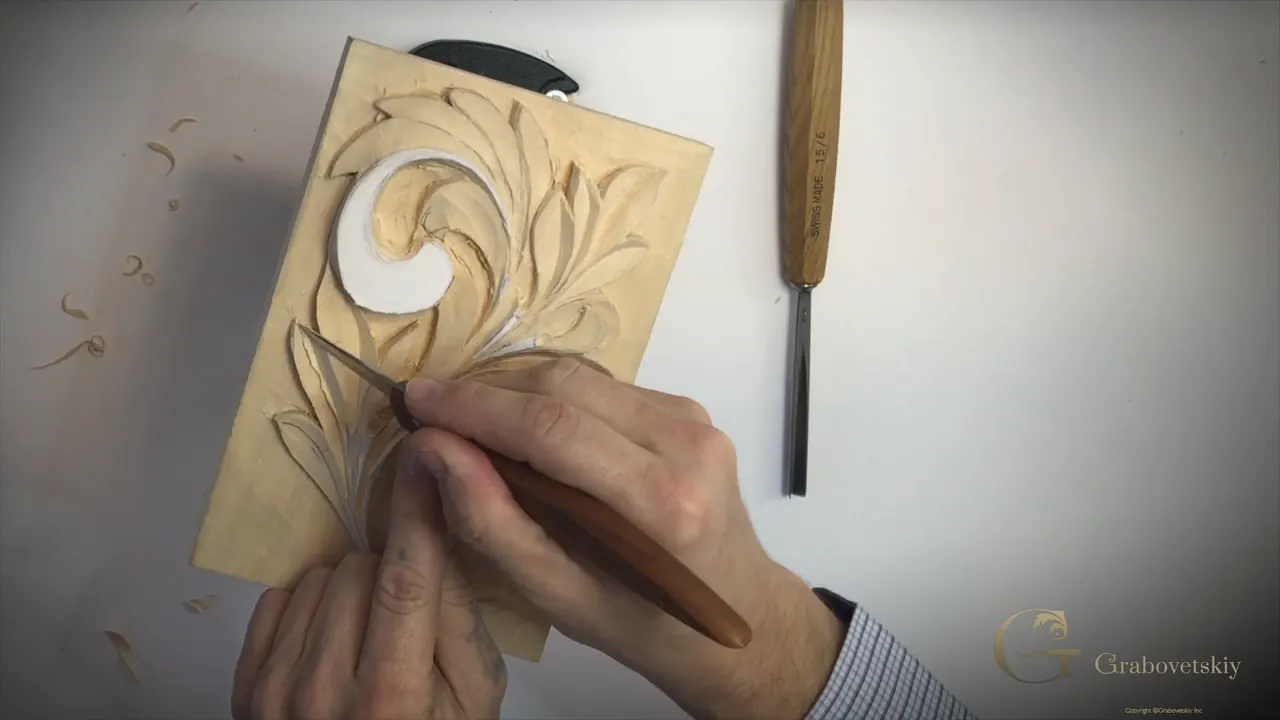
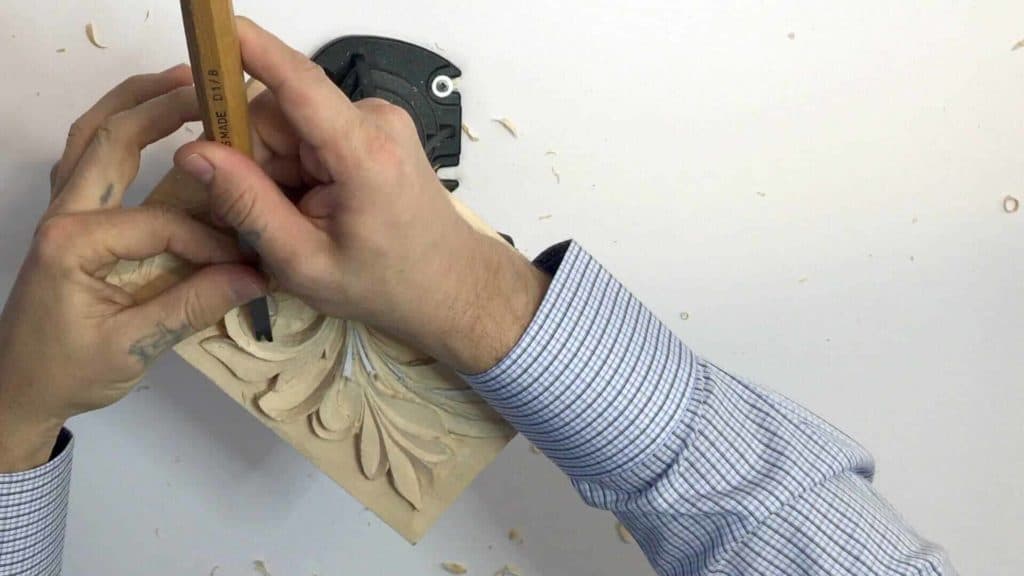
The V inside an ancient acanthus leaf is, most likely, the mark of a knife. I keep that most likely on purpose. In lesson 7 of my Greek acanthus leaf carving course I say the wood carvers of ancient times, most likely, had nothing but a knife. That's why the oldest forms of the leaf carry that V on the inside. With a blade it's much quicker and more convenient than some other technique.
Have you got a knife? Can you push it straight down and then slice in from both sides? Then you're holding the tool those carvers most likely had, and on this lime panel you'll see each move it made, plus the one lobe I left with no V at all.
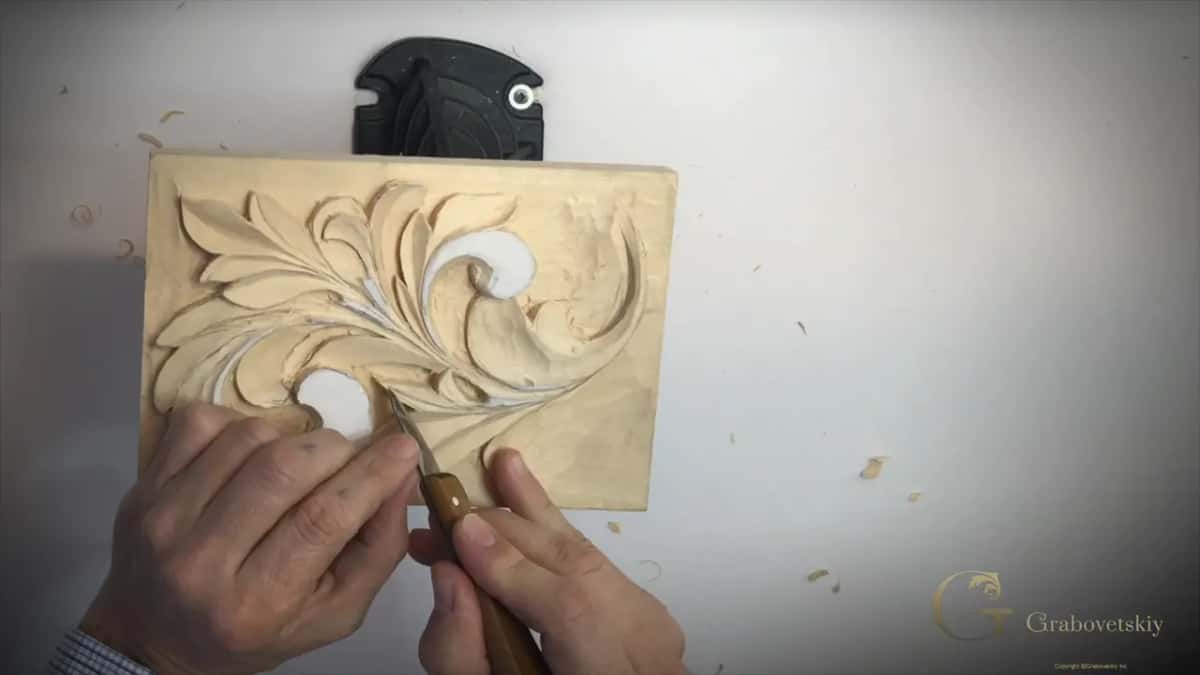
This lesson in six lines
- As I see it, the old carvers had one tool, most likely the knife, and the V was the quick way to carve with it.
- Several lobes got the knife, down on the line and then a slice from either side.
- Most of the time the middle line goes a little off the center.
- A V tool went in shallow, then deeper.
- One lobe got no center line, and I'll judge it later against the whole picture.
- Byzantine carvers still kept some V cuts, and later on they stopped.
Why do the oldest acanthus leaves have a V cut?
A knife, most likely. I said so in this lesson while I was carving with one. The wood carvers in ancient times, I would say, would have only a knife, and that's why the most ancient forms of acanthus leaf have the V on the inside of the leaf itself. Quick and convenient, I said.
I've said it in other courses too. My First Cuts course for beginners opens with the first tool, the basic knife, and there I call it pretty much the most ancient tool.
In a lesson of my tools course about a set of knives, I said I believe the most ancient wood carvers used only the knife. Not too ancient times either, I said, maybe about the 10th, 9th or 8th century, like the Viking world. On a long boat you can't take all your tools, but you can always grab one knife and carve something.
When I started the Byzantine acanthus, I gave the difference in three lines. The Greek leaf has a sharp V cut inside, I said, just like with the knife in. A Roman leaf gets a concave there. And the Byzantine leaf has a raised up convex in the middle.
How does a knife carve the V inside a lobe?
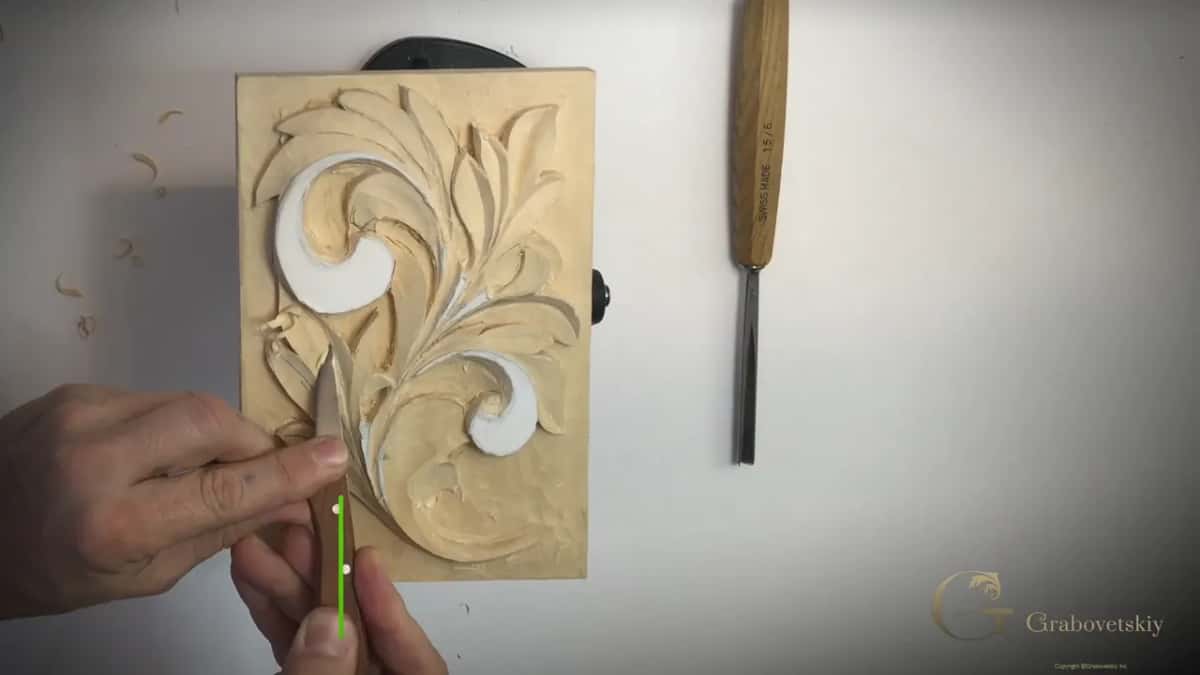
With three moves, and they're quick. For the second lobe I said I could do the same, just use a knife. A straight-down cut went in first. Then I carved this side, turned the panel, and carved from the other one. That's really quick, actually, with the knife.
And my middle line came out looking really sharp, just because the knife carved it, and really clean. After that I refined the outside shape a little.
The next lobe got the knife again. First I established the middle line, with less pressure in one spot. Next I came at it from one side, gradually, right to the line, with a really low bevel. Last came the far side, nice and to the line, and I was happy there.
Part two starts on another side of the leaf, with a knife once more. A center cut, then one side. My edge wasn't quite what I wanted to see, but this leaf gets undercut later, so for now I only took off the excess I didn't need. One more pass from the opposite side, and the waste just snaps out. I kept refining that until I had a really nice and sharp point, and I separated that detail from its neighbor.
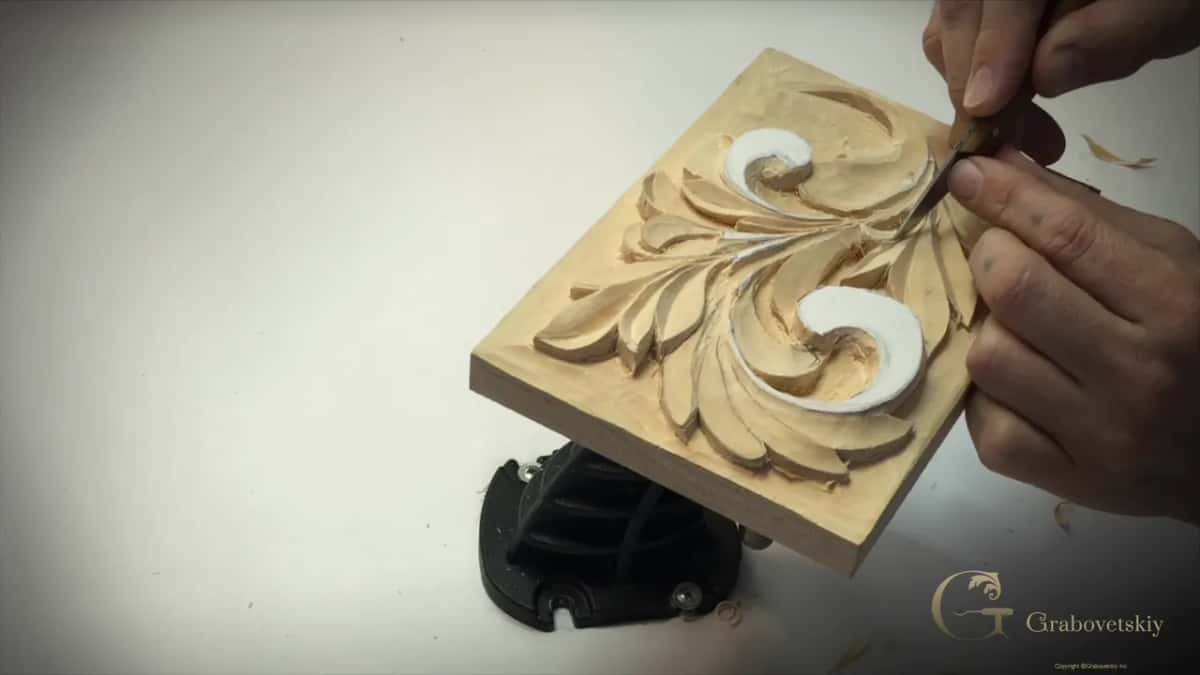
My V sits a little to one side
I was about to say I never put it right in the center. I shouldn't say never. Sometimes I do, but most of the time I don't put it halfway between the two edges of the detail.
Here, on the first detail, the leaf goes one way, and I wanted its left side wider than the right. So the line moved about an eighth of an inch (3 mm) to the right of the center point, and the next two got the same. When the light hits, I want the shadow on the side that's going to be higher. That gives me a sharper shadow there. I try to make sense of it, but sometimes it's just hard to explain.
Later, in part two, another detail was leaning, and its center line had to move toward the left, the same eighth again. Greek acanthus lesson 6, the lesson before this one, works on the same idea.
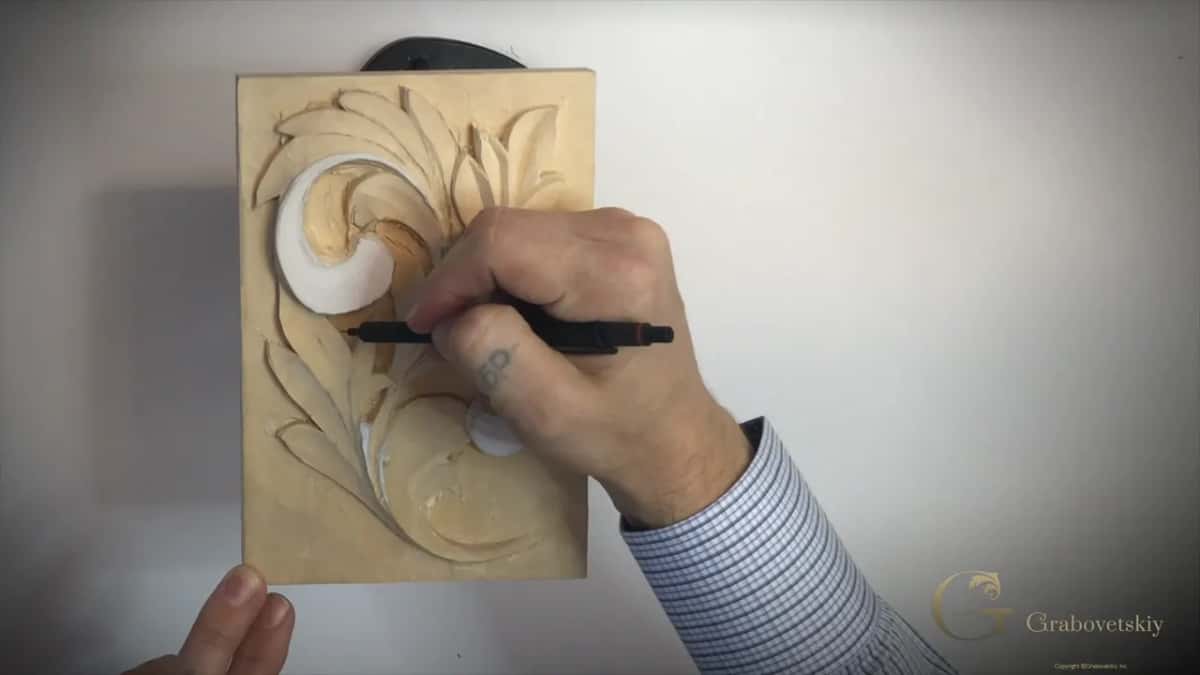
Can a V tool carve the V instead of a knife?
I started this lesson with one. After a moment's thought about which one to use today, I took a 45-degree V tool, 6 mm (about 1/4 in). First I checked that my lines weren't connected to each other. The tool went in not deep at the beginning, and then deeper.
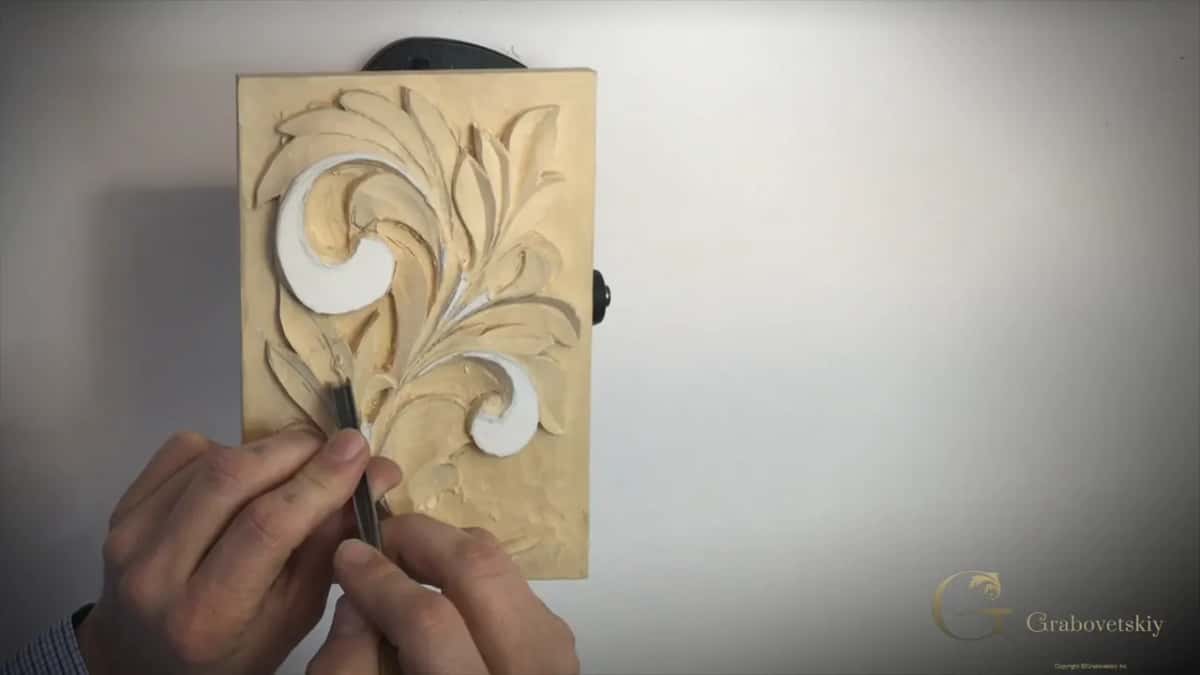
My high point showed up next, the ridge right there, and when I use the right-hand side of my V tool as a chisel, that ridge is my boundary, which I don't want to cross. So I leaned the tool toward the right and took off some material, little by little.
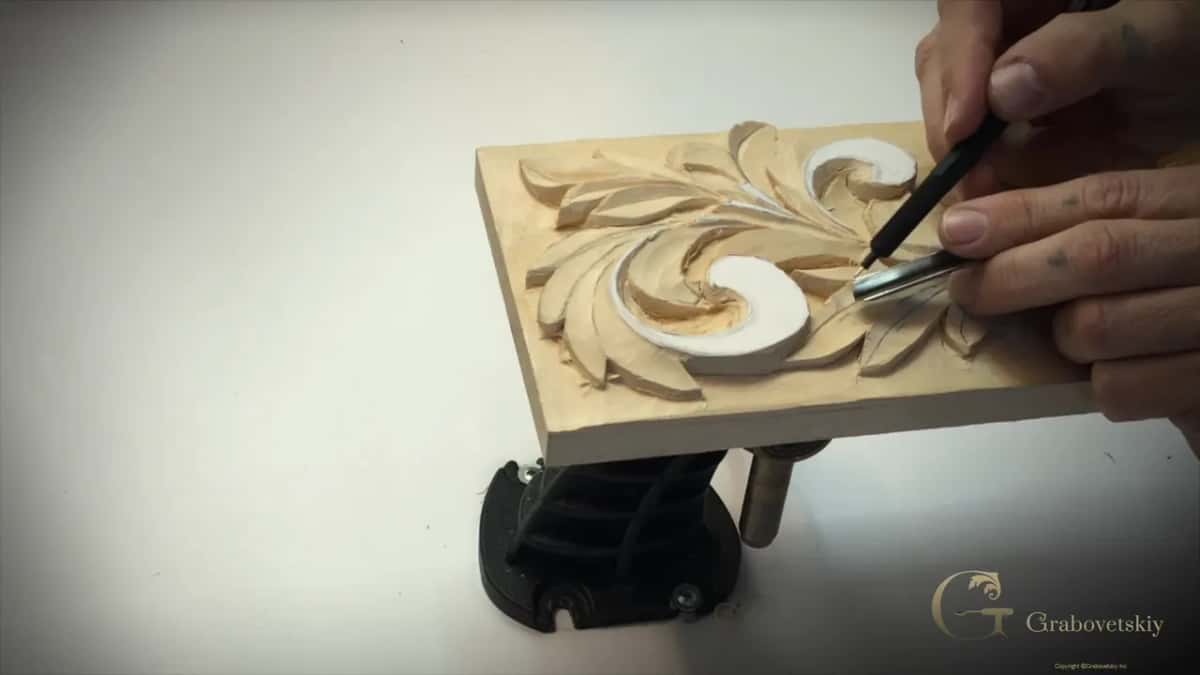
I had to be really careful there, because with a 45-degree tool it's not really convenient once I approach that side.
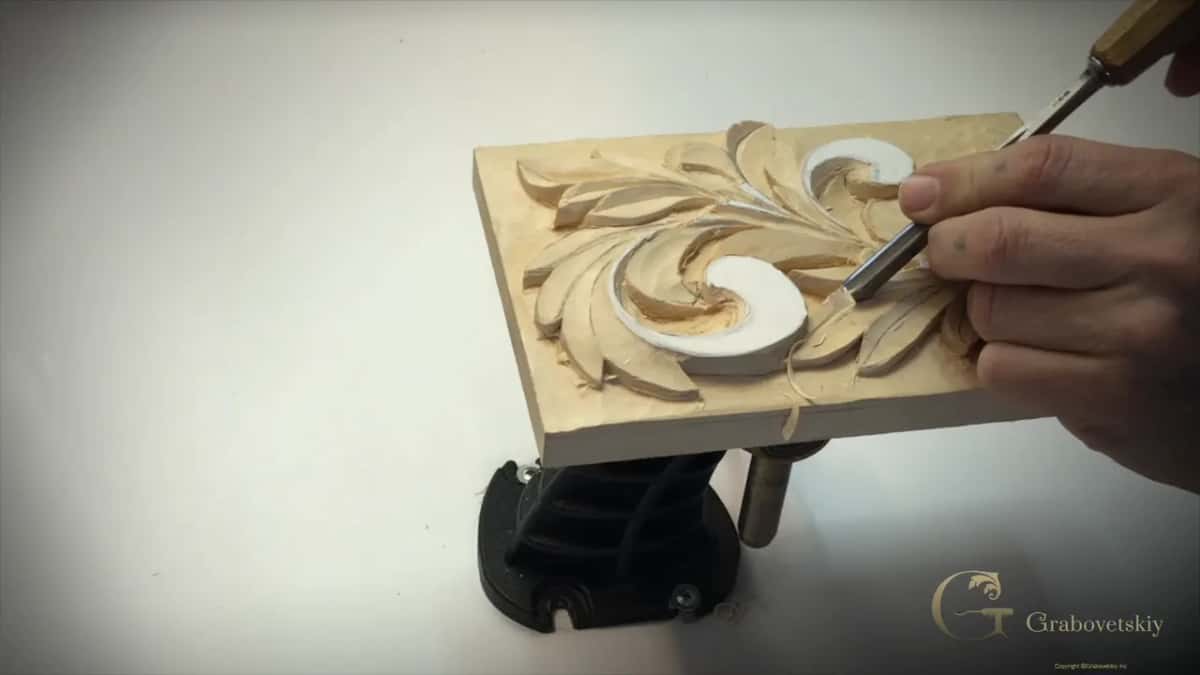
I turned the panel after that. In this case I don't have to use the V tool, I said. On that side I could use just my carving knife, number 12, and blend it to the center. That's also a really good technique, really quick, I would say, and I could have used it pretty much from the beginning.
Near the end of part one I took a different V tool, a 12a, 3 mm (1/8 in), and refined that V right in the middle to make it look even better. A slight one went on one more spot, for the shadow line.
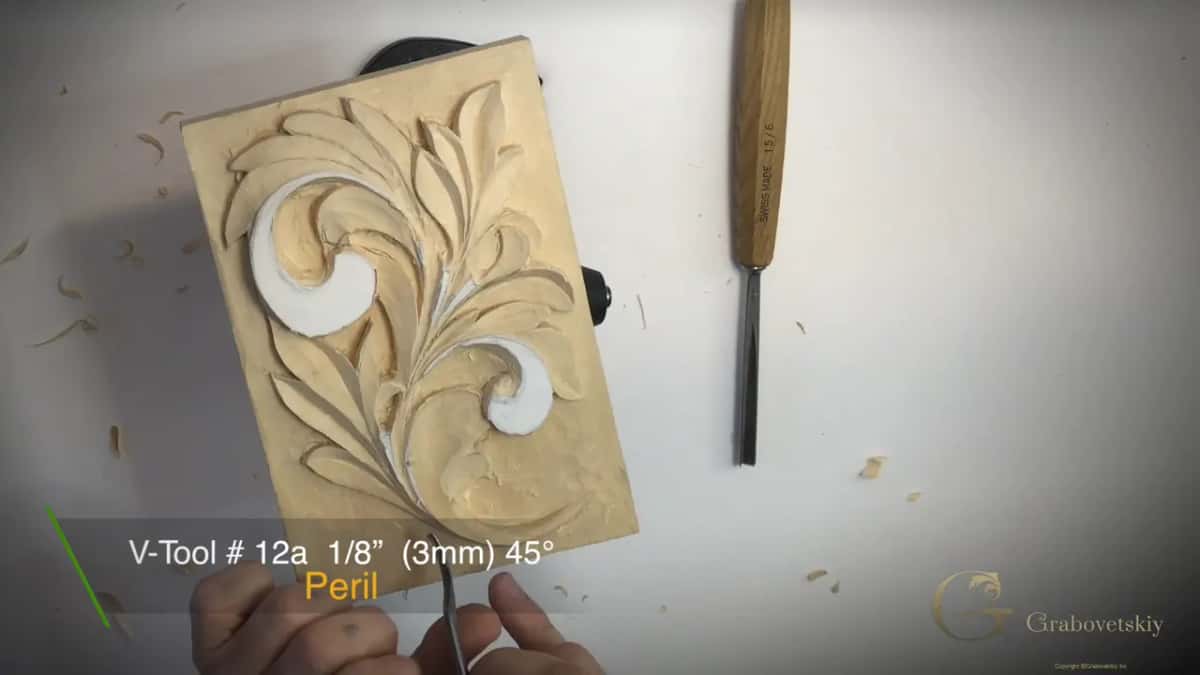
The same 12a comes back in part two, and there I said it's marked 12A, and it's a spoon, a three millimeter spoon. Your V tool doesn't have to be a spoon. I just like that I can push on it with my thumb, I get a lot better control on smaller details like that, and I can escape easily.

How deep should the V cut go?
Deep, but never down at the level of the background. On one detail in part two I didn't want it too deep, so I made just a V cut in the center and said I think it's good.
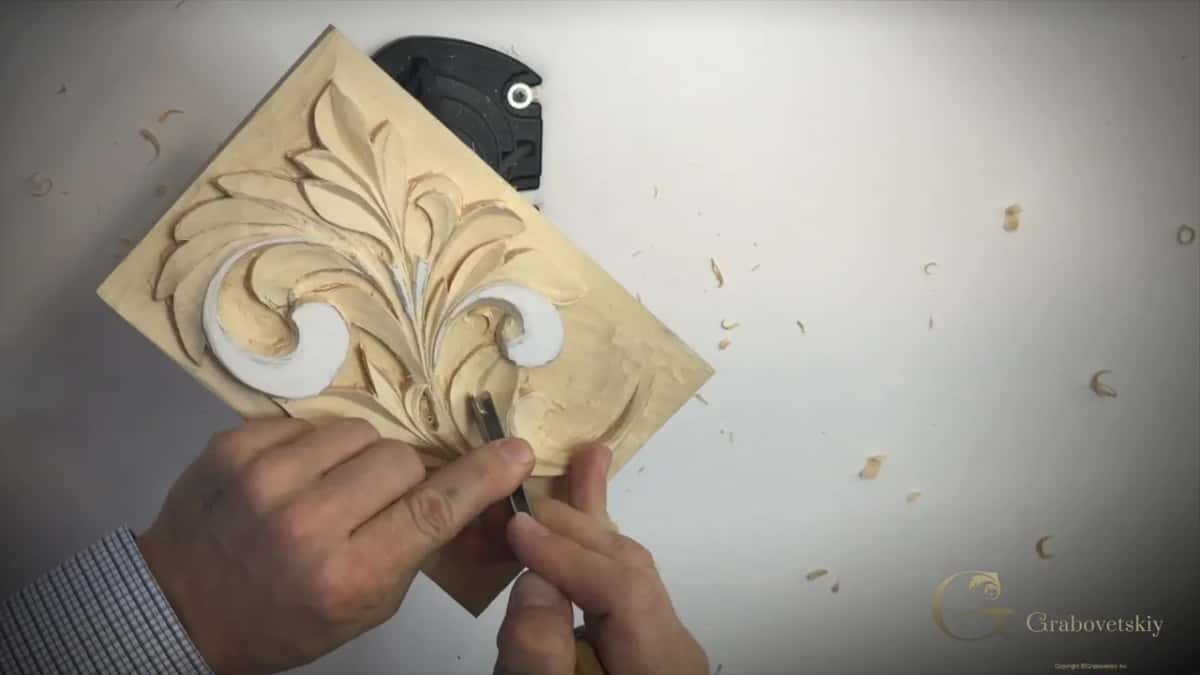
Part three has a detail I was somewhat happy with, though I probably wanted it deeper. I still didn't like it. So I took the V tool again and made it even deeper. But I can't go too deep, because then it ends up on the same level as the background and doesn't look natural. I don't want to see any holes underneath it. Later this leaf will also go even deeper underneath its neighbor, and we'll refine under it then.
Does every lobe of a Greek leaf get a V cut?
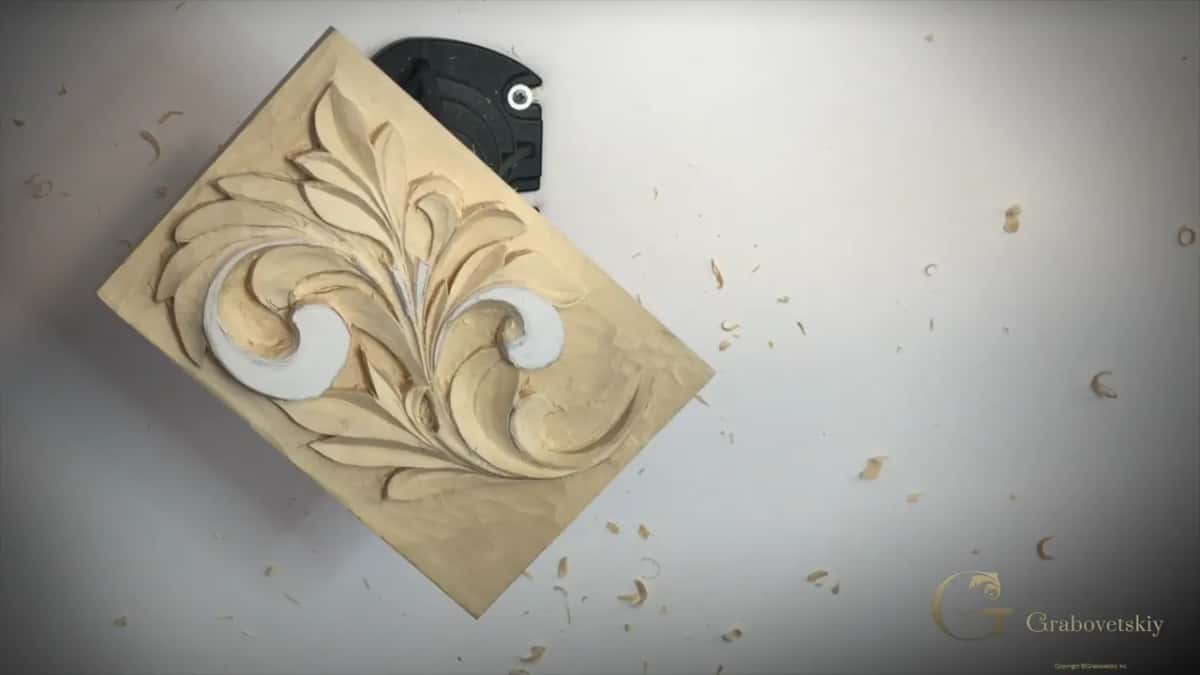
One lobe on this panel didn't. In part three I reestablished my design, looked at one detail and said I would probably not do the middle cut there. A gouge alone made that detail, with no center line. Later on I'll see how it looks in the overall picture.
The grain changed direction there, so I approached from the other side, cleaned it, and left it alone for now, to decide later if I want anything else.
In lesson 5 I compared the Greek leaf with the Corinthian. With the Corinthian acanthus we left some higher ridge on the inside of the leaves. A lot of times the Greek leaf has absolutely no ridge, just a pure V cut. But you could leave one, and it still would be authentic.
Drawing this leaf in lesson 1, I said the inside still looks somewhat like a V cut, concave on both sides, if you want to be accurate to the historical Greek style.
When did carvers stop making the V cut?
Later in the history of the acanthus leaf. While I drew the big curl in part three, I said that in the future they would stop doing that V cut. The Byzantine style still had some of the V cuts, but later on they stopped, especially in areas like that one.
A livestream in April 2020 went through it period by period, by the section cut of the leaf. Ancient acanthus is supposed to show a V there. Roman, a concave. Byzantine, a concave, convex, concave. Early Italian, the Roman Christian Empire after Byzantine, gets convex, concave, convex, concave, convex, and French is concave, concave, concave.
And on my Roman leaf I once said the Romans made the inside sometimes like a V cut and sometimes concave.
How do you turn a curl with a V tool?
Slowly, with the tool laid on a finger. The big detail in part three could stop right where it was, or the design could go all the way, curling in. I did that. This distance is less than that one, because the leaf is going to curl down there.
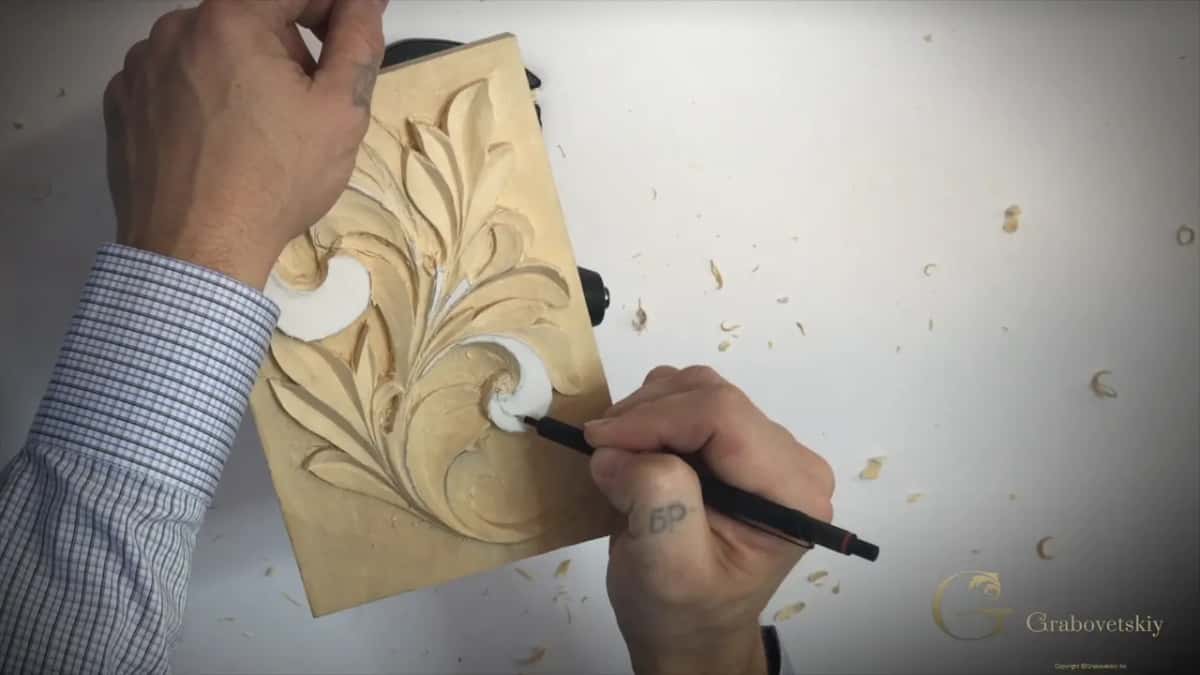
For the curl I took my number 15, a 6 mm V tool, which I called a 45-degree one in lesson 3. I started carefully at one end. Watch how I hold it: I lay the V tool right on one finger, hold it with another finger, and keep referencing. That finger controls how far I'm going, because it's a micro cut.
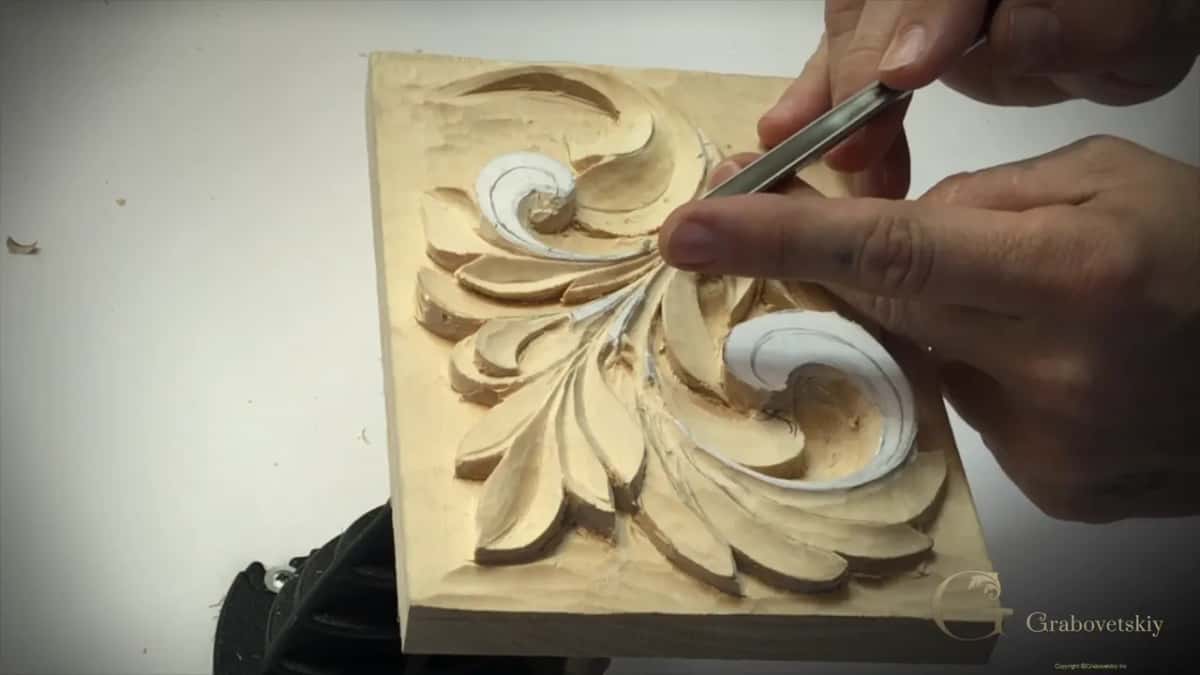
Believe me, it's really easy to mess up that line. But if you manage to make it nice and long, it's going to be beautiful. Through the turn I had to make sure I wasn't digging too deep, so it's better to take your time. At the end I wasn't sure. I could probably go a little deeper. Yeah, sure.
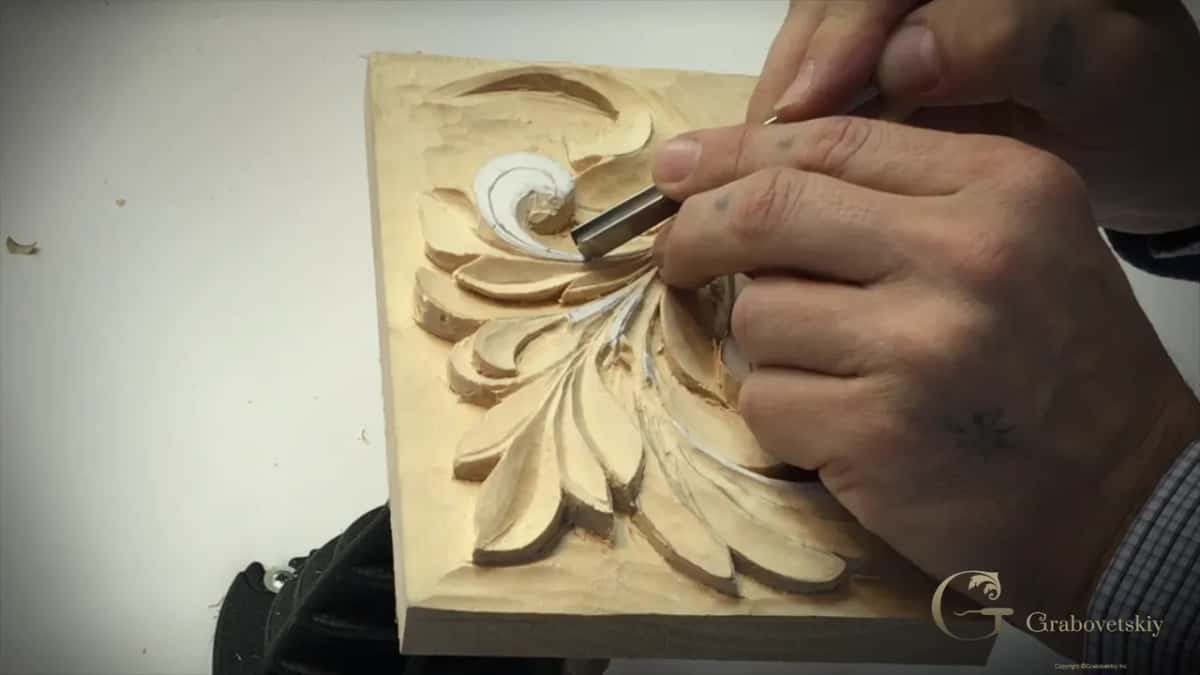
Part four opens with one area brought to the edge, just with the side of my V tool, the same idea as a chisel, and I tried not to overdo it.
Which gouges bring the sides down to the V?
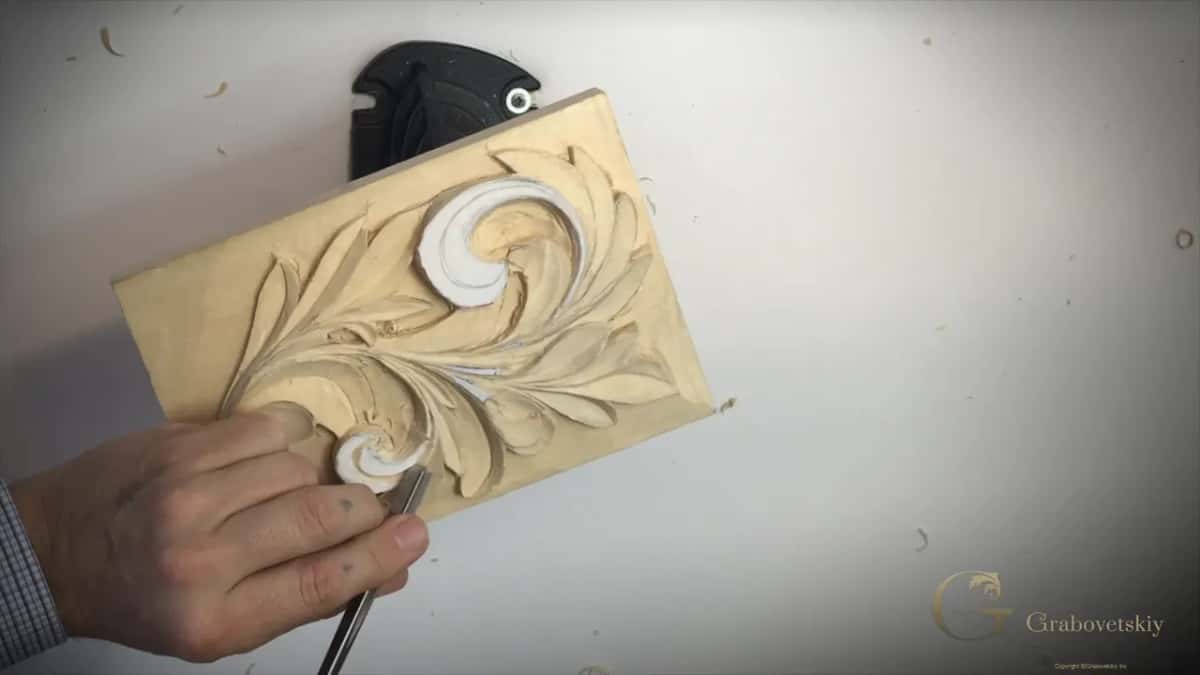
A number 7 straight gouge brought several sides down, and I'll tell you why I like that one. In part two I said either the chisel part of the spoon V tool or a number 7 straight gouge can bring that side to the center line, and both are appropriate.
On another detail I wanted one side more concave, to give more depth and make it feel more like 3D. I took the number 7, 14 mm (9/16 in), and brought that side in to the center line, starting at the edge. Then the grain changed direction, and I had to watch how I was carving.
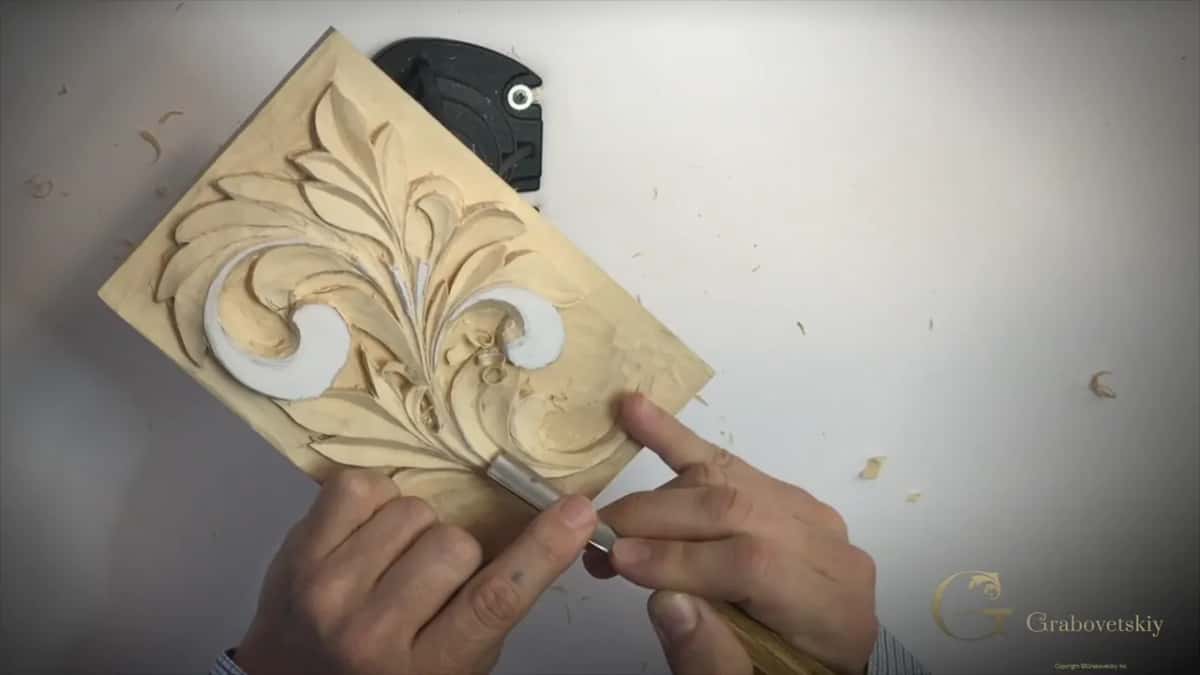
Later I tried to make each pass of the number 7 as long as possible. There the grain turned too, and it was a good thing I had extra material in that spot.
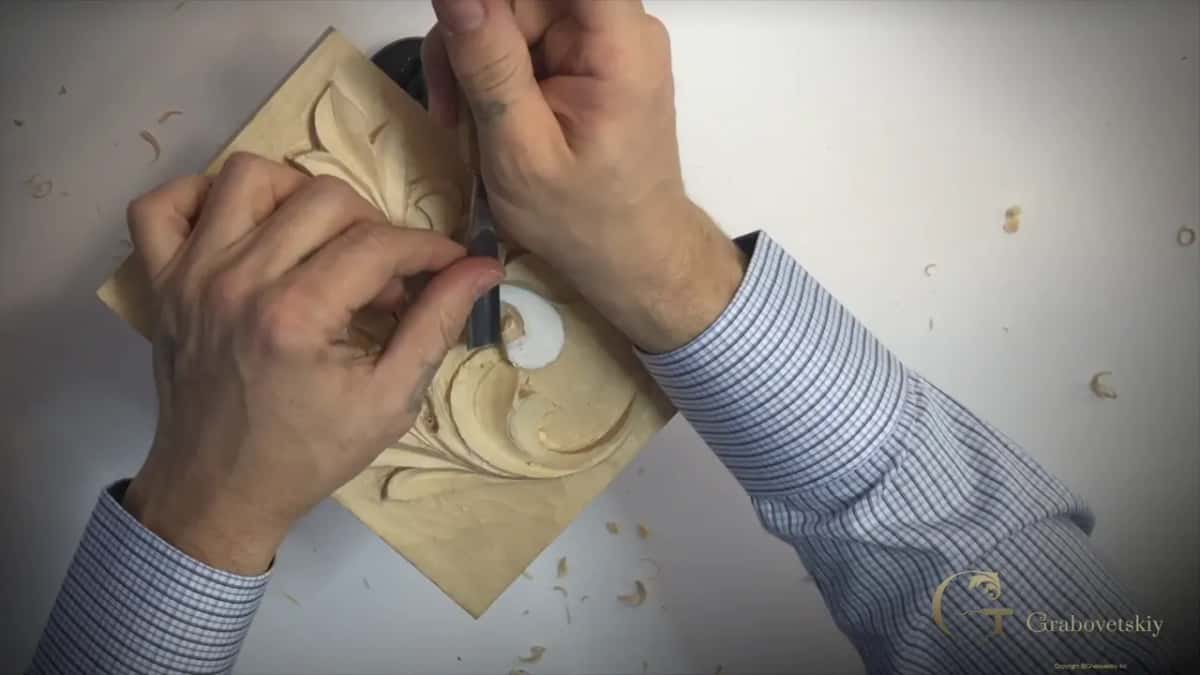
Before the number 7 went back in, in part four, I stroked its edge first. Just the inside bevel. I'm not going to touch the outside. Then that side came to the center, and if you watch what I'm doing there, I'm making micro rotations.
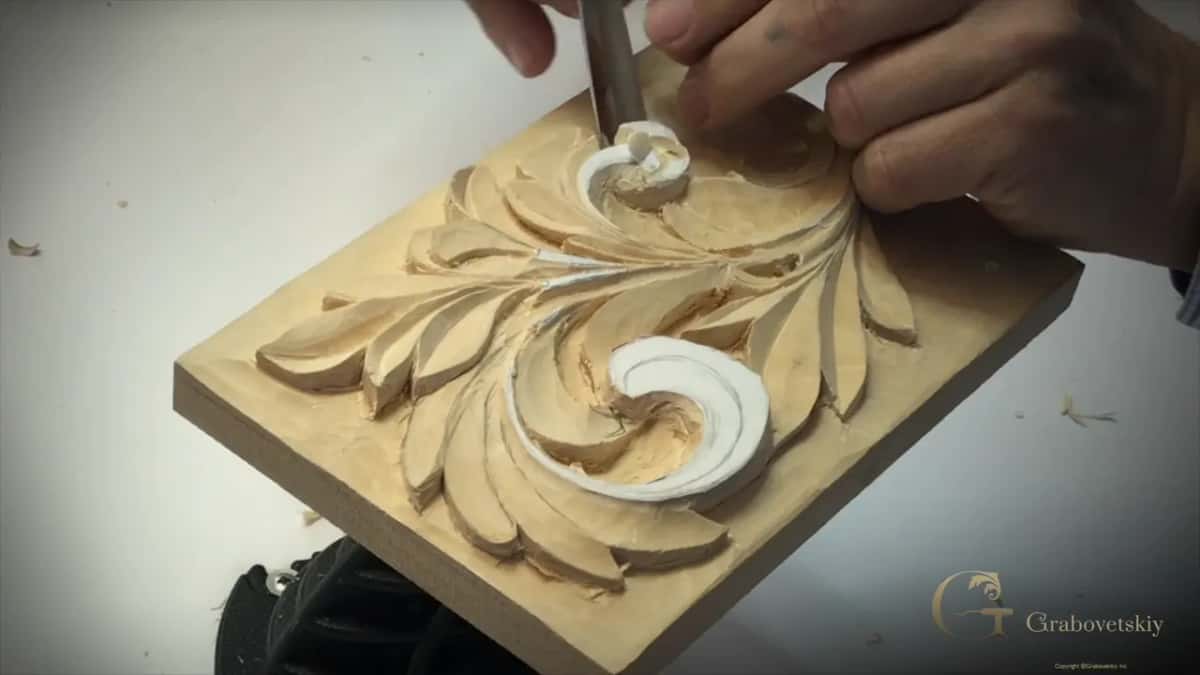
This number 7 is 14 mm, European size, a little shorter than full size, which I really like to use. It's one of my favorite tools. I have a few number 7s, but this one I'm using a lot, and I've had it for, I don't know how many years, like 20 years or so.
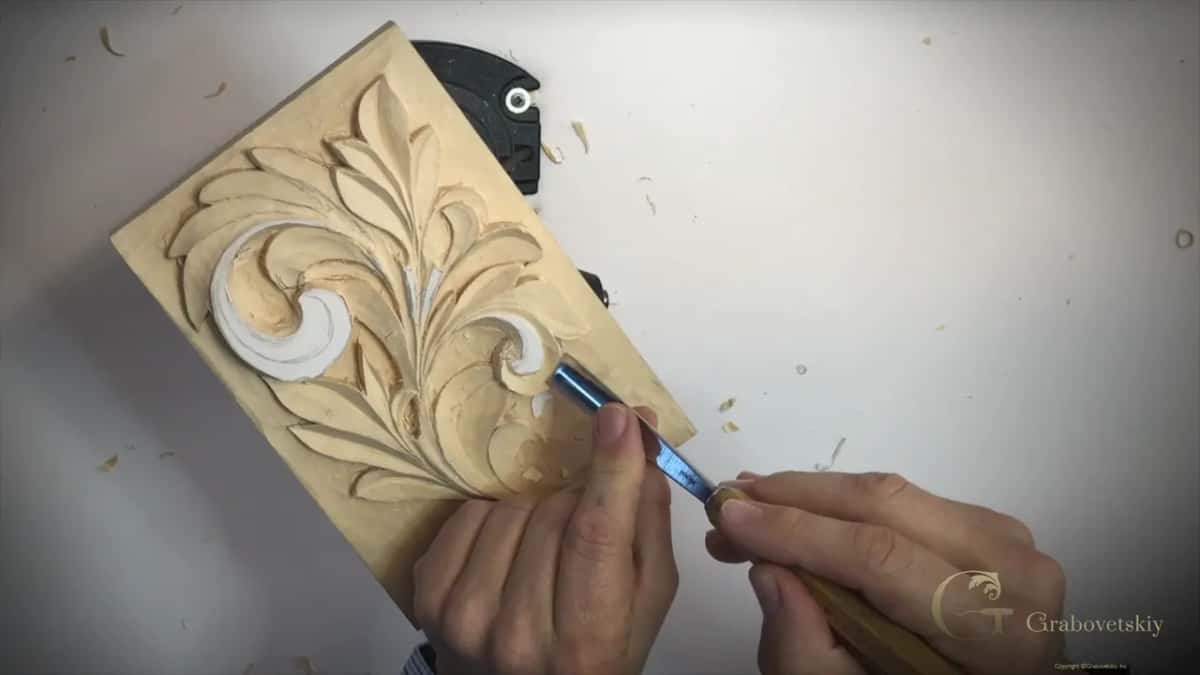
What does a tiny gouge do beside the pipe?
It exaggerates that area, and I like that. In the second part I cleaned one pipe, took my paper off first, and made it more roundy. Areas like this, where a small detail sits really close to the pipe, I kind of like to exaggerate, so I took a really tiny gouge and made a concave cut right next to it.
It was about 3 millimeters, an eighth of an inch, a small dockyard gouge. Maybe it's less, maybe a two and a half. There is no marking on it. It just had to be small enough.
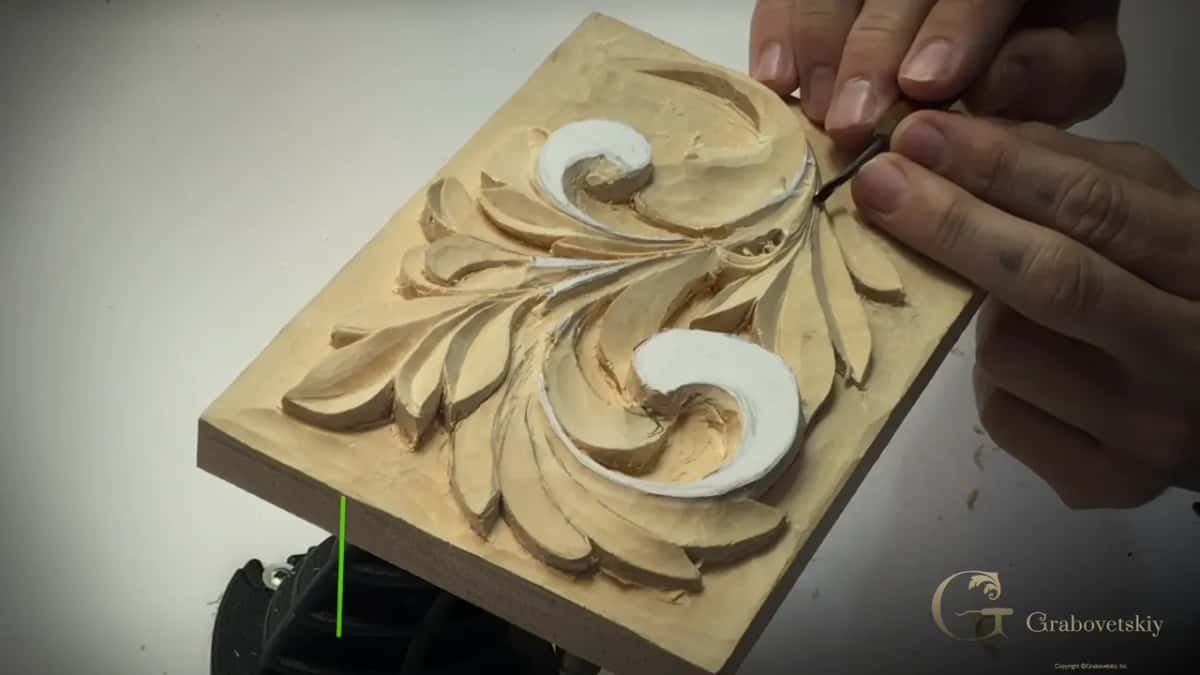
Care matters there, because when you carve with a gouge, one side always comes out clean and the other one doesn't. A number 5, 3 mm, rounded that area afterward.
On the Roman leaf I gave the reason I attack from two sides. It's the grain of the wood. With a gouge or a veiner, one side is always cleaner than the other side.
The same small tools come back in part three. The small dockyard gouge made one outline stand out, the number 5 at 3 mm blended that line in, and since I still didn't like that side, a number 5 at 8 mm, about 5/16 inch, cleaned it.
Why use a number 1 chisel like a knife?
To work with its corner, much like a knife point. Toward the end of the lesson there were a couple of ways to take one side to the center line. I could use just the knife. The other approach was a number 1, and I took the 8 mm (5/16 in) one, a double bevel. It's a straight chisel, so it's not a gouge and it's not a veiner, and number 1s come with either a single or a double bevel.
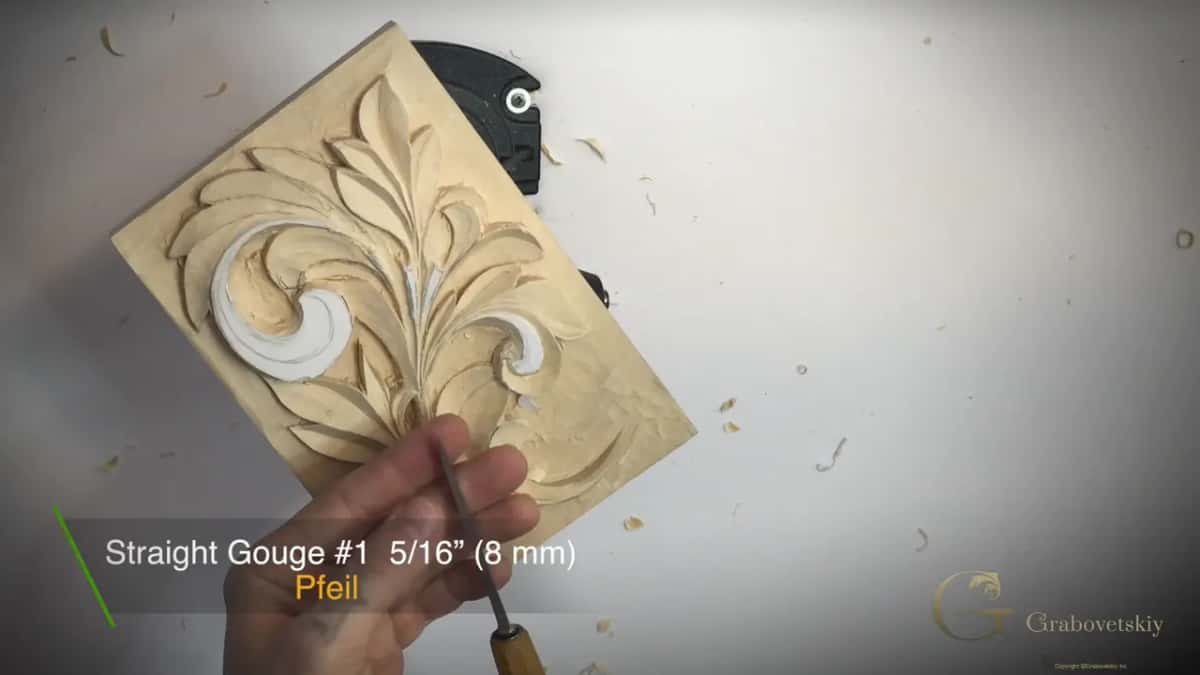
Then the rule. The grain goes one direction and I'm working on the outside, so I find the high point first, work downhill with the grain, and change direction after.
The knife would have done, but I thought this tool was a good idea here, because I'm still using just a corner of it, and I kind of like that. And to prove a point that there's more than one way to get the same results, I used the same tool on the other side, blended it in, then turned it and took it down, just like a chisel.
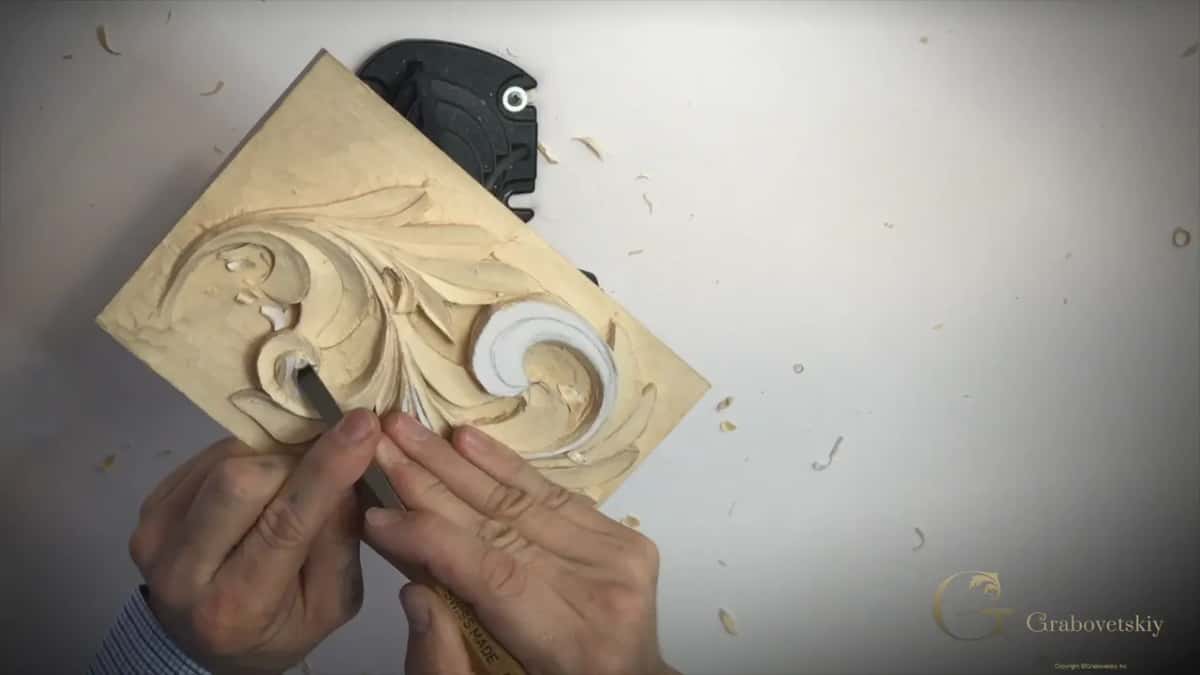
In a beginner workshop on a cutting board I said that in ancient times the only tool those people had was either a knife or just a straight chisel. You could do lots of the work there with the number one carpenter straight chisel, using just the edge of it. You're using one point of the chisel, one side of it, to have the advantage of the knife. Learn the knife, I said there, and other tools get much, much easier to use.
Every tool I picked up for this leaf
| The tool and its size | What it did on this Greek leaf | Lesson part |
|---|---|---|
| Carving knife, number 12 | Went straight down, then sliced in from both sides of the line | Parts one, two |
| V tool at 45 degrees, 6 mm (1/4 in) | Opened the first lobe, shallow at first, deeper after | Part one |
| Spoon V tool 12a, 3 mm (1/8 in) | Refined the middle, with my thumb pushing on it | Parts one, two |
| Number 15 V tool, 6 mm | Turned the big curl, laid on one finger | Part three |
| Straight gouge #7, 14 mm (9/16 in) | Brought the sides in to the center line, my favorite | Parts two to four |
| A little dockyard gouge with no marking | Concave cut right beside the pipe | Parts two, three |
| Two number 5 gouges, 3 and 8 mm | Rounded, blended and cleaned the small areas | Second and third |
| Straight chisel #1, 8 mm (5/16 in) | Its corner took one side down to the line | Part four |
Is the leaf finished after lesson 7?
The leaf still has work ahead. At the end of part four I said that for now I'm going to leave it like that, although I could make my cleaning cuts. I'm not quite happy yet with how it looks overall. And then I said I guess I could live with that for now.
This leaf gets undercut later in the course, and lesson 8 comes next. Later on we're going to work on different acanthus leaves too, and believe me, you can get really beautiful designs.
Do you have a knife and a piece of wood? Could you hold the blade low to it? Then every lesson of this Greek acanthus course is open to you with tuition.
How it's done
- Check your lines. Draw the middle line on each detail and make sure no two lines connect.
- Set the line off the center. Usually I shift it, here about 1/8 inch (3 mm), so the higher side throws the sharper shadow.
- Straight-down cut first. Put the number 12 knife straight in on the middle line.
- Slice in from one side. Come in gradually toward the line, holding the blade at a really low bevel.
- Turn the panel and slice the other side. One more pass from the opposite side, and the waste snaps out. Keep refining until the point is nice and sharp.
- Watch the depth. Shallow first, then deeper, but stop above the background, so no holes show underneath.
- Refine the middle. A small 3 mm V tool, about 1/8 inch, cleans the middle and adds a slight shadow line.
Frequently asked questions
Did ancient carvers carve acanthus leaves with only a knife?
Most likely, I would say, and on camera I keep that hedge. On camera in lesson 7 my words are that wood carvers in ancient times would have had a knife and nothing else. A cutting board workshop for beginners is where I named two tools they had, a knife or a straight chisel.
What separates the Greek V from the Roman and Byzantine leaf?
The shape inside each lobe. A Greek one gets a sharp V, the way a blade leaves it, while Roman work has a concave and Byzantine work a raised up convex down the middle. Still, on the Roman course I said Romans sometimes made a V there too.
Which V tool works for the Greek V cut?
On this leaf the V tools were a 45-degree one, a quarter inch (6 mm), a number 15 at 6 mm and the 12a spoon at 3 mm. Back in lesson 5 I said any 60 or 45-degree V tool will do. A knife carves that same V as well.
What to carve next