

Alexander Grabovetskiy, woodcarver, School of Woodcarving · Published 2020
Why do carvers repeat the same shape in a design?
Quick answer: Repetition in a carved design is the rule that an idea carved in one place has to come back in another, or it looks unrelated to the whole. On a Venetian ceiling I carved, one flipping part of a leaf returned on the opposite side, and columns planned for the same job will echo it.
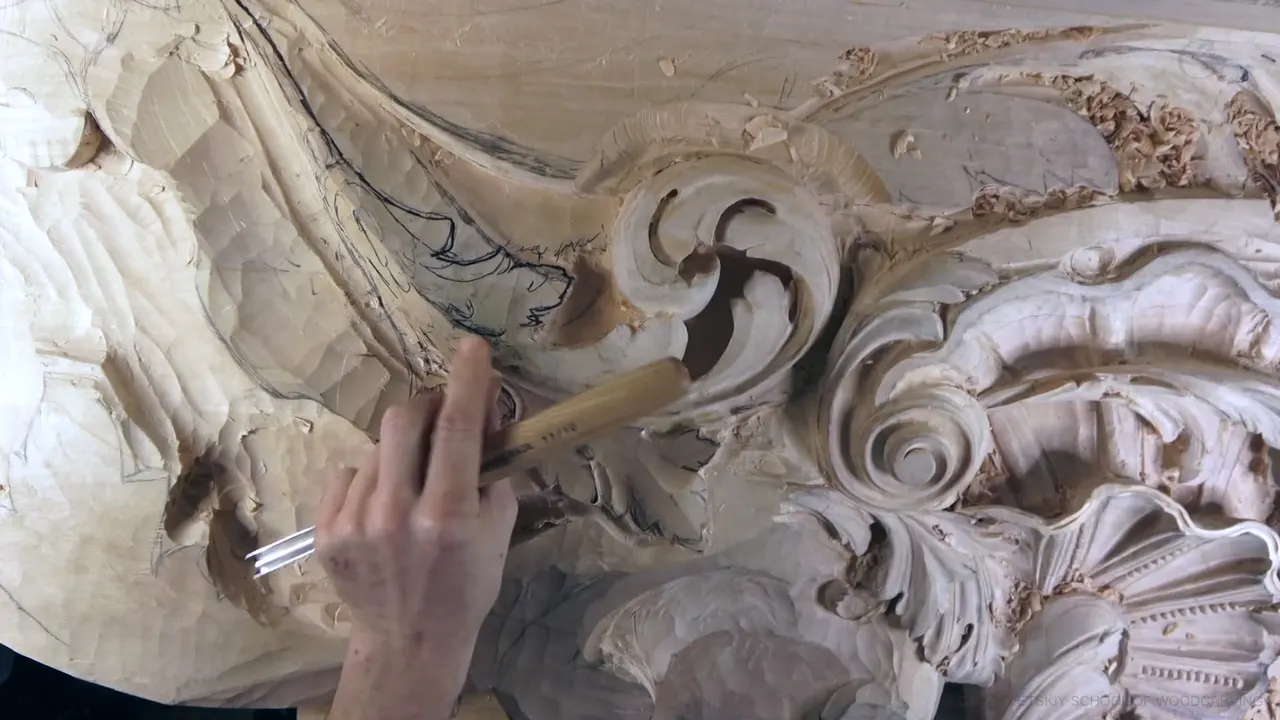
Repetition in design is carving one idea more than once, so a whole piece reads as one design. In workshop 41 I was carving a Venetian ceiling, and one part of an acanthus leaf turns, flips over, and goes underneath its neighbor. I didn't let that happen only once. It came back on the next part, then on the opposite side of the board, and the columns planned below the corbels will carry it too.
Have you ever stood in an old church or palace and felt that everything in it belonged together? Would you like your own carving to give people that same feeling? One law of design does a lot of that work, and you can carve it into a piece on purpose.
I'm going to be honest with you. Most people who see this ceiling will never catch it. Some of the people looking will be professionals on the project, and now and then somebody really knowledgeable comes along. You'll see where the idea came back on this board, what I let change each time, and the extra movement I kept out of it.
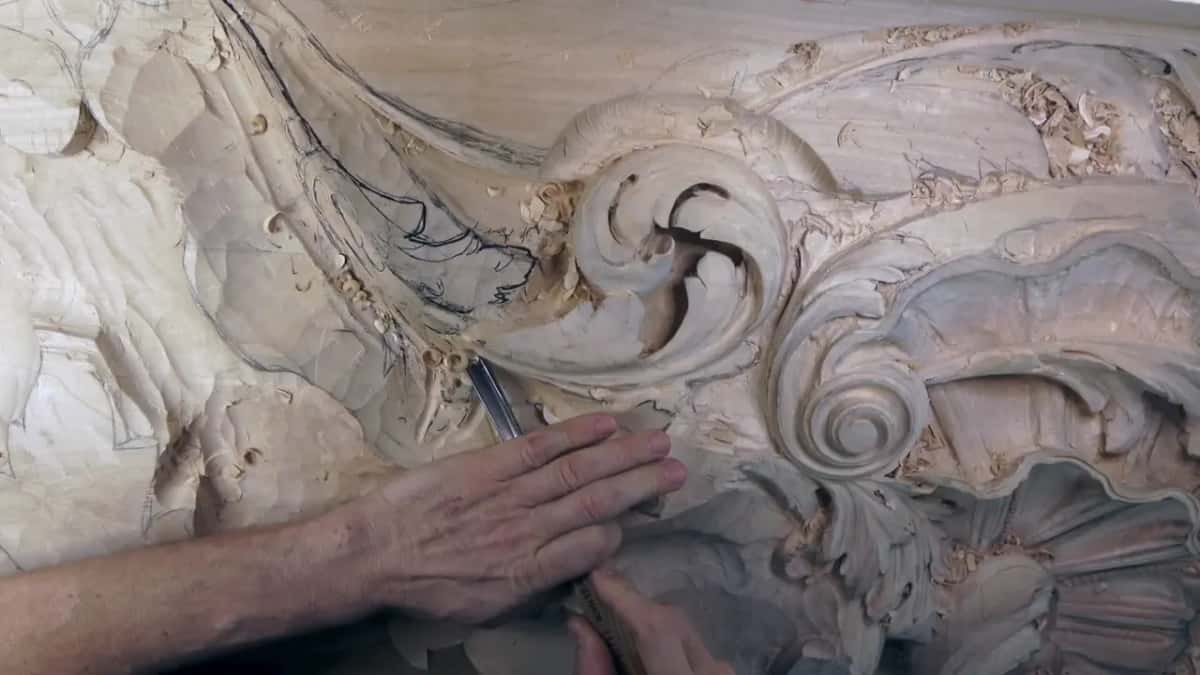
Six things workshop 41 shows about repetition
An idea you carve only once looks unrelated to the rest of the design, so it needs a second home.
The repeat stays near the first, never an exact copy.
While outlining the opposite side, I moved one point a long way over so the repeat would follow that side's movement.
The columns planned for this job will get it again, a little smaller.
Few visitors will notice.
I left out a second movement that would have pulled the eye away from the main one.
What does repetition mean in carved ornament?
In ornament like this, repetition means an idea you carve in one spot comes back somewhere else in the same design. I said it out loud at the bench in workshop 41, while I was working with a 4 mm (5/32 in) #11. By the law of design you have to repeat. If you've got one part, some idea, you have to repeat it somewhere else. Otherwise it's not related to the overall design.
I learned that law long before this ceiling. At sixteen I became the only apprentice of a fine-art master in Russia, and he taught me that design means the laws of space, rhythm, repetition, and understanding the tools. Repetition was one of those four.
Rhythm is a separate law with its own page. It decides how far apart the divisions of a leaf sit, which I cover in workshop 34, so I'll leave it there. If the word movement is new to you, workshop 38 explains it, and the rest of the laws have a course of their own, Principles of Design in Wood Carving.
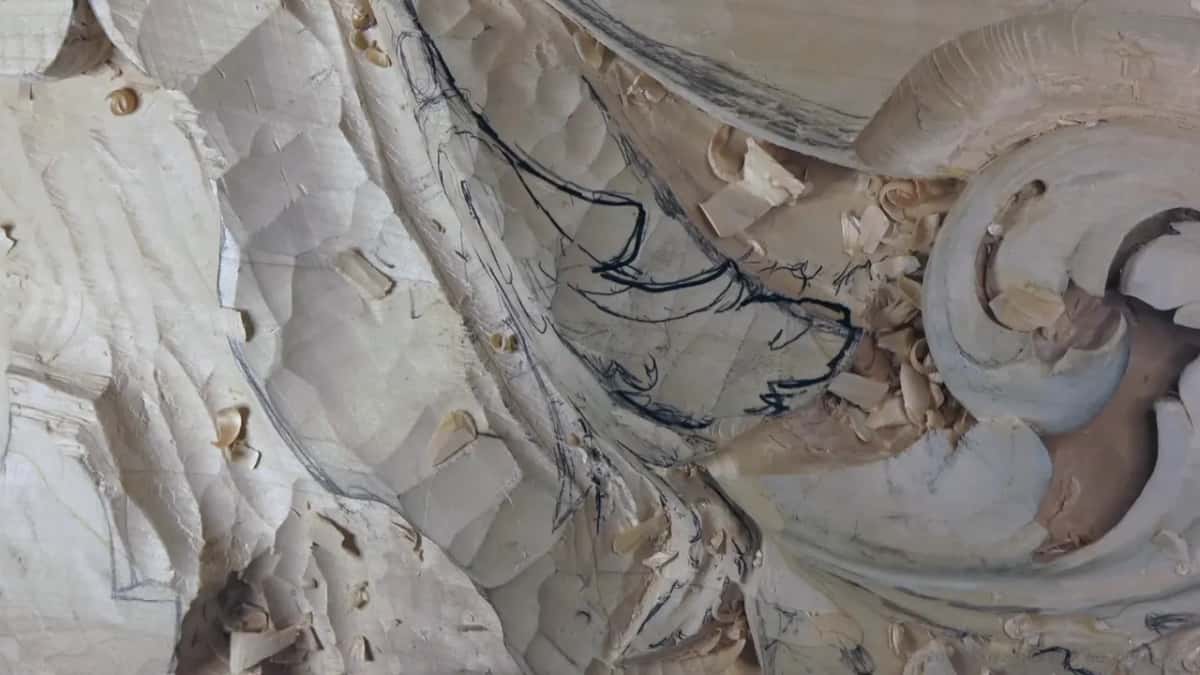
Where did this idea start on the ceiling?
Near the center of the board I had a really beautiful chunk of wood left, and I didn't want to lose it. A spot right by the center is also going to draw the attention. So I decided to do something different there.
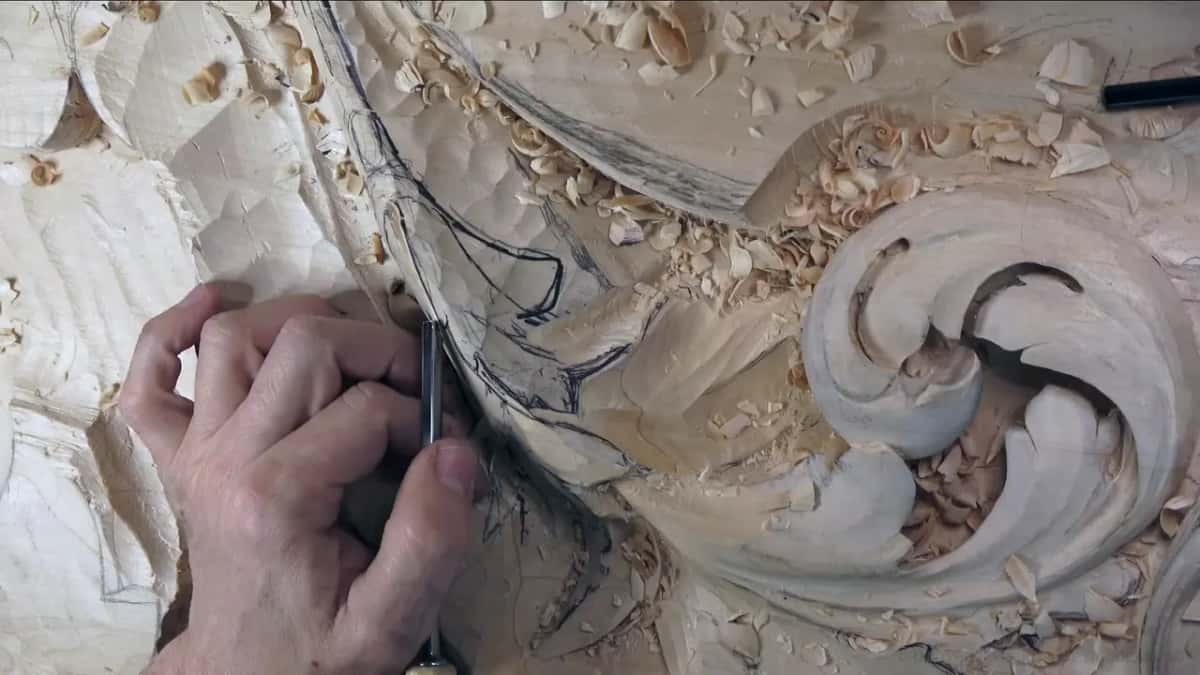
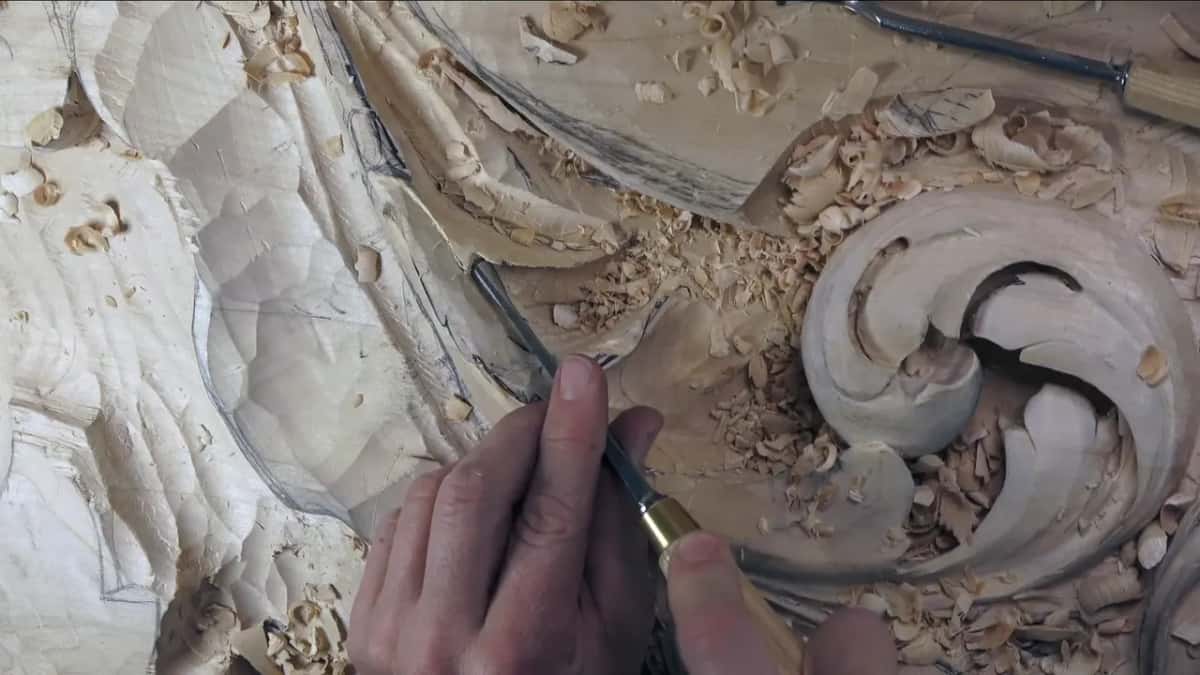
The idea itself was a repeat from the start. I took the twist of a small detail I'd already carved nearby, one that twists and goes in and then out, and gave it more depth. A concave on one side meant carving that side much deeper, which gives you a lot more material to work with, or it just doesn't look good.
Then I made one side of it longer than I first had it. With that part dropped all the way down, I got the chance to make the movement even more three-dimensional, and it solved the problem of too many empty spots. Part of it could even go closer and get rid of voids I didn't need.
The first flip got a really big concave, started with a downhill pass of an 18 mm (about 3/4 in) #11 gouge. Light will come from the side. That's why I wanted it deep, with a good shadow line. I blended it with the bigger #3 and kept one ridge on purpose, because that ridge belongs to the movement.
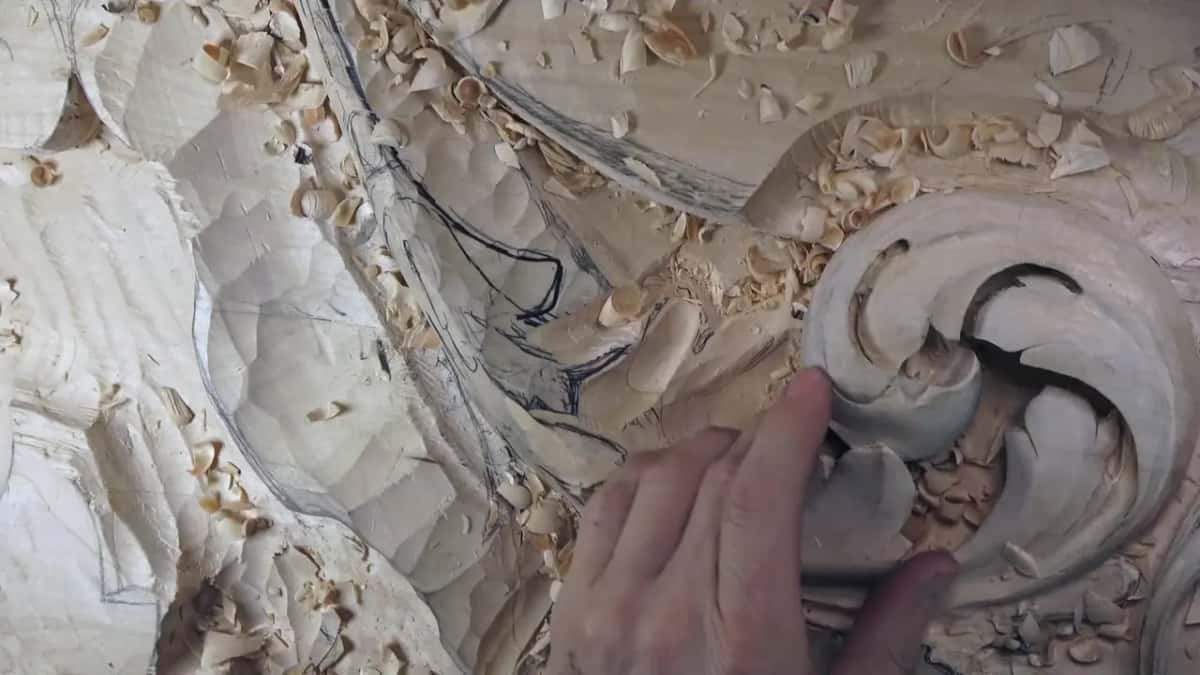
Why can't a good detail stand alone?
A detail carved once has nothing tying it to the piece around it. It can be a beautiful piece of work and still look like it belongs to some other design entirely. A shape used this way is what people in design call a motif.
The element I was carving when I said all this grows from underneath and seems to go inside and then come back out. I love it, and I said why on camera. Below the corbels on this job there are going to be columns, and they'll carry about the same movement on a smaller scale.
That's the law doing its job. Without a second home somewhere on the job, the part I love would stand there by itself.
Does a repeat have to be an exact copy?
A repeat only has to come close. When I talked about the columns, I said they won't be exactly the same. A little smaller, and the idea close to the first one.
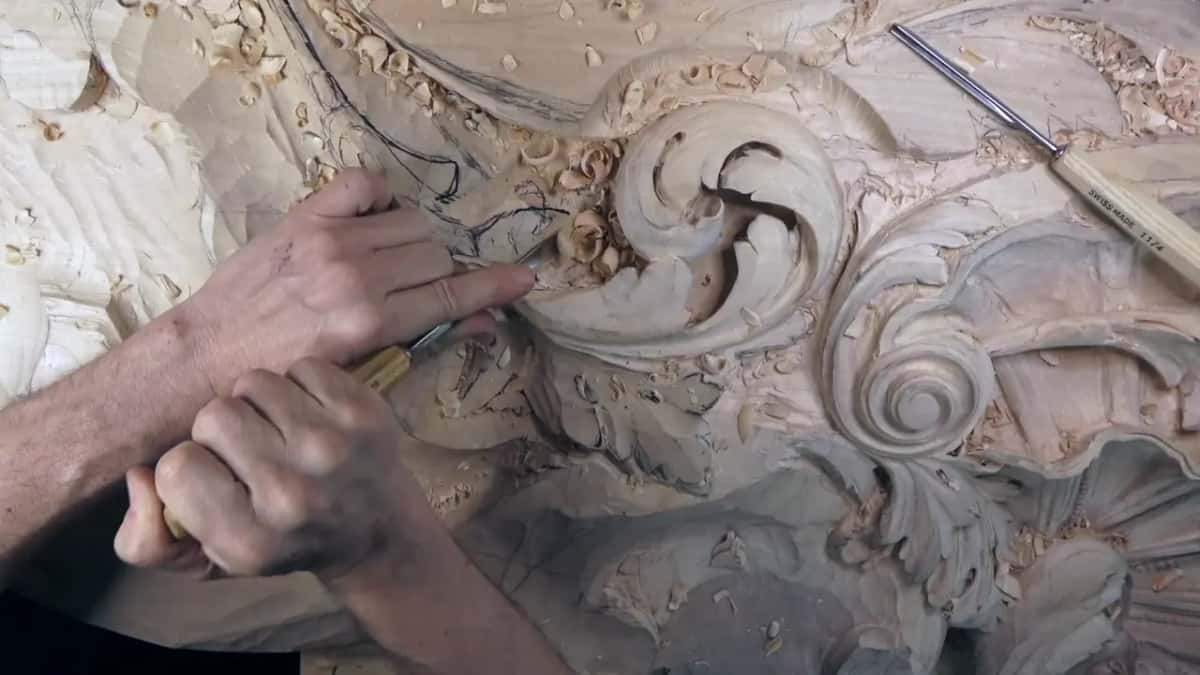
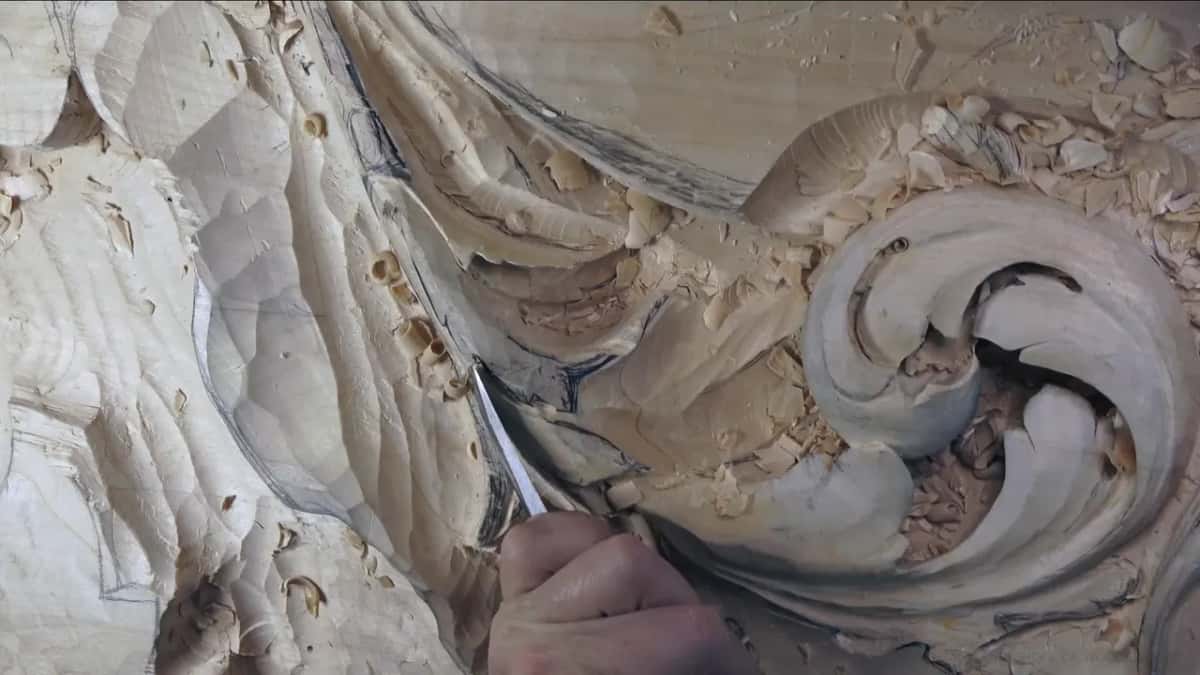
The opposite side of this board shows a different kind of change. I wanted about the same idea there, but it had to be more logical in the overall movement, so while I outlined it I brought one point all the way over to another spot. Same idea, new direction.
The eye moved on the far side too. I wasn't happy with how one spot looked, so I made it a little bigger, because the center of the eye has to sit at about six parts out of ten between two points. More goldish, rule-ish, if you want to say it that way. That's the golden ratio, 1.62 if you count it, or 62 parts out of 100.
Don't mix this up with progression. Progression grows one ornament larger each time and runs it toward the heaviest part of a design. What I planned for these columns is a quieter move, the same shape coming back a little smaller. If you want one idea carried down through many sizes on a single board, the furniture panel shows how far down that can go.
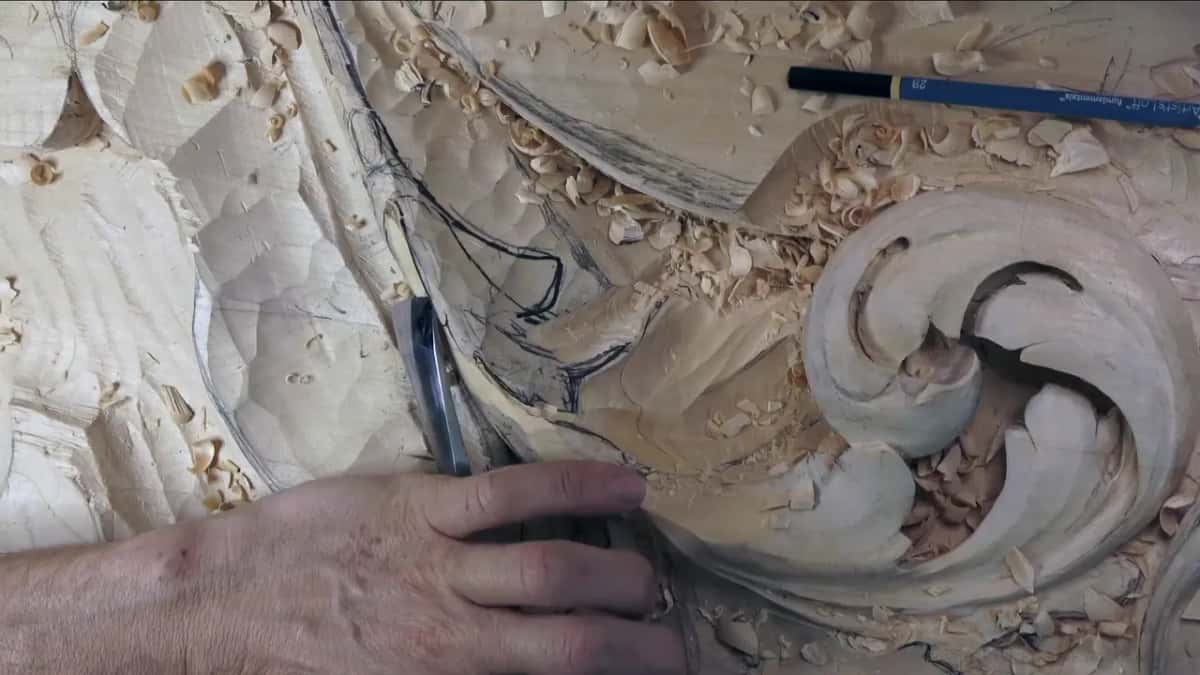
The idea lives in four places, three on the board and one still to come.
| Place | What the idea does in that spot | Tool |
|---|---|---|
| Near the center | Turns and flips, then slides under its neighbor | Big #11 gouge |
| The next part | Same flip again, with a separation first | Spoon, 10 mm |
| The opposite side | Close to the first, bent to the overall movement | 30 mm #11 |
| Under the corbels | The same movement on columns, a little smaller | Not carved yet |
Where does repetition in architecture show up in one room?
People usually picture a row of columns or a line of arches when they hear that phrase, and that's a fair picture. In this project the repeat travels between two different parts of the building. The ceiling board carries the leaf, and the columns that will stand under the corbels get a smaller version of the same movement.
When I filmed workshop 41, those columns didn't exist yet. The plan did. That's why one element on the ceiling mattered so much to me, because it already had a second home waiting.
The rules came with the job. Most of my commission work gives me the freedom to design, and I'd say something like 99.9% of the time I design from scratch, just following some rules about what they want to see. On this job the rule was to stay authentic to Venice in the Middle Ages. A couple of jobs came with the design more or less decided before I started, and even then I still had to design inside it.

Who notices a repeated shape?
Very few people do. On this job some professional people will be looking at it, and I don't mean only the members of the school. I mean the architects and designers who are involved in the project.
There aren't many people left on the planet Earth who really understand what is going on in a piece like this. Every so often one of them looks at your work. Not always, just sometimes, and I think that's a good thing.
The same goes for mistakes. Later in this workshop I made a small mistake, because I wasn't too careful and my tool wasn't too sharp either, so I had to move an eye farther over. Nobody's going to know it except the people watching, I said, and back then that was hundreds of members.
How did I carve the same idea a second time?
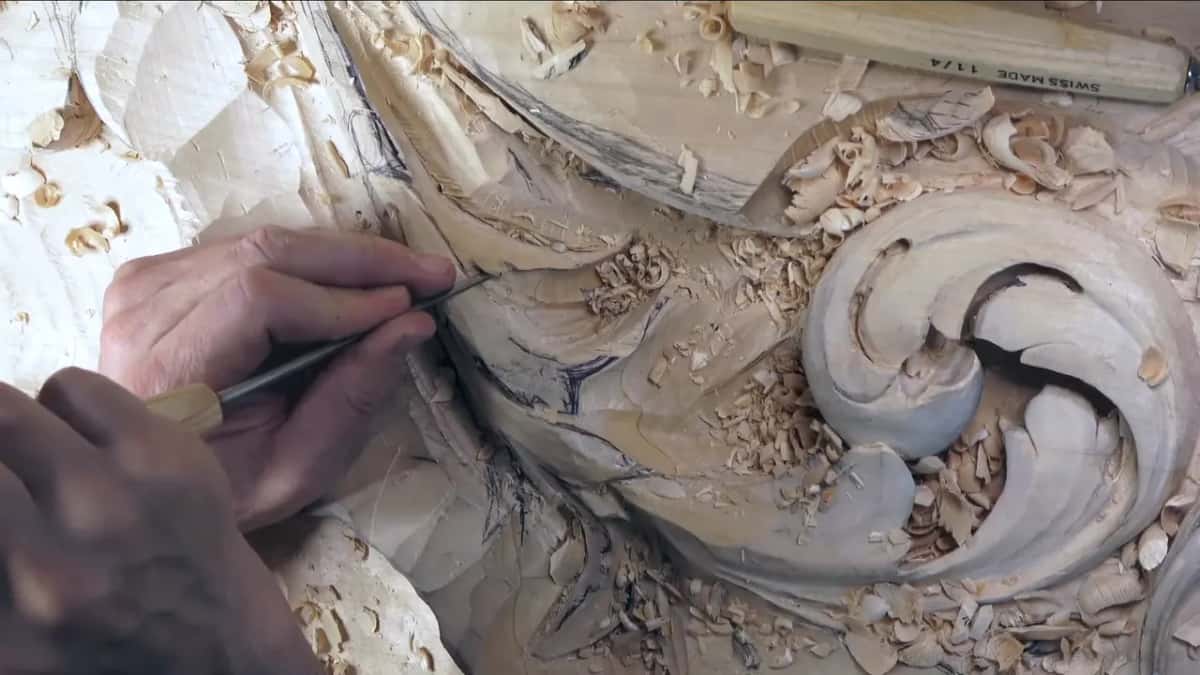
With the same tools, mostly, and in the same order. I took the next part and did exactly the same thing I'd done on the first one. I know I'm using big tools. I don't have to, but I think big tools are always a plus. First a separation, then I cleared the wood on both sides and excavated around it with a big #11 to make room for the flip.
Then I tried to take a whole side off right away. Oops. That is no bueno. It was too much stress on the wood, and stress against the grain is exactly what I'd just done. At least I could see what was going on.
The concave came next, made the same way as on the first flip. Then came a problem I'd made for myself. Because I developed that detail later than the rest, I'd lost my flow line, the tangency line of the three-dimensional world, so I fixed that first, and after that it ran nice and smooth. Where I went straight down with a #3, I stayed shallow, since tool marks that go too deep are hard to clean later.
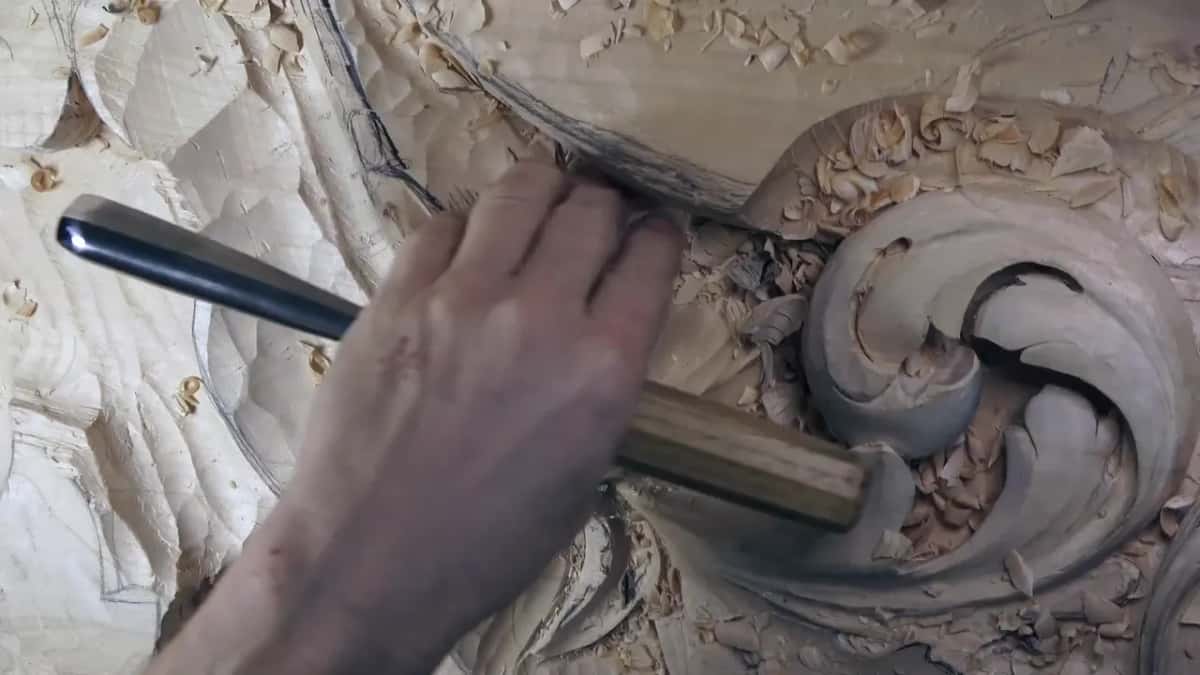
Inside, a spoon was the logical tool, and I said so. I used a 10 mm (3/8 in) spoon on its side, and later a bigger one, which gave a much cleaner and quicker result. Before I could lose the idea, a 1 mm (about 1/32 in) #11 also went along the separations to put some shadow in.
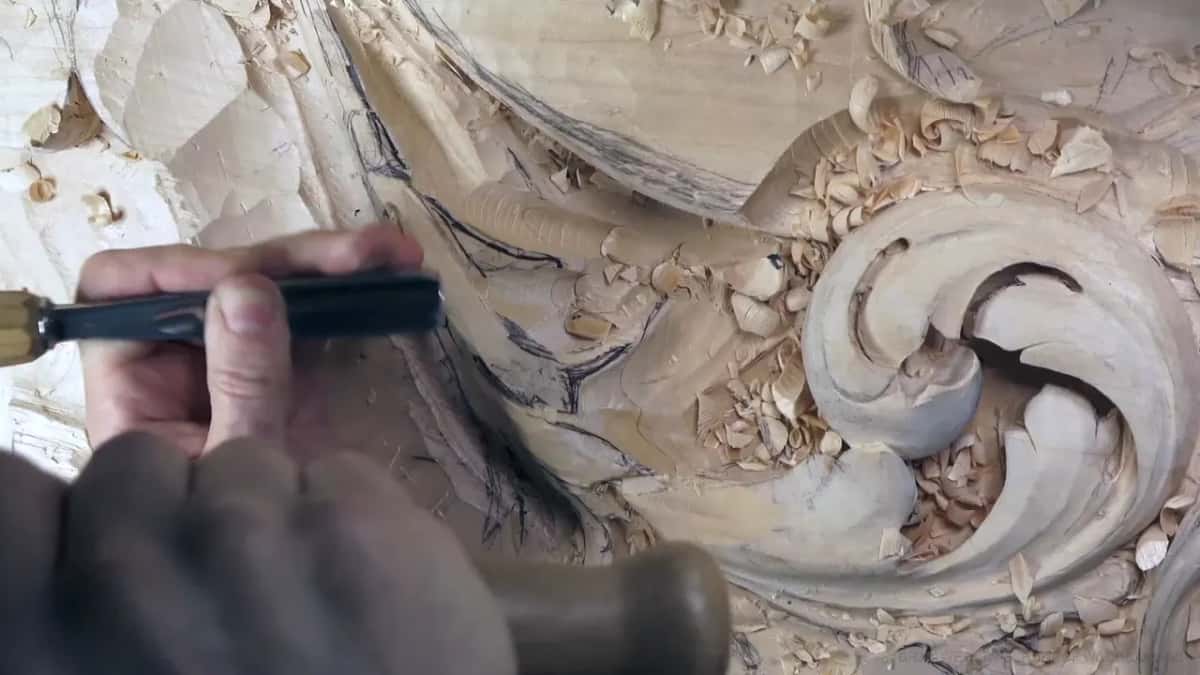
Earlier, before the spoon, I'd pushed on with the tool I had. A spoon gouge would have been much better for that excavating, but I was able to do it, and I don't want to change tools all the time. I didn't like what happened in one spot, but it was okay, and I still got a beautiful movement going downhill.
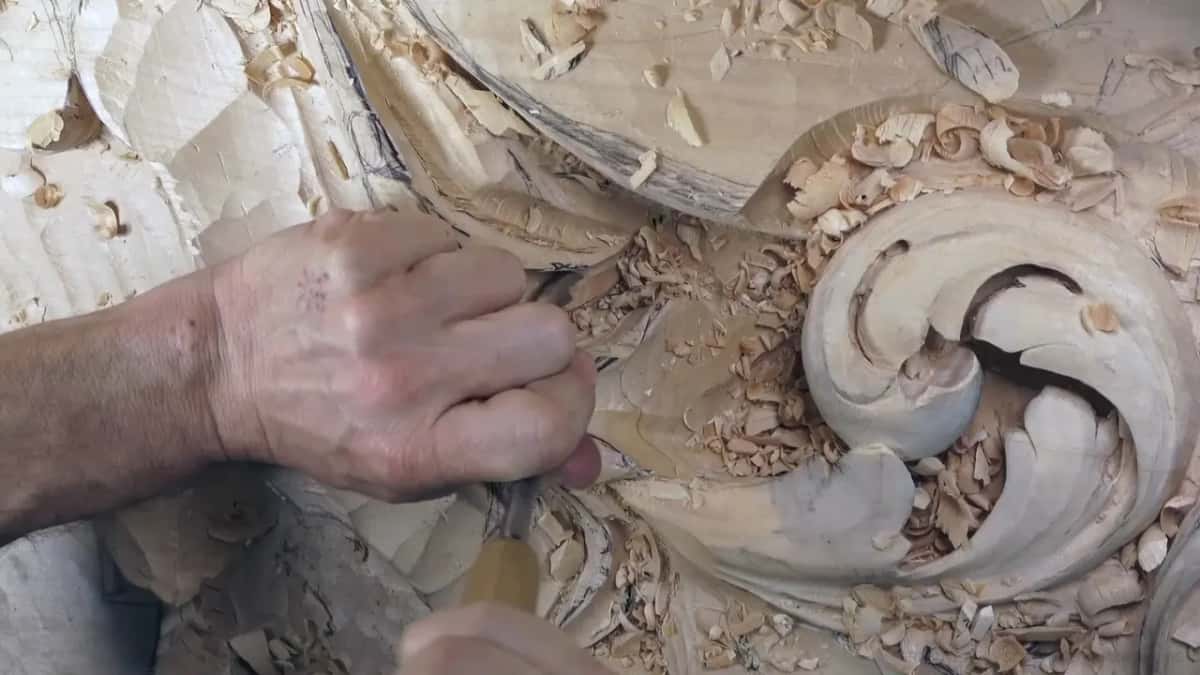
What changed when the idea moved to the opposite side?
The tools got bigger. A 10 mm (3/8 in) #11 did the outline, and then I picked up a 30 mm (1 3/16 in), because the small one would have taken me forever. After that came an 18 mm (about 3/4 in) #11, which is still big. That outline gave the part a really round feel, because it also has to go underneath, the same idea as the first.
I could move around there with no worry, because that wood belongs to a future shell, and the shell has to go underneath anyway. It also made it easier to get the tools underneath. Then, at one point, I just stopped. I've got to stop, I said, I don't want to be too fanatical about it.
The divisions waited too. Late in the workshop I outlined one area and left its separations for later, for when I'm ready to work on the inside. By then some of the wood has gone downhill, and my tools can reach much more easily. Earlier in the workshop I'd admitted putting some divisions in too early, with a lot of excavating still ahead of me.
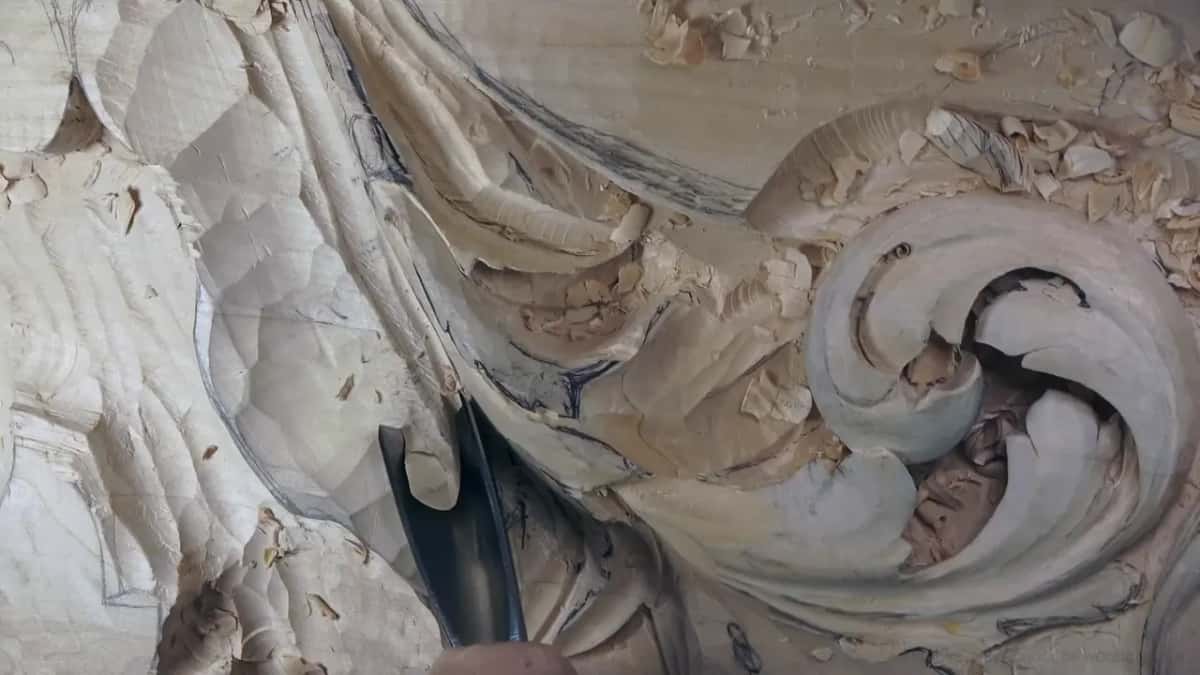
What happens when a repeat fights the design?
Your eye gets pulled away from the main movement. Right before I talked about the columns, I stopped myself from adding more in one direction, because too much movement that way would distract from the overall movement. I still wanted it logical, and here logical meant one part going underneath the other.
Width can do the same damage. For the second flip I kept the end narrow and let it shrink, because too wide just isn't going to look nice. Depth does it too. I can't go too deep, or I lose the overall movement again. I know I repeat myself, but it is what it is.
A crowded design gets fixed by taking mass away, and a furniture panel of mine shows how that works.
Is there room for this idea on your bench?
Do you have a favorite shape in old carving, a curl or a leaf you keep coming back to? Could it turn up twice on one piece, once full size and once a little smaller? Then give it a second home, and let it bend to fit.

Workshop 40 comes right before this one and workshop 42 right after, and part 4 runs on through workshop 49. Part 3 covers workshops 26 through 37 in the same room, and the flip itself has its own page back in workshop 16. The tuition gives you access to every one of them.
How it's done
- Carve the first version far enough to judge. Get it to where you can see how it turns, flips and hollows before you start a second one.
- Choose a second home. Another part of the same piece works. Here it was the next part along, then the far side.
- Outline before any waste comes out. Draw the new version with a #11 and slide its points until it follows the movement of that side.
- Clear wood with large tools. A small gouge takes forever on a big area.
- Hollow it, then blend. Make the concave the way you made the first one, then blend with a #3 and keep the one ridge that belongs to the movement.
- Save the deep undercut. Go under a little now, and leave the deepest work and the strongest separations for later.
Frequently asked questions
What is an example of repetition in design?
A Venetian ceiling from my own bench is a good one. A leaf section turns and flips under its neighbor, and I carved that idea again on the opposite side. Columns meant for the same job will take it up once more, a little smaller.
Are repetition and rhythm the same law?
My teacher in Russia named them as two separate laws, next to space and understanding the tools. In workshop 41 I talked about repetition by name, because one idea on the ceiling had to come back somewhere else on the job.
Should a repeated shape be an exact copy?
Close is plenty. The columns will get a smaller version, and on the far side of this ceiling I shifted one point a long way over, so the new version followed the movement on that side. A perfect copy was never my aim.
What to carve next