
Alexander Grabovetskiy, woodcarver, School of Woodcarving · Published 2020
How do you decide on a cut when you are not sure it will look right?
Quick answer: Deciding an uncertain cut is mostly a matter of keeping your options open. Try the idea lightly first, remove less than you think you need, and check the shape from another angle before going deep. If a favorite detail fights the leaf, give it up, and make the final call yourself.
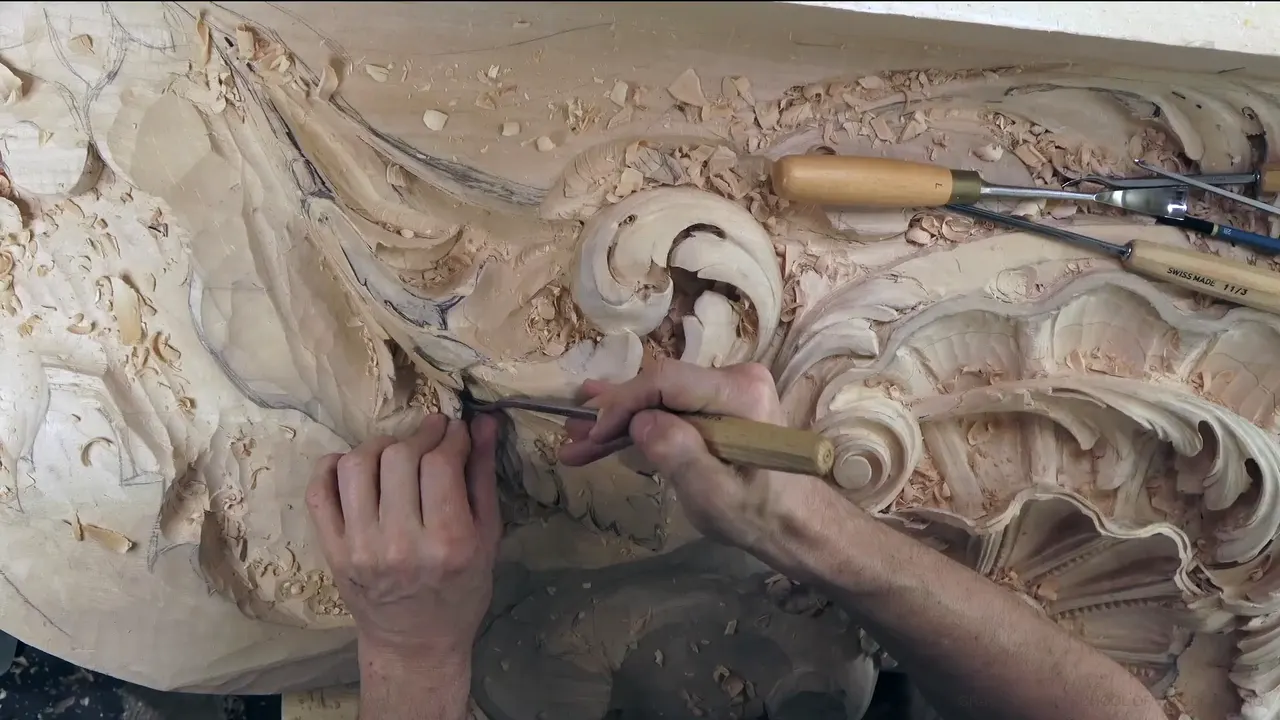
Deciding a cut you are unsure of means picking the move you can still take back. On a relief leaf that is a light test chop, a little less wood than your eye asks for, and one more look from another angle before the gouge goes in deep. Those are the relief carving tips I leaned on all through workshop 42 of the Venice room, a ceiling commission for a client.
Have you ever stood over something you were making, tool in hand, and not known if the next move would help it? Has a shape you liked up close ever looked wrong from a few steps back? Then take the smaller move first. Every habit below came off that one board, in the twelve parts of a single workshop.
Six habits for a pass that could go either way
Chop the idea in lightly before you commit to it.
Take less than you want.
When you catch yourself getting carried away, stop and leave the spot for now.
Walk around it and look again.
If you're stuck on one half of a leaf, see what the other half already does.
Let the leaf beat a detail you love, and then make the call yourself.

Is it normal to doubt yourself after years at the bench?
For me it is, and workshop 42 caught it on camera. Partway through part 8 I asked out loud whether I was doing the right thing. I hope so, I said, and went back to work.
I've carved for over forty years, and the question still came. Part 7 had it too. While I was laying out a small separation, something didn't make sense to me, and a moment later it did. I even said sorry for saying let me think, then told you the plain truth. I was thinking, and that's why I was taking time.

What can one light chop tell you before you commit?
A light chop lets you see the idea on the wood before you go deep. Early in the workshop I had a really interesting movement in front of me, and no plan yet for it. It was supposed to run down, I didn't want it too narrow, and maybe it had to move a little farther one way.
So I took the skew and chopped it down, just to see if it would look good or not. Have to be careful, I said. Then I looked, liked it, and said it gave me the idea I was after.
That one chop told me two things. The part had to stay wide, and a number 11 could take care of the rest.
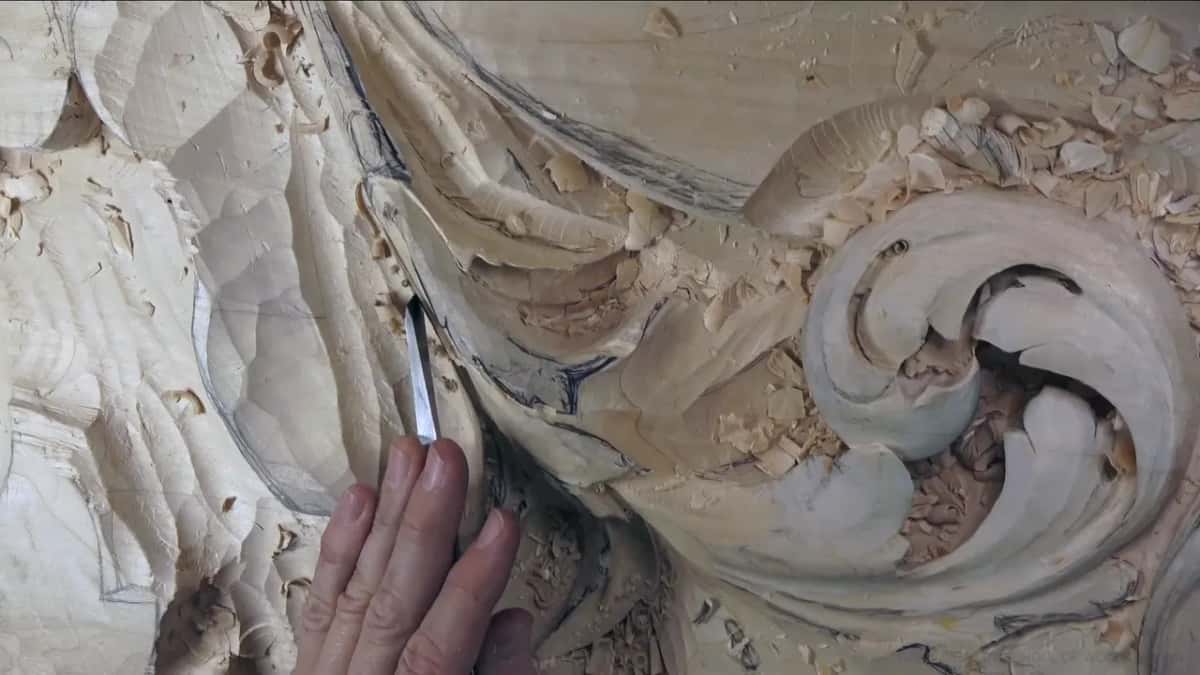
In part 1 I had reshaped a skew, thinner from both sides, and told you it was more helpful to me that way. See? Just like butter. It's trial and error, kept small enough that one try costs you a sliver. More on tools like this one lives in my course on carving tools.
Which move do you make when two both look right?
I take the smaller one, the one I can still undo. Later on I had just cleaned up a really interesting opening with a 2 mm (5/64 in) number 11, and it looked nice and clean. There was room to take it further, so I asked the question out loud, should I or shouldn't I.
I doubted I should. A millimeter (0.04 in) could still come off later, deeper right there, and it would help to come at it from the right positions every time.

So I left it, at least for now. Get carried away, I told you, and you make a mess. Once, going deeper than I needed, I made a piece loose, and though I said it was strong, I could feel it move.
The same brake came on later, while I took a hump off with the skew. I didn't want to make a mistake and remove too much too early. All I needed was a little bit.
Right at the start I put both sides of it in one breath. I don't want it too thin, I said, but I don't want to leave what I don't have to leave either.
One area stayed plainer for a different reason. Most of it will be covered with flowers, I said, so I didn't need to develop it much, and I could, but I really didn't need to.
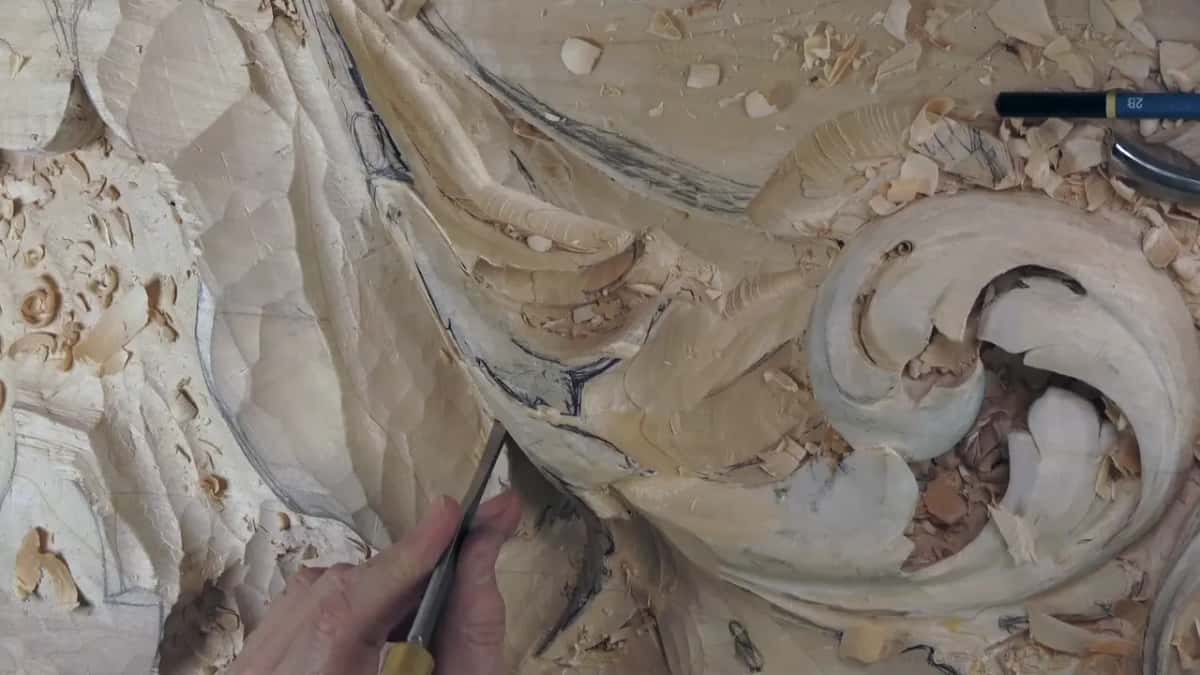
I even have a name for a shape that's close but not done, and in part 9 I called it semi-final form. And most steps offer two or three honest ways, as I said in workshop 36, so picking the smaller one is how I choose between them when I can't see the winner.
When should you stop and think instead of carving?
Stop the moment something looks off and you can't yet say why. One movement ran down, down, down and inside, and I wondered out loud whether it would make sense at all. I looked again, and yes, it did.
Two small shapes near the end looked wrong to me until I gave them a second look. They go up, I said, and repeat that other part, so maybe it makes sense.
A different kind of pause came early. Maybe I was doing it too quick, I said, and maybe I just needed to relieve the area first and get the undercut in, which would be the proper way.
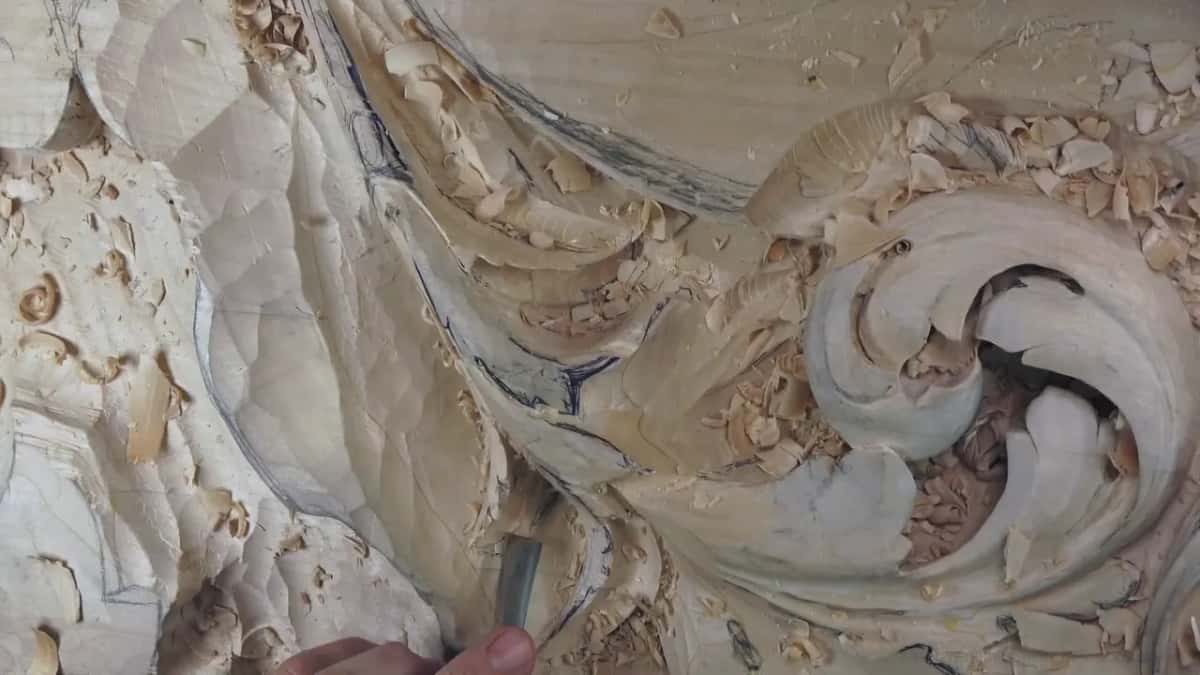
Each pause kept the gouge out of the wood while the decision was still open. What a real-time carving video keeps is exactly these minutes, the ones a short clip would cut.
Does it help to name what you don't want first?
In workshop 42 I did it out loud, over and over. I ruled out a lobe ending in too sharp a point, because I still wanted to see some curliness there. Then I decided how it would end.
Along one row the points had to change. One was really pointy, the next less pointy, and the last one absolutely no pointy, like a transition, I said.
Another time it was the overall feel of a movement, seen from where I stood, that I wanted to keep. And once it was a concave that came out too small. A number 7 made it, I said I should give it a little bigger, and a number 8 did. A convex was possible there too, but a concave was probably going to look better.
Why give up a detail you love?
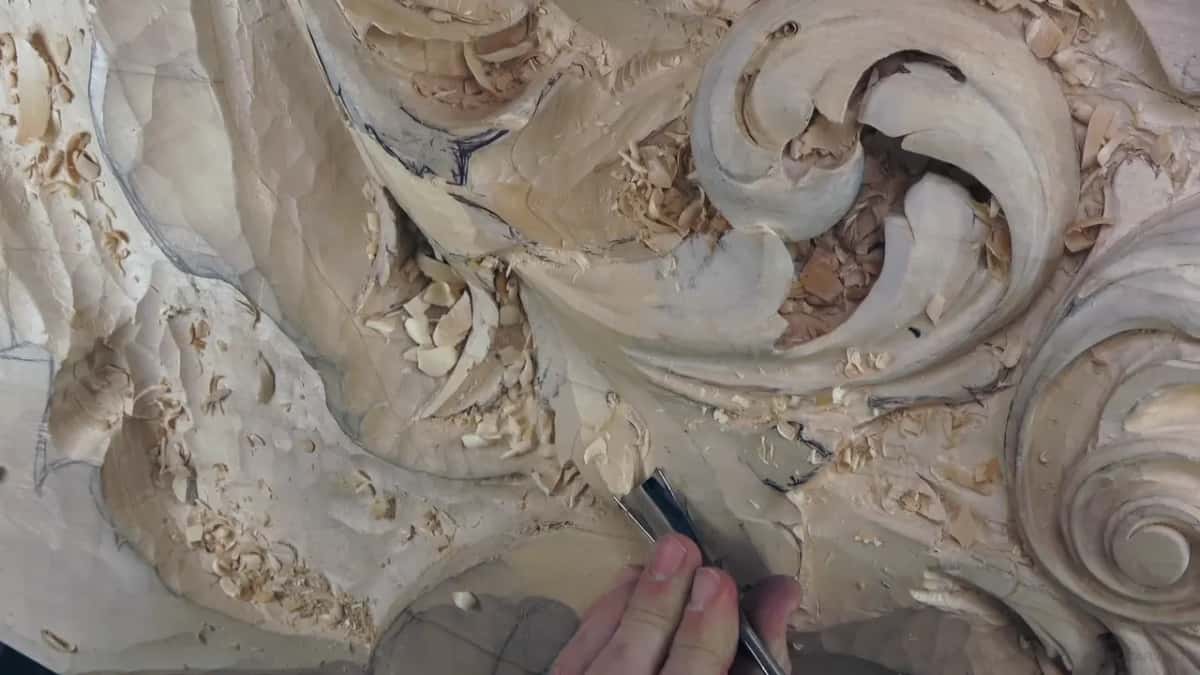
The leaf has to work first, and sometimes the part you love is the part in the way. I loved the idea of a curl in one spot. I also said I had to be more logical about how it was going to work, so that spot became part of the next movement, and a few separations nearby still gave me enough curls.
Near the end a convex asked the same question. I hate to lose that convex, I said, but it won't look right if I don't do it. Later in that part I reached for a back bent, because I still wanted a little convex there.
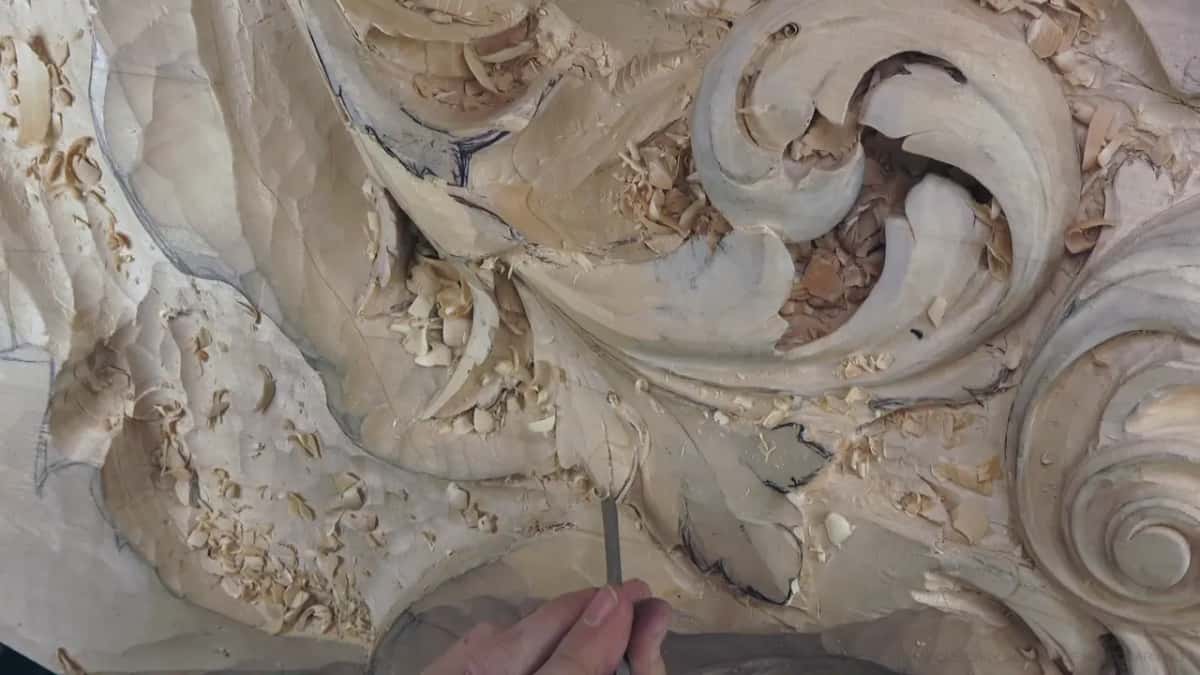
The middle line argued with me too. I could see it, only not the way I wanted. Everything on that acanthus lobe is supposed to go to the middle, so I twisted the line and chopped out a section with a one inch (25 mm) number 5.
Some calls take a second. One bit got a single look, and I said that is not really nice movement, and chopped it.
How can the other side of the leaf settle a doubt?
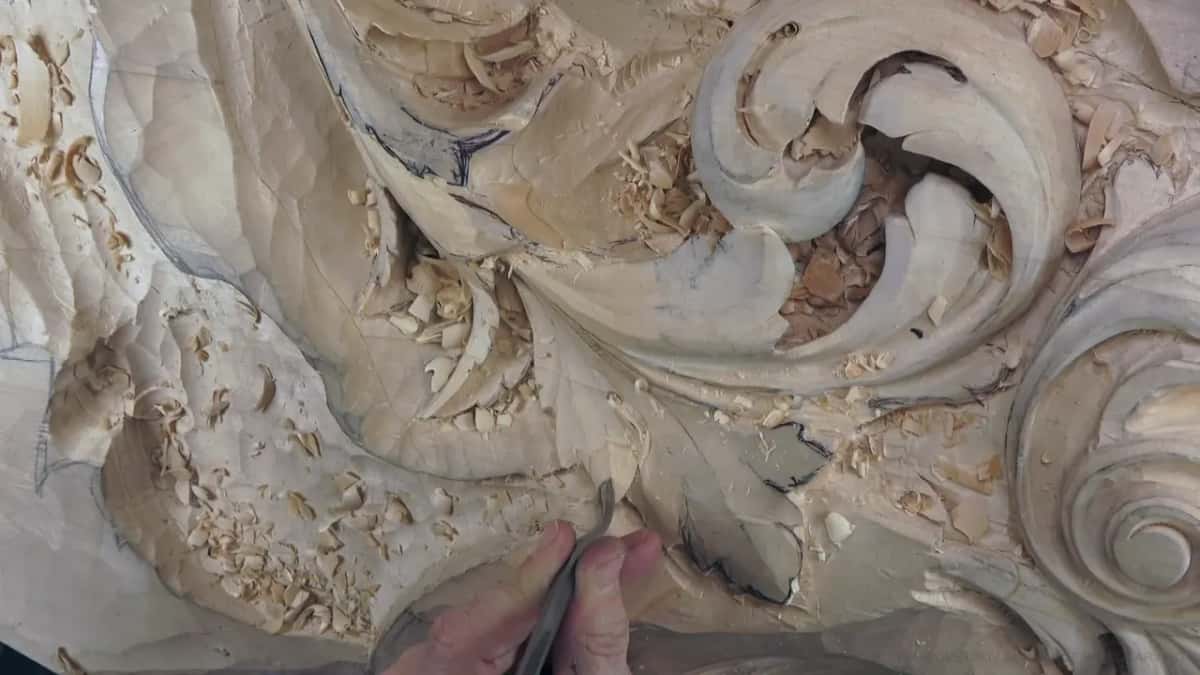
Look across the leaf, because you may have answered the question there already. Over one spot I weighed one idea and then another, and saw I could do exactly what I had done on the other side. Maybe it's going to be better, I said.
A separation works the same way. With one in place, I said it would repeat on the other side, somewhere right about there.
Here is each doubt from this workshop, in the order it came up.
| The doubt itself | What I said about it at the bench | My move right after that |
|---|---|---|
| Too narrow here | I didn't want that part going too narrow | Chopped it with the skew |
| Go deeper now | I doubt I should, it can come later | Left it there for now |
| Which way here | Maybe the same as the other side works | Weighed the other side's idea |
| Keep the curl | I love it, but it must be logical | Separations still gave enough curls |
| Right or wrong | Only me who knows, I'm the one designing | Kept carving and hoped so |
| Glue or leave | Left alone it still looks good, I said | Glued the piece back in |
| Lose the convex | I hate to lose it, but it's needed | Reached for a back bent |
What do you do when the side view says no?
Believe it, and fix the shape before you go on. Early on I thought I could make one part even more beautiful from that angle. That side was a little too bulky, so I made one part tinier and took another lower, and said I thought it would look better.
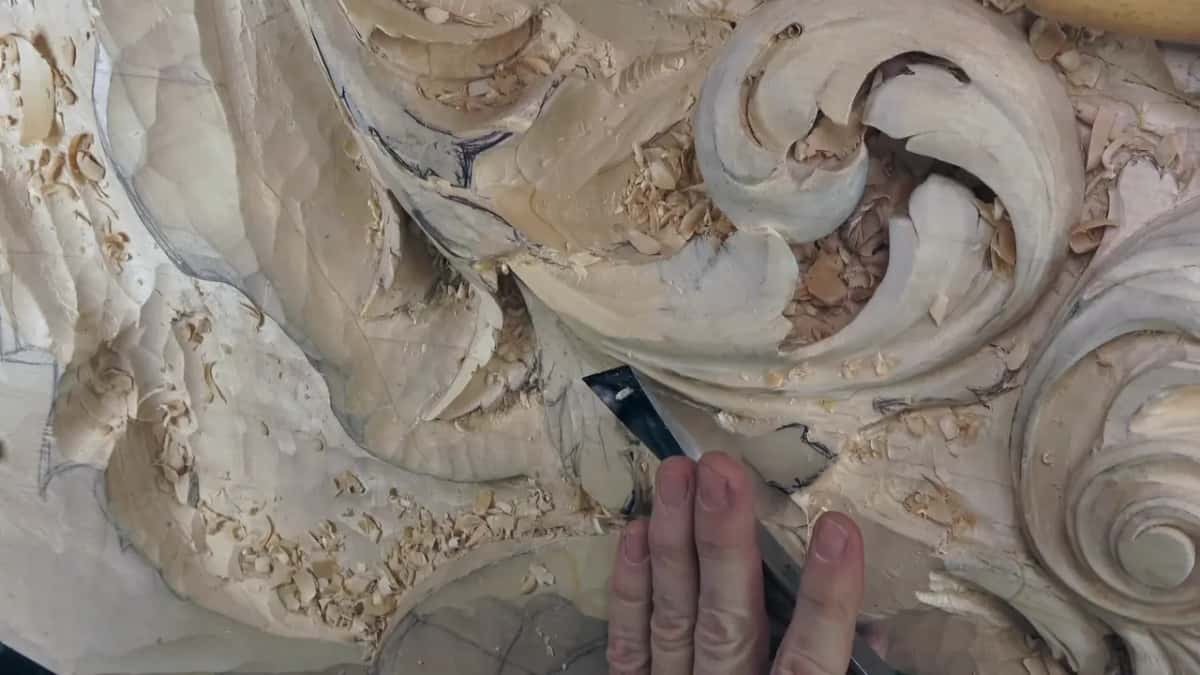
A side view also showed me a little hump that didn't look good to me. I'm looking from the side view, I told the camera, so I see what you probably don't see. Later I took a hump off with a skew chisel.
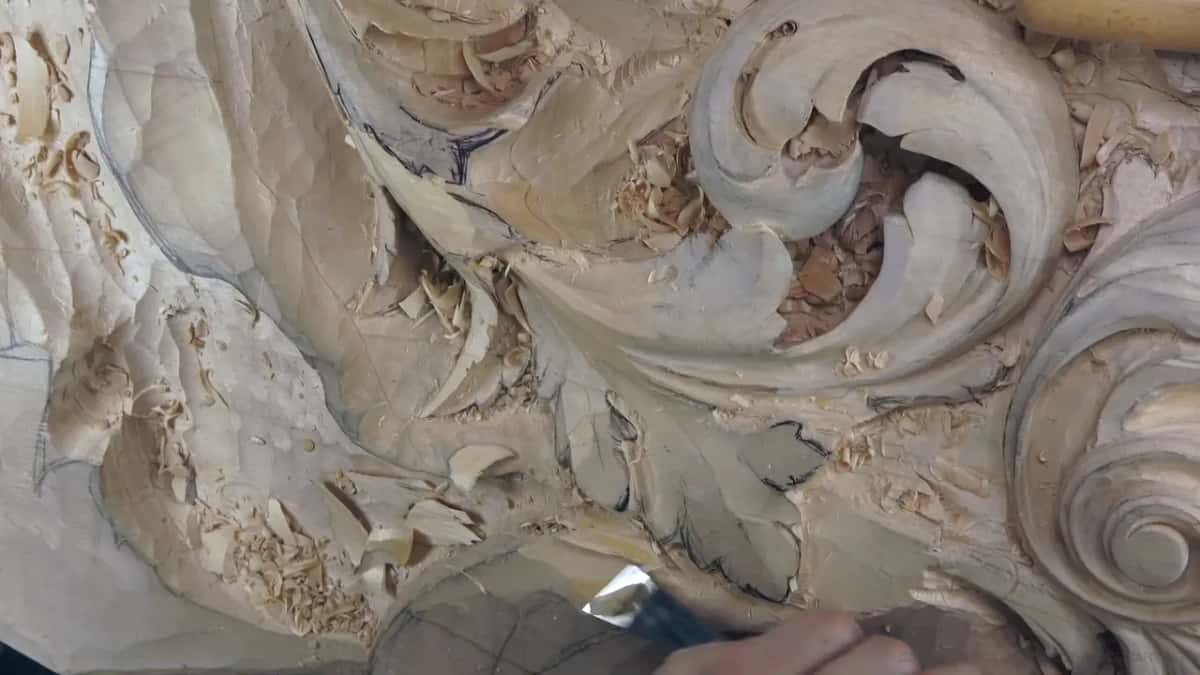
Even an eye moved. I said it went probably right here, then, well, actually, no, that would be the right one, and I started it with a number 11. Where an eye goes is a judgment of its own, and workshop 19 covers it.
The plainest case of all came late. A shape could go this way or that way, maybe yes, maybe no, and I knocked it down a little anyway.
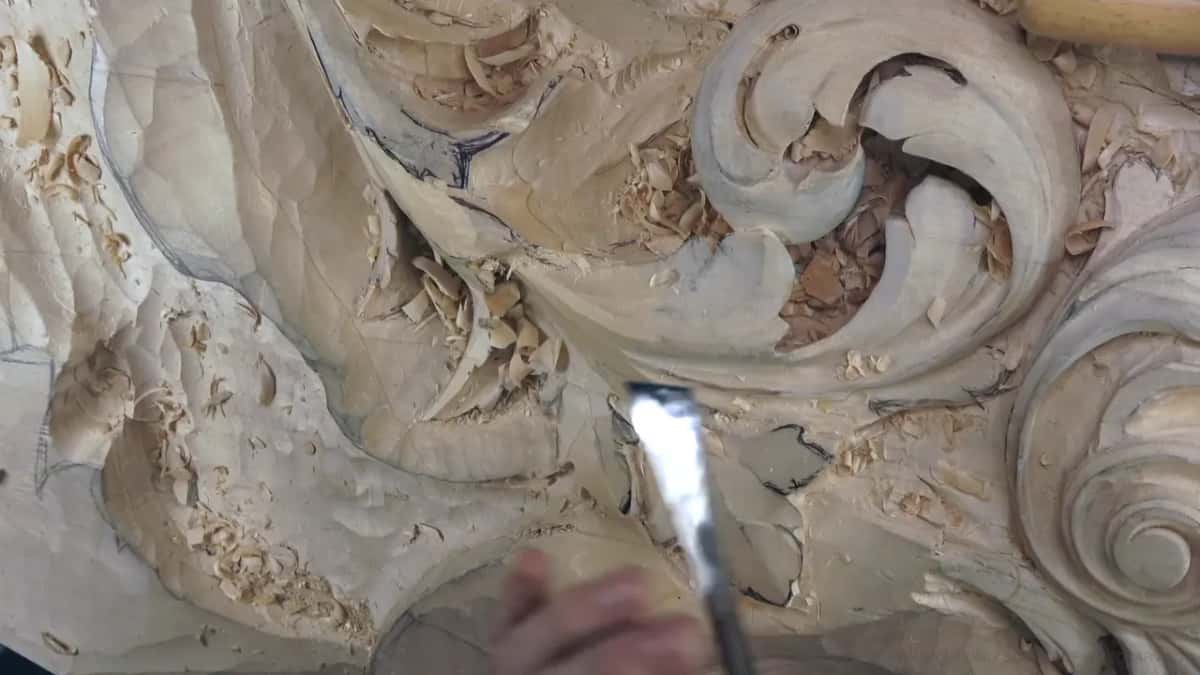
Who decides if a call was right?
The carver does, and on this board that was me. It's probably only me who knows if it's right or not, I said, because I'm the one designing it and making the decision how it's going to look. I had told you earlier that if you don't agree with me, that's okay too.
One point I wasn't sure about. I kind of loved it, so I left it like that. I was glad I went with that detail, because a simple acanthus probably would fly, but it wouldn't give me the feel of satisfaction.
Then something near a separation went a way I didn't like, and I said I would have to glue it. In the next part I weighed it once more. I could leave it and just work my way in, and it would still look good, but with that part back the leaf would look more three-dimensional, so I glued it back.
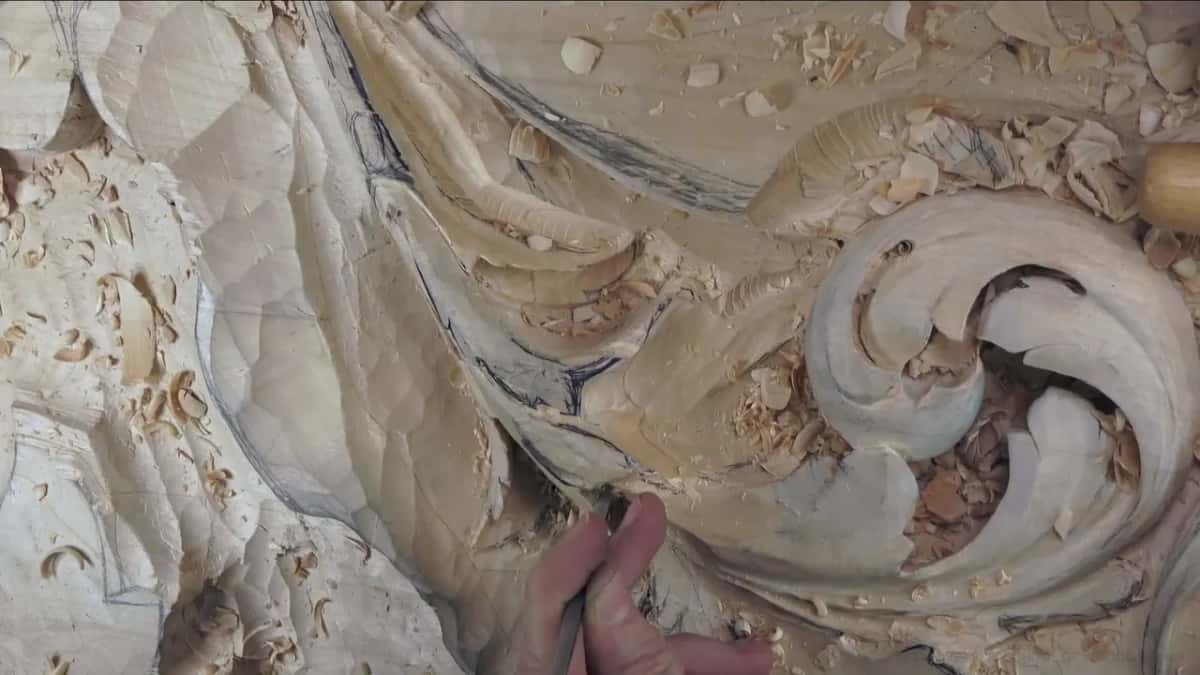
The last doubt of the workshop came in part 12, taking one leaf a little bit underneath with a really tiny number 11. I'm not sure if I should or not, I said. A moment later I decided it gave a more interesting look. It does. The laws behind calls like these sit in my design course.
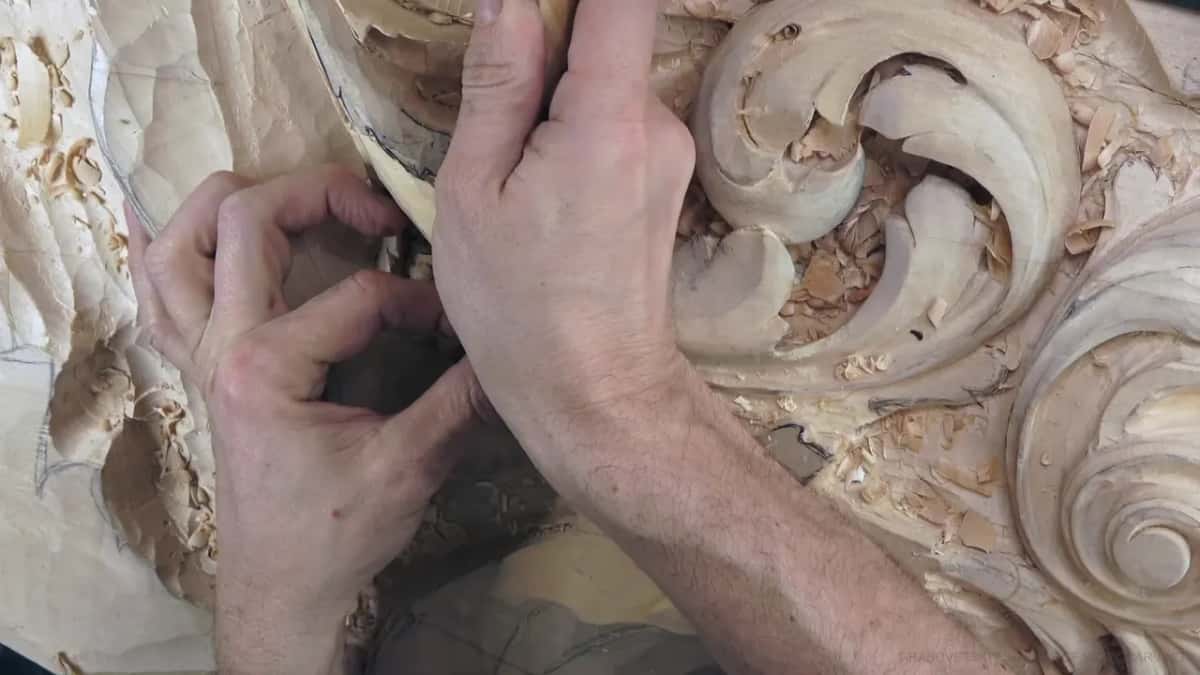
Relief carving techniques that make a doubtful pass safer
Keep the edges sharp. My number 9 needed sharpening in the middle of a plug cut, so I stopped and sharpened it, and after that the full rotation went through. Another tool felt like it needed a touch later, and once it was sharp it was much better.
I don't film my sharpening, because I'd have to spend time moving the camera, and I asked you to forgive me for that. My sharpening course shows the part I leave out here. Push too hard, I said, and you break the edge, and that's no bueno.
Step down as the space closes. Across the first two parts a 7 mm (9/32 in) spoon gouge was too big, then 5 mm (3/16 in), then 4 mm (5/32 in), so I went straight to 2 mm (5/64 in).
Lock in what you like. I outlined a set of separations right away once, because I didn't want to lose them, and I thought it was really nice, what I had just done. A division went in right away too, before I lost the overall picture.

Clear the marks so you can see. Too many pencil marks bug my eyes, I said, and I cleaned the mess off.
And when the tool is the doubt, change it. At one point I said, you know what, I should use a back bent, that's the right tool for the job.
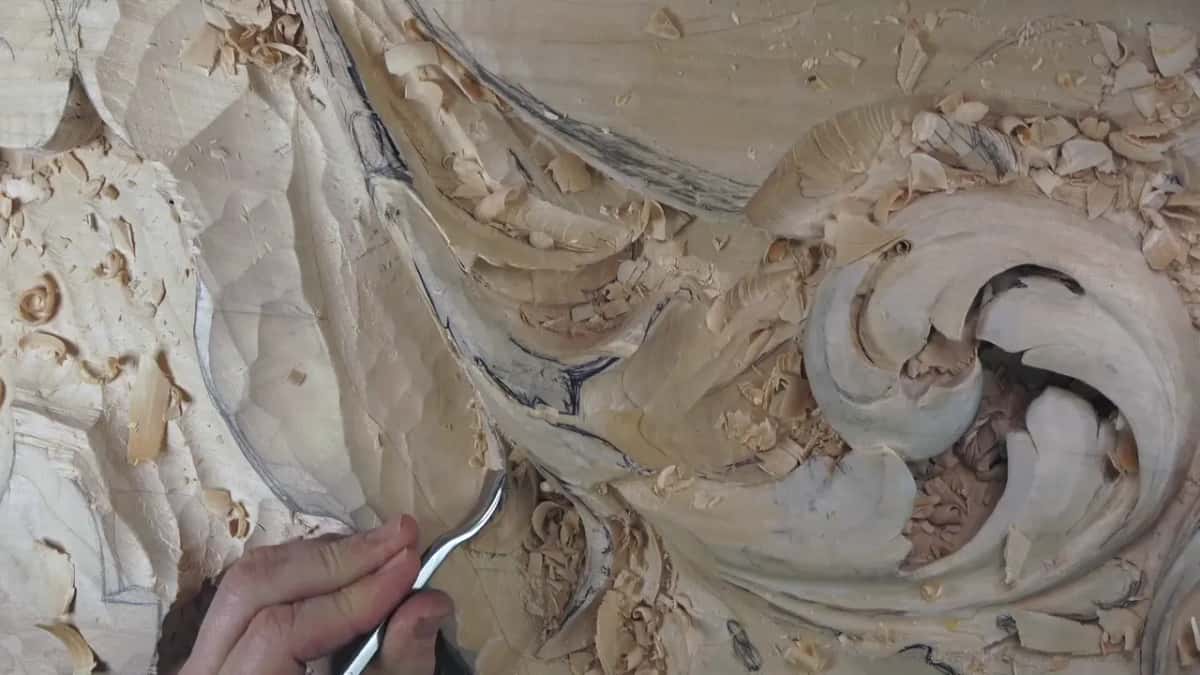
Where can you watch these calls happen?
Workshop 42 holds every one of them, in twelve parts on one lime board. It sits between workshop 41 and workshop 43 in the Part 4 course, and part 3 carries the same board through workshops 26 through 37. The plan for this room changed in workshop 2 as well.
Somewhere in part 9 I told you we were going to make a deep shadow, then caught myself. I shouldn't say we, I said. Me and a tool.
If you'd like to watch me make each of these calls as it happens, the tuition opens every workshop in the room.
How it's done
- Take your time. When a line stops making sense, think before the next pass. In part 7 I said I was taking time for exactly that.
- Try the skew first. Chop the line in with it and see whether the shape looks good before a gouge goes deeper.
- Pick the option you can undo. Leave some wood on for a second pass later.
- Check the profile. Seen side on, a leaf shows a hump or a bulky spot that the front hides.
- Borrow from the other half of the leaf when you're stuck. If one half already works, repeat it.
- Make the call. Give up a favorite detail when it fights the whole leaf, then carry on with the next small pass.
Frequently asked questions
What should you do if a carving looks wrong from the side?
Take the side view seriously and change the shape before going on. On a Venice ceiling board, a look side on showed me a little hump I did not want to see, and I fixed that movement right there. I told the camera that from where I was looking, I could see what you probably don't see.
Is it normal to feel unsure halfway through a carving?
Very normal, and it still happens to me. After more than forty years of carving, I still asked the camera on this board whether I was doing the right thing, said I hoped so, and kept going with the next small pass.
Should you switch tools when a cut feels wrong?
Switch the moment the tool itself is the doubt. A straight number 7 wasn't going to work in one hollow of this ceiling board, so a spoon gouge took over. For a nicer roundness in another spot, I said a back bent was the right tool.
What to carve next