
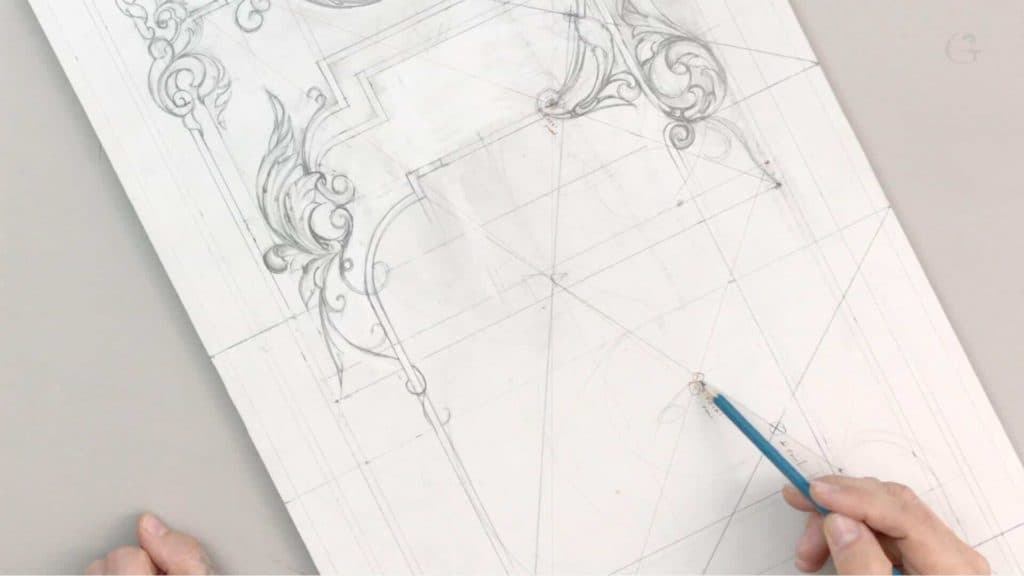
Alexander Grabovetskiy, woodcarver, School of Woodcarving · Published 2018
What is a second focal point in ornament design?
Quick answer: A second focal point is the counterweight to the main one. It is the anti-hero of the design, or the second hero of the story, and on this panel it lives low down, where the eye lands once the top has finished with it. Give it real weight, never equal weight.
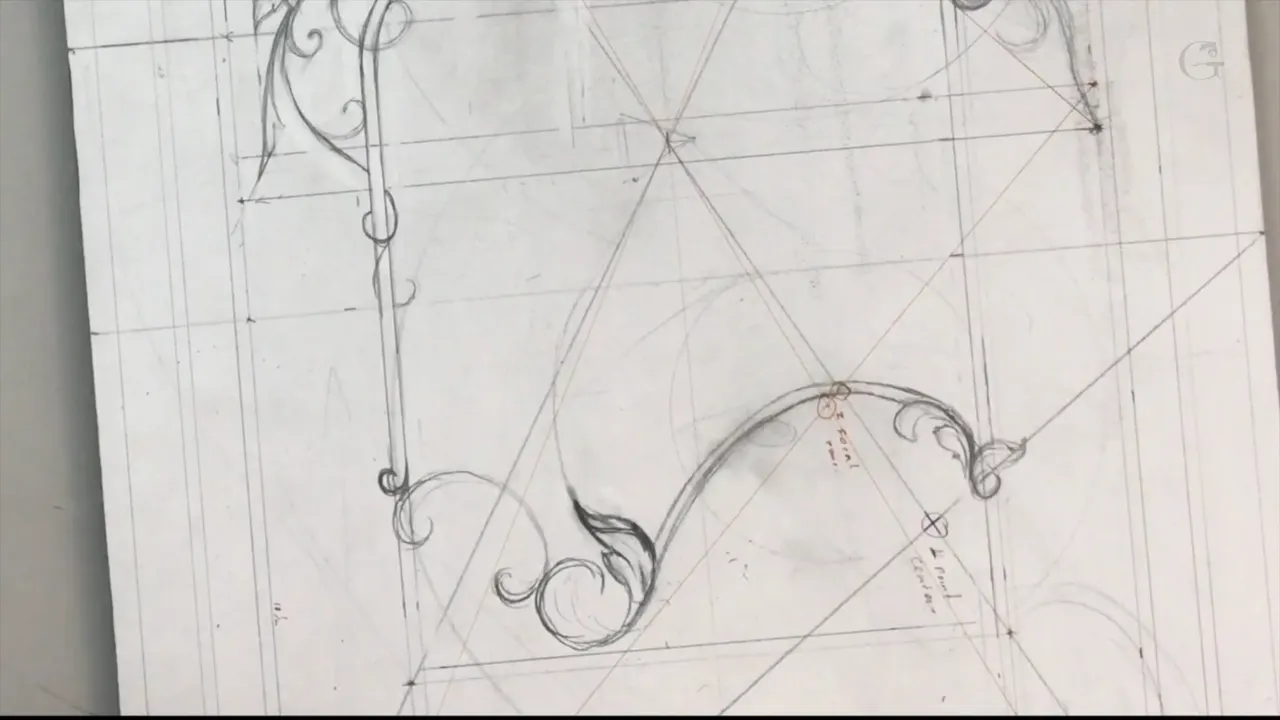
A panel needs somewhere for the eye to go after the main event. I call that place the anti-hero, or the second hero of the story, and on this board it lives down at the foot. It has to carry real weight. It must never carry equal weight, because then the panel has two masters and obeys neither.
Have you ever built a beautiful top half and then stared at the lower half with no idea what belongs there? Or filled the lower area with more of the same and watched the whole composition go monotonous? The bottom of a panel is a different job from the top, and it wants a different answer.
Today the bottom gets designed. A counter movement goes in, the side moldings get matched and then hidden, an acanthus lands on a circle I drew weeks ago, and one detail from the upper half travels along a strip of paper and arrives a couple of millimetres out. I keep it anyway.

What the lower half of this board has to do
- Carry weight without competing. Second, not equal.
- Repeat a movement that already exists somewhere above it, so the two halves are related rather than merely adjacent.
- Aim at the construction circles, which nobody will ever see.
- Leave space empty on purpose. Flowers are coming later, and filling it twice is filling it worse.
- Hide the join where the side molding arrives, usually under a leaf.
- Be wrong a few times first. Several of my returns went in and came straight back out.
Where does the counterweight belong?
Opposite the first, and further along the route your eye already travels. My main event sits high, so its counterweight goes low. Put both in the same half and they fight; separate them and the eye has a route with a beginning and an end.

What surprises people is how the lower one gets its weight. Not from more ornament. From negative space, which is the thing I said I wanted attention drawn to down here. A shape surrounded by air pulls harder than a shape surrounded by more shapes.
What does anti-hero mean here?
Counterweight, and the borrowed word earns its place. A story with only one character in it is a lecture, and a lecture is a different animal. The second character exists to push back, to be interesting without winning, and to make the first one legible by contrast. Ornament works identically and almost nobody teaches it that way.

Practically it means the lower movement repeats the upper one while running counter to it. Same vocabulary, opposite direction. You can see the idea in any good Baroque cartouche, where the bottom scroll answers the top scroll instead of copying it.
Here is what changes between the two ends of a panel.
| The role | Where it sits on my board | How much weight | What it is allowed to do |
|---|---|---|---|
| Main focal point | High up, on the golden section | The heaviest | Hold the flowers and the deepest relief |
| The anti-hero | Low down, answering the top | Second only | Run counter, and pull using empty space |
| Side moldings | Both edges, the full height | Kept quiet | Arrive and then vanish under a leaf |
| Filler work | Wherever a gap opens up later on | The least | Close a space and claim nothing |
| Construction lines | Everywhere, underneath the whole thing | No weight | Be aimed at and never once seen |
How do you aim at a circle drawn weeks ago?
Keep the construction on the board. Those compass circles went down several lessons ago and they are still faintly there. Which is why I could say on camera that I know it is invisible, but there is a circle we drew off that point, and I want to hit it.

This is the payoff for the geometry laid out in the lesson on root rectangles. Weeks later, in a completely different corner of the panel, a new element lands on a line that was drawn before the design existed, and the two agree without any effort from me.
Erase your construction early and every later decision becomes a guess. The composition then holds together by luck, and luck runs out somewhere around the third corner.
Can you copy a detail from one end to the other?
Take a strip of paper, mark the size off the original, carry it to the far end and mark it again. The whole technique is that simple. No measuring, no arithmetic, and it works on any panel too big to span by hand.

Mine came out about 3/32 of an inch, a shade over 2 mm, off the line I was aiming at. The repeated detail is therefore slightly wider than the original. I looked at it, decided it was not a problem, and moved on, which is a judgement rather than sloppiness.

A repeat that is exact reads mechanical. A repeat that is near reads alive. The tolerance you can accept depends on how far apart the two live, and at opposite ends of a panel nobody on earth is going to catch 2 mm. The same forgiveness does not apply to a pair sitting side by side, which is the lesson of the curl that had to shrink.
What is a sketch line actually worth?
Almost nothing on its own, and it still has to be good. The first line I put down here is only a sketch, I said as much while drawing it, and I also said I have to be as close as possible even so. Those two statements are not in conflict.

A sketch line is a proposal. It gets refined, thickened, moved or deleted, and when the gouge finally arrives I pay far more attention to the detail than any pencil ever did. But a sloppy proposal produces a sloppy refinement, because you end up correcting the line instead of developing the idea.
When a curve refuses to come true by hand I reach for the circle template and find the hole nearest the sweep I want. One pass and the line is honest. No more cheating than a straightedge is cheating, and I use one of those too.

Why keep saying it is only your opinion?
Ornament has no referee. I said plainly that some of you are maybe not going to agree with me, and that it is okay, and that I will survive. None of that is false modesty. There is no authority you can appeal to about whether a scroll should turn left.
What there is instead is a set of rules that explain why something feels wrong, which is a different animal from a rule that tells you what to draw. The line of beauty, that S shape Hogarth argued for in 1753, is the oldest example. It describes a preference. It does not issue instructions.

So I tried several returns in this session and threw them away, and at one point I put a mark in the wrong spot entirely and had to measure again from a different point. A working method is what you are watching, not a proof.

Is a panel like this beyond a beginner?
Harder than a simple leaf, certainly, and still not out of reach. I know this board already looks complicated to some of you, and I will say what I said on the recording: believe me, it is going to be a lot of fun to carve. Difficulty and misery are not the same thing.

What I am trying to show is that you are actually able to do something more complicated, the kind of thing they did in history. A simple flower teaches you one cut repeated. A panel like this teaches you how decisions depend on each other, and that knowledge transfers to every piece you make afterwards.
I am always on the side of the challenge. Doing something that has not been done before is worth the discomfort, and you will feel good about it in a way that a safe project never delivers. Look at what Grinling Gibbons was attempting as a young man and the argument makes itself.
Which is why the whole drawing sits in this course rather than a summary of it. You are welcome to carve something simpler than what you see here. Watching a hard panel get designed still changes how you approach an easy one.
When is the cheapest time to change your mind?
Today, on paper, before anything is committed. I want to make as many changes at the beginning as I possibly can, thinking through the whole process and redefining everything while the only cost is an eraser.

Count what a change costs at each stage. On the drawing it costs seconds. After the outline is carved in it costs hours. Once the ground is down to depth it costs a new board, because you cannot put lime back.
That arithmetic is why this course shows the drawing at all. I did it on purpose, because I do not want to only show how I carve. I want to show how I think, and the thinking is where every expensive mistake gets avoided or made.

You can see the same habit in surviving workshop drawings. Go through a museum drawings collection and the sheets are covered in ghosts, second attempts, and pinholes where a detail was pricked through and moved. Those men were no more certain than we are. They were simply cheaper about it.
Why leave part of the panel empty?
Flowers are coming. That stretch of board is going to serve as negative for now, because I am still going to fill it with the flowers and the movements later, and filling it twice would mean erasing it once.

Planning an empty area is the hardest discipline in ornament. Most beginners never learn it, and on the day you draw them an unfinished panel and one with breathing room look the same. That stops being true the moment the acanthus goes in and one of them has nowhere to put it.

The side moldings get handled the same way. I bring them across to where they belong, then let a leaf sit over the arrival so the join never announces itself. A molding that visibly stops is a molding you will look at forever.
How far down does the repetition go?
All the way, at every scale I can manage. The baroque line gets repeated smaller. A volute in the middle answers the one further up. A small detail from one corner turns up in several more places before the session ends, each time at a different size.

The law of repetition is doing its real work there, and it is why I keep mentioning it. Repetition at one size is wallpaper. Repetition across sizes is what makes a Corinthian capital hold your attention for two thousand years, and it costs nothing but attention while drawing.

I love acanthus design, and the old shops incorporated a great deal of movement with it for exactly this reason: the leaf takes any size you give it and still reads as itself. Compare a Roman leaf with a modern one and the family resemblance survives every change of scale and century.
The board is not finished and I said so. One element is still too big, one return still bothers me, and the whole lower half is waiting on flowers. If you want the rest of it in order, the sequence sits in this design workshop, the flowers arrive in the next lesson, and the timber underneath all of it is the ordinary lime and basswood I use for everything. Everything here is taught the same way inside the school, and it ends up at the carving stage.

One more thing about the anti-hero before the flowers arrive. Its job is finished the moment your eye reaches it and turns back toward the top, and that turn is the thing to test. Cover the upper half with a sheet of paper and study the lower end alone. When that end reads as a complete little composition by itself, it is too strong and it will steal the panel. If it feels like it is waiting for something, it is doing exactly what I want. Mine is still waiting, and I said as much on the recording: one element is too big and one return still bothers me. That test costs nothing, and at this stage it is worth more than any rule, because a drawing cannot tell you how it will be looked at.
Related work sits in the lesson where a crowded corner came apart, and the same counterweight logic runs through any decent cartouche you will find on period furniture.
So: do you want a panel with one good half, or one that reads all the way down? Shall we carve?
How it's done
- Put it opposite the first. Place the counterweight at the far end of the route the eye already travels. Two heavy points in one half of a board will fight each other permanently.
- Give it air, not ornament. Weight down here comes from empty space around a shape rather than from piling more shapes in. Air pulls harder than incident does.
- Run it counter. Repeat the upper movement using the same vocabulary but send it the opposite way. Copying the top produces monotony; answering it produces a composition.
- Aim at the old construction. Keep the compass circles and diagonals on the board. A new element touching a line drawn weeks earlier agrees with the panel without any effort at all.
- Carry sizes on paper. Mark a detail on the edge of a paper strip, walk it along and mark again. No arithmetic, and it works on any panel too big to span by hand.
- Hide the joins. Bring the side moldings across and let a leaf sit over the arrival. A molding that visibly stops is something a viewer will look at forever.
- Leave the gaps you will need. Plan the empty areas now. Filling a space today and clearing it tomorrow for the flowers is work done twice and drawn worse the second time.
Frequently asked questions
Does every panel need two focal points?
Anything taller than it is wide usually does. Your eye reaches the lower end eventually, and arriving at nothing is what makes a well drawn top half feel unfinished.
How much weight should the lower one carry?
Clearly second. Cover the top half with paper and study the bottom alone. When it reads as a complete little composition it is too strong and will steal the board.
Why keep construction lines that never get carved?
Aiming. Weeks after they go down, a fresh element can meet one and the two agree instantly. Erase them early and every later decision turns into guesswork.
What to carve next