
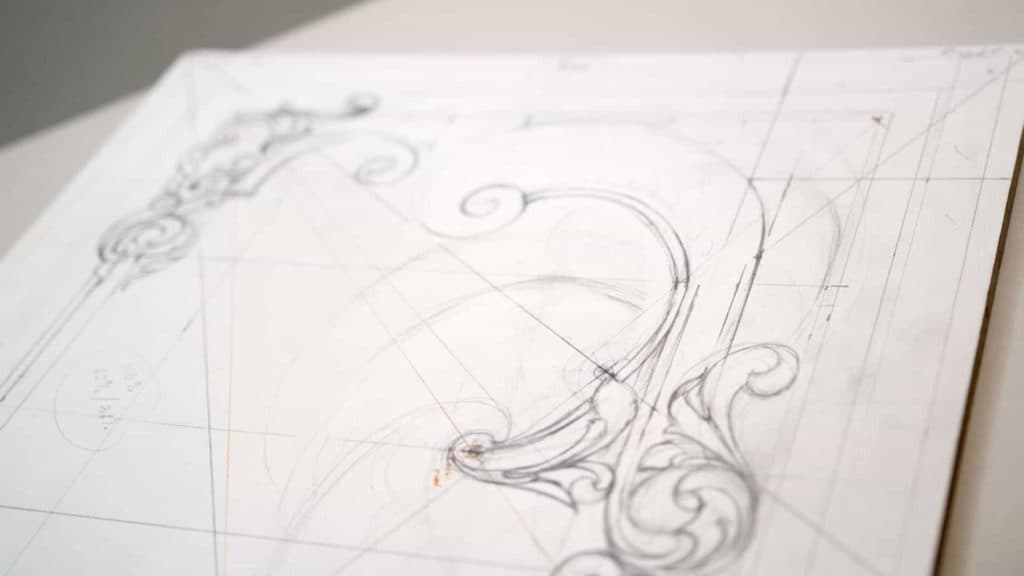
Alexander Grabovetskiy, woodcarver, School of Woodcarving · Published 2018
Which direction does the eye travel across a carved panel?
Quick answer: Reading direction on a carved panel follows the habit a viewer learned from books. Western eyes enter top left and run down to the right; Eastern eyes start in the opposite corner and travel the other way. The same diagonal therefore climbs for one person and falls for another.
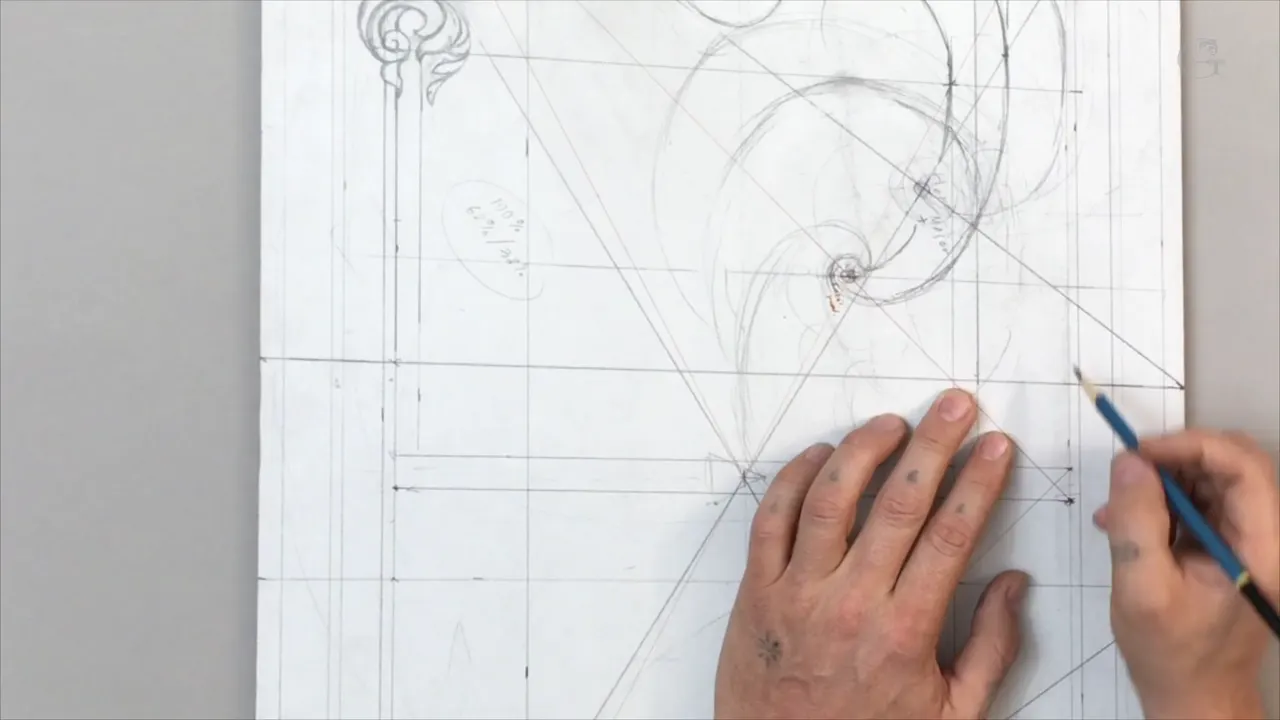
A carved panel is read in a direction, and the direction depends on who is looking. Western eyes come in at the top left corner and travel toward the lower right. Eastern eyes begin top right and run the opposite way. Rule a diagonal, put a car on it, and the same picture rolls downhill for one person and climbs for another.
Ever wondered why one composition feels like it is going somewhere and another one simply sits there doing nothing? Or put a beautiful detail in a corner and found that nobody noticed it? Where the movement starts decides it.
I begin every design at the upper left. Most of my students read left to right, so their eye lands there first. Then I spend the rest of the panel trying to make it work for the other half of the world too.

What decides how a panel is read
- Reading habit, not taste. A Western viewer travels from the upper left corner downward.
- An Eastern viewer starts upper right, so the same diagonal reverses its meaning completely.
- 62 against 38, or simply the 60/40 rule, places nearly everything on this board.
- A strip of paper measures better than a rule, because it carries a distance without naming a number.
- Layer one is drawn knowing most of it will be hidden.
- Real art is geometry before it is feeling, and the second half without the first gives you very little.
How can a drawing prove which way you read?
Take a blank sheet and draw a diagonal falling from the top left corner toward the bottom right. Put a small car on that line. Ask anyone with a Western reading habit which way the car is moving and they will tell you it is going downhill, because their eye entered at that corner and travelled with the slope.

Now rule the opposite diagonal, falling the other way, and put the same car on it. The identical shape on the identical slope now looks like it is climbing. Nothing about the drawing changed. The entry point changed.

Show both to someone who reads right to left and the answers swap over. Brains work that way, and we are not all the same. A composition that ignores this is guessing about half its audience.

Can one panel work for both directions?
Exactly what I am trying for here, and I am not certain anybody has tried it on a carved door panel before. I begin the movement in that left corner and run it down and across, which suits a Western eye and the habits behind it. Then, later in the design, I develop the return so the carving also reads from the opposite corner inward.
Confusing brains on purpose, if you like. Uniting two worlds, which is not a small ambition for a door panel. I grew up between Europe and Asia, so both readings feel natural to me and it seems a waste to serve only one of them.

Whether it fully works is for a viewer to say, not me. What I can tell you is that building the return costs almost nothing once the main movement is down, and a panel that reads both ways has twice as many ways of catching somebody. The previous lesson put the first ornament in that upper corner.

How does the 62 against 38 rule work?
The same golden proportion, stated as percentages so you can use it without arithmetic. Call any line 100 per cent. The point you want sits near 62 of that hundred, which leaves 38 on the other side. Round it to 60 and 40 and nothing on a carved panel will complain.
Counting six parts out of ten gives the same number again, and that is how I actually work. Divide by eye, count six, mark it. No calculator, no Fibonacci table taped to the bench.

| Way of saying it | What you actually do at the bench | When it suits |
|---|---|---|
| The decimal, 0.618 of the length | Multiply, then measure | Working from a drawing that already carries exact dimensions |
| Sixty two against thirty eight | Treat the line as a hundred and take a bit under two thirds of it | Explaining it to somebody |
| Six parts out of ten, counted by eye | Halve by eye, halve again, count | A pencil in hand and no rule anywhere near |
| Sixty forty | Roughly two thirds and move on | Small stuff nobody checks |
Why measure with a scrap of paper?
A distance matters more than a number here. I take a scrap of paper, mark the length I want on its edge, and carry it to the other side of the board. Nothing gets read off a scale, so there is no chance of writing down 11 3/8 and later using 11 5/8.

Speed comes into it as well. Carrying it on paper takes four seconds and is exact by definition, since you never converted it into anything. Cabinetmakers have used story sticks this way since long before Chippendale, for centuries for precisely that reason.
And it keeps you honest about what you are really doing. You are not building to a dimension. What you repeat, over and over in different places on the same board, is a relationship. Our border lesson works the same way.

Why draw a layer that will be hidden?
Layer one is the background movement, and a great deal of it disappears behind the ornament before this panel is finished. I draw it anyway, in full, and the reason is simple enough.

Everything should feel as though it grows from the focal point. Any stem vanishing behind a flower came from somewhere, and if you never drew that somewhere, the eye finds the gap. Not consciously. It just reads as decoration stuck on rather than a plant that grew.

So the clusters get built in depth: one layer on top, then a second behind it, then a third further back still. On 5 mm, 3/16 in, of relief that depth is mostly implied rather than carved, which makes the drawing underneath it carry even more weight. The carving stage is where it gets tested.

Is art really just geometry?
Real art is real math and real geometry, and that opinion costs me friends. Since the 1950s and 1960s the whole idea of art has been shrunk down to a kind of soul therapy. If it feels good it is good, draw whatever you feel, no need to know anything.
I ran into it directly. My youngest daughter wanted to be an artist, so we found her a teacher here in the United States, expecting composition rules and colour theory and the things a young artist is supposed to be handed. None of it arrived. Just feelings.
So there are fewer genuine pieces of art from the back half of the twentieth century than there used to be. Not none, and I am not saying none. Fewer, and you can feel the difference walking through any museum that hangs both centuries side by side. The craft under the feeling went missing, and you cannot get the result without it, any more than a musician gets Bach by feeling strongly about the piano.
Everything on this panel is an attempt to put that craft back where it belongs. Proportion, entry point, repetition, enclosure. Every one of those was standard equipment for a carver in the Gibbons century. Feeling comes after. Our beginner course starts at the same place, and if you want the whole method rather than one lesson, come and work through it with us.
Should a movement run narrow to wide?
Because nothing alive keeps one width along its whole length. Every stem leaves its root thin and thickens on the way. Leaves open from a point. A volute tightens as it coils. Give a movement one constant width and you have drawn a pipe.
So each of my main movements starts narrow and opens out. Then I repeat that same idea somewhere else on the board at a bigger scale, which gives the panel a family resemblance without repeating a shape outright.
Choosing the bigger scale is where the geometry comes back. Rather than invent a width, I take a measurement that already exists on the board, the widest point of the smaller movement, and use it for the larger one. It came out close to an intersection I had drawn hours earlier. Not perfect. Really close, which is how you know the underlying proportions are doing their job rather than my taste doing it.
Geometrical movement is what I mean by that. Nothing stiff about it, and nothing mechanical either. Simply a curve whose dimensions were borrowed from somewhere honest rather than from my mood that afternoon. Every leaf in our Roman acanthus course is built that way.

Why is a straight line the enemy here?
It does not feel organic, and I will rub one out the moment I notice it. Somewhere in this lesson I put down a connection between two points and it came out too straight, and even though it hit both targets I could not leave it there.
The trouble is that a straight run reads as manufactured. Nothing in a Baroque panel or on any growing plant takes the shortest path between two points. A line that bows even slightly on its way is read by the eye as having grown there, and the difference between the two versions is often less than a pencil width.

So the movement still has to arrive at its point. It just has to get there the long way, and finding that route is most of what the eraser is for. Please forgive me while I do it on camera; I am working out what I want to see, and making it move in the right directions organically.
One honest admission. Almost impossible for you to see what I see, because the finished picture is already in my head and I cannot get it out of there onto the board in one go. That gap is why this takes four lessons and not one, and it is the same gap our tools course and sharpening course close on the practical side.

What is the enclosure rule?
An ornament needs something holding it in. The enclosure is where the main energy of the composition is contained, and on this panel it runs inside the borders, around the inner focal point that the eye actually settles on, inside the moldings drawn earlier.
Two focal points are in play by now. One of them is the hero of the whole board. The inner one is the center of the inside perimeter, and that is the one a viewer's eye really lands on, because the bands are framing it. Energy spirals off both of them, outward and back again.
What comes out of the pencil after that is none of those things. There is energy in it, and some feel of three dimensions, which I can point at on a drawing far more easily than I can define. The acanthus work in our Corinthian course is built the same way, and choosing a board that can hold it is covered in our wood guide.
Where does the flower cluster go?
On the hero side, running toward the line I set as its boundary. The main cluster of flowers lands in that area and then reaches across to the far line, which stops it before it sprawls into the opposite corner.
Inside all of this I am also building a central panel of its own, a smaller enclosed field within the borders. Another boundary line sets its edge, and the space between those two lines then wants filling, usually with a return movement that comes back on itself rather than a new shape.
Most of that return ends up buried. It still gets drawn, because a viewer should be able to feel the movement even where the eye cannot follow it, and because the flowers need something underneath them to sit on. Our rosette course deals with flower clusters on their own.

None of that makes the drawing quicker. What it does is make the drawing right, which is a different thing entirely, and on a panel that will outlive everyone in this conversation it is the only measure that matters at all.
A lot of erasing and redrawing goes into this, and it goes on until the thing looks the way it is supposed to look. That is the usual process for me, and it has not changed in forty years of doing it. Main movements first, then details, and a bench covered in rubber crumbs somewhere in between the two.
How it's done
- Decide where the eye enters. Pick the corner your viewers will look at first. For a mostly Western audience it is the top left, and the main movement should begin there.
- Test it with a car on a diagonal. Rule a diagonal on scrap paper and draw a vehicle on it. Ask somebody which way the vehicle is moving. Their answer tells you which corner their eye entered by.
- Build the return as well. Once the main movement is down, develop a second reading from the opposite corner inward. It costs almost nothing and doubles the number of people the panel catches.
- Place the important points at 62 per cent. Treat any line as a hundred. The point you want sits around 62 along it, leaving 38 on the far side. Counting six parts of ten gets you there by eye.
- Carry distances on a paper strip. Mark the length on the edge of a scrap and move it. No numbers get written down, so none can be misread, and a distance carried this way is exact by definition.
- Draw the background layer in full. Put in the movements that end up buried beneath the ornament. A stem needs a believable origin even where nobody can follow it.
- Run every movement narrow to wide. Nothing alive keeps one width along its length. Start thin, open out, then repeat the same idea larger elsewhere using a width the board already carries.
Frequently asked questions
Does reading direction really change how a design looks?
Completely, and the proof takes ten seconds. Draw a car on a falling diagonal and a Western viewer says it is rolling downhill. Put the identical car on the opposite diagonal and the same person says it is climbing. Nothing changed except where their eye came in.
What is the 60/40 rule in composition?
A rough form of the golden proportion, put so you can use it without arithmetic. Treat any line as one hundred and place your point near 62 of that. Sixty and forty is close enough for a carved panel, and nobody has ever complained about the difference in four decades of my doing it this way.
Why use a strip of paper instead of a ruler?
A distance carried on paper never becomes a number, so nothing gets misread. Mark the edge, move the scrap, draw. Cabinetmakers have used story sticks this way since long before Chippendale, and the whole operation takes four seconds.
What to carve next