
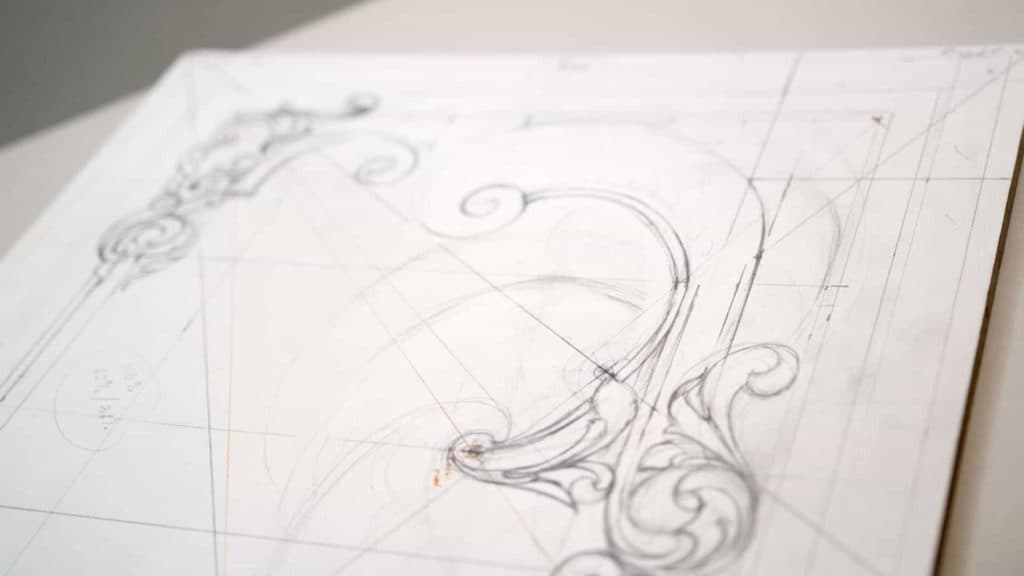
Alexander Grabovetskiy, woodcarver, School of Woodcarving · Published 2018
How do you fix a crowded acanthus design?
Quick answer: A crowded ornament design is fixed by taking mass away, not by adding more. Hide one of two acanthus leaves under its neighbour, enlarge what remains, and keep the outline you already trusted. The corner then reads as one movement rather than a fight, and your eye stops being pulled off the centre.
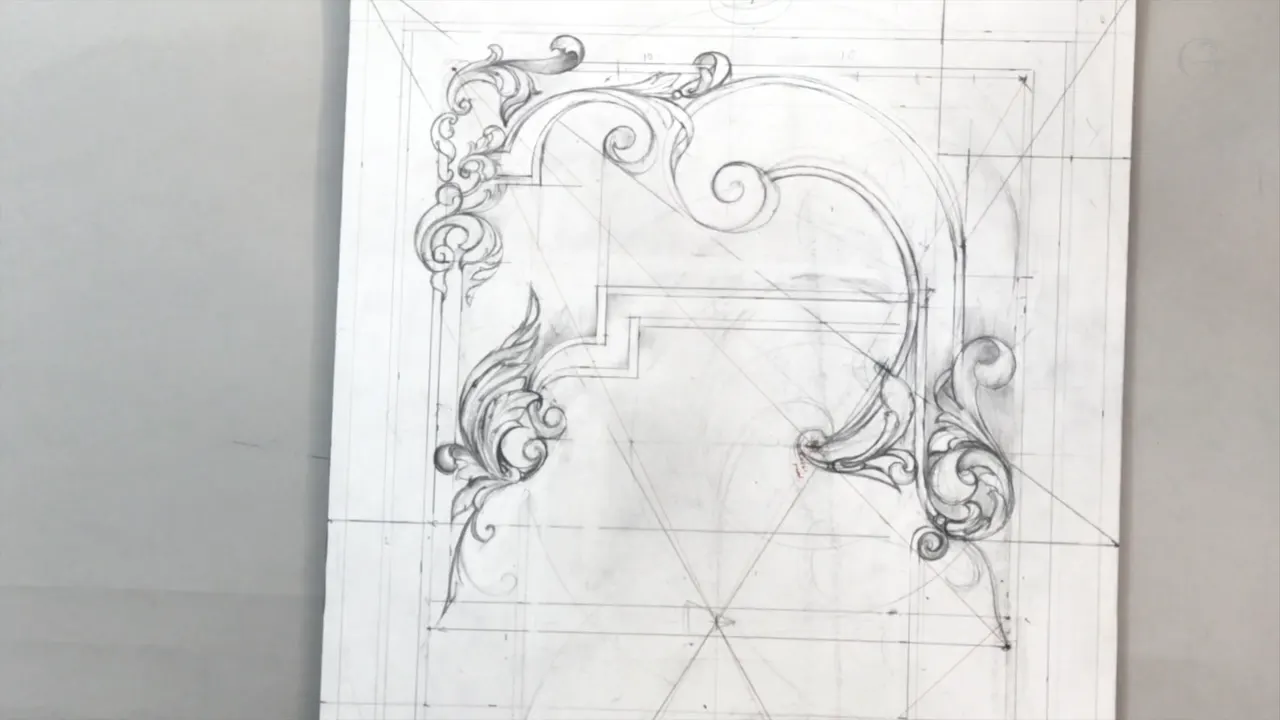
The fix for a crowded corner is nearly always subtraction. I had two acanthus leaves fighting in one small area, so I hid one behind the other and made the survivor bigger. Same outline, half the incident. My eye finally stayed where I wanted it instead of being dragged into the corner.
Have you ever finished a section, felt pleased with it, walked away, come back and found you could not stand it? Or filled a tight space with good detail and watched the detail eat the whole composition? Crowding is the most common fault in ornament and it almost never announces itself while you are drawing.
This lesson is me undoing my own work from the day before. Along the way there is a word I correct out loud, an eighteenth century trick that makes a flat drawing read round, an element that curls in behind a molding, and the single case where a dead end is allowed to stand.
What this repair actually turns on
- Distance finds faults that proximity hides, so walk away and stare for a while.
- Hold on to the boundary you trusted and change only what happens inside it.
- Two competing leaves become one leaf with the other tucked underneath.
- Thickness has to match across the panel, so the thin side gets redrawn rather than the thick one.
- A volute drawn with its own side showing reads as round on a flat sheet.
- Movement that carries on through a junction is not the same as movement that halts there.
When is a corner too crowded?
Step away from the bench and stare at it for a while. Nothing else finds it reliably. When I came back to this area the movement itself was still good, and I said so, but there was too much of it packed into too little room and it pulled my eye clean off the centre of the panel.

Crowding is not the same as busyness. A panel can be dense everywhere and still read calmly, because the density is even. Trouble starts when one small area holds more incident than its neighbours, and it then behaves like a second focal point that nobody asked for.
Do you throw the whole thing out and start again?
Keep the outline. Whatever made you draw that boundary in the first place is probably still sound, and the boundary is what ties the area to the rest of the composition. What goes is the interior, which in this case meant turning two visible acanthus leaves into one.

Technically there are still two. The second one has simply gone underneath the first and only its tip shows now. Nothing was thrown away, the density halved, and the corner kept every connection it had to its neighbours.
Why make the surviving leaf bigger?
Balance across the panel decided it, not the corner on its own. On one side I had a properly thick acanthus movement and on this side everything was running a little too small, and that mismatch shows up from across the room long before any detail does.

Redraw the thin side, never the thick one. Shrinking good work to match weak work is the wrong direction, and it is the instinct most people have, which is why panels get progressively timid as they go along.
| The symptom | Where the trouble usually comes from | Wrong move | What I usually do instead of it |
|---|---|---|---|
| Corner shouts | Too much incident in a small area | Add elsewhere | Tuck one element under another |
| Sides disagree | One leaf family runs thinner than the other | Shrink it | Enlarge the weaker side until it matches |
| Detail looks thin | No micro subdivisions inside the lobes | More leaves | Divide the lobes you already drew |
| Corner reads flat | Volute drawn as a single spiral with no side showing | Darken it | Show its edge as well |
| Ending feels loose | The movement is parallel to nothing | Curl harder | Set it parallel to a named diagonal |
Curl or volute, which is the right word?
A volute is the accurate word and I corrected myself on camera the moment I heard it come out wrong. Curl is what most of us say. Volute names the scroll that runs on a spiral and keeps a constant width, and the difference matters because the two are drawn differently.

Naming things properly is not pedantry in this trade. An Ionic capital is two volutes and a bit of egg and dart, and once you have that word you start seeing the same geometry in furniture, in rinceau scrollwork, and in every piece of Grinling Gibbons foliage ever cut.
Where a full acanthus movement would be too much, small foliage does the job. It fills, it connects, and it does not demand attention. I used it here to reach a line I wanted touched without putting another leaf into an area that had just been emptied on purpose.
How much detail is enough?
Enough is when the lobe stops looking like a shape and starts looking like a leaf. On this corner I liked the movement and still felt it was not detailed enough, which is a different complaint from crowding and needs the opposite treatment.

Subdivide inside what you already have rather than adding new elements. One lobe becomes two movements, then the micro subdivisions run along the central line, and the leaf gains richness without gaining area. Crowding comes from new mass. Depth comes from dividing the mass you already committed to.

The main eye goes in early and everything else takes its bearing from it. Where an acanthus lobe turns, shadow gathers, and that gathering is the eye. Draw it first and the subdivisions almost place themselves; draw it last and you will be moving it three times.
Does repetition make a panel boring?
Repetition is what stops it being noise. Whenever I reach an awkward gap, the first thing I try is repeating a movement that already exists somewhere else on the board, and most of the time the gap accepts it immediately.

Even the rounding did that. A section had been bothering me, so I made it rounder, found the sweep that matched an existing one, and let the line run under its neighbour instead of stopping at it. One correction bought me a repeat and a fix at the same time.

The danger is mechanical repetition, where every element is the same size at the same interval. Symmetry of that kind belongs on a machined moulding, not on a carved panel. What ornament wants is one idea returning at another scale, which is how a neoclassical frieze keeps your attention for two hundred years.
Wrapping is the other move that buys a lot for very little. Let a leaf wrap around the movement it belongs to and it stops being a shape stuck on top of the design and becomes part of the structure. Every serious acanthus tradition does this, and it is the first thing missing from work that looks pasted together.
Where should an ending point?
Mark the start point, lay the ruler along the baroque diagonal and draw a line parallel to it, then build the movement on that. I chose the baroque line here rather than the other one because this ending sits closer to the outside of the panel.

You will never see that guideline in the finished carving. Believe me when I say the eye still feels it. An ending that runs parallel to a real diagonal looks settled, and an ending at some private angle of its own looks like an accident, even to somebody who could not tell you why.
The same rule governs eyes. Draw a parallel line through the lobes, put every eye on it, then run the micro subdivisions off that central line. Two eyes wandering off their shared line will spoil a leaf faster than a clumsy outline will.

Can a flat drawing read as round?
Draw its side. Rather than one spiral line, show how thick the scroll is as it turns, so the viewer sees the edge of the band as well as its face. Two pencil lines where there was one, and the corner lifts off the paper.

Carvers in the eighteenth and nineteenth centuries leaned on this constantly, and it kept going long after. What the trick really does is hand the eye a second surface at a different angle, and a shaded drawing hands you that same information by a costlier route.
Shadow does the rest. Those micro pipes in the corner were bothering me until I put some shade under them, and the moment the shade went in the area sat down and behaved. In relief the shadow is not an effect added afterwards, it is the thing you are actually carving.

Can a leaf vanish under the molding?
Seventeenth century carvers did this constantly. One element curls in behind the molding, vanishes, and sometimes even returns on the far side. By the eighteenth century the move had gone out of fashion, which is exactly why it looks so alive when you use it now.

Here I curl one edge in behind and let the opposite edge overlap the molding on top. One edge under, the other over, in a single junction. Working both ways at one junction tells a viewer the ornament and the frame occupy real depths rather than sitting on one plane, and that beats another leaf easily.
Go and look at a seventeenth century panel with this in mind and you will find the move everywhere. Work from that period reads as deeper than it physically is partly for this reason, and the same logic drives extreme undercutting later on.
Is a dead end ever allowed?
Once, and the condition is strict. A leaf may finish against another line, looking for all the world like the T-stop I warn about, provided the overall movement genuinely continues past that point in something else.

Nobody is tracking one line. The eye tracks a route through the whole corner, and when that route carries on somewhere else the pause does no harm. Get that wrong and you have simply excused a fault, so test it honestly: cover the leaf with your thumb and see whether the movement still goes anywhere.
Everything else in the invisible stop lesson still applies. This is the one exception, and I would rather you knew it than spent a year contorting perfectly good leaves to avoid a rule that has a door in it.
What about the parts that still bother you?
Leave them. I filled the last gap with a plain acanthus leaf, nothing clever, and let the molding wrap underneath it. Then I looked at the whole corner and told the camera that I like the main idea but not the development of how it looks, which is where the lesson ends.

Honest, and completely normal. A drawing gets three or four passes before it earns a gouge, and the fastest way to waste a week is to force a passage on the day it refuses. I reached for a different pencil and stopped there.

The board goes back on the bench tomorrow. If you want the whole sequence in order it lives in this design workshop, the next lesson picks up where this one gives up, and the timber I am drawing on is the ordinary lime and basswood I use for everything. When the drawing is finally settled it goes to the carving stage.
Three or four times in this lesson I put a line down, looked at it, and said out loud that I did not like it. None of that is me performing humility for a camera. Drawing is a conversation with a board, and a carver who never argues back is a carver who copies. If you want that argument taught properly, with a panel in front of you and somebody watching your lines, the school is built for it.
Keep a record of what you changed, even if it is only a pencil note in the margin. Six months later you will hit the same fault on a different board, and the memory of how you got out of it the first time is worth more than any rule I can give you here. Mine are in a sketchbook that nobody else could read. Half the entries are a squiggle and two words, and they still work, because the squiggle is the part my hand remembers.
So: would you rather protect the work you already did, or make the panel right? Shall we carve?
How it's done
- Walk away and look. Put the board across the room and stare at it for a few minutes. Crowding never shows itself at arm's length, and no other instrument finds it reliably.
- Hold the boundary. Leave the boundary that already ties this area into the rest of the panel. Only what happens inside it is in question here.
- Push one leaf behind. Take two competing leaves and push one behind the other so that only its tip shows. Nothing gets thrown away and the density halves.
- Enlarge the weaker side. Compare thickness across the whole board and redraw the thin side up to match the thick one. Shrinking good work down to meet weak work runs the wrong way.
- Set endings on a named diagonal. Rule a line parallel to the baroque or sinister diagonal and build the ending on it. That guide never shows in the carving and an eye still reads it.
- Show the side of the volute. Add a second line beside the spiral so the scroll displays a real width. A flat drawing starts reading as round straight away.
- Subdivide before you add. When a leaf looks thin, divide the lobes you already have rather than bringing in new elements. Richness without extra mass is what you are after.
Frequently asked questions
What separates a crowded corner from a rich one?
Evenness is what decides it. A panel can be dense from edge to edge and still read calmly, but one area carrying more incident than its neighbours behaves like a rival focal point.
Should a crowded area be redrawn from scratch?
Rarely. Whatever made you draw that boundary in the first place is usually still sound, so hold on to the outline and change only what sits inside it.
What is the difference between a curl and a volute?
Volute names a scroll that runs on a spiral and holds a constant width. Curl is loose speech. Ionic capitals are built from volutes, and so is most furniture scrollwork.
What to carve next