
![You said You like ASHLEY ILES but reach for PFEIL (Swiss made) more often [ WOOD CARVING TOOLS ]](/_next/image?url=https%3A%2F%2Fmedia.schoolofwoodcarving.com%2Fwp-content%2Fuploads%2F2021%2F12%2FPfeil-vs-Ashley-Iles-1024x576.jpg&w=3840&q=75)
Alexander Grabovetskiy, woodcarver, School of Woodcarving · Published 2021
Why use Pfeil more often than Ashley Iles?
Quick answer: Reaching for Pfeil more often than Ashley Iles is, for me, a matter of the number 11 profile. On a 12 mm Pfeil the wing runs 4 to 5 mm longer, so I get deeper and the shadow gets more beautiful. That wing also spreads, so I can blend. For steel and handle, I still like the English maker.
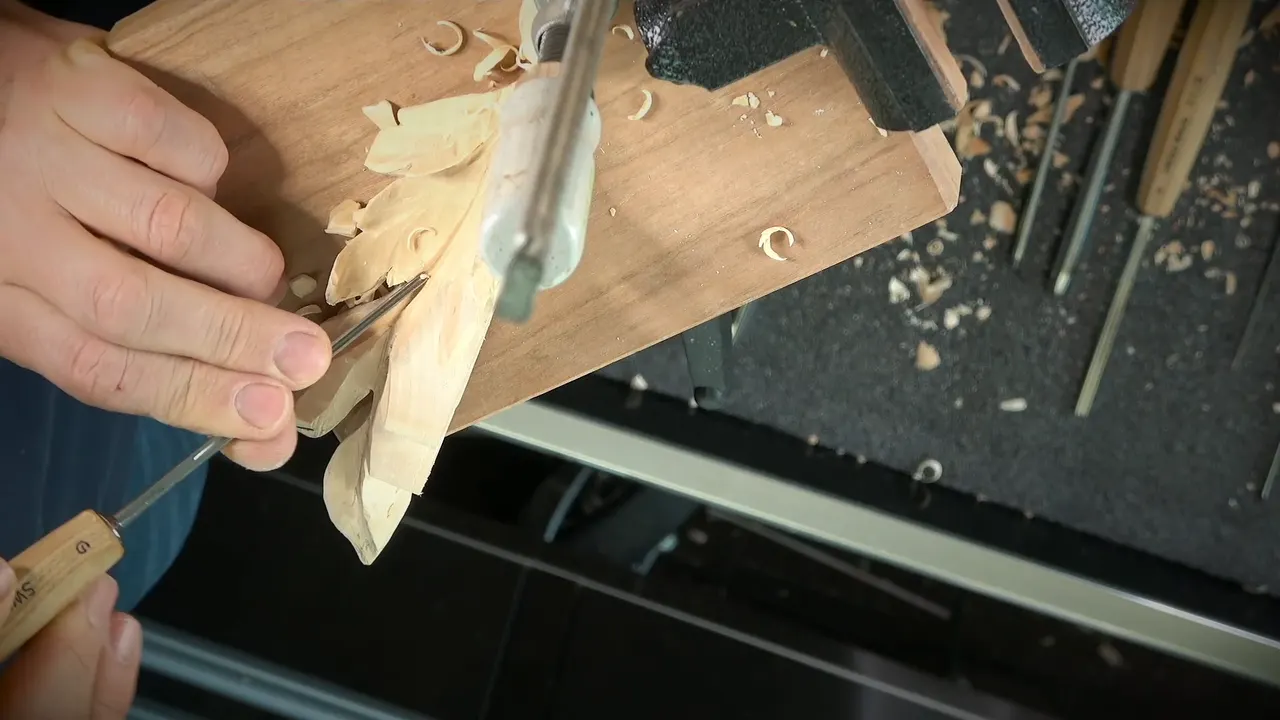
Picking Pfeil over Ashley Iles is, for me, all about the profile of the number 11. On a live stream on December 30, 2021, I gave two reasons. The Pfeil wing is a lot longer. And it spreads apart. For the steel, I still like Ashley Iles better.
Someone asked me about it on my stream the day before, and I answered it in a block of wood with my mallet in hand.
Do you want the leaves you carve to look deep, with real shadow under them? Want to know what to check on a tool before you buy? Then look at the wing itself before the name on the handle, as I asked on the stream.
Two reasons for the Pfeil and one for Ashley Iles
On two number 11s of 12 mm (about 1/2 in), the Pfeil wing came out four or five millimeters (about 3/16 in) longer.
A longer wing lets me go deeper, and deeper gives a more beautiful shadow.
It spreads apart, so inside an acanthus I can blend instead of leaving a deep U.
For steel, handle and size I'd probably just buy Ashley Iles.
Pfeil makes a number 17 and an 18, a couple of tools other people don't.
My Pfeil tools have no bronze ferrule, and I wish they did.

Why don't I always name the brand?
When I film for my school, I want the tool I'm using to be one you can get. On that stream I said I had over 2,500 videos on the school site. Students in my school hear the tool named every time I grab one, the number and the width, for example a number 11 at 3 mm (1/8 in). In the beginning, a couple of years before that stream, I also told you what brand I used.
Then I held one up. A tool from Germany, more like an antique, 2.5 mm (about 3/32 in), pretty much a number 11. I named it as a Hugo Pfeil, and you have probably never heard of it. Search for that brand and you won't find it, except maybe in antique places like eBay.
Really good European steel, though. I love those tools, and this one sits between a 2 and a 3 in width. Sometimes that's just excellent for getting into some areas. We're talking about half a millimeter, and it's still an 11.
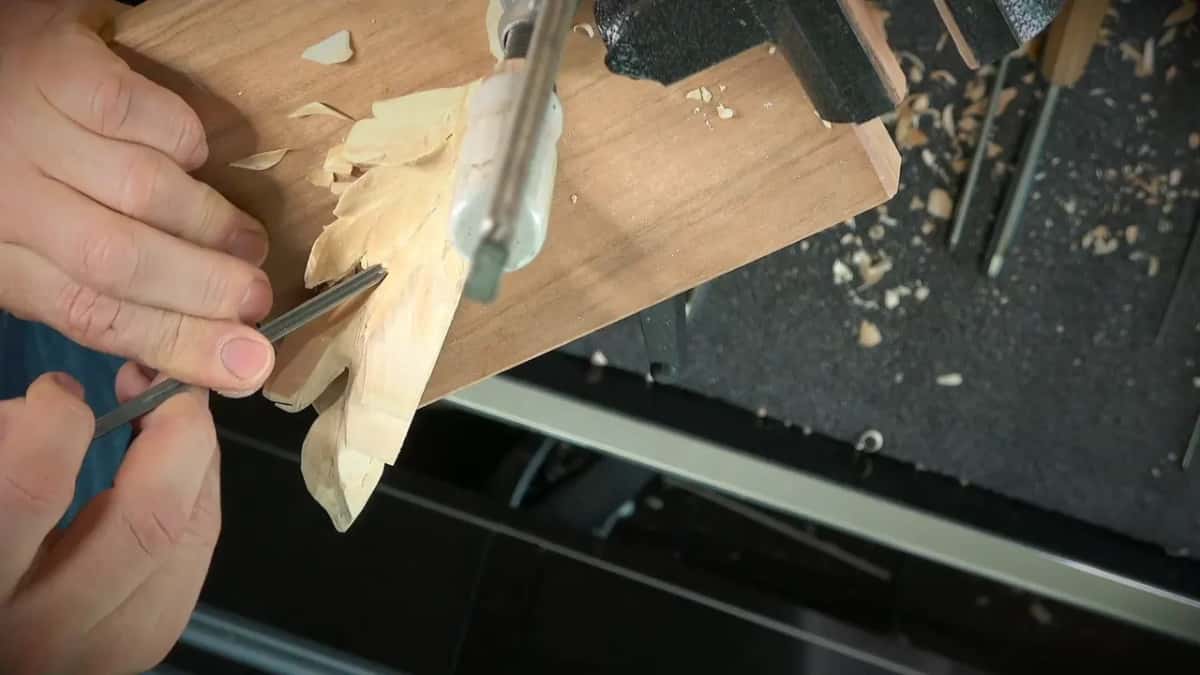
Is Ashley Iles steel better than Pfeil steel?
To me it is. Among English-made tools today, I really love Ashley Iles, and that is the truth. They are wonderful quality tools, and I'm not talking about how they look.
Plenty of companies make really good looking tools, but the quality of the steel is not there. Even when the steel comes from one place, Sheffield, there are many steel makers there.
If I compared the two only on steel, handle and the full size, I'd probably just buy Ashley Iles. Don't get me wrong. Pfeil tools are excellent, and their steel is really excellent too. I own a lot of Pfeil tools, Swiss made. Pfeil is a huge manufacturer, and you can get their tools everywhere.
Still, on the steel itself, the iron part, I like Ashley Iles better. The tools selection lesson puts the makers in the order I'd buy them for a first set.
How much longer is the wing on a Pfeil number 11?
About 4 or 5 mm longer, at the same 12 mm width. I showed it in the block, starting with an Ashley Iles number 11 and the mallet. A number 11 is always the letter U.
Next came exactly the same size from Pfeil, 12 mm, set right beside the first mark. You can see the difference pretty much right away, I said. Well, actually, you can't see that. I don't think so.
I pretty much lined up the bottoms, although my Pfeil sat a little lower. Another mark right on top showed the wing, and that distance on the Pfeil is a lot longer. A little later I reset my camera and came in closer to show that wing again.
Why does a deeper groove give a better shadow?
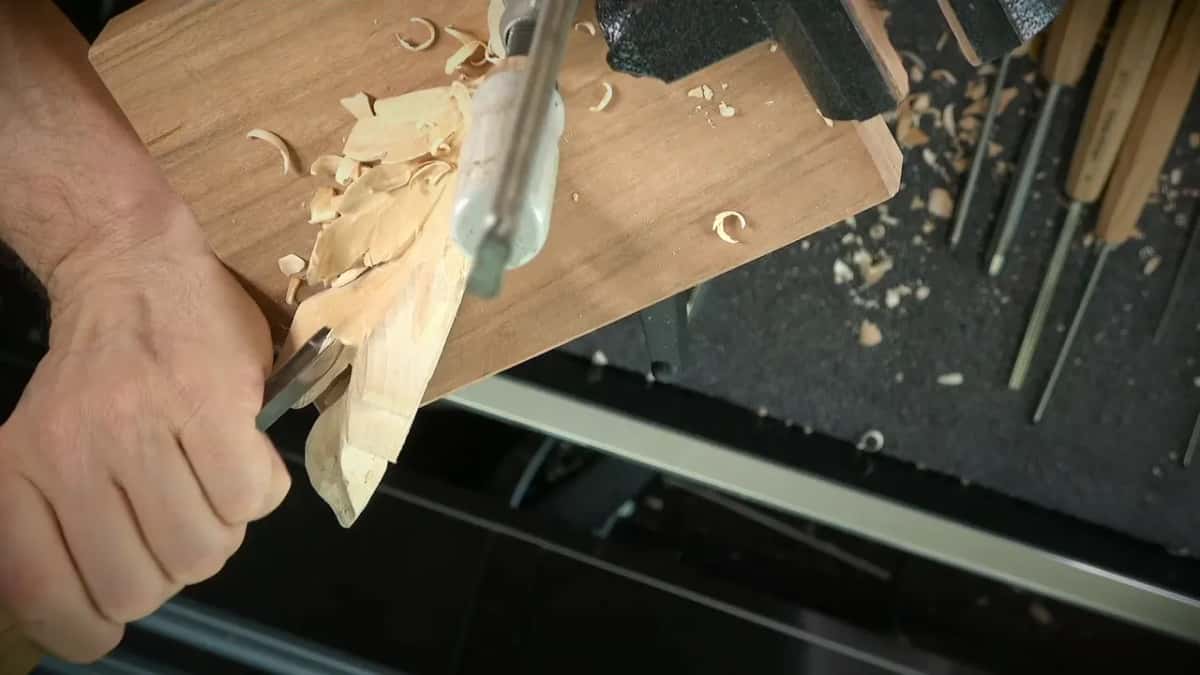
Wood carving is all about shadows, light and shadow. It's really, really important for me to get as deep as possible. The deeper you get, if you just place that tool underneath, the more beautiful the shadow will be.
That's the reason I love the Pfeil profile much better. I still use the Ashley Iles. The lack of that extra wing is just a slight limitation, nothing big.
Most Ashley Iles veiners have a wing that's not that long, almost like a number 10 London pattern with a little longer wing. Two Cherries do have the true U, and they have a longer wing.
What does the spread on a Pfeil wing do?
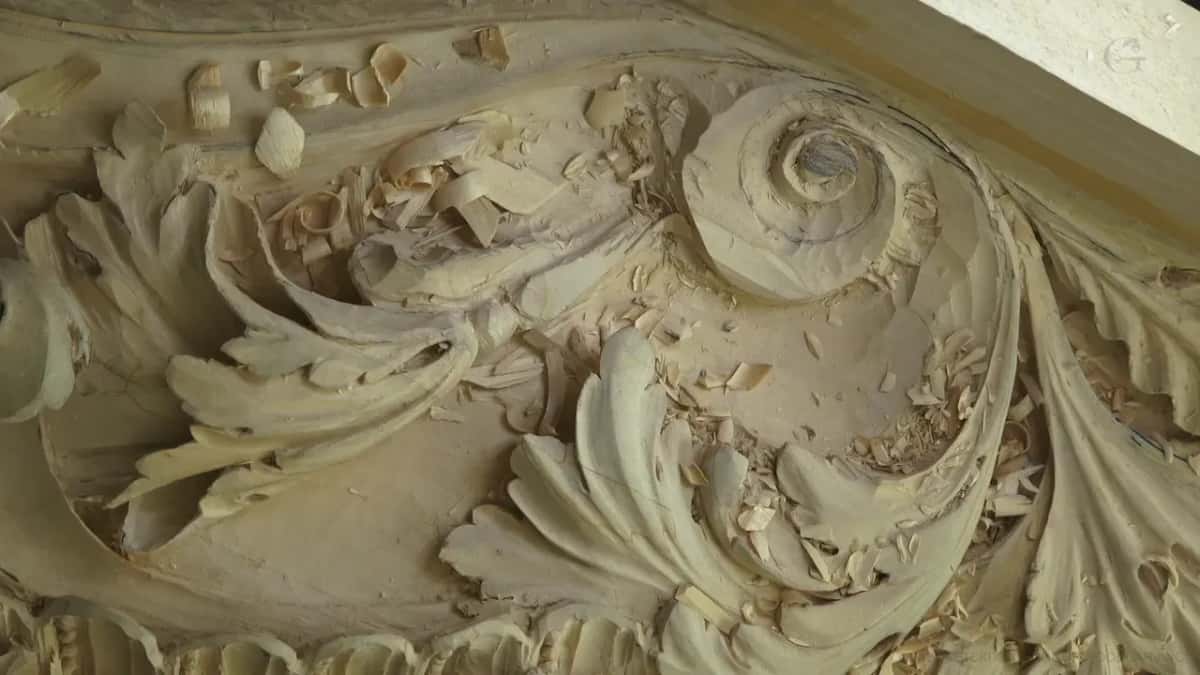
It blends. Look at the wing itself. It isn't a straight line. There's a slight sweep in it, a slight curvature, not huge, but it doesn't go really straight up. It spreads.
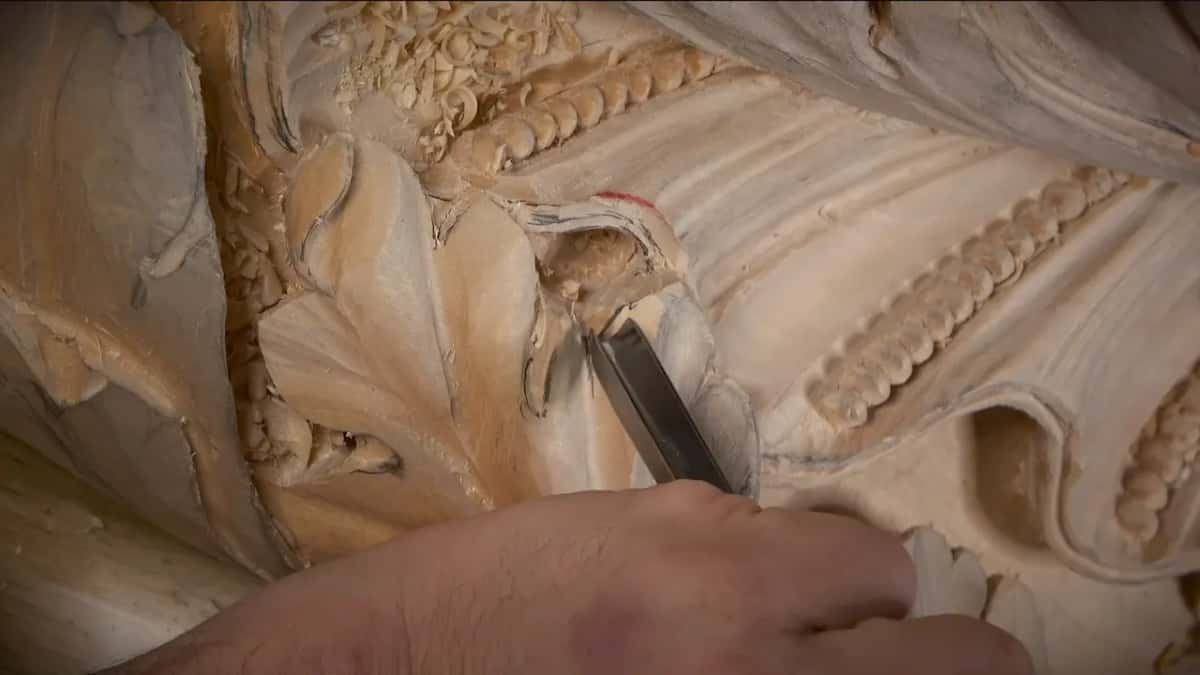
I carve a lot of acanthus movements. With a true U shape tool I'd have a problem, though a small one, because I can still use it. Inside the groove I really, really need that spread, because it creates much better blending. I can rotate the tool to the right a little and blend, or to the left and blend, without leaving a really deep U shape.
I like that profile especially on the bigger sizes. We're talking about 7 mm, just slightly bigger than a quarter inch. It looks huge on camera. Seven millimeters is not that big.
Unfortunately, or maybe fortunately, only Pfeil makes that type of number 11, I said, and to me it's the most logical. The Venice Room I was carving then had a lot of acanthus, the most common movement in wood carving and stone carving.

Why would a forged number 11 spread at all?
My reasoning went back to the blacksmith. Think how tools were made in the 16th, 17th, 18th and 19th century. They'd lay a rod in the middle of the steel they were forging, over some kind of cavity, and hit it with the hammer right inside, and that made the U shape.
That U would never be perfect. Just by the logic of how it worked, it would still have some spread. And the Pfeil 11 reached that.

Can one number 11 work like several gouges?
Pretty much, and that's why I love the 11 in the first place. It's like a multi-tool in one. Read across the U, spot to spot, and that's about a number 9 sweep. Move to either side and you get an 8. Lay it completely on its side and it's close to a 3. A 5, a 3, all the tools pretty much, depending on your angle of attack.
Carve straight down and you do what a 9 does, a really deep excavation. Rotate slightly to the right or the left and the groove turns into a 7, not as deep. Roll it even more, almost onto its side, and you get a really shallow groove.
And the good thing about a number 11 is that you can go as deep as the tool allows. Even a 9 has some limits. If you need a really deep groove, your number 9 will limit you.
How do I undercut with a small number 11?
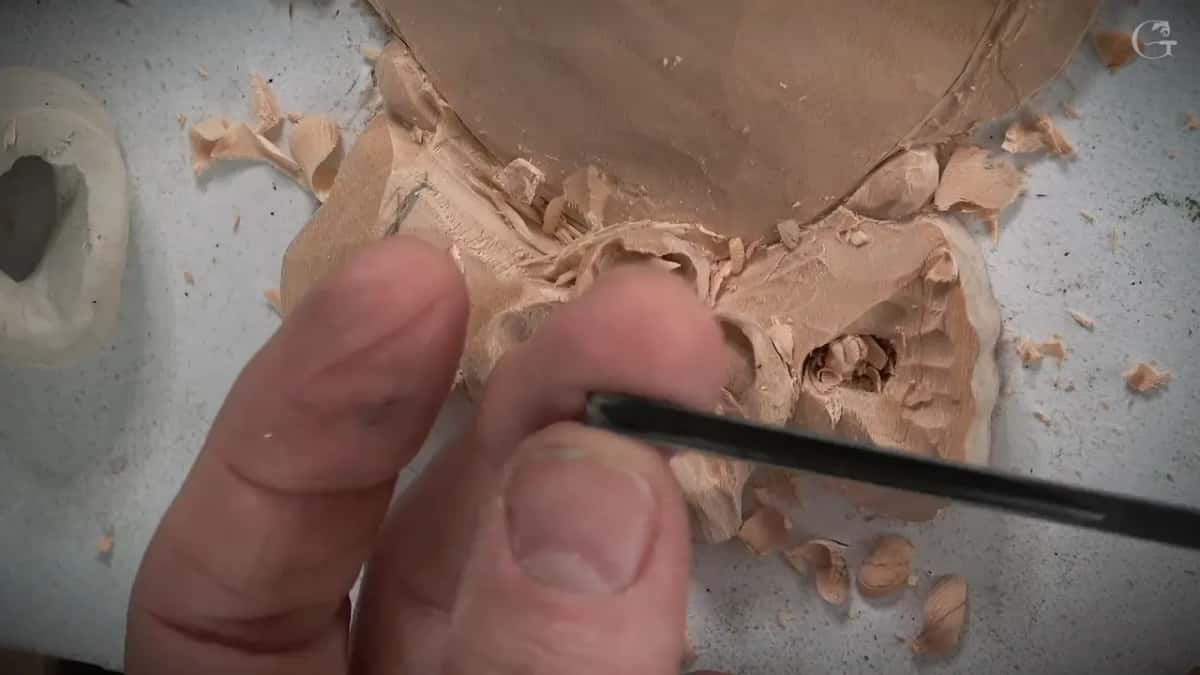
With a smaller one, 2 and a half mm, carving straight down works as a 9 would. To undercut on one side, you rotate it and use the tool just like that, and you can get really, really deep. Right there I was already undercut, and you could see the shadow it made.
With the Pfeil 11 I can place it straight down, and I can also reverse it just slightly. I compared it with a V-tool on camera. With the number 11 and the undercut, the shadow plays much better, and that part comes out much cleaner.
A deeper undercut gives a better shadow. Because that wing is not perfectly straight, you can rotate even more. I made one pass, then a second one, and the second made an even deeper shadow, like a dome effect.

What are the Pfeil number 17 and number 18?
They're a couple of tools other people don't make, and the 17 is one I really love to use. It is not a veiner, but it's an excellent tool. It looks like a V-tool. It isn't one, and it isn't a number 16 either. Down low it has a much bigger gouge part, so it's just like a number 9 with an even bigger spread.
You've probably never even heard of it. I use it sometimes right inside the grooves on my acanthus, to play with right rotation and left rotation without a really sharp line. I don't want to see any sharp line.
The 18 is by Pfeil too, Swiss made, and oops, I held it upside down at first. I carved an 18, then a 17 right close by, then an 11, so you could compare. Number 18 sits right between the 17 and the 11. It has a curvature, which I like, and the 17 has a slight curvature too. People call the 18 a sheller, the tool for shell carving.
Why are V-tools more limited than a veiner?
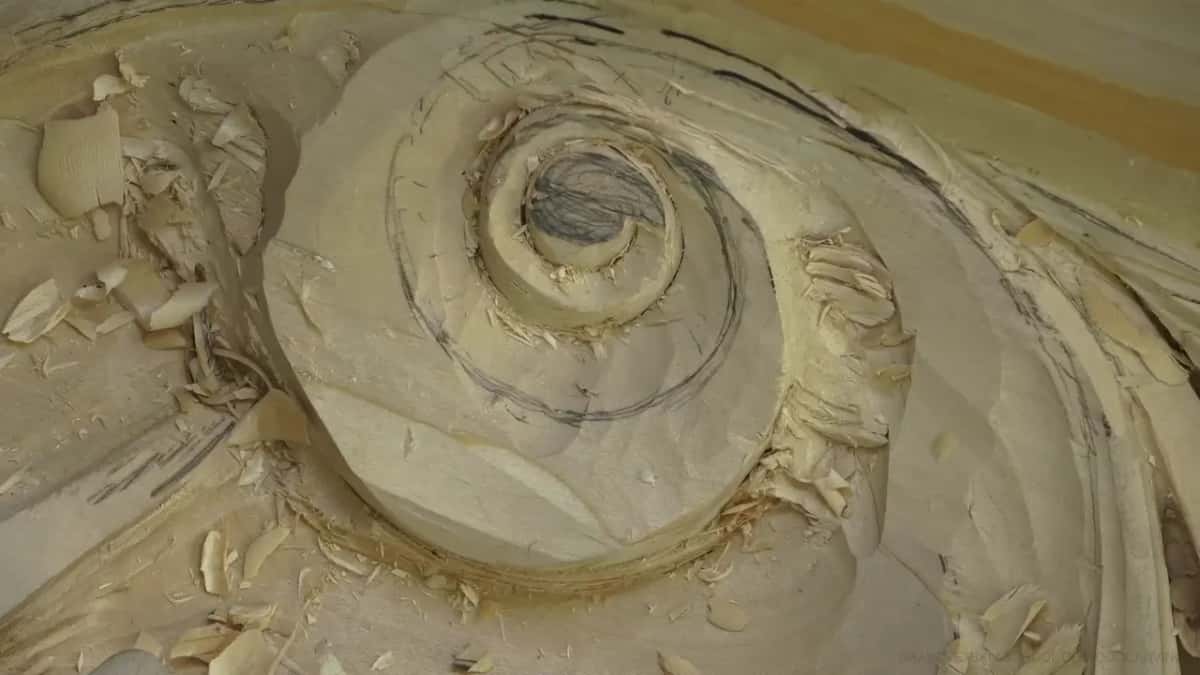
Their wings are straight. Parting tools go from number 12, and then 13, 14, 15 and 16, and those are the V-tools. They narrow to a really tiny gouge part, almost to a sharp point. A 17 doesn't have that.
I showed a number 16 at 6 mm (about 1/4 in). It does have a slight curvature in the bottom, a little sweep and gouge part. But the wings are completely straight. Really straight. Sometimes that limits you from doing beautiful work.
My client on the Venice Room asked me to use tools authentic to the end of the 15th century and the beginning of the 16th. I couldn't just grab a normal V-tool, a number 15 or 16. They didn't have it then in Venice, I said, and they didn't use it. Most of the tools they used were just gouges.
| The tool | What I showed about it on camera | My word on it |
|---|---|---|
| Ashley Iles 11, 12 mm | A U with a shorter wing than the Pfeil | a slight limitation |
| Pfeil 11, 12 mm | A wing that runs longer and spreads apart | my two reasons |
| Small 11, 2.5 mm | Rotated under one side for a really deep undercut | you can see the shadow |
| Pfeil number 17 | Like a 9 underneath, with a bigger spread | an excellent tool |
| Pfeil number 18 | A curve that sits right between the 17 and the 11 | called a sheller |
| Number 16 V-tool, 6 mm | A little gouge down low with completely straight wings | it limits sometimes |

Does it matter that Pfeil has no ferrule?
It does to me. Put a Pfeil beside an Ashley Iles and the difference is the ferrule. My Pfeil has only the handle and the metal part, and no bronze ferrule. The steel is good. Its property is wonderful, and the profiles are excellent. I think Pfeil has one of the best charts of profiles.
Why does it matter? First, the look, and second, it's practical. But wood is always moving. It dries out, puffs, takes water and dries again, and sometimes those handles get kind of loose. A ferrule holds that part in place and keeps the wood from spreading apart.
Some of my old handles have a crack just because of that movement. And some super old antique tools of mine, with a ferrule even on the small ones, hold together with no cracks at all. The one I showed was from the beginning of the 19th century.
Of course you can change a handle. For me, though, the ferrule is important, and I wish Pfeil made that part. It's not a deal breaker. Just because of the profile I'd still buy them. Come on, I'm not after jewelry.

Which maker has the fuller line of carving tools?
Ashley Iles has the full line, all the sweeps and all the profiles, and the sweep is the curvature of the tool. Pfeil too, and other makers carry plenty. Henry Taylor doesn't have a full line of carving tools any more, although I love Henry Taylor and how it feels in my hands.
Pfeil has much better charts, in my opinion. Henry Taylor doesn't have the true U, I said. They have a number 48, which they call a veiner, and it's pretty close to the Ashley Iles London pattern.
Steel history came up too. I love Addis tools, ten generations of them, and one of the Herring Brothers married a daughter of the Addis family. Nobody knows what steel they used, and I said it's probably about the same as what Henry Taylor and Ashley Iles use right now.
Which one is the better maker, then?
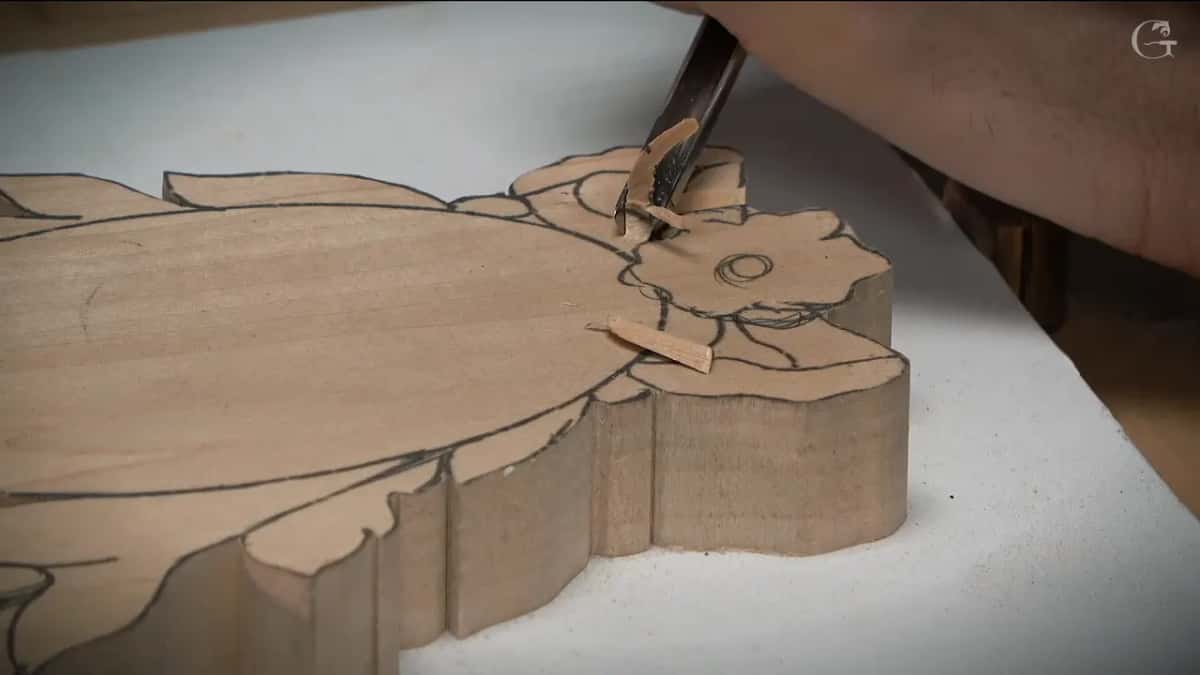
Neither, the way I see it. One doesn't beat the other, or beat anything else. Profiles are what it's all about. I'm not sticking to just one brand, though I know some wood carvers who are really loyal to only one, and that's it.

I own a lot of Pfeil and Ashley Iles, all the Henry Taylor that's available, plenty of Addis and Herring Brothers, Two Cherries, and old Marples and Sons. Whatever you name, I most likely have it. Different projects, different operations, different tools.

The rest of this course covers the bevel for hardwood, back bent tools, scrapers, a cheap Schaaf set, how the bench is laid out and how the work is held. Sharpening has a course of its own, and my live streams have their own page too.
Every time I grab a tool in my school, I tell you the number and the width. Start here if you want to carve along with me.
How it's done
- Take a block and a mallet. I picked up a block of wood and my mallet for the comparison.
- Carve the first U. A 12 mm number 11 from Ashley Iles went in first, driven with the mallet.
- Set the second U beside it. Exactly the same size from Pfeil, 12 mm, went right next to that first mark.
- Line up the bottoms. I matched the floors as closely as I could, and my Pfeil ended up a little lower.
- Mark on top and compare. Another mark right on top shows each wing. On the Pfeil it ran longer by 4 to 5 mm.
- Look along the wing. Check whether it climbs straight up or spreads apart from the bottom of the U. Mine had a slight curvature, not huge.
Frequently asked questions
Is Pfeil steel as good as Ashley Iles steel?
Both are excellent steel in my hands, and I own plenty of each. Asked to pick on the metal alone, I still lean toward the English one, Ashley Iles. The Swiss maker wins my vote on the shape of its number 11, which is why it's in my hand so often.
What did the side by side test in the block show?
Two U shapes, each 12 mm wide, went into one block next to each other with a mallet. Lined up at the bottom, the Pfeil wing ran somewhere between 4 and 5 mm farther than the other. The Pfeil also sat a little lower in the wood.
What is a number 17 carving tool?
A Pfeil tool that looks like a V-tool but isn't one. Down at the bottom sits a much bigger gouge part, so it works the way a number 9 does, with an even wider spread. I use it inside acanthus grooves, rolling right and left with no sharp line left behind.
What to carve next