

Alexander Grabovetskiy, woodcarver, School of Woodcarving · Published 2017
What wood carving tools should I buy first?
Quick answer: Your first set of carving tools is a choice between makers whose steel is tempered to about the same hardness. In this lesson I put Auriou first for a beginner set, money allowing, then Ashley Iles, then Pfeil. A year later I still liked Ashley Iles most.
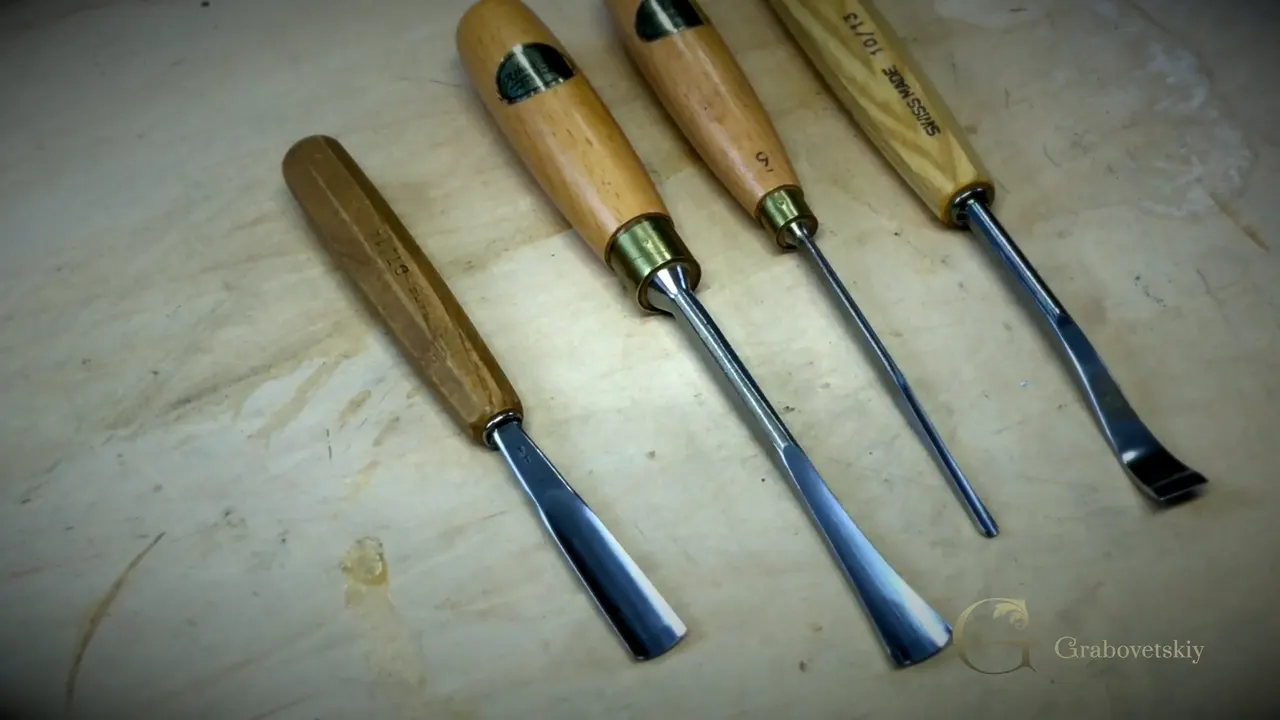
Choosing wood carving tools for beginners is a question I had to answer for myself, and this lesson is where I put the makers in order. Auriou came first if you can afford it, Ashley Iles second, and Pfeil third.
Like probably everybody else, I had that question. When I came from Russia I owned one gouge and one knife. That was everything. My teacher gave me the gouge, and the knife I made myself. Then I landed in the United States and found out you can buy absolutely anything here. You need only work out where, and how much the thing is going to cost you.
Do you want a gouge that holds its edge for a long time? Do you want a handle that still feels right in your hand after a long day at the bench? Then start with the makers I ranked here, and read what changed after I filmed it, because some of it did.
My order of makers, then and later
- Auriou first, Ashley Iles second, Pfeil third.
- Ashley Iles pays me nothing, and still the bulk of what I own is theirs, mostly fishtails that get into corners.
- Their steel hardness sits close together.
- A newer Auriou batch, bought a year after this lesson, let me down.
- Schaaf and BeaverCraft were my 2020 picks for the lowest price.
- The most useful sweeps to start with are an eight and a nine, and my eight for the beginner board measured about 10 mm.
What did I buy first in America?
A Swiss Made set, because that was what I could buy right away. In the United States the same tools are called Pfeil. When I looked at one, I saw how straight it was assembled and how nicely it was done, and it was just a really nice tool to work with.
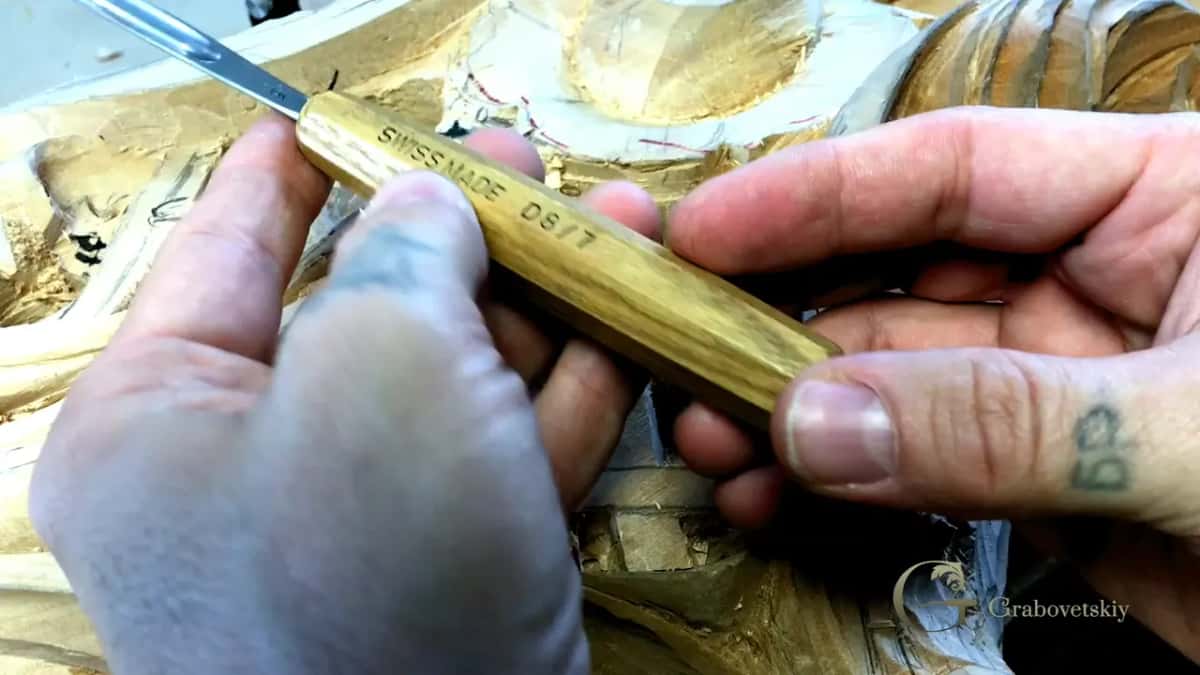
Good tools. What I like about Pfeil is the steel, which holds the edge really long, and the thickness is really nice too. Straight tools, long lasting, and the handle just fits my hand really nicely.
What brands will you find in a store, and online?
Two or three, at a store like Woodcraft. When you go there, you will not find too many different brands. The main one is Pfeil, then probably Flexcut, and maybe some Dockyard miniature tools, and that is it.
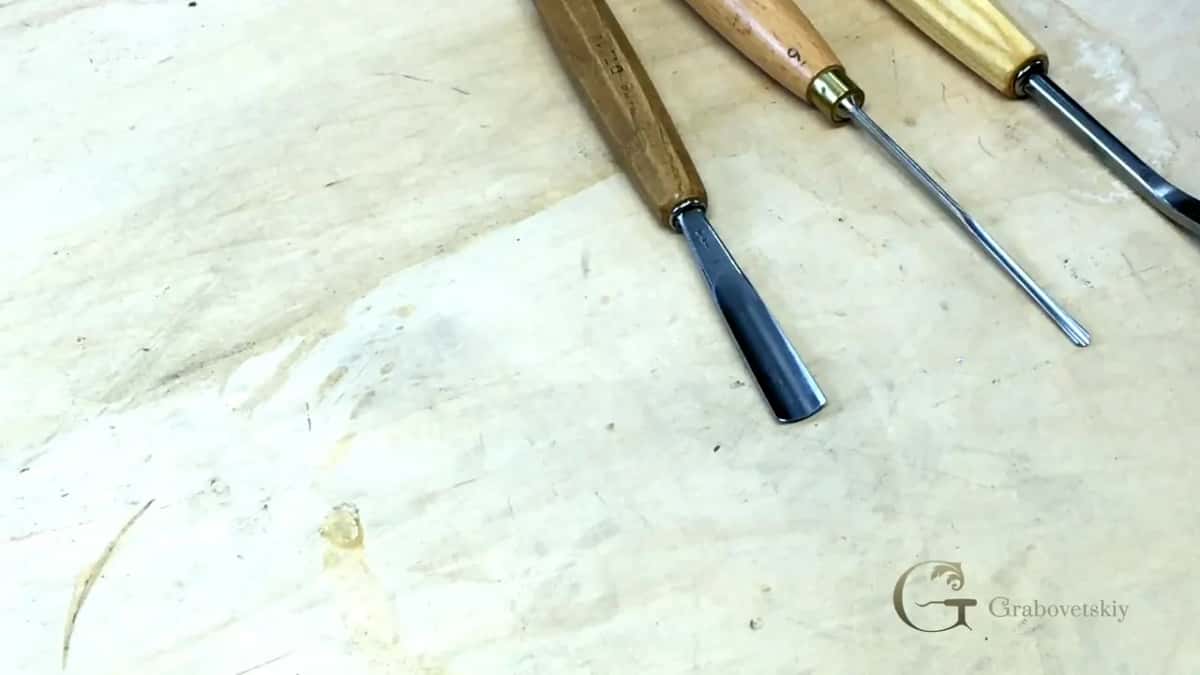
Then I found out there are a lot more choices. Online I could buy Ashley Iles, Auriou, a German brand called Lamp, Two Cherries, Dastra, Stubai and Henry Taylor tools, and so on. I have multiple brands on my shelf, so I can tell you what works for me. There are different opinions, and I do not want to argue.
Flexcut is one of the names on that Woodcraft shelf. On a livestream on April 5, 2020 I said that for me it is not the best tool for a professional result. It could be used for undercutting, but not for everyday work, because the ribs on that tool are really sharp, and they get to your hand while you try to control it. Nothing wrong with the tools, and you can still carve with them. And I never use mine.
How hard is the steel in a carving gouge?
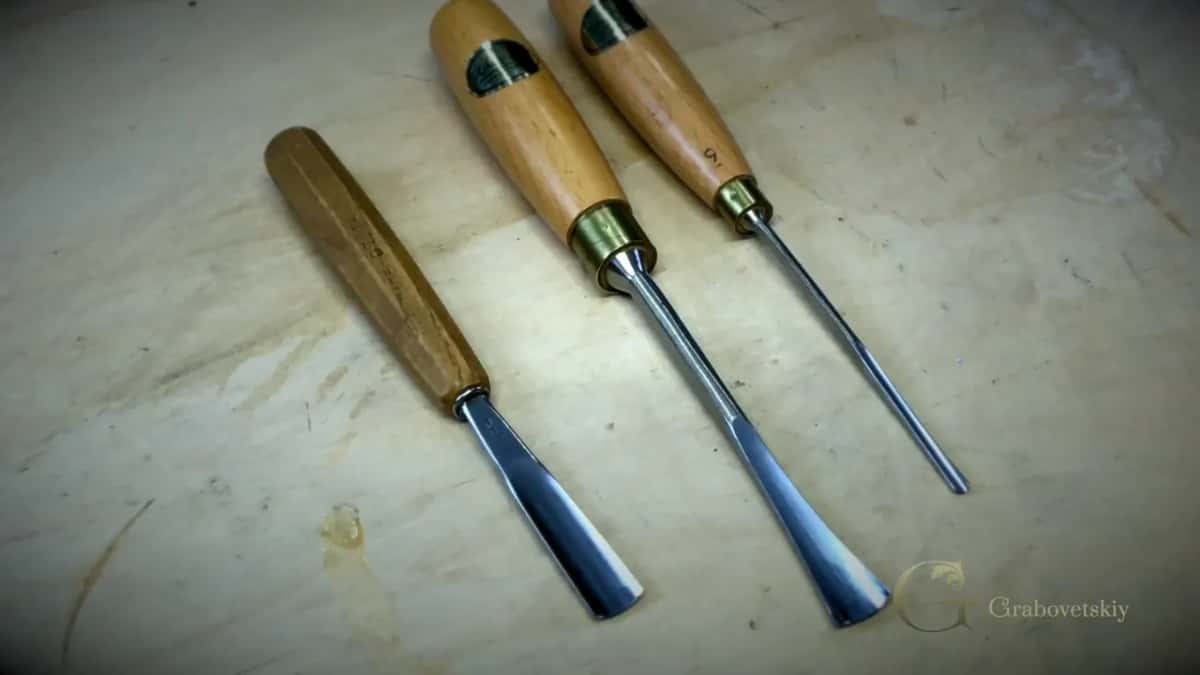
I would say they are all about the same, as far as how they are tempered. For Pfeil, if I remember correctly, it is from 59 to 61 HRC on the Rockwell scale. The Ashley Iles figure is HRC 61, and Two Cherries is about 61. The exact number for Lamp I do not know, and I would assume about 58 to 60.
On that same livestream somebody asked how long a tool set lasts. Those professional tools, I said, last a lifetime, and I have some tools from when I was 16 years old that are still in good shape. It all depends how you take care of them. How long the edge holds depends on the brand, and on whether it is a softer metal or a harder one.
Should a carving handle be round or octagonal?
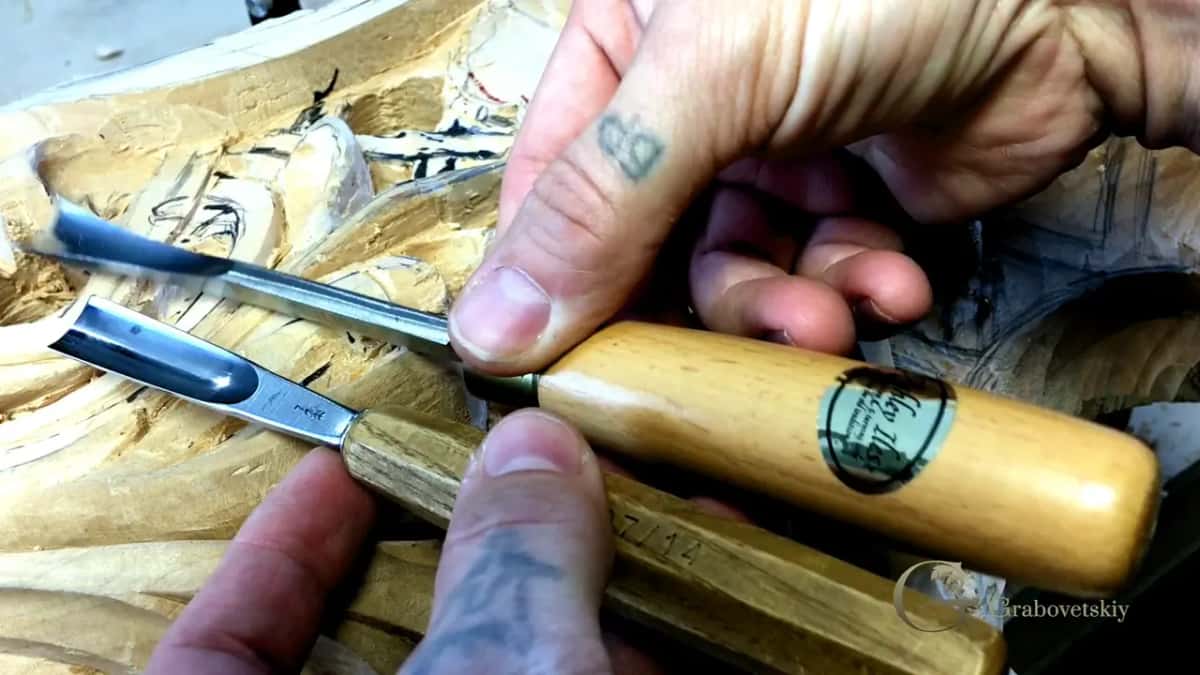
Round suits my hand for a long day, though I like both. The traditional English round handle with its satin finish comes from Ashley Iles. Hold a tool all day long, and those ribs of an octagonal handle are less comfortable in my hand than the rounded one. For me the round one wins, though I would not call the gap enormous.

An octagonal handle laid on the bench stays exactly where you put it, and that is perfectly true. Some people told me a round one rolled off on them multiple times, especially a small tool. I carve every single day, I have owned round handles about as long as I have owned octagonal ones, and not once in my life has a tool rolled off my bench. If it happens to you, put some kind of mat on the bench and lay your tools on it.
Why are most of my tools Ashley Iles fishtails?
Thick steel, and a shape that gets into corners. You have to understand, I am not getting any money from Ashley Iles, and I am not trying to advertise those tools. Put one side by side with a Pfeil and you can see how thick it is. The English steel is noticeably thicker.
The fishtail is what most of mine are, although they make other kinds too. I really like them, because you can get to the corners with a fishtail.
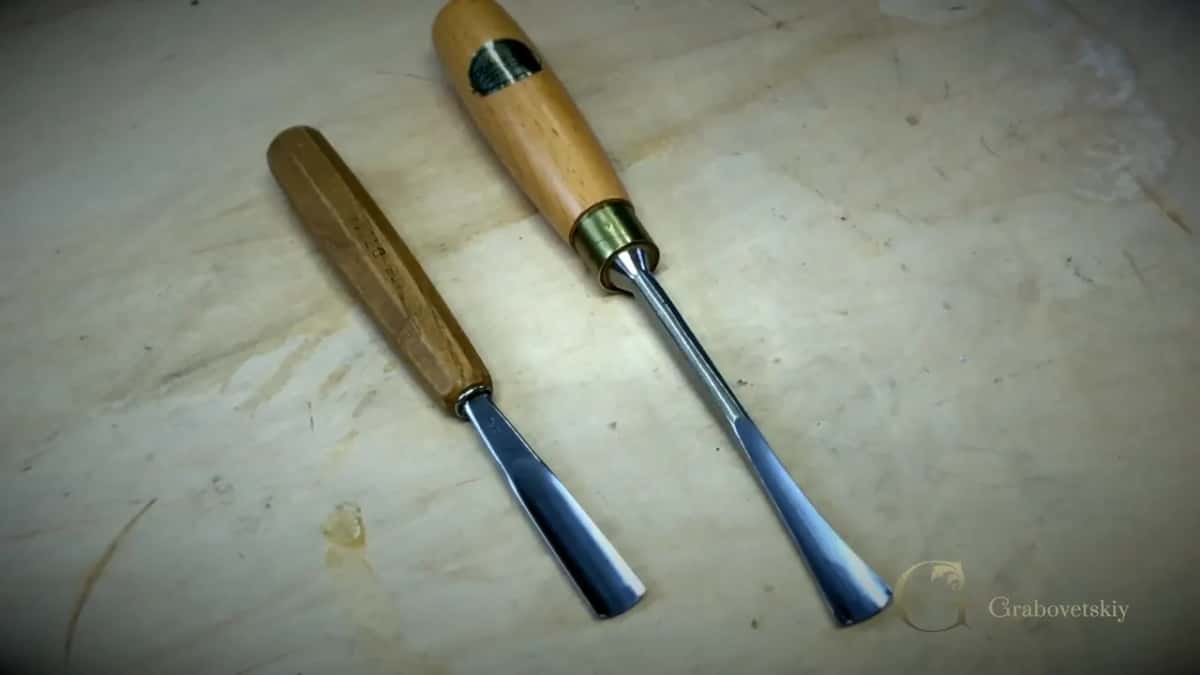
In a question and answer lesson I put two number nines next to each other, both marked six millimeters, about a quarter inch. The straight one has a long groove inside, and I can use it pretty much all my life until that groove ends. The fishtail has only a tail, like a fish, and the rest of it is just the stem.
Now the difference. I can get inside a hole with the fishtail, rotate it, and carve all around in there, and that is how I do my deep excavations. With a straight tool you can get inside, but you cannot rotate it. I can also use just the corner and get into tiny spots where a straight tool will not go. The number nine is the one I like to use the most.

What should you check before buying a gouge?
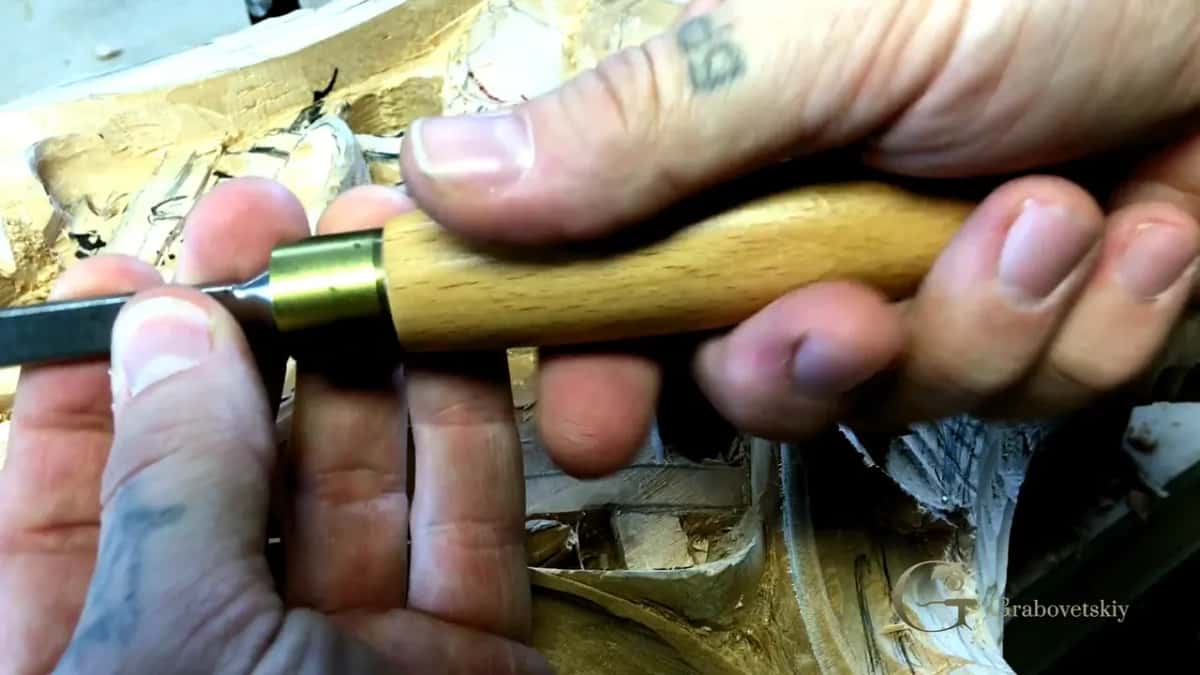
Check that the tool is really straight, the handle against the gouge part itself. That is a really important part when you are buying your tools, although it is not that big of a deal.
Swiss Made tools carry a marking. One I held up in 2020 had the number 11 for the sweep, which is a U shape, and a 4 for millimeters, a little less than 3/16 of an inch. Some tools have no marking at all. An English tool I held up had only a little mark on the side, a number six, with nothing about its width.

A professional really does not need to know how wide a tool is. I look at a tool and know it is about one inch, pretty much 25 millimeters. British carvers follow what is called the London pattern, and you can see all those sweeps on Tools for Working Wood.
Which carving tools for a beginner would I buy first?
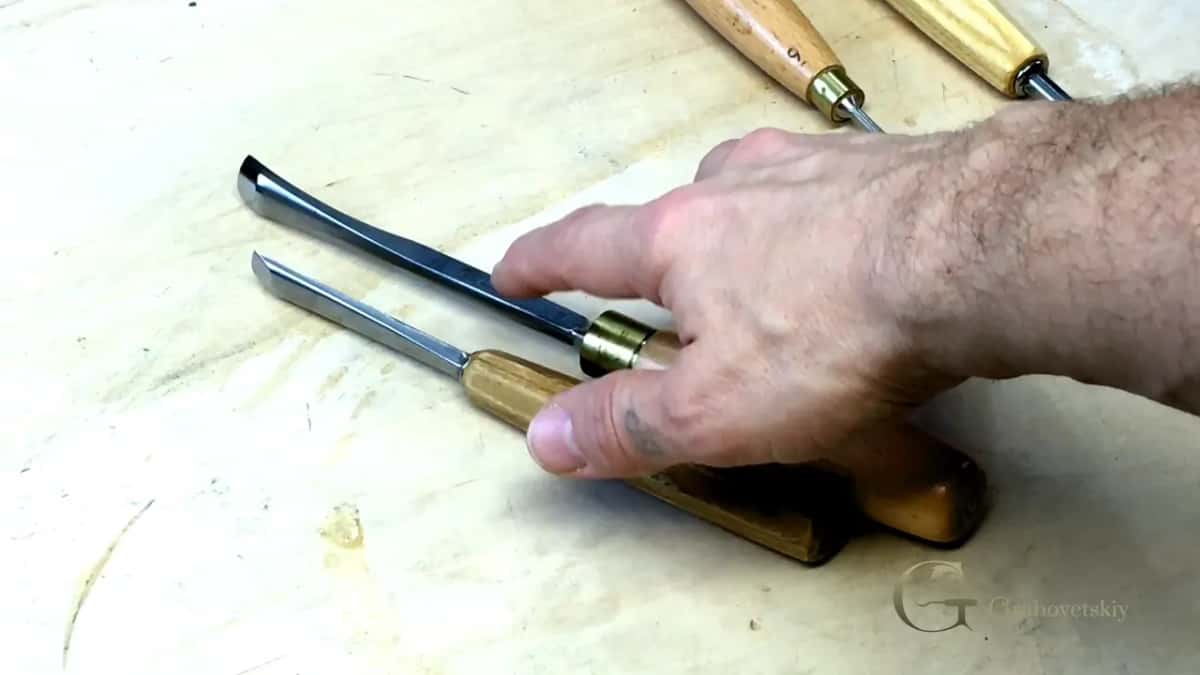
Auriou, when the price is within reach. It is a French-made tool, and Auriou started to sell in the United States only about six years before I filmed this lesson. The design is beautiful. Octagonal handle again, thicker than Pfeil, and near enough identical in the hand to the English tools. The steel is tempered to much the same place as everybody else, and the edge lasts a long time.
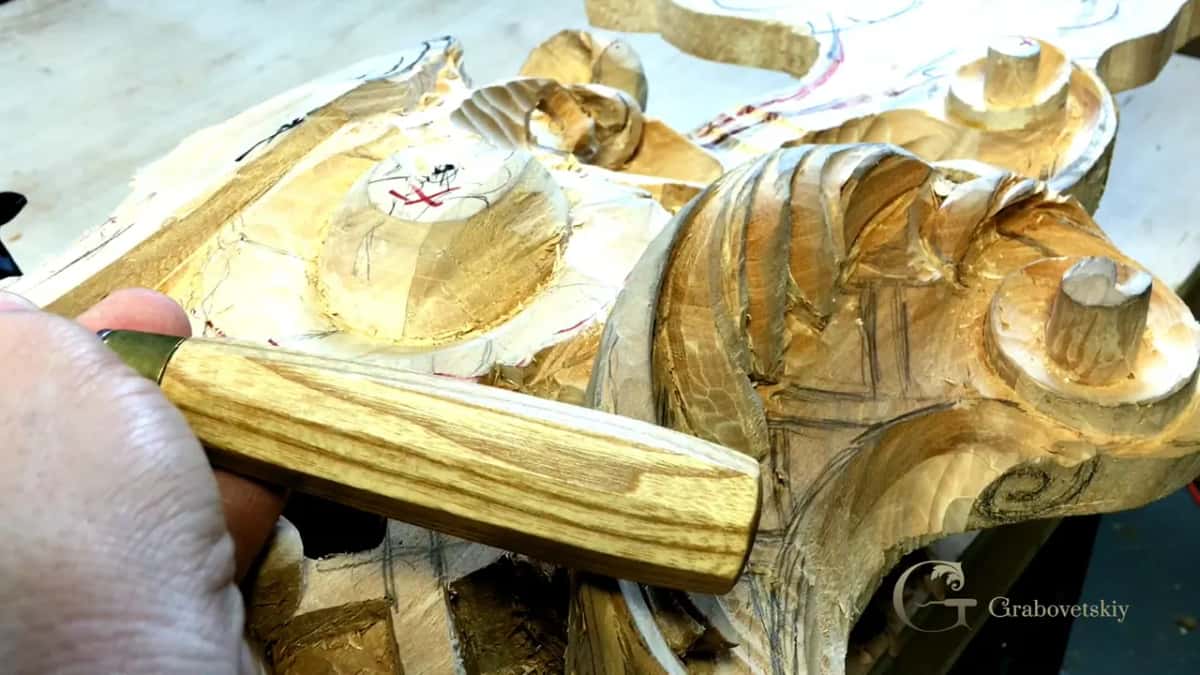
So I said that if you can afford them, Auriou is probably the choice number one for the beginner set, although it is a professional tool that will last you a lifetime, and you will use it every day. I have had my tools for years, and I use them daily. If I started collecting my tools from the beginning again, I would probably do the same thing.
Look at a number eight by Ashley Iles. It is massive, a really strong tool. And of course, if you abuse a tool, it does not matter how nicely it is built. It can still be broken.
For micro carving I really love, again, the Peter Benson collection that Ashley Iles makes. They are not really micro. More like mini chisels and mini gouges, and you can get in really tiny spots with them. On another livestream that April I held up a micro tool by Peter Benson and said Peter Benson is also a master woodcarver. In that stream, carving the eyes with a number nine of one-eighth of an inch, I said it does not matter what brand. You can use Pfeil, which is mostly available, and I was using Ashley Iles because I really love those tools. Sharpening tools that small has a lesson of its own.

The four makers stood like this in the lesson.
| Maker and country | What I said about it in this lesson | Where it stands |
|---|---|---|
| Auriou, made in France | Beautiful, holds the edge, and the octagonal handle is as thick as an English one | First, if the money is there |
| Ashley Iles, from England | Thick steel, mostly fishtails, a round handle with a satin finish | Second, and most of my tools |
| Pfeil, marked Swiss Made | Straight, lasts long, keeps a good edge, with a thinner handle | Third for me |
| Lamp, German steel | I own only micro tools, and they showed rust sooner than my Pfeil | Not the bigger sizes |
Which tools rusted on my shelf?
My Lamp tools. Lamp is a German steel, sold, I believe, by Woodcarvers Supply, and I have only micro tools from them. I saw some rust on those tools. They were lying on the same shelf, right next to my Pfeil tools, and the Lamp steel gets moisture in the metal quicker than Pfeil. I do not know how to explain why. A good tool, just not my choice. I would not buy the bigger sizes by Lamp, and I use them just for micro carving.
Did my order change after this lesson?
The top of it did. About a year later, in lesson 23 of the Hashemi flowers course, I came back to the brands I like, and Ashley Iles was still the one I liked most. I had bought an Auriou set about seven years back, when they first came on the market, and I was really impressed with how they were made, gorgeous tools with really good steel.
That year I found the latest editions and bought some more, and I expected the same quality. I was kind of disappointed, because the quality was not there anymore. It was not the same as what I had six or seven years before.
In my opinion, Ashley Iles is a complete set of all the tools you are going to need, and Pfeil gives you some unique tools that Ashley Iles does not provide. There is a whole lesson on why I reach for Pfeil more often. I really like Henry Taylor too. Those tools are not shiny like Pfeil, but the metal is gorgeous. Light tools, too, and the handle is the same traditional English handle as Ashley Iles, a little thinner.
On one more livestream that April I put it in order again. For a long time Ashley Iles had been my favorite tool maker, and their Sheffield steel is just gorgeous. Auriou was my second choice. The first batch I bought was the best of the best. After Auriou I would put Pfeil, Stubai and Two Cherries on the same level.
Can cheaper tools still carve well?
They can carve beautifully. On the Venice Room project I opened a set of seven Schaaf tools that look like Pfeil, and I reshaped one the usual way, with a really long bevel. It was a number three of 20 millimeters, 3/4 of an inch. There is absolutely no difference between really high-end, expensive tools and this one, I said, and it still carves beautifully. Please do not ask me about quality, though. You cannot compare those with really high-end tools, and it all depends what you mean when you say quality.

A smaller Schaaf set of four tools I showed there was almost enough tools to start carving. On the stream where I ranked them again, I said that for just the cheapest price I would probably go with Schaaf, and maybe with the Beaver tools from Ukraine, which are actually good. Both have a lesson of their own in this course, Schaaf and BeaverCraft.
How many gouges do you need to start?
It all depends on the project. On that April 5 livestream I said a complicated project probably needs a little more than 20 tools, and most of that work is done with number 11 veiners. Specialty tools like a skew gouge are really helpful, but I do not use them for all the school projects, because I do not expect anybody to buy them. They are not cheap.
In the beginner course I lined up the sweeps. The true gouge starts at number three, which is almost flat, and goes to number nine, the true half round. Ten and eleven are more like the letter U. Most useful is the number nine and number eight. The one I took for the curly kitchen cutting board was a number eight of about 10 millimeters, about three-eighths of an inch, made by Ashley Iles in England. If you are close to those numbers, you should be fine.
Keeping them sharp has a course of its own, and the rest of the tools course sits beside this lesson. If you want to see a number eight go into the wood, start with a beginner project.
How it's done
- Pick the maker you can afford. Auriou first if the money is there. For the lowest price, Schaaf, or the BeaverCraft tools from Ukraine.
- Start near a nine and an eight. These two sweeps are the most useful. I used an eight of about 10 mm, three-eighths of an inch, on the cutting board.
- Check that it is straight. Look at the handle against the steel. It matters when you buy, but it is not that big of a deal.
- Read the marking. On a Swiss Made tool one number is the sweep and the other is the width in millimeters. An 11 with a 4 is a U shape about 4 mm wide.
- Look up the London pattern. British carvers follow that numbering, and the Tools for Working Wood site lets you see all of those sweeps in one place.
- Lay a mat down if tools roll. Put some kind of mat on the workbench and lay your tools on it, and they will not roll anywhere.
Frequently asked questions
Which carving tool brand did you recommend for a beginner set?
Auriou, if your budget allows it. In this lesson I called it probably the choice number one, a professional tool you use every day and keep for a lifetime. About a year later a newer batch of theirs disappointed me, and Ashley Iles from England stayed my favorite.
How many carving gouges does a beginner need?
Four can almost do it. A small Schaaf set of four I showed on the Venice Room project was almost enough to start carving. A complicated project, I said in 2020, needs a little more than 20, mostly number 11 veiners.
Are octagonal handles better than round ones?
Both work, and I like both. An eight sided handle will not roll away, which is true, while a round English one is more comfortable for me when I hold it all day long. Carving daily, with round handles on my bench about as long as eight sided ones, I never had a tool roll off even once.
What to carve next