
Alexander Grabovetskiy, woodcarver, School of Woodcarving · Published 2020
What bevel should I have when carving hardwood?
Quick answer: The bevel I use for hardwood is short, most of the time, because a really long one leaves the metal weak at the point, and on oak or cherry that's a little dangerous. To keep my hand low anyway, I rounded the heel off one short number 3 gouge. My mallet gouge stays untouched.
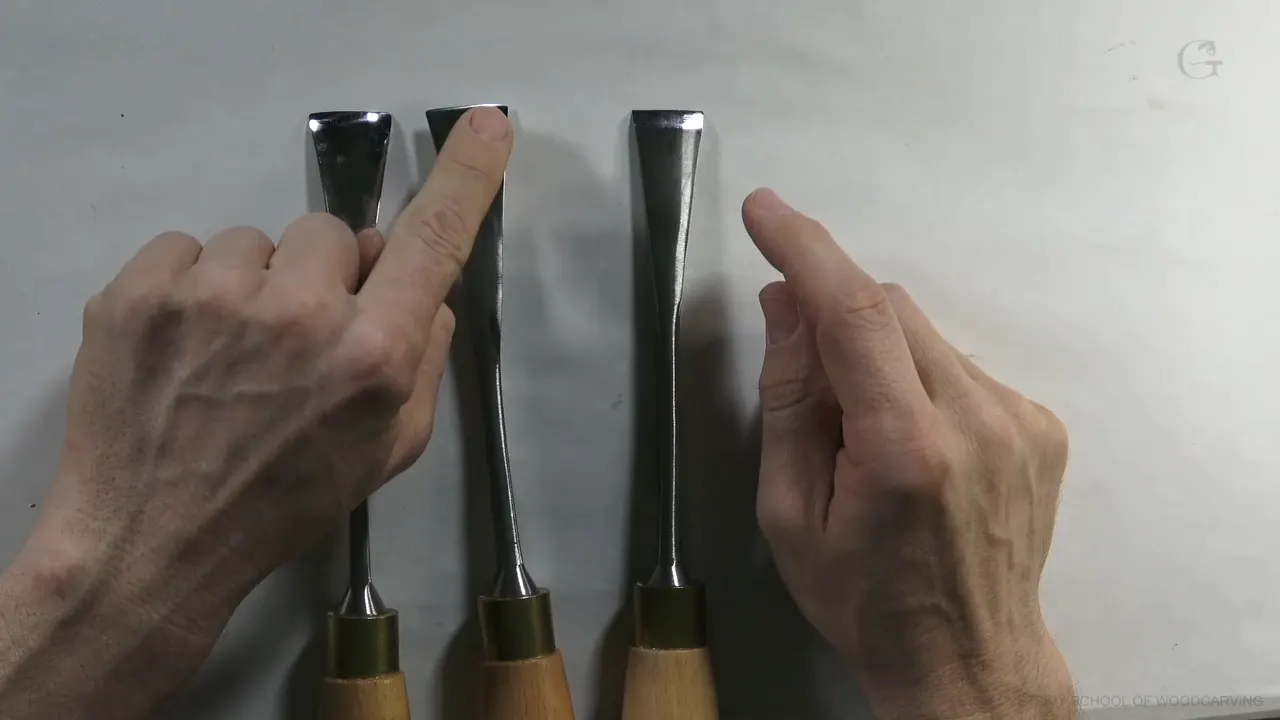
The bevel for carving hardwood is usually short on my gouges. A long bevel gets weak right at its point on the hard woods. But a short one makes you lift your hand high to get the edge in, and your elbow and shoulder come up with it. So on one of my number 3 gouges I rounded the heel off, and that tool still grabs the wood with my hand down low.
Have you ever turned a gouge over to look at the bevel? Did you wonder how long it should be? I read that same question on camera, about my last livestream, where I showed the longer bevel that's on my tools. Somebody wanted to know if I shorten my bevel for harder wood. And I said yes. Then I put three of the same tool side by side to show you why.
I'll show you the three grinds, the problem each one brings, and the two tools I carve hardwood with by hand. My other classes say it a little differently in places. I'll give you those too, each with the place I said it.
The short answer on bevels for carving hardwood
- For hardwoods like oak and cherry, I usually keep the bevel really short.
- A long bevel is weak near the point.
- A short bevel sends the handle up, and the elbow and shoulder follow it.
- On one short bevel the heel is rounded off, so the edge grabs while my hand stays low.
- One tool stays untouched, with a normal heel, for heavy mallet work.
- In other classes I keep long bevels on oak too, with a micro bevel inside.
What do three bevels on the same gouge look like?
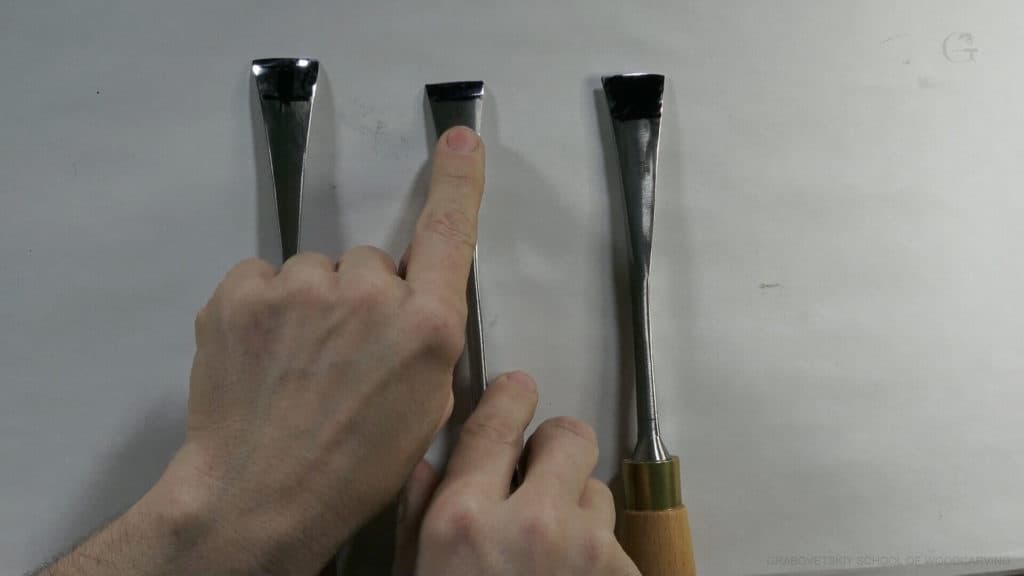
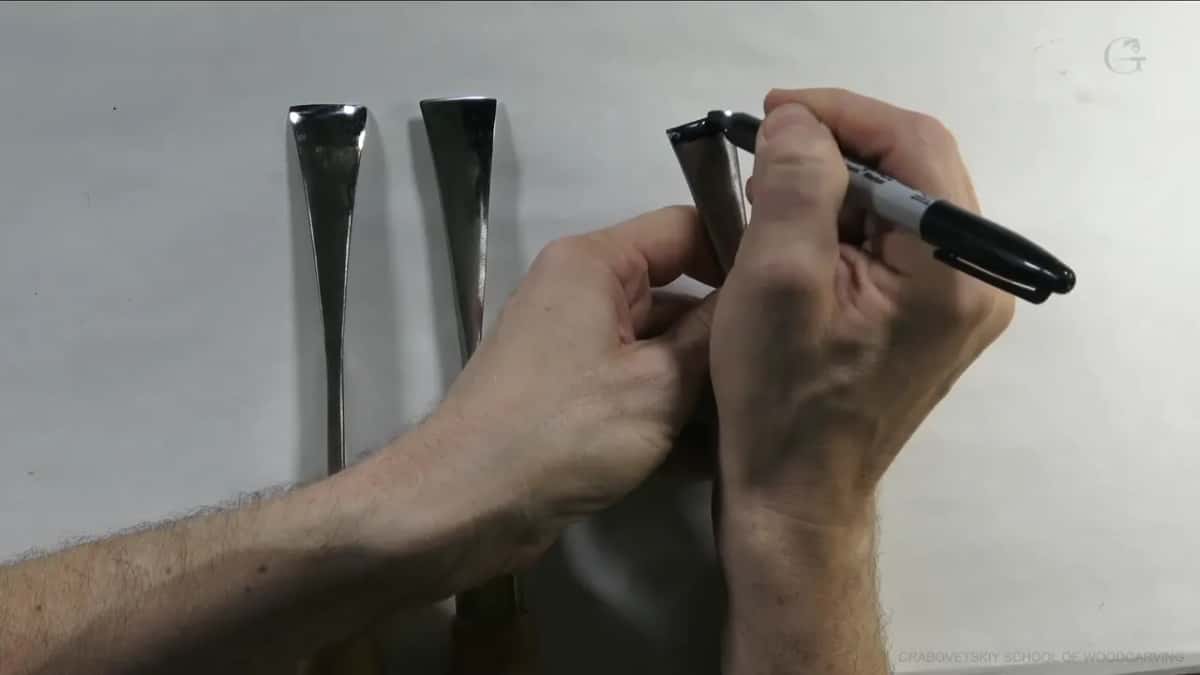
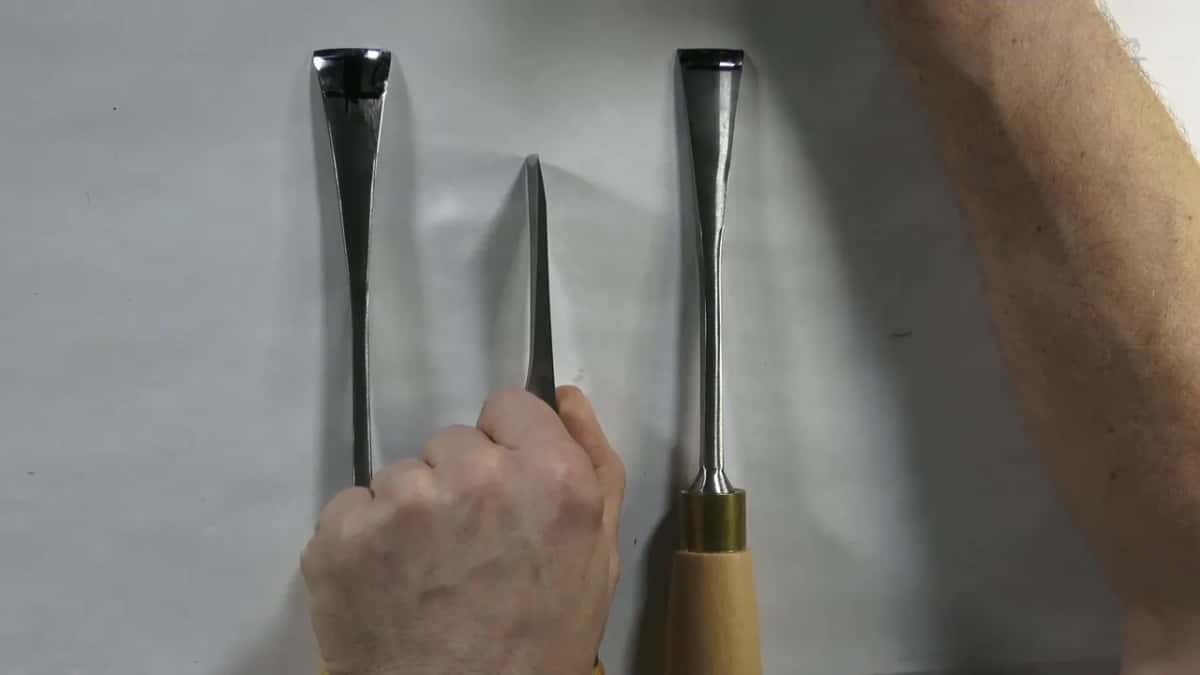
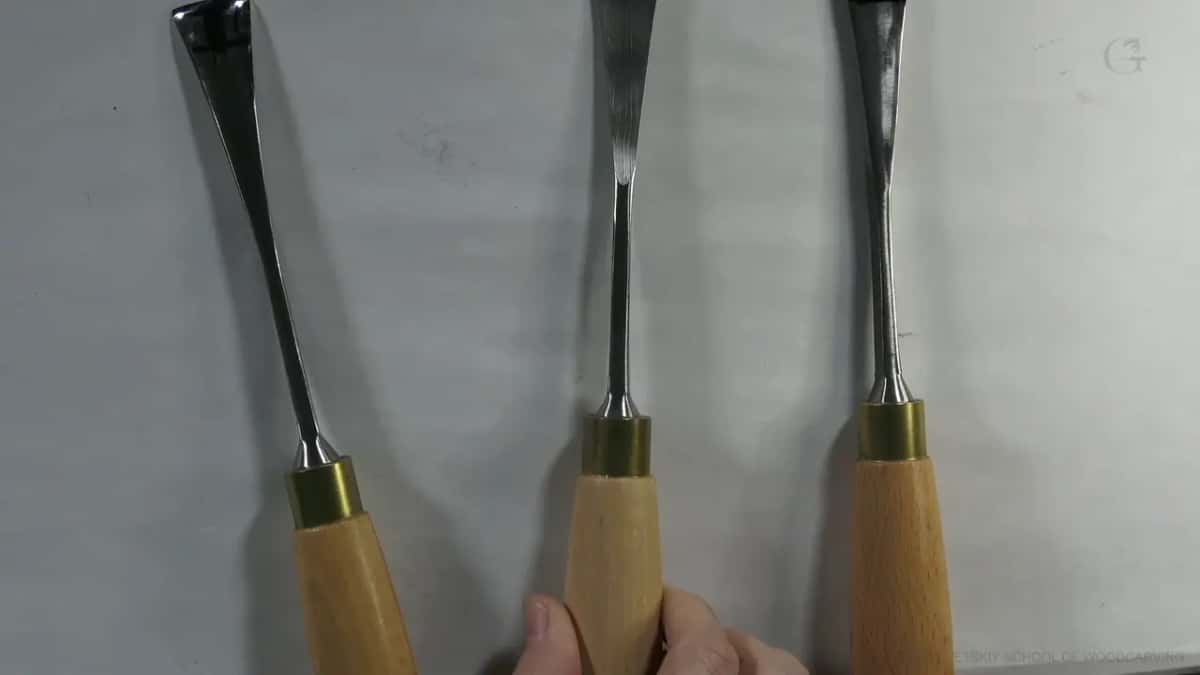
All three tools are about the same size, a number 3, and each one is ground in its own way. The first has a short bevel, only about a quarter inch (6 mm). That's what I have on it. The second one's bevel goes about 20 millimeters, about three quarters of an inch. The third is not even a bevel.
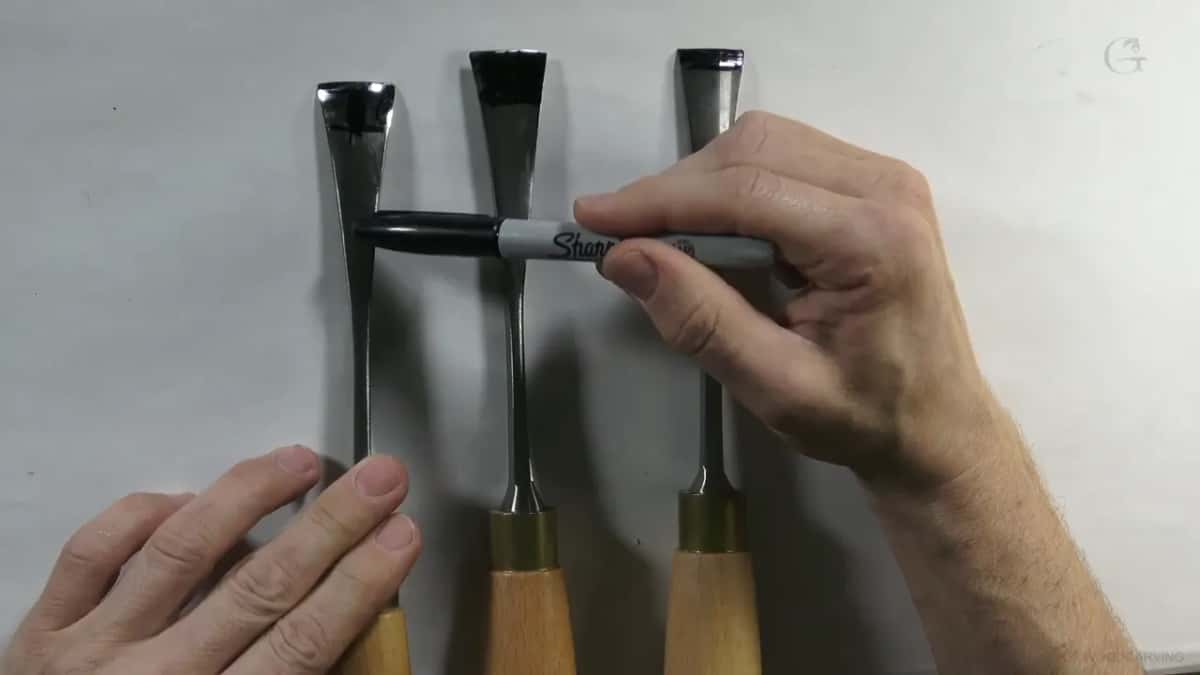
It's a short bevel, but rounded, so there's no heel. The heel is this part I pointed at, back where the bevel ends. The others have one. The third has just a really smooth rounding going on right there, and there's a reason why I did that.
Why is a long bevel risky on oak and cherry?
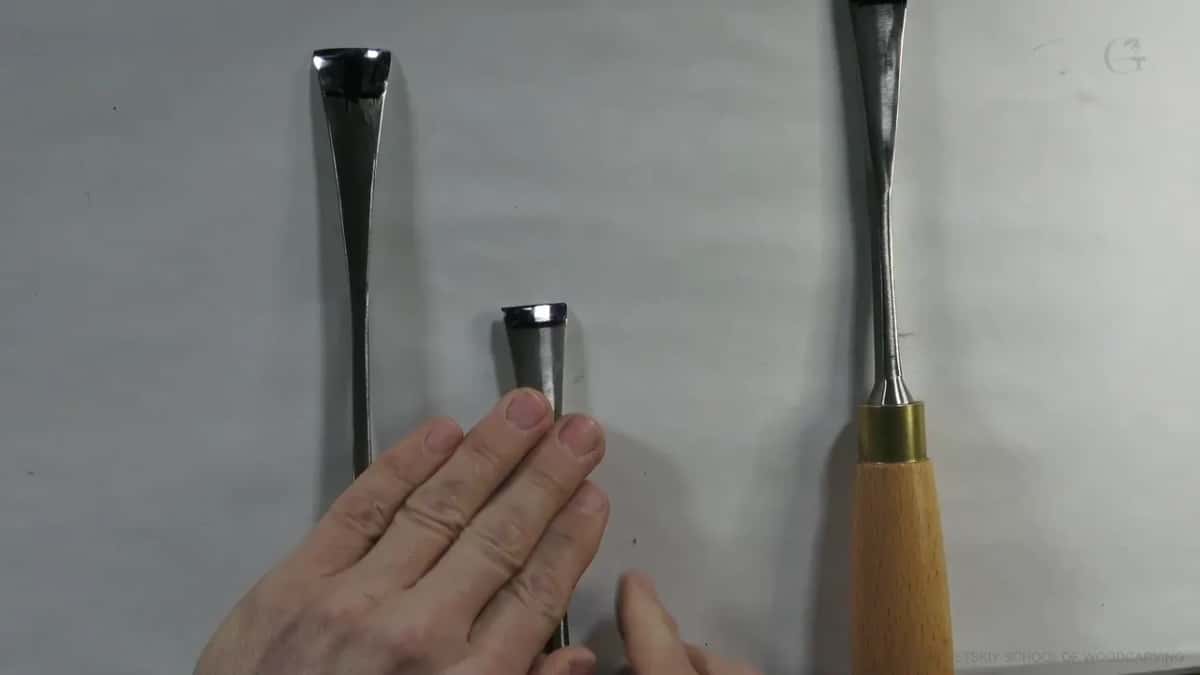
When you create a really long bevel, the metal near the point becomes really weak. I brought the tool a little closer to the camera to show you the spot. And if you use that on the hard woods, like oak or cherry, it can give you trouble.
Not all oaks are the same, though. Brown oak is a little softer than white American oak. Red oak is also really hard wood. With any of those hardwoods, a weaker or long bevel is a little dangerous, so for those I use a really short bevel most of the time.
In Venice Room workshop 41 you can hear what a long one does. I was pushing down with a gouge whose bevel is really long, and sometimes it just stops. The stopping point is something you can hear. I can break that tool if I force it too much, because I have almost no metal at the end, so I have to be careful with it. A bevel that long I wouldn't use on a hardwood, because you can break the tool, and it's easy to break. So I took a different number 7 with a smaller bevel. Much better. I didn't get that same effect. It was still kind of long, and shorter would have been better, but it was okay.
What goes wrong when the bevel is short?
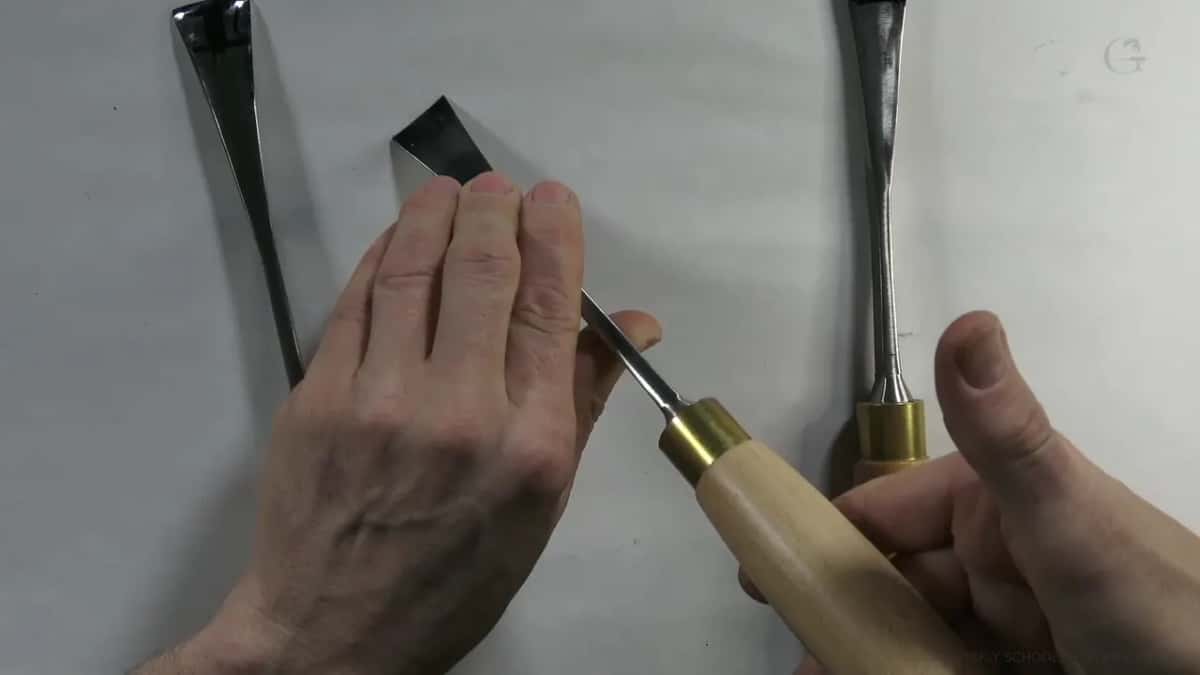
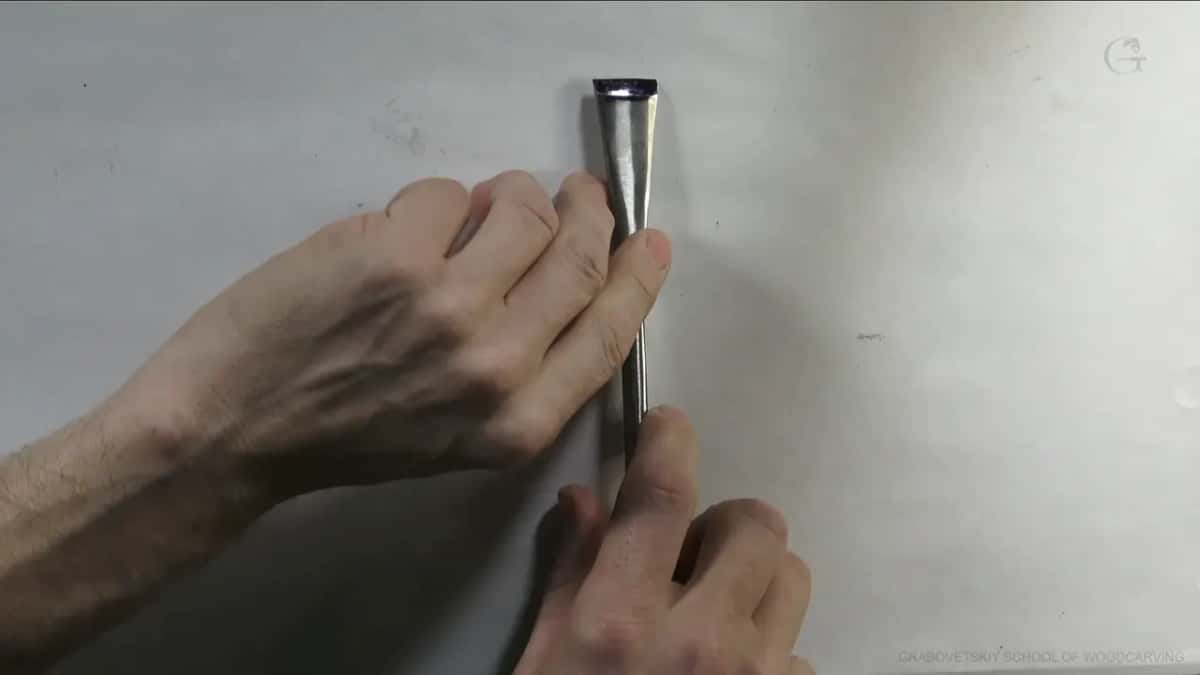
Your hand goes up. If the bevel is short like that, you have to raise the tool a lot. On camera I lifted it high and was still not grabbing the material. The video only has a sheet of white paper under the edge, and you can already see the height.
The trouble comes when you carve every day. Raise your tool too high, and your elbow has to come up, and then your shoulder. Do that all day long, many hours a day, and you get some pain. You get tired. You can get used to it, but you get tired.
I've said the same thing from the other side. Back at the Maine Coast in-person class I told the room that on softer woods the bevel has to be low enough that your knuckles almost touch the wood. That way you won't get pain, and you won't get tired with your shoulder and elbow, and you can carve all day long if the tools really have that low bevel. Some people call it a long bevel. I call it low. Pretty much it's low and long, so it's prolonged. A bevel is a wedge, I said, on a chisel or a gouge, and a high bevel causes resistance in the wood, lots of resistance.
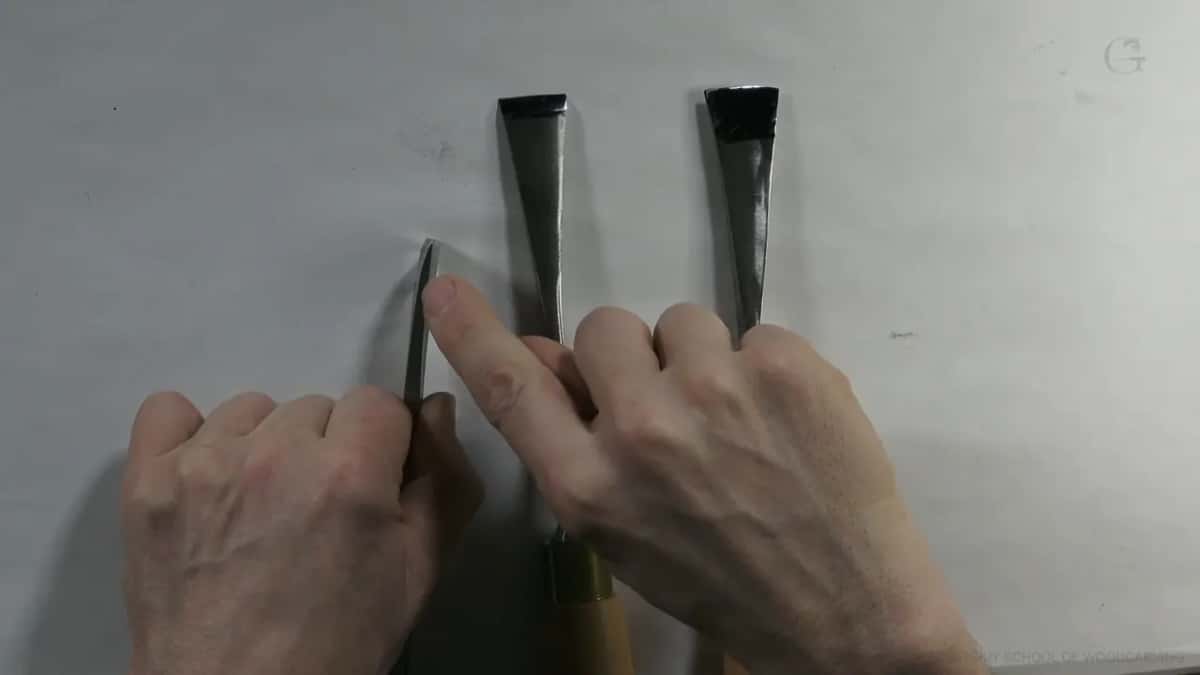
My lesson on sharpening a straight gouge shows what a high angle does in my hand. The tool just lays on that part, I can't carve, and my hand has to go really high, almost the elbow. Is it possible to carve like that? Yeah, absolutely. It's not a big deal.
How does a rounded heel fix it?
This is the tool where I got rid of the problem. Look really close at this part. It's really strong. It's not really long. But just because I rounded that heel, I'm still able to grab the material, and my hand is still kind of low. I don't have to raise my elbow.
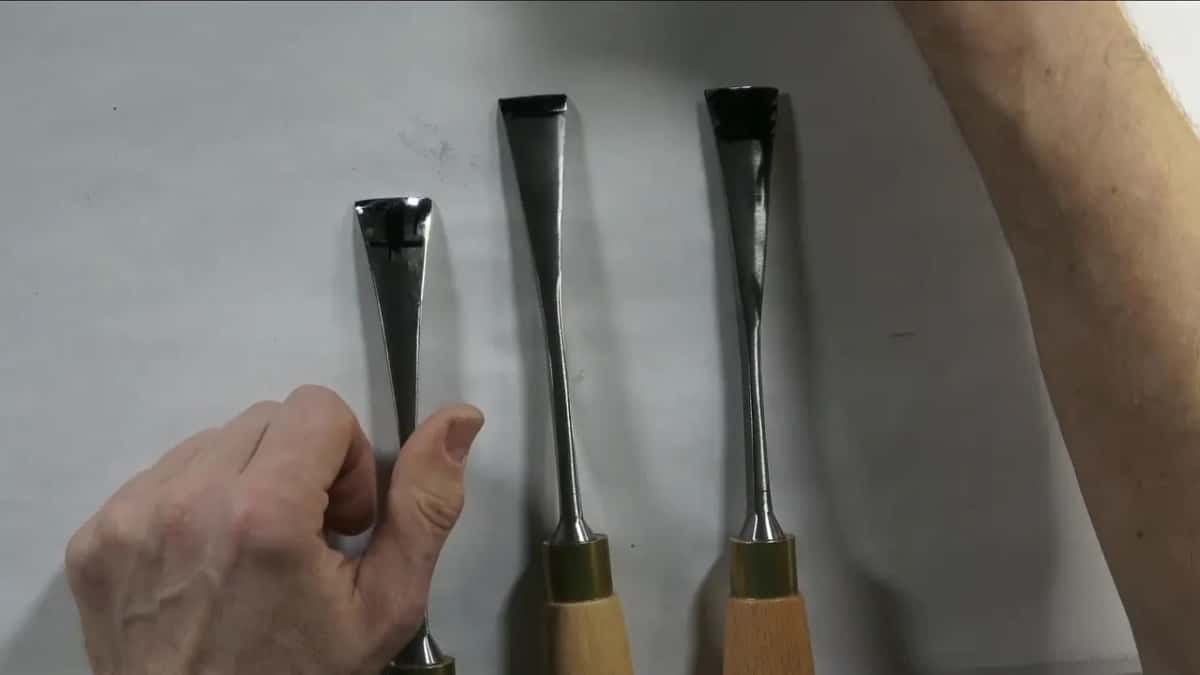
I just got rid of the heel. That's the whole change on that number 3, a short bevel with a smooth rounding where the heel used to be. The short bevel keeps the edge strong for the hard wood, and the rounding lets it reach the wood with my hand down low.
How did I round it? This video doesn't show that part, and my grinding and honing lessons live in the sharpening course. One warning from the Maine class, though. Every ordinary grinder is wheel based, and a grinding wheel leaves your bevel hollow, so that part becomes even weaker. It also overheats the tool at the weak spot, even when you don't see it turn blue, and then you're going to break it really quickly. I said it plainly in part two of that straight gouge lesson, while grinding a gouge. If your metal is blue, you killed your tool. You can regrind it and take out all the blue, and it's not the end of the world.
Why leave one gouge untouched for the mallet?
You're probably asking me why I left this one untouched. If you're using a mallet on the hardwoods, you usually use a really heavy one. Mine is two pounds, 32 ounces (about 0.9 kg).
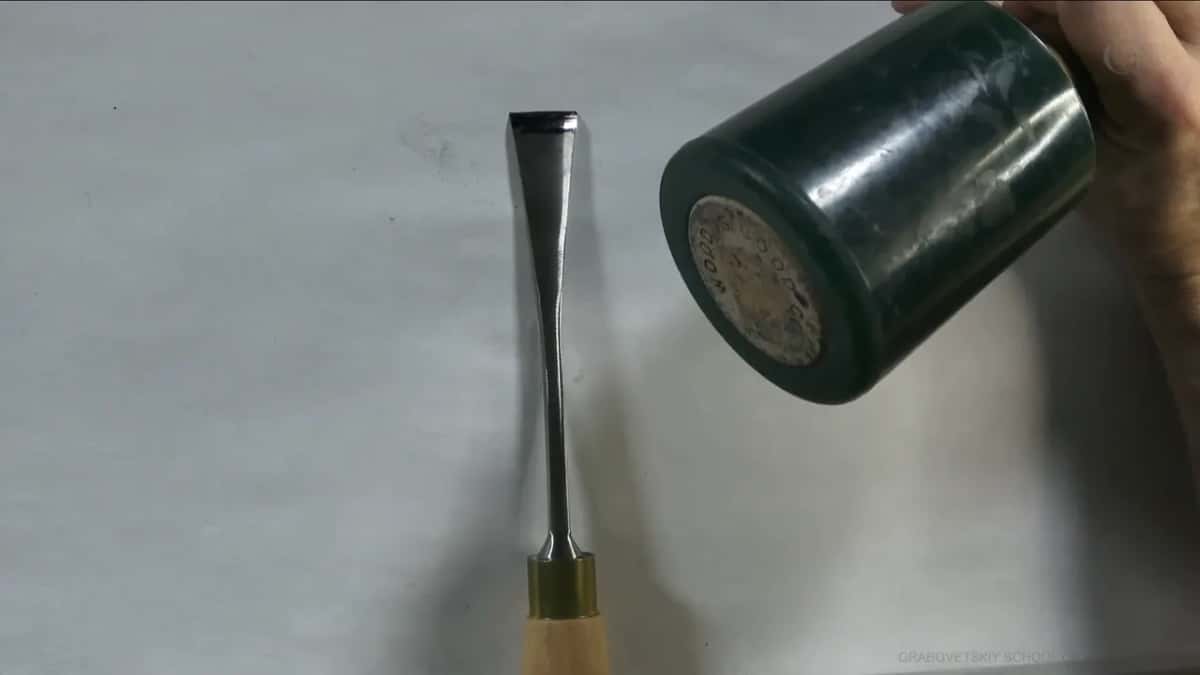
With a mallet you really have to hit the end of the tool, the handle. I set the mallet face on it to show you. About three inches, I said, even a bit more than three inches, about three and one-eighth, about 80 millimeters. You can't just slide along a piece of wood, so you really need to raise it. The only way to carve is to raise it up, and then you can hit.
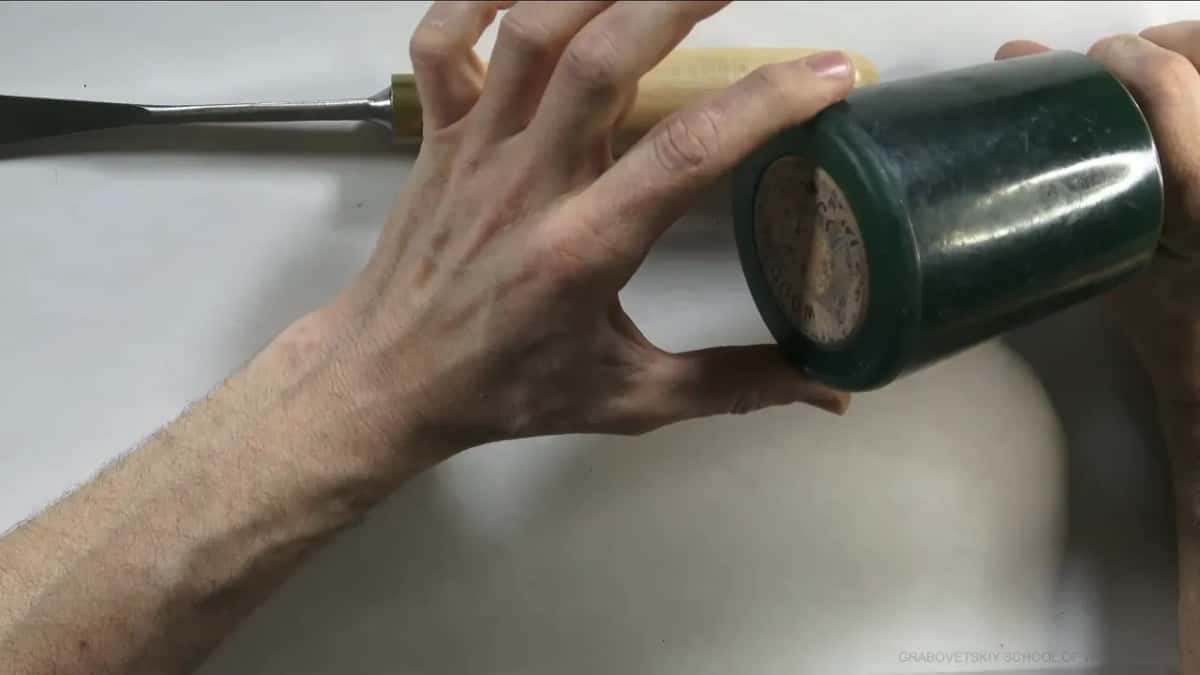
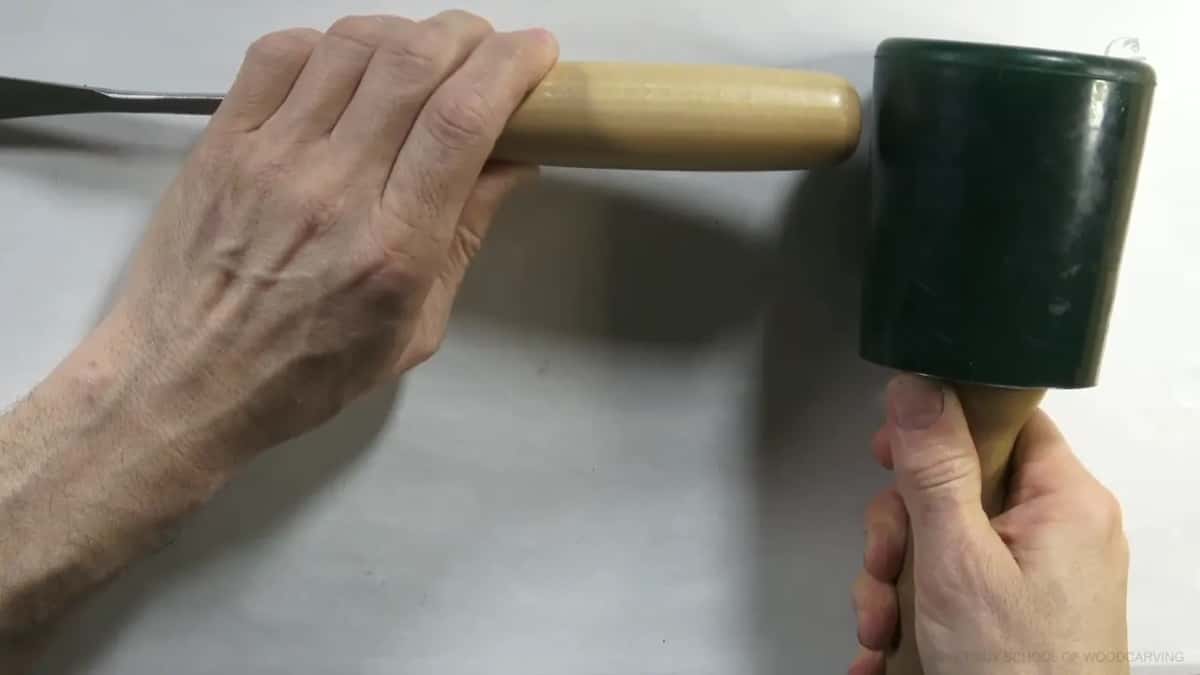
That's why I left some of my tools without a long bevel. They're for the mallet and the harder woods. I gave the Maine class the same reason another way. You have to consider how thick the head of a mallet is when you hit, so the tool has to be raised enough for not touching the surface. Then it's slightly higher, if you're using a lot of that technique.
In a question and answer video of mine someone asked what angle I'd recommend for oak. Of course, oak is the harder wood, I said, and to carve oak, most likely you have to use a mallet. It depends how thick your mallet is, so you set that bevel by how you want to hit. I'm not measuring the angle. I'm just eyeballing. The best bevel for me, mallet or not, is when your hand goes underneath the handle, your knuckle almost touches the wood, and the edge grabs the material. If you want to be really technical, that comes to about 18 to 22 degrees.
Which two gouges do I use on hardwood by hand?
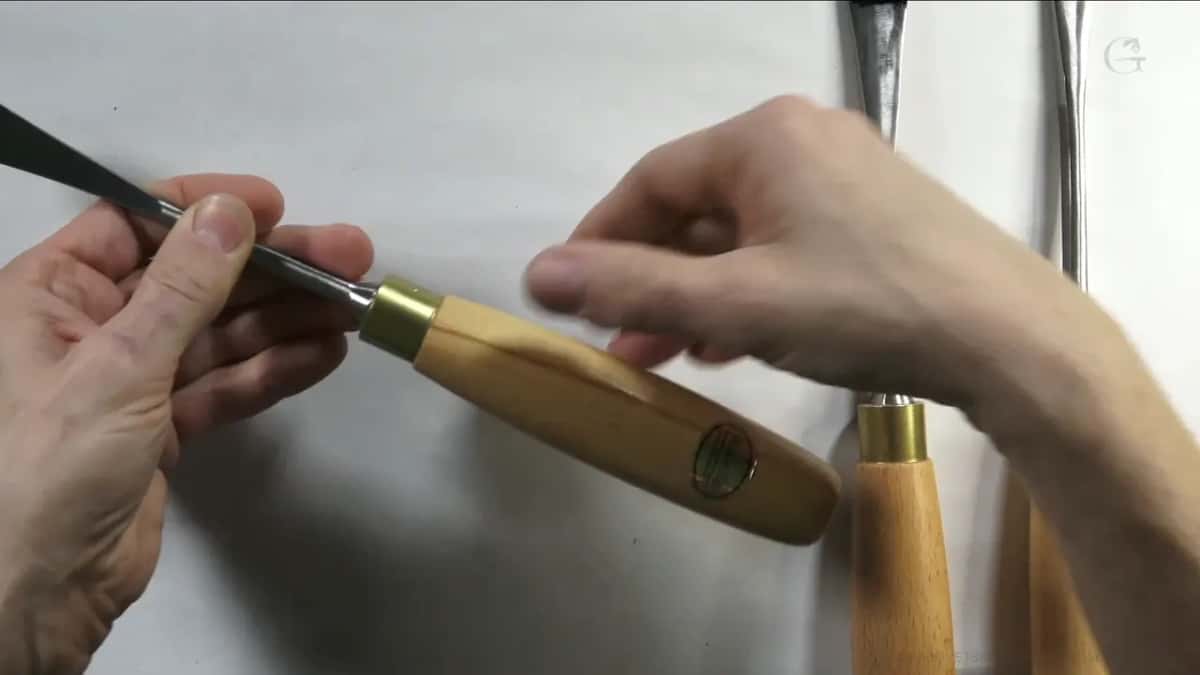
The harder woods don't take only the mallet, though. You also carve by hand. By hand, those are the two tools I'm using for the hardwoods. One has the rounded heel. The other has just a normal heel. At the end I brought them a little closer to the camera and asked if you could see that.
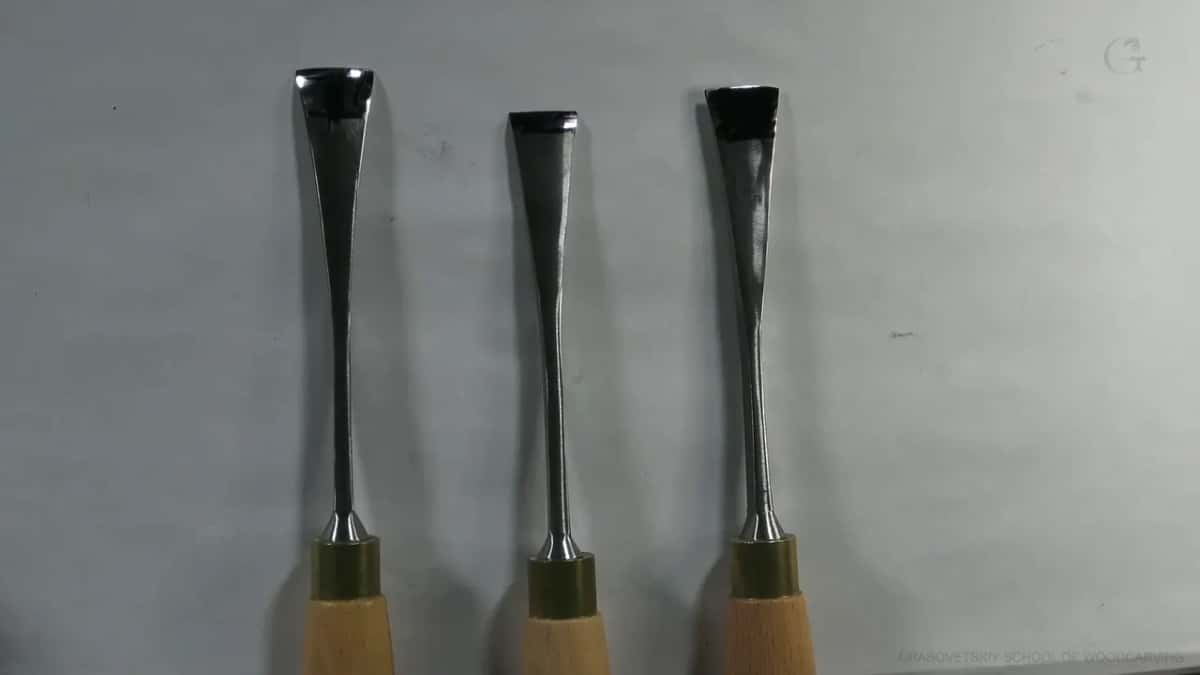
Side by side, here is each grind as I described it in this video.
| The grind | What I said about it on camera | When I reach for it |
|---|---|---|
| Short bevel, about a quarter inch (6 mm), normal heel | My usual bevel for the hard woods, but I have to lift it a lot to grab the wood | Mallet work, and by hand in hardwood |
| Long bevel, about 20 mm (3/4 in) | On hard woods the metal gets really weak at the point, a little dangerous | Not my usual pick for hardwood |
| Short bevel with the heel rounded off | Really strong, not really long, and my hand stays kind of low | By hand in hardwood, elbow down |
Do I always keep a short bevel on hardwood?
In this video, mostly yes. But I've talked about bevels in other classes too, and they don't all land on one rule. I'd rather you hear each one in the place I said it.
In the Hashemi Flowers course, workshop 24, I showed a tool with a really, really long bevel. Almost all of my tools, I said, have a long, long bevel. A brand-new tool usually comes with a bevel that's really short, and you can see the thickness is the same on my tools. One of them I use more for the mallet. Carving by hand, I use the long one, and harder woods like oak get the short bevel. And the long bevel I use almost everywhere, pretty much. Actually, on oak also. A really low bevel makes it a lot easier to slice through the fibers, with a lot less resistance.
I said both things in one breath in the spoon gouge lesson. I have some tools with just a short bevel and some with long bevels, and that all depends on how you use it, by hand or with a mallet. If it's a hardwood, you have to do a shorter bevel. Softer wood can take a longer one. But I'm staying on the longer bevel even for the hardwood, and sometimes I use the same gouge on the hardwood and soft wood.
At the Maine Coast class, when someone raised the wood itself, I took oak. A hardwood, and you can break the edge, because at that point it becomes really weak. And then I said, not necessarily. We establish the main bevel first, and a secondary micro bevel on the inside. It's still low enough, but that point becomes really strong, and you're still able to use it on a hard wood. Half a minute later, after the mallet, I put it in one line. If you're doing a lot of just hand pushing, the lower bevel always wins. Then someone asked whether the micro bevel goes on every time or only for very hard wood. Always, I said, on all of my tools, because some of them are so extremely low that the point would be weak.
Back in that straight gouge lesson, it goes the other way again. I showed a number 7 by Ashley Iles, made in England. Its angle is really low, about half an inch (13 mm) back from the edge, and it has a micro bevel too. Beside it lay a tool of the same thickness whose angle was really high. I resharpened one and didn't do anything to the other. When I'm carving oak, I'm using the high one, because it's much stronger. Lime wood or basswood gets the low one. For fine detail in lime or basswood I like a really low angle, about five degrees, even lower.
So these videos don't settle on one length for hardwood. Two things keep coming back, though. A really long point is weak, and the mallet needs the handle raised. Past that, as I said in the Venice Room, on some tools I have a long bevel, on others a higher one, and it all depends on the job I'm doing right now.
Is oak harder to carve than lime?
A lot harder. On a livestream in April 2020 someone said they expected lime to be easier than oak because of the grain. Absolutely, I said. Oak is a lot harder wood, and lime wood, which is the best wood, is absolutely easier. I still love to carve oak, especially English brown oak. Walnut and cherry too. But on most of my projects, if I have a chance to carve basswood, I use basswood.
And it depends on the oak. When a viewer wrote that they hate carving oak, I said if it's a white oak, I don't like it either. But English brown oak just carves beautifully. That fits this video, where I called brown oak a little softer than white American oak.
Can you find the heel on a gouge now? And do you see why one tool of mine stays untouched for the mallet? Then you hold the start of this lesson. The whole video sits in my course about tools, with the other tool lessons beside it, and you can pick a course and begin whenever you're ready.
How it's done
- Find the heel. Turn the gouge on its side and look behind the edge for the spot where the bevel ends. That part is called the heel. On my third number 3 it's gone, rounded smooth.
- See how long the bevel runs. Roughly 6 mm is what the short one runs on my number 3. The long one runs around three quarters of an inch, and on that one the point is the weak part.
- Check your hand on the wood. Put your hand underneath the handle so your knuckle almost touches the wood, and see if the edge grabs. If the tool must go way up and it still won't grab, your elbow pays for it, and your shoulder too, over a long day.
- Round the heel for hand work. On a short bevel you carve hardwood with by hand, take the heel off and leave a smooth rounding. That way my elbow stays down, and the edge stays strong.
- Leave the mallet gouge alone. A normal heel is fine on the gouge you strike, since a tool hit on the handle stands high anyway.
- Keep really long bevels out of hard wood. Ground that long, the end has hardly any metal. I wouldn't put one on a hardwood, because the tool is easy to break.
Frequently asked questions
Does a short bevel make a carving tool stronger?
On my tools, yes. Grind it long and the tip ends up thin, and on one Venice Room gouge I said I could break it by forcing it. For oak I take the higher, untouched one in my straight gouge video, since that one is much stronger.
How long is a short bevel on a number 3 gouge?
Mine in this video runs a quarter inch or so, roughly 6 mm, while the long one next to it reaches around 20 mm. I don't measure angles. I eyeball them, though in one question and answer video I put my best bevel at 18 to 22 degrees.
Why does carving with a short bevel tire my shoulder?
Your hand has to come way up before a short bevel grabs the wood. The elbow follows, then the shoulder, and after many hours a day you get some pain. Rounding the heel off let my hand stay low on that tool.
What to carve next