

Alexander Grabovetskiy, woodcarver, School of Woodcarving · Published 2020
What is the difference between wood carving and sculpture?
Quick answer: Wood carving is sculpture made by taking material away. A modeler builds a form up in clay and keeps adding, while a carver starts with a block bigger than the piece and chops out whatever doesn't belong there. On my ceiling panel the main movements were planned first, and I left wood standing wherever I might still need it.
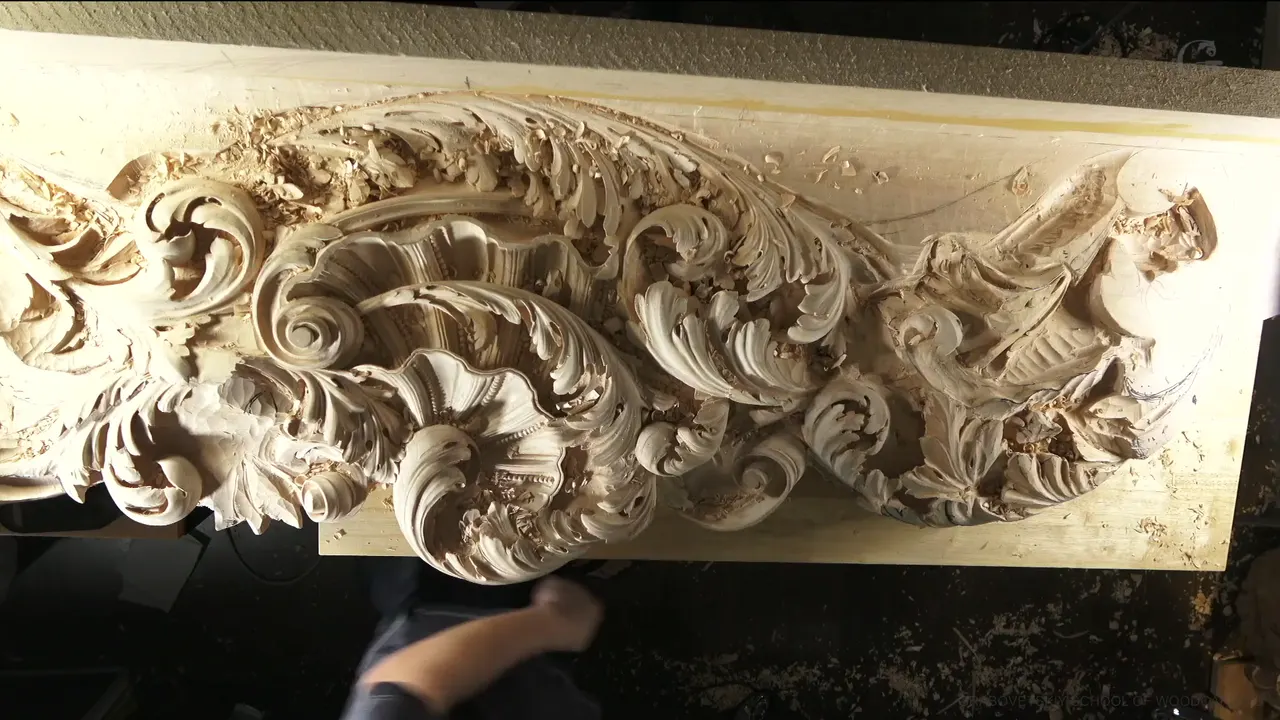
Wood carving is sculpture that works by taking wood away, chop after chop, until the form is all that's left. Carvers are sculptors too. We work in three dimensions like anyone who makes a figure, so the real split in wood carving vs sculpture is the way the material moves. Modern sculptors usually build a form up with clay or other media. On my bench it goes the other way. I start with a chunk bigger than the piece and take out whatever isn't supposed to be there.
Would you like to see a chunk turn into a leaf? Would it help to know what a carver has to keep back so he doesn't run out of wood? Then come to my bench for workshop 55. You'll get the plan I carved from, the story of some huge lion heads I modeled in plastilina first, and one plug cut I called off because part of a shell was coming.
What workshop 55 shows about carving by subtraction
- A carver is a sculptor who only chops out, while most sculptors working now build up with clay or other media.
- I'd say millions of people draw and paint. Maybe thousands sculpt.
- Michelangelo sometimes carved directly into the marble, and he worked from models too.
- Before I carved a group of big lion heads, I modeled them in plastilina.
- This ceiling was planned in its main movements only, and the eyes and separations came out on the wood.
- I leave wood standing where a corbel will connect, where the next part meets it, and around an eye I might still change.
Where does the line fall in wood carving vs sculpture?
At the direction the material moves. A carver is a sculptor, and I should say we work with sculpture the same as anyone else, in the three-dimensional world. Most sculptors working today add on. They put clay or some other media onto the form. They add, add, add, chop a little out and add again until the form is there, and they use a lot of clay and concrete, which takes its own skills.
Wood and stone go the other way. You're not adding stuff on. You chop, chop, chop, and what you're doing is taking away whatever isn't supposed to be in that particular piece.

The Wikipedia page on sculpture draws that same line, carving as the removal of material and modelling as the addition of it. It even names my side of it. Subtractive, the page says, and that's the right word for what happens on my bench all day.
How many people can work in three dimensions?
Far fewer than can draw, in my view. There are a lot of artists who draw and paint in two dimensions, millions of people all over the world, and in almost any village, in any country, at least someone is artistic and can draw. Even in a small classroom of 10 to 30 children, almost every class has one artistic child.
I was one of those children at school. I always had to do something for the class, and that meant drawing and painting big informational posters.
Sculptors are rarer. Millions of artists, and only maybe thousands of sculptors, the way I see it. Sculptors work in the three-dimensional world, painters in the two-dimensional one, and carvers are one kind of sculptor inside that smaller group. They're artistic too, with that same ability to develop a beautiful design, and so is anyone who carves wood or stone, works clay, draws or paints.
In old England, the way I tell it, carvers even stood on levels, with boat carvers and their axes and adzes at the bottom and Grinling Gibbons at the top, because he could design and think in three dimensions. If his kind of work pulls at you, the Grinling Gibbons class is where to look.
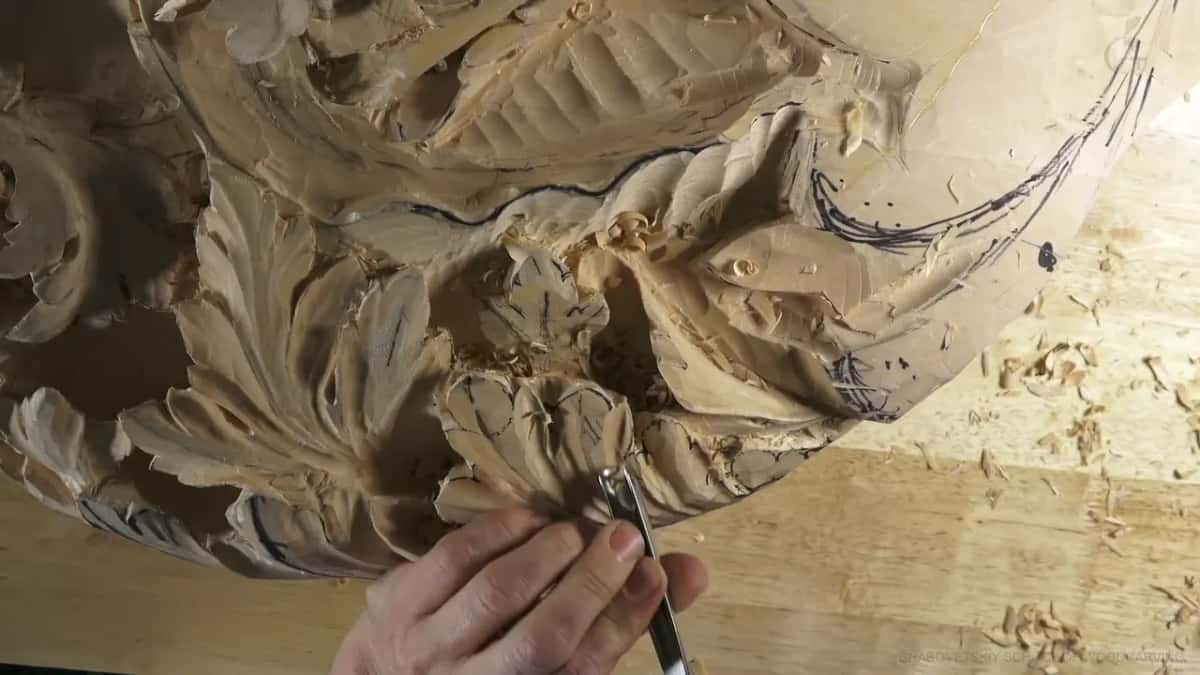
Did Michelangelo only see the statue inside the marble?
He did at times, and that's the picture we carry of Michelangelo. A huge piece of marble, the form already there inside it, and a man chopping until something like the David stands up out of the stone. That's what we think he did all the time.
Study that period a little deeper, though, and it wasn't always that way. He made models too, and the history of Renaissance sculpture says wood carvers of that age worked both ways, some straight into the block with a small sketch for guidance, others from a model in plaster or clay.

Sculptors later went a step further. They made a clay model and copied it onto the marble with a pointing machine, an old kind of copy machine, if you like.
Does a carver ever add anything?
Only in a model, or when boards get glued together for the blank.
Let me tell you a story. A while back I carved lion heads, huge ones, about 48 inches (122 cm). I started from modeling. It wasn't hardening clay, only plastilina, the soft kind, and I modeled everything on that lion in it before any wood came off. Sculptors did that, and I do it sometimes too.
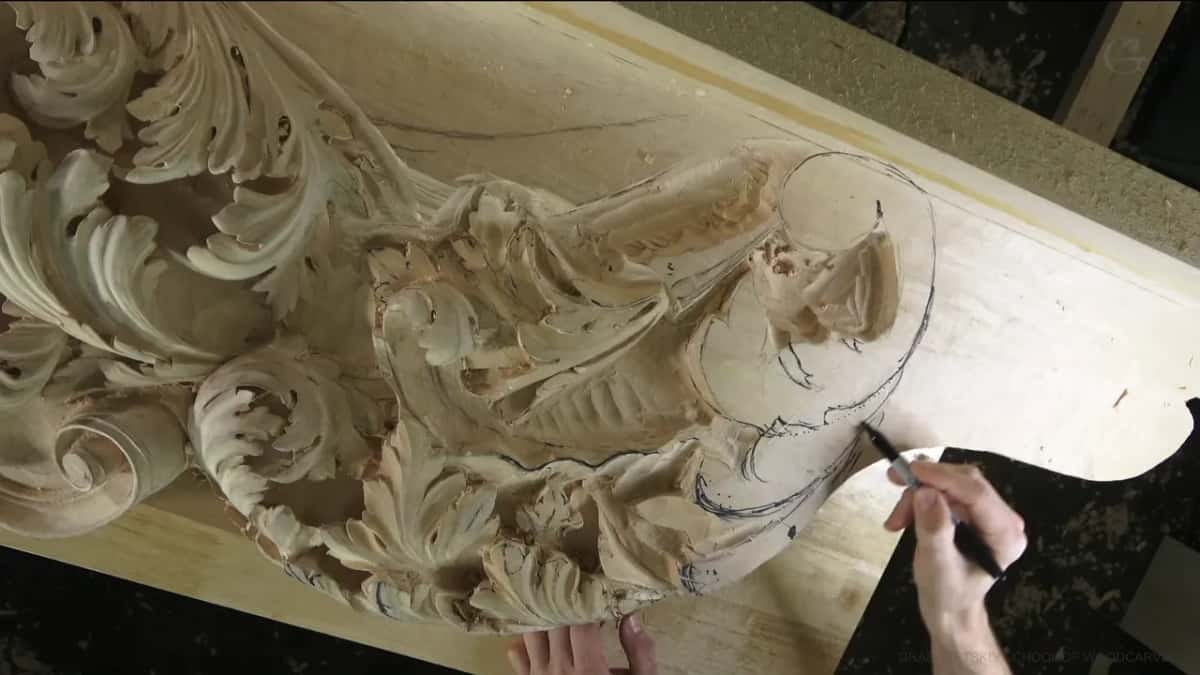
This ceiling had a model of its own, on a computer. I worked out the main movements in 3D with no details at all, and on the wood I'm following those main movements.
The glue is plain joinery. This part of the panel runs on up toward the ceiling, so another board gets glued on above it, and later a huge corbel will be connected to it with two big dominoes. That's the adding. Once a gouge goes in, the work runs one way.
How does a chunk of wood become a leaf?
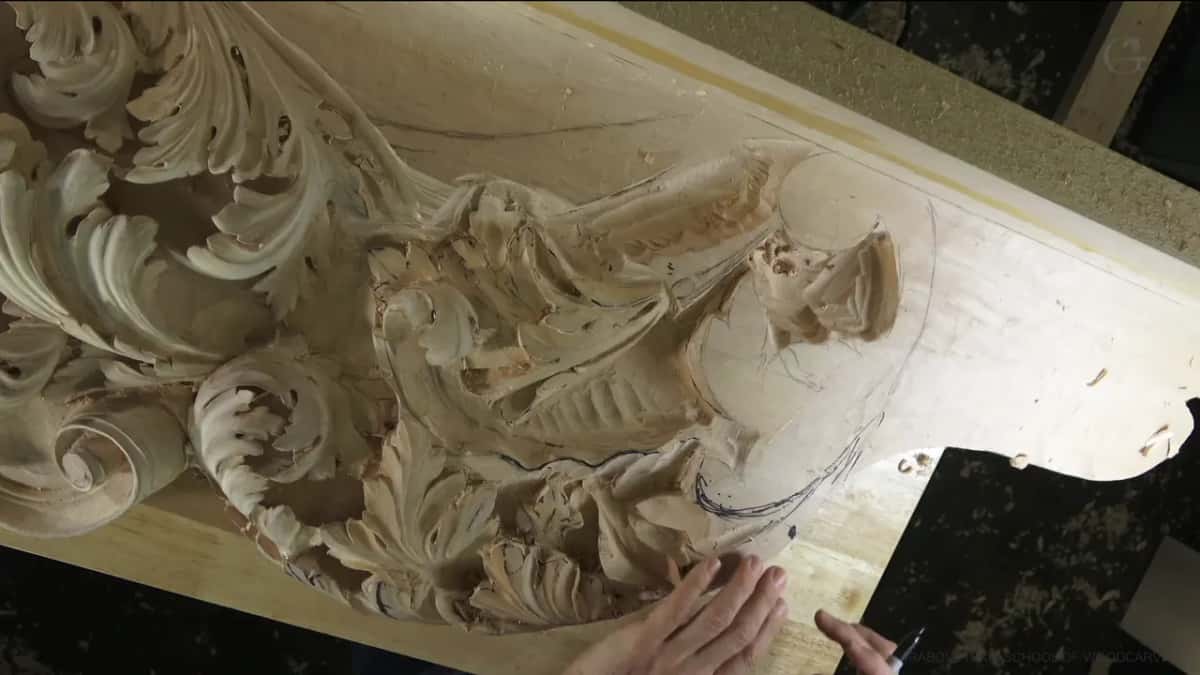
Slowly, one piece of waste at a time, over the whole session. Early in workshop 55 I had a chunk at one end of the board, and I needed to develop a movement out of it that connects to the overall movement of the whole ceiling. As of then it didn't make any sense. This part becomes the head of an acanthus, and most of another part may end up invisible, while a little piece will grow from underneath the movement beside it.
It doesn't make sense yet, I said on camera. But it will. It will.
I'm not going to show you the big picture today, because for me it's impossible, so I'm working on just one of the sections.
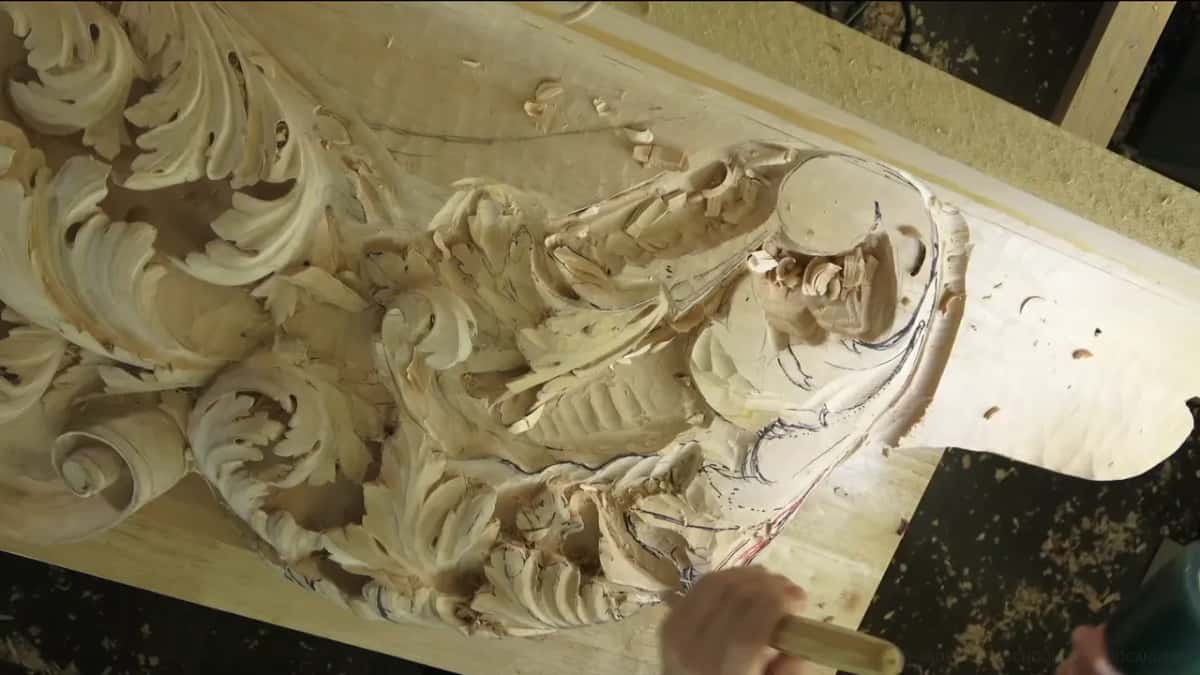
It also has to stay authentic to the original, and this is Venetian style, from Venice, Italy. The first pass on the chunk was an outlining cut, or setting in, as they call it in England, with a 12 mm number 11, about half an inch, and a mallet behind it. I hold the mallet free hanging, loose inside the palm, so the hand doesn't get tired.
What does taking wood away force a carver to keep?
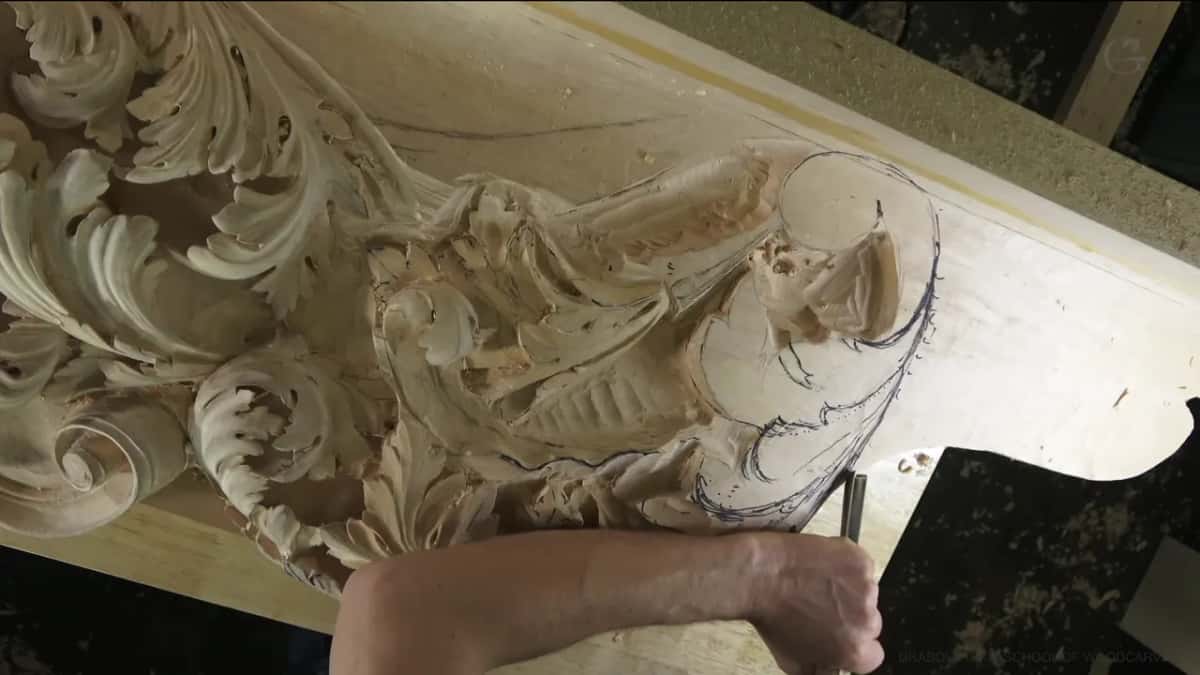
Wood you won't see, and wood you might still need. Where that corbel will connect, I have to keep some thickness, and you won't see it once the panel is up, but I have to keep it.
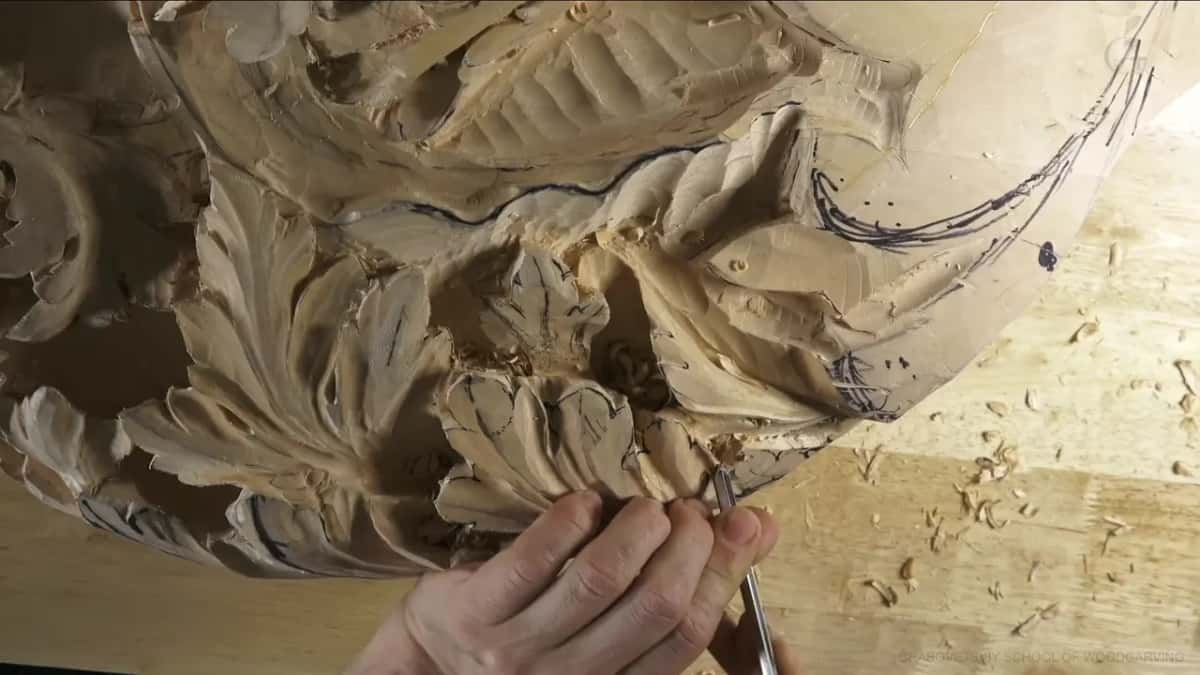
Deep work asks the same thing. When I went in with a 30 mm (1 3/16 in) number 11 for a three-dimensional look, I tried to get that side as low as possible and still left a chunk for the connection point. I know it looks scary. It's not. I know what I'm doing.
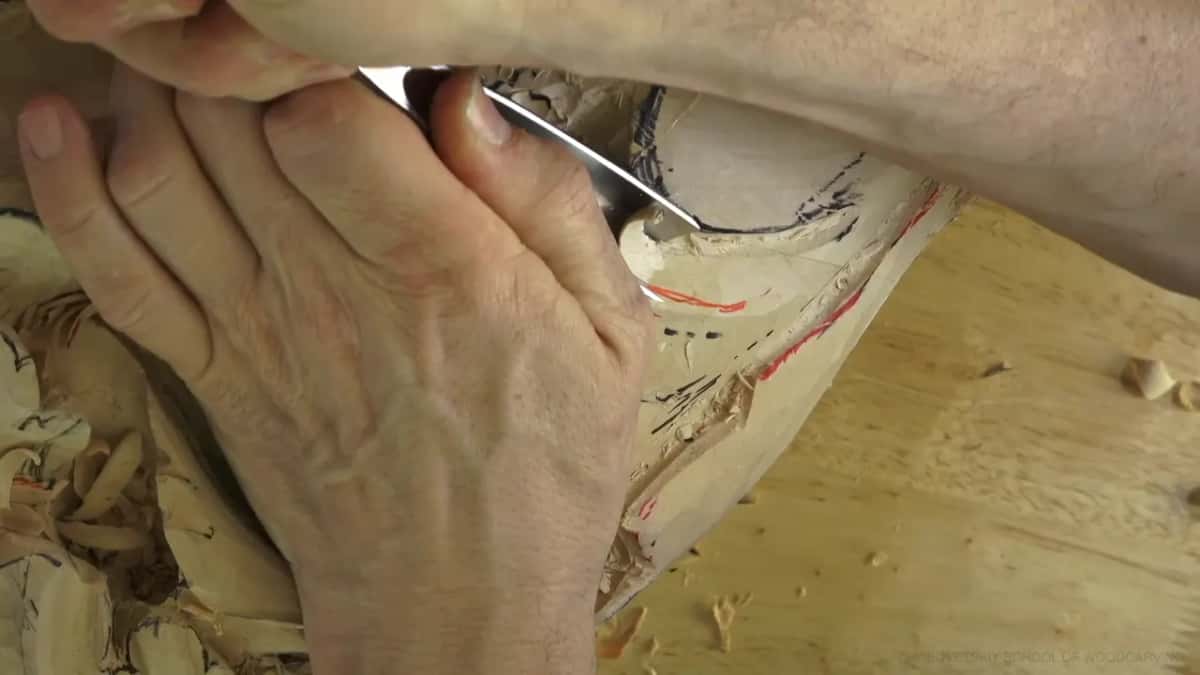
A leaned veiner asks it too. With a 10 mm (3/8 in) number 11 tipped over to one side, I carved a deep concave and raised the ridge beside it, without taking too much from the other side, because I didn't want to lose the main convex. And I still didn't lose my convex.
I'll even keep a piece just because I like it. One chunk on the new leaf was sticking out a little, and I wanted to save it.

And on the first big eye of the new leaf I went almost huge. Let's see if it's going to look good or not, I said, and if it's not, I still have material. Wood sets limits the other way too. In one area I wanted much bigger eyes, up to 10 mm (3/8 in) maybe, and I didn't think 10 mm would fit.
Even the high parts come from taking away. To get the convex in the middle of a lobe, I have to carve the concaves first, and the convex is what's left standing between them.
What came out of this panel, and what stayed
Here's workshop 55 in six moves. Each one took wood away, and each one left some behind on purpose. For the whole kit, tool by tool, workshop 50 goes through it.
| Tool | Removed | Kept |
|---|---|---|
| Number 11, 30 mm | Lowered one side for a three dimensional look | A connection chunk |
| Half inch eleven, mallet | Set in the outline of a new acanthus head | Thickness for dominoes |
| Leaned 10 mm eleven | A deep concave that lifts the ridge beside it | The main convex |
| The half inch nine | Stopped before the plug, since a shell goes there | Wood for later |
| Five mm eleven | A little depth near the eyes, then a blend | Room to raise |
| Two mm eleven | One deeper line, just to give some shadow | The full excavation |
Look down the last column, and you'll see every row kept something back. Five of the six are number 11s. The first pass on something new is a number 11 for me, as always.

When do you stop removing wood?
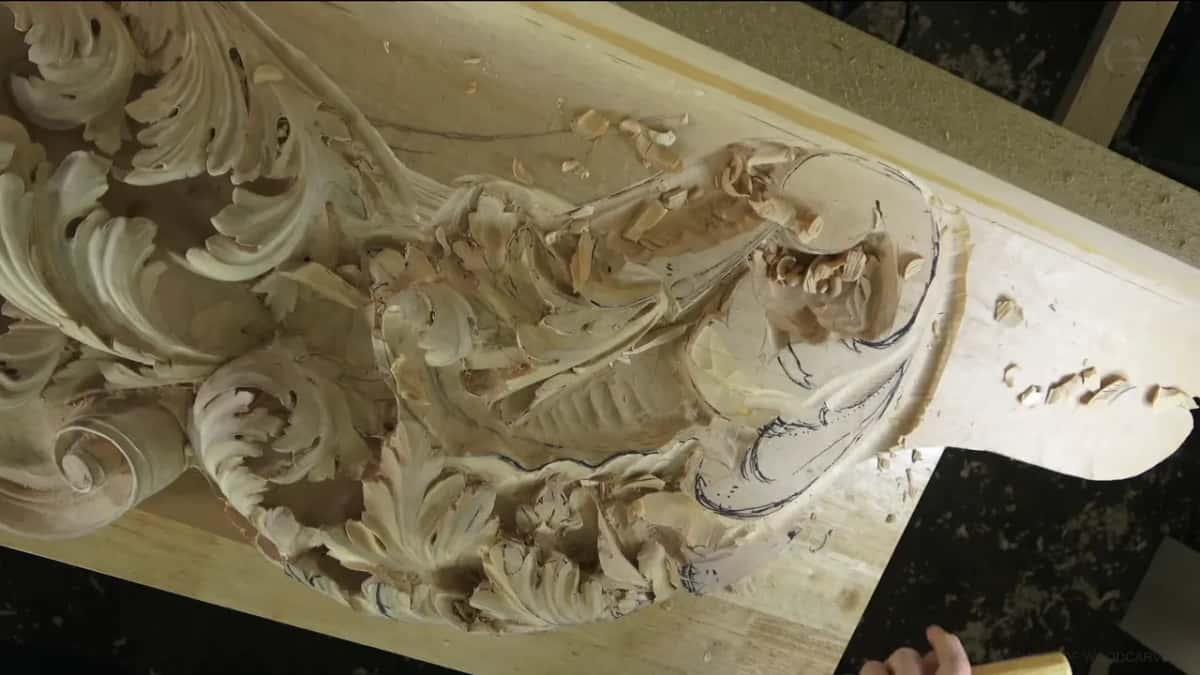
When a part of the design isn't carved yet. Late in the session I had a big area that needed a deep shadow spot, and I reached for the plug cutting technique with a half inch number 9 (about 13 mm), straight down.
Then I stopped. Big mistake, I told the camera, and I apologized, because part of a shell goes there. Later on, yes, I'll be able to plug it. Not now.
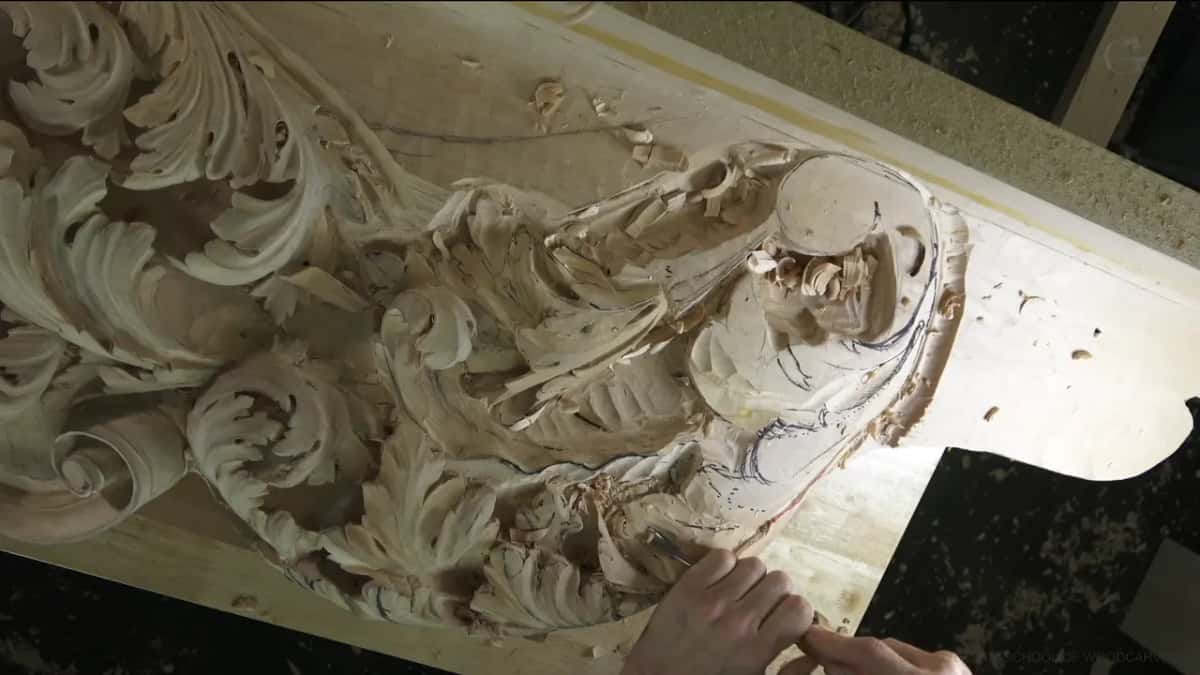
Smaller versions of that came up all through the lesson. Around two eyes I went only a little deeper with a 5 mm (3/16 in) number 11, so I could still raise the part. On one new separation I carved a deeper line with a smaller 2 mm (5/64 in) tool, just to give some shadow, and left the real excavation for later, so at least I could see what was going on.
Under one overlapping part I kept the hollow shallow. Not too concave, at least as of now. If a half-carved leaf worries you, workshop 53 is about that messy middle.

Should you carve from a drawing or straight from the block?
Either road works, and I've done both. Someone on one of my livestreams asked me about exactly this, the 2D way that starts with a drawing against the 3D way that starts from the form, and I said I don't see anything wrong with either approach.
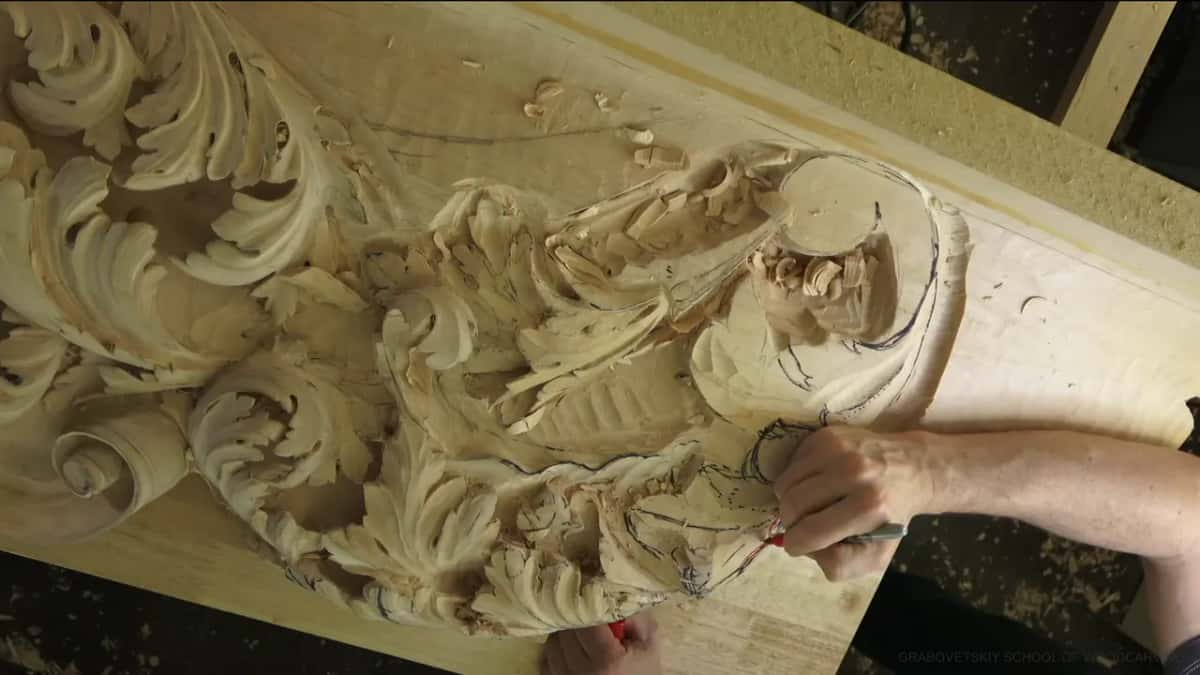
On this ceiling, which began in the first part of this room, I placed the main movements for the whole design but didn't draw the details on paper, the separations and the eyes and all the rest. I'm carving and designing on the go.
The way I understood his question, the artistic approach is to look at a piece of wood and reveal what's already hidden in that form. That's exactly what I'm doing at this bench when I look at the chunk. The wood in front of you doesn't look quite like the development did on paper, so I read the chunk as it is and draw my boundary right on it with a red marker.
You still have to be artistic whichever way you start. That part isn't that hard, by the way.
Where does a beginner start on the carving side of sculpture?
With design, in my order of things, then sharpening, then carving. In my furniture panel design course I spent a long time developing the idea, because it had to be authentic to 18th century design, and the principles of design course holds the laws I carve by, space, rhythm, repetition and knowing your tools.
For this room, the Part 5 page shows the whole stretch of the ceiling, workshop 54 has two gouges carving one curve, and workshop 56 picks up right after this one. Part 4 comes before it, and the lessons map shows where every piece sits.
One tuition opens every course in the school, this room included, and the plan renews automatically each month or each year until you stop it.
Does a chunk of wood with a leaf waiting inside it sound like a good afternoon to you? Then pick up a gouge and come carve with me.
One small thing from that day. Partway through I swapped the red marker for a different one, and by the end the centers of the new concaves were marked in orange.
How it's done
- Settle the main movements. Mine were worked out in 3D first, with no details at all.
- Mark the chunk. Draw the new boundary right on the wood, the way I did with a red marker.
- Set in the outline. A 12 mm number 11, about half an inch, and a mallet held free hanging in the palm, so the hand doesn't tire.
- Go low, keep a chunk. Lower the side with a big eleven, mine was 30 mm, and keep a chunk where the next part will connect.
- Try the eye big. Almost huge, while there's still material to fall back on.
- Concave before convex. Carve the concaves first, then the convex in the middle.
- Blend and clean. A skew blends in, a half inch (about 14 mm) number 7 cleans a surface, and a 13 mm (half inch) number 3 back bent goes over the convexes.
Frequently asked questions
Can a wood carving be called a sculpture?
Carvers are sculptors, and I say that plainly. We work in the three-dimensional world the same as anyone who shapes a figure, and I should say we also work with sculpture. What makes a carving its own thing is the direction, since the wood only ever gets taken away.
Is carving additive or subtractive?
Subtractive, every stroke of it. You begin with more wood than the finished piece will need and take away whatever doesn't belong. Once in a while I try a form first by adding, in a model, the way I modeled a set of lion heads in plastilina before I carved them.
Did Michelangelo carve without a model?
At times he did. We think of him as the man who looked into a raw block, saw a figure like the David and chopped it free. Read about that time more closely, though, and you find him working from models as well.
What to carve next