

Alexander Grabovetskiy, woodcarver, School of Woodcarving · Published 2020
Why does the acanthus leaf look different in every country?
Quick answer: The acanthus leaf is one structure carved many ways. Every region keeps the same bones, main divisions, eyes and a middle line, and changes how long and how round each part runs. An early Venetian head divides short and nearly circular, where a French one runs a long way first.
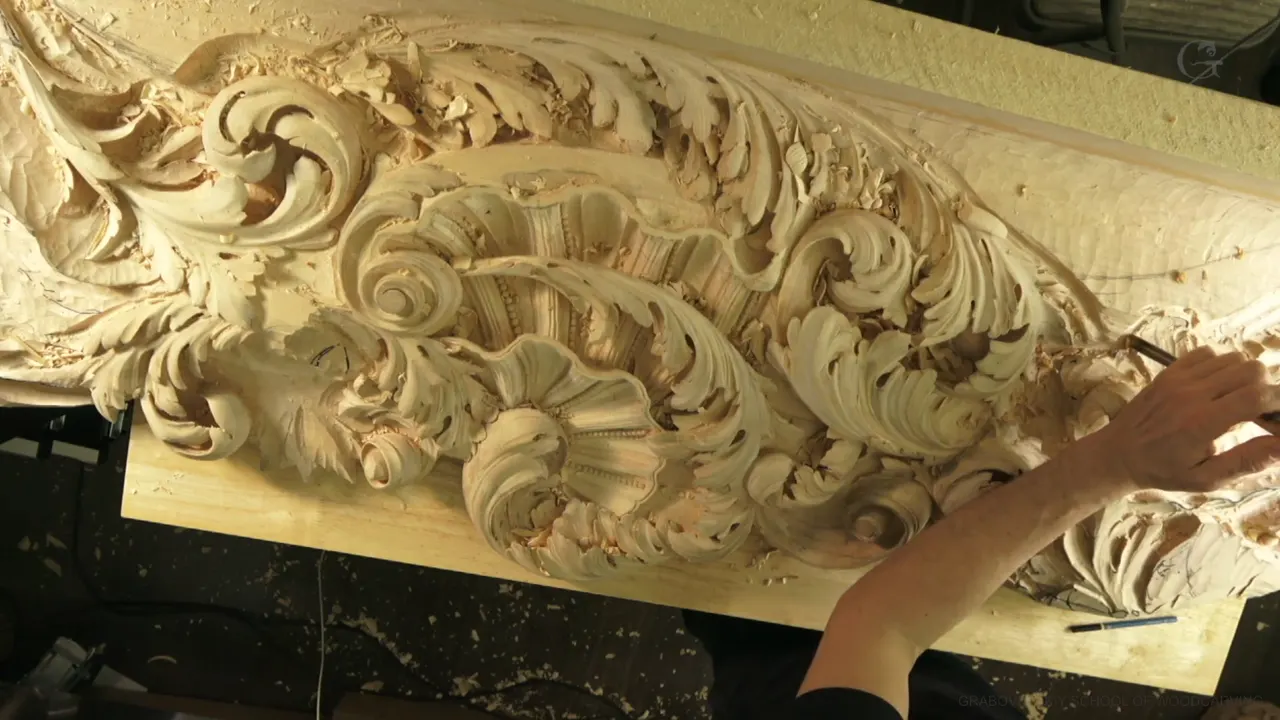
The acanthus leaf is one structure, and region after region carved it its own way. The bones stay put. Every acanthus has main divisions, eyes where one part flips over another, pipes, and a middle line that the rest of the leaf runs to. What changes is how long each part runs before it divides, and how round it turns. On the Venetian panel in workshop 52 the divisions are short and almost round, and I say on camera that in France the same part would run long. That is acanthus leaf history the way a carver meets it, with a gouge in the hand.
Have you noticed that acanthus leaves on old buildings rarely match each other? Would you like to know which part of the leaf a region changed, and which part it left alone? Then start with the room your leaf is going into, because the room picks the leaf. After this page you should be able to look at a division and tell whether it belongs on a Venetian ceiling.

What stays and what changes on an acanthus
- Main divisions come in threes or fives most of the time, sometimes eights.
- An eye is a part turning over its neighbor, and a pipe is a raised part.
- Everything goes to the middle line.
- Venetian divisions of the 15th, 16th century are really short, and the head is nearly round.
- In France the same part runs long, and the division comes after.
- Concaves and convexes change between cultures too.
- The room decides which acanthus you carve, and this one had to be Venetian.
What does acanthus leaf history look like at the bench?
It looks like a map with a different leaf in country after country. People are sometimes really confused about the designs, I say on the stream, and the reason is that acanthus comes in types. Those types developed region by region.
Go to Morocco and the acanthus movement is absolutely different from a German one. Germany alone has a Northern German acanthus and a Southern German acanthus. France is different again. Belgium has its own, England has English acanthus, and even the Slavic countries, Russia and Ukraine, carve an acanthus movement of their own. I can go on and on.
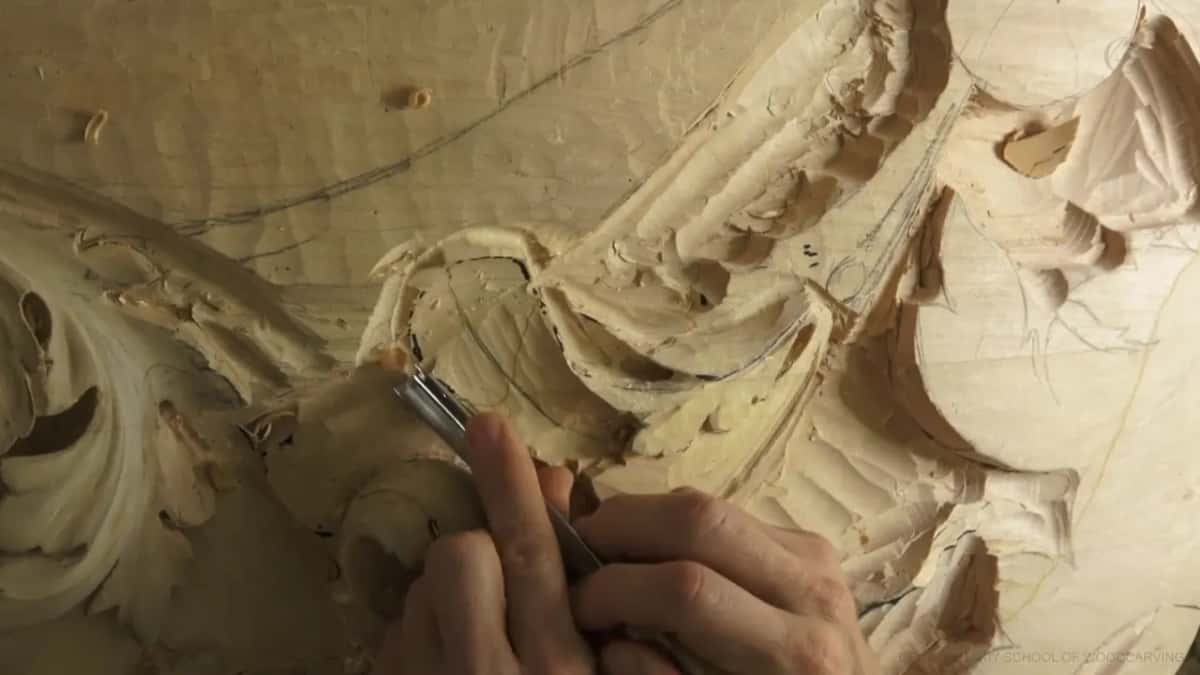
Almost all the cultures that carve stone and carve wood are somehow connected to this leaf. Greece is one of the most ancient of them as far as art and the acanthus go. The one on my bench is Venetian, from Italy.
Which parts of an acanthus never change?
Divisions, eyes and the middle line hold still on every acanthus I describe in this workshop. Every acanthus is supposed to have main divisions, three or five or eight of them, and those numbers are connected to the Fibonacci sequence. Most of the time it's either three or five.
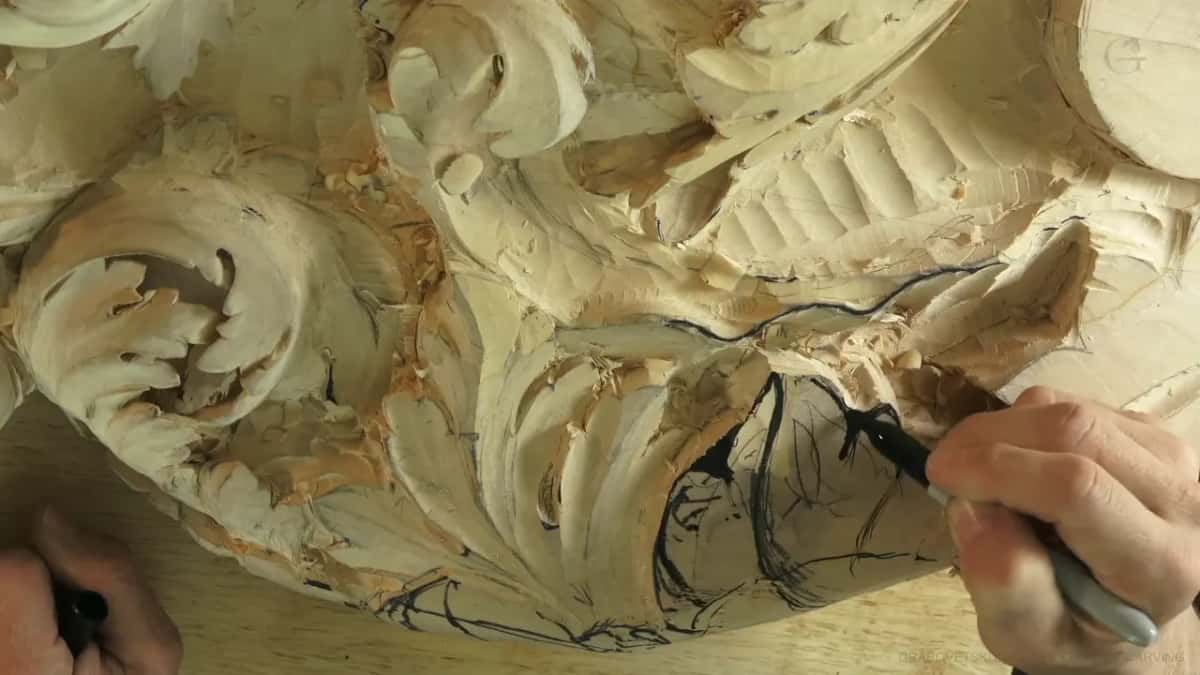
Eyes and pipes are supposed to be on every acanthus as well. The eye is a flipping over part. One part flips above another one. The pipe is the raised part, and on this panel I make it with a concave on each side.

One mistake with the pipe is common. A lot of people carve it as two parallel lines. Look straight down at it and it's supposed to narrow, and it always has to kind of bow.
And everything is supposed to go to the middle line. Otherwise it is not going to make sense, and more than once in this workshop I stop to reestablish my middle line when a line looks wrong.
My relief cuts stay the same too. I'm always doing those relief cuts on the triangles between divisions, and they are really important. Some habits are simply the way it's done. The divisions I start on this leaf repeat on the inside, where they will be invisible, and that is a common way to create acanthus movement.
That is the whole structure, and there is nothing complicated about it. What is complicated is the knowledge of history, how different cultures used the leaf.
The hollows are where cultures part ways. In different cultures there are different concaves and different convexes, so the shape of a pipe is one of the things that changes. The Byzantine acanthus course compares those leaf by leaf, and I won't repeat it here.
How long should the divisions on an acanthus be?
That depends on where the leaf comes from and when. On this Venetian head the divisions are really, really short, and I show you one small chunk on camera so you can see how short they run.
In France this same part would be really long, and only then would the division come. I catch myself on that one, though. I shouldn't say French style as if it were one style, because it all depends on what part of France I'm talking about.
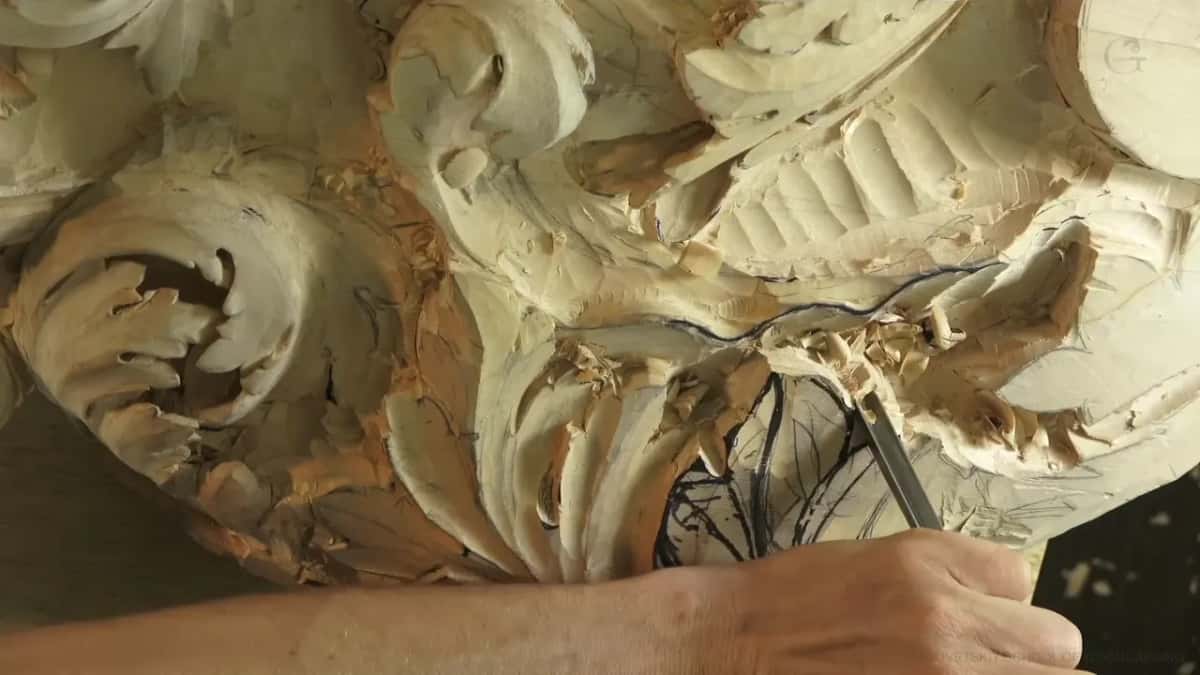
The head gets the same treatment. Each part of it is not really long. It is more like a round, and if you circle it you get almost a circle. So you don't do a really long one like in the French style. How the overall movement develops is different as well.
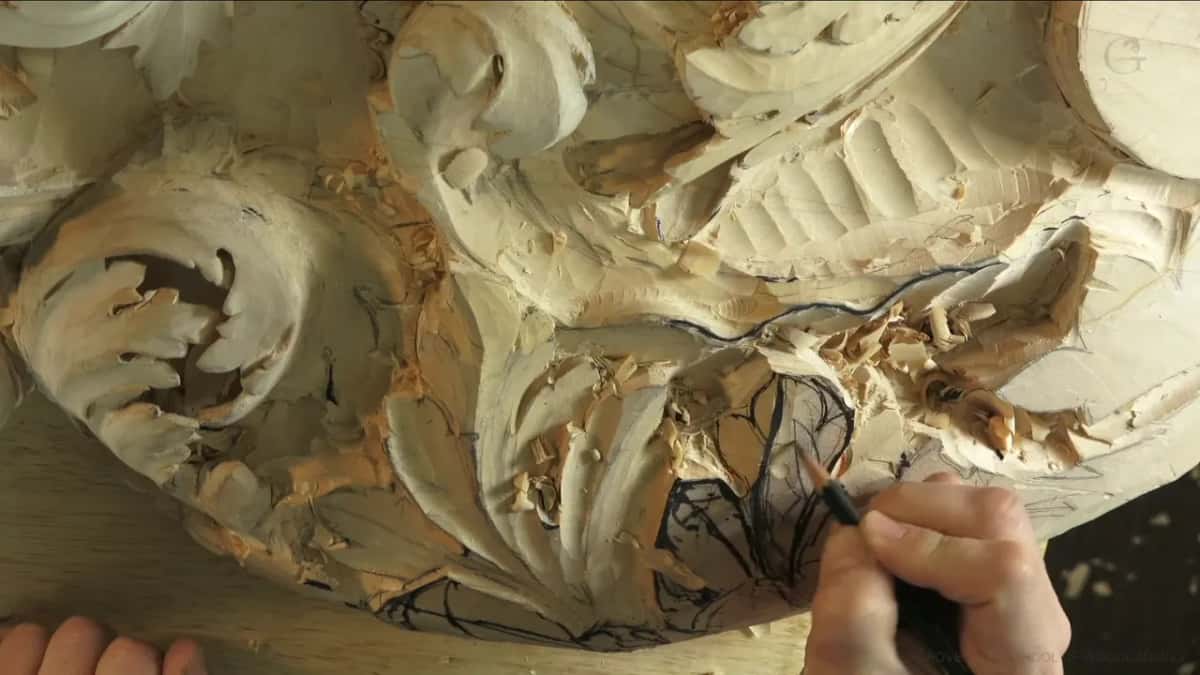
Did Venetian acanthus heads always look this short and round?
They did at the start. I am staying authentic to the original Venetian design on this panel, and the original heads were not supposed to be really long. They did not have the really long ones back then. Longer ones developed a little later.
So when I say Venetian here, I mean the early one, the 15th and 16th century, and that is the one this room wants.
Is a Venetian acanthus the same as a Roman one?
Both are from Italy. They are still two different leaves. Roman style, when I say it, means only ancient Rome, the Roman Empire. This Venetian style is from Italy too, from long after the Roman Empire. That makes it a much later development.
I tell you on the stream that a leaf can be Roman style and not Italian, even if it's in Italy.
What makes the acanthus in workshop 52 Venetian?
Short divisions are the first sign, and there are a few more I point to while I carve.
One is a little ridge. Raising the pipes with a number 8 about 6 mm (1/4 in) wide, I still want to see a little bit of a ridge in the middle, because then it's going to be authentic to the original period, the Italian Venetian style.

Another is curls. The early Italian carvers of the 15th and 16th century really loved curliness, with plenty of movement, curvature and divisions, and you can see it once the small divisions start to pile up on this head.
The third is the shape across the leaf. The concave, convex, concave was adapted from Byzantine work, the early Orthodox carving of Greece and modern Turkey, the Christian Byzantine Empire. The Romans, I tell you, stole the idea from the Greeks. When I get to Venice I stop myself. I shouldn't say stolen. Adapted is the word.
If the head of a Venetian leaf is what you want to carve next, Part 2 of the Venice Room goes into it.
Can the same leaf be carved more than one way?
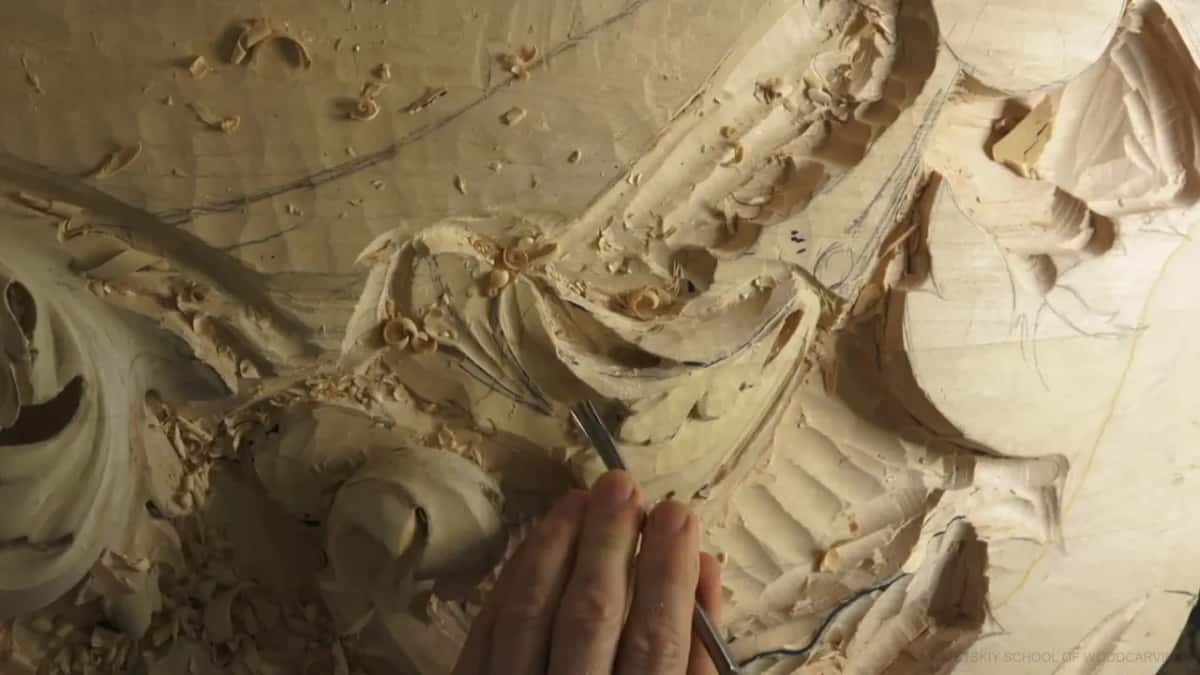
It can, even on one panel by one carver. Early in workshop 52 I tell you there's a couple of ways I could develop one part. I could completely separate it without creating any eyes or pipes, just separate divisions. I think it's going to be good the way I have it, so I leave it.
A little later there are two ways to send a part underneath. It can go under both lines, or only under the line beside it, and in that case the second is more logical. On the other side I do the opposite, so the two sides are not the same. They're different.
Later I think about lowering one piece, and then I've got an idea. I keep that chunk, with the idea of carving a detail underneath it.
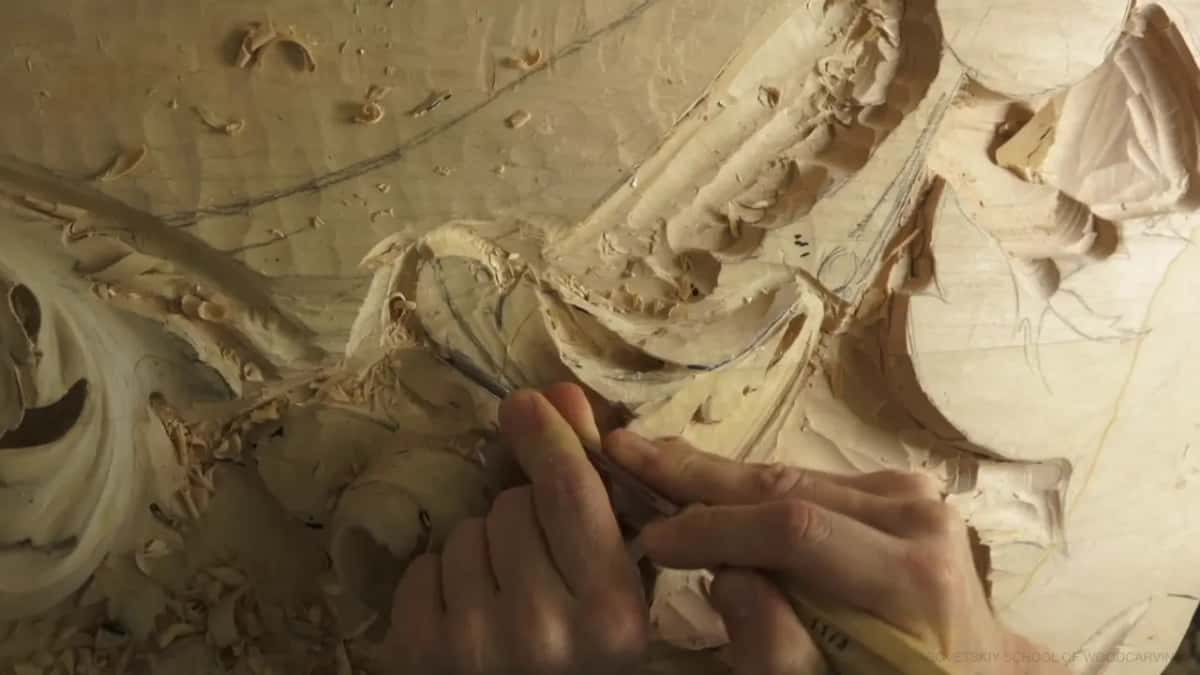
There's a different approach to acanthus in how you treat that part of the movement, too, and I say so while I blend it with the skew.
Why does the room decide which acanthus you carve?
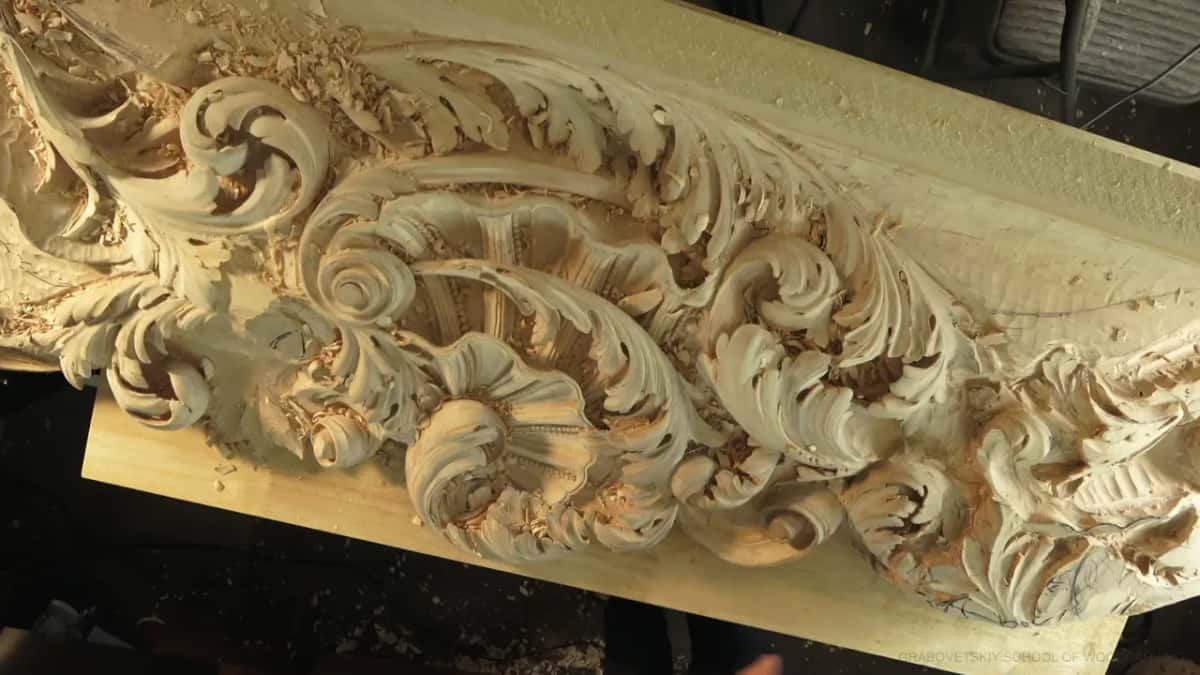
The leaf has to belong to the room it hangs in. This carving goes all the way to the ceiling, and I still have to glue more on top. Just this section is about 10 feet (3 m) long, and it will spread as far again on the sides.
A corbel gets attached on the other side, and a shell sits right beside the leaf, with another acanthus running down behind it. This element has to be really, really authentic to Italian design, Venetian of that same early period. Later in the workshop I start on a big chunk, and I want to make sure it looks really good and fluent to the overall movement.
So when a division looks wrong, I judge it by whether it looks like an acanthus leaf, and whether it is uniform with the overall design.
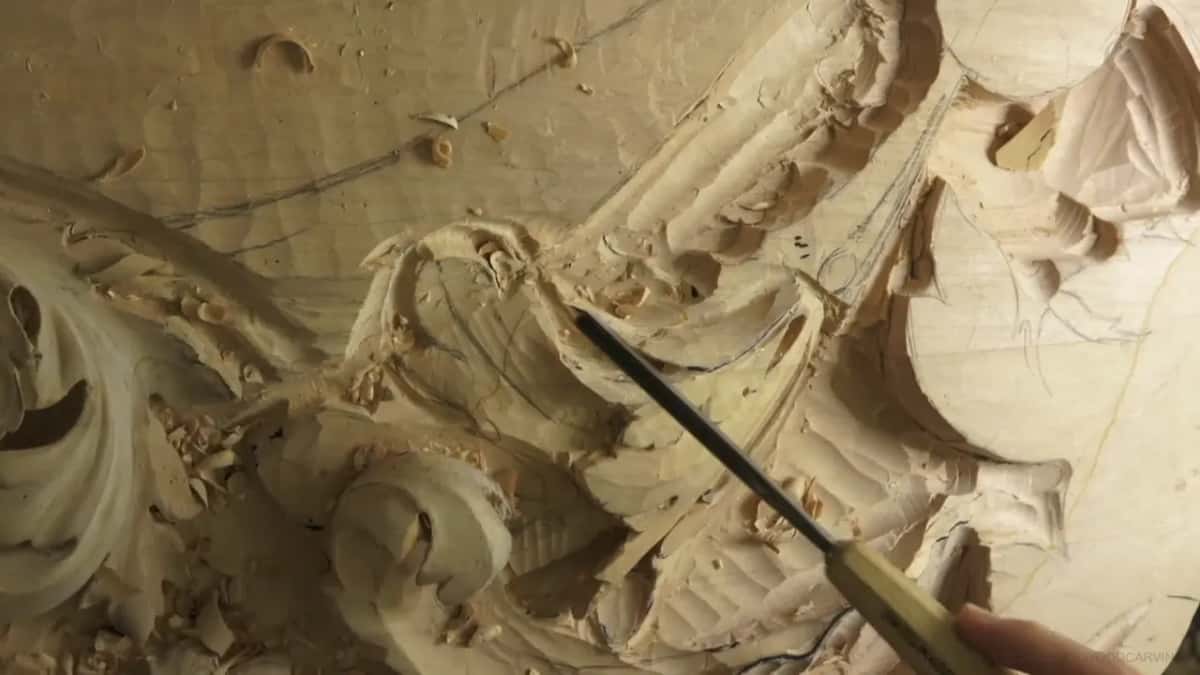
Let me tell you a story from early in this workshop. I laid out a preliminary division and I was not happy with it, because it did not look like an acanthus leaf. I took a skew chisel, one inch, about 25 mm, and made that part a little wider on both sides. Then it looked more organic. A knife or a flatter gouge would have given about the same result.

Can you learn to see where a leaf comes from?
You can, and the people who study it do. People who understand design, and who have studied how the acanthus developed, can see the difference.
Where to find good references is a lesson of its own, workshop 28, and the design side sits in the principles of design course. The deciding part, which piece goes under and which goes over, you can practice just on a piece of wood, the way I say in workshop 52.

The bones against this Venetian leaf, part by part
Each row gives the rule first and this panel second.
| Part | Rule | Here |
|---|---|---|
| Main divisions | Threes and fives on most leaves, eights now and then. | Short, and almost like a circle. |
| Each eye | A part flipping over another, on every single acanthus leaf. | A huge one from a veiner. |
| Middle line | Everything runs to it, otherwise the leaf makes no sense. | Keeps a little ridge down it. |
| Every pipe | The raised part, with a concave carved on either side. | Number 11 and number 8 hollows. |
| Head length | Changes with the country and the century you carve for. | Short, the way Venice started out. |
What else happens in the rest of workshop 52?
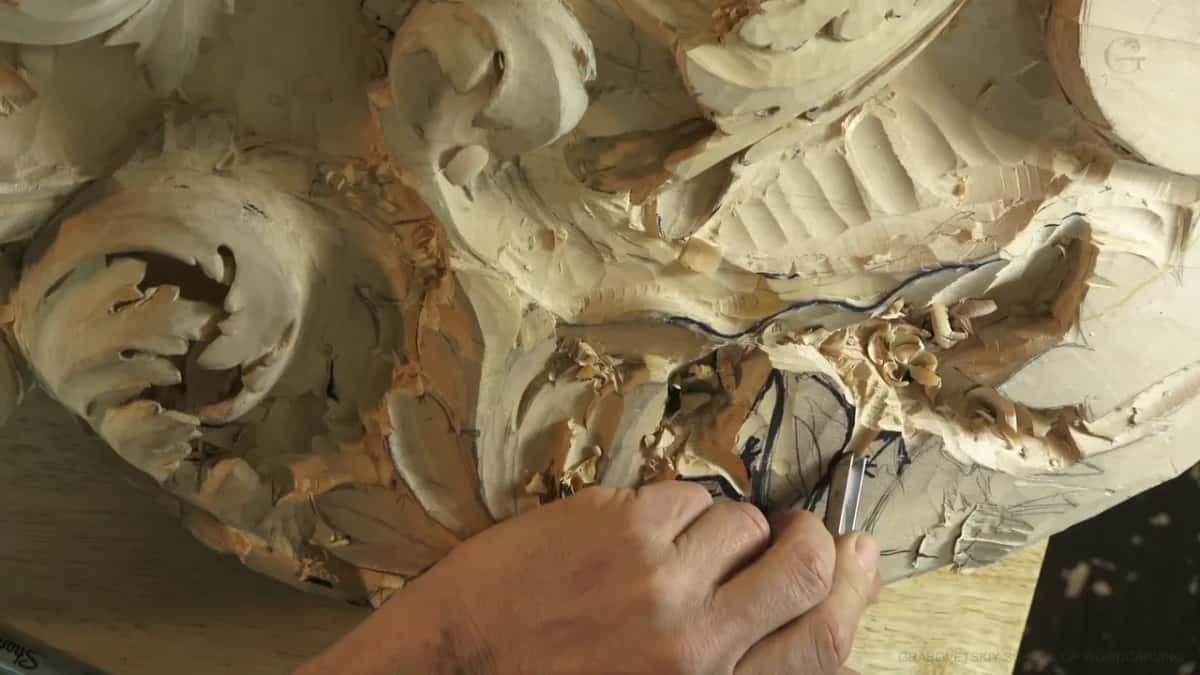
A lot of carving, over two sessions. The first opens a huge eye, a number 11 of 10 mm (3/8 in) doing the work, and relieves the triangles with number 11 veiners. I'm using lots of them on this carving.
Later in that session a one inch number 5 (25 mm) shapes one edge of the head, and a single hit gives me the letter S. One part is like a head of acanthus going up and up, with really deep excavation on the side, and it's a solid piece. I didn't glue anything on. Another movement runs all the way inside the panel and ends in an acanthus head, so I leave material there for it. I'm blessed with a lot of material in one area, six inches (152 mm) down to the bottom, so I have room to work without making too much impact on the design.
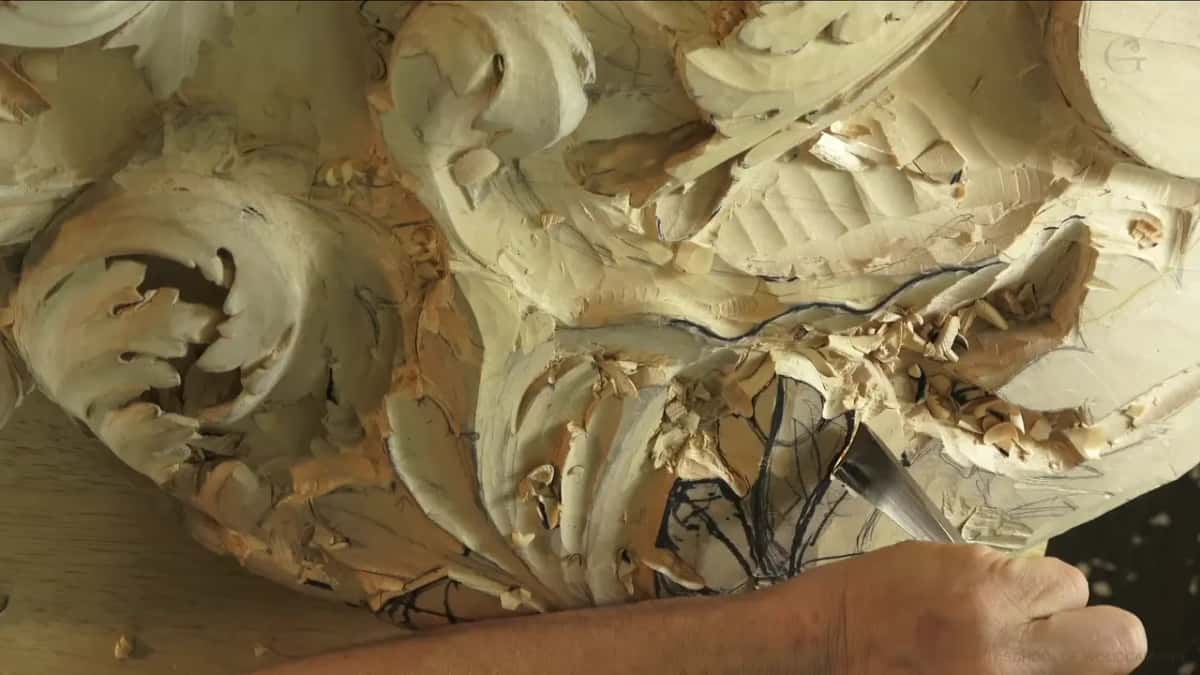
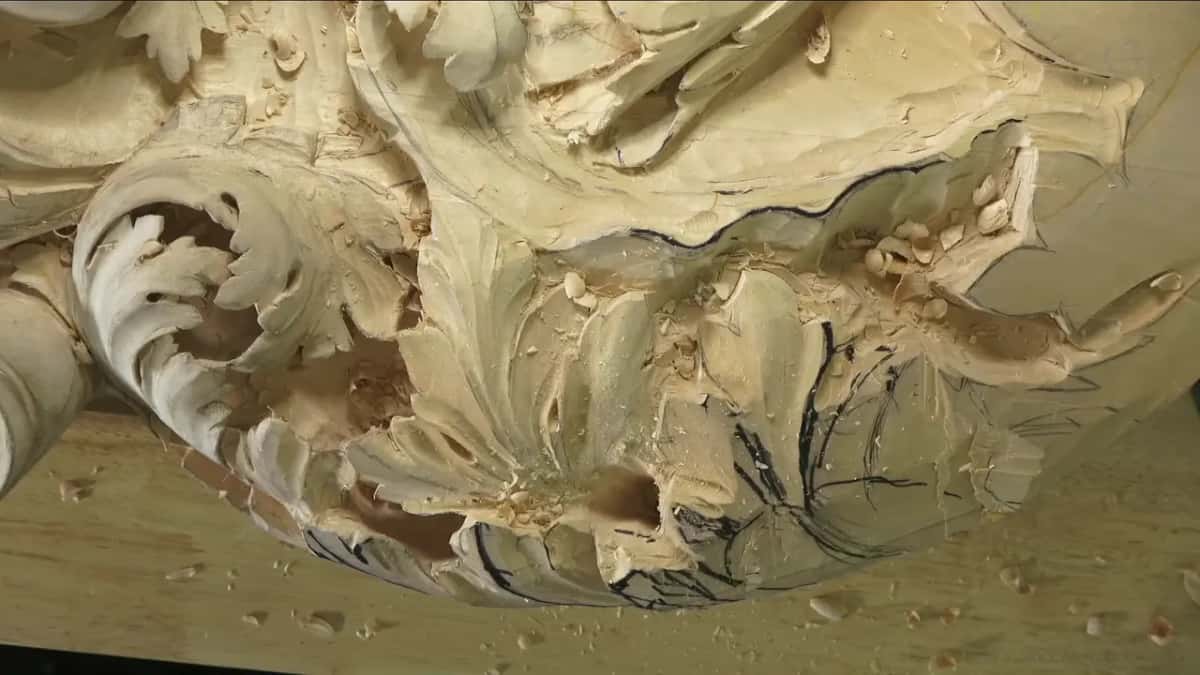
The second session goes inside the panel. The excavations run about two inches, about 50 mm, deep everywhere, and that depth is what gives the lightness. I dig them with plug cuts, and sometimes the chips come out as perfect, clean, rounded plugs. Where I have extra material, I can get even more three-dimensional.
At the very end I say it plainly. So that is Venetian style, Venice, Italy, 15th, 16th century.
Workshop 51 comes before it and workshop 53 comes after, and the whole run of twelve sits in Part 5 of the Venice Room.
Would you like to carve an acanthus that belongs to its room? And when you look up at an old ceiling, do you want to know which century you are looking at? Then the Venice Room is open on the tuition page, and this workshop is number 52 of it.
If you have never carved a leaf at all, the lessons map shows where the single Greek leaf sits, and the twelve workshops before these carry this same panel.
For some reason my bench was moving that day, and that is not good. My camera couldn't get any higher either, so some of the carving on one side stays out of the picture.
How it's done
- Count the main divisions. Lay out the main divisions first, the count every acanthus works from. On a Venetian head each one stays short.
- Relieve every triangle. Put a number 11 veiner into each triangle between two divisions. Keep that pass shallow, or you will have another problem to clean up on the surface below.
- Chop toward the form. Chop to an approximate shape. The final form comes later, and this gives you something to work from.
- Choose which part drops. Decide which of two neighbors goes below the other. Then lean the veiner a little toward that side, so the motion shows right away.
- Keep the head round. Keep each part of a Venetian head short, almost a circle. A one inch number 5 (25 mm) gave me a letter S along one edge in a single hit.
- Raise a pipe with two hollows. Carve a concave on each side and leave a little ridge in the middle.
- Blend what is left. Take the leftover ridges down with a skew until one part feels like it goes underneath the next.
Frequently asked questions
Is a French acanthus the same as a Venetian one?
A French leaf runs a long way and only then divides, while the Venetian heads in this workshop stay short and nearly round. Even that depends on which part of France you mean, so I try not to speak of one French style.
What parts does every acanthus leaf have?
The main divisions come first, three, five or eight of them, as in the Fibonacci numbers. Then eyes, where one piece turns over the next, and pipes, the raised parts, and every line heads for the middle line. Otherwise the leaf makes no sense.
Were the first Venetian acanthus heads short?
Short ones came first in the original design this panel follows. Longer heads developed a little later, and because I want this leaf authentic to that original, I keep every part of its head close to a circle.
What to carve next