
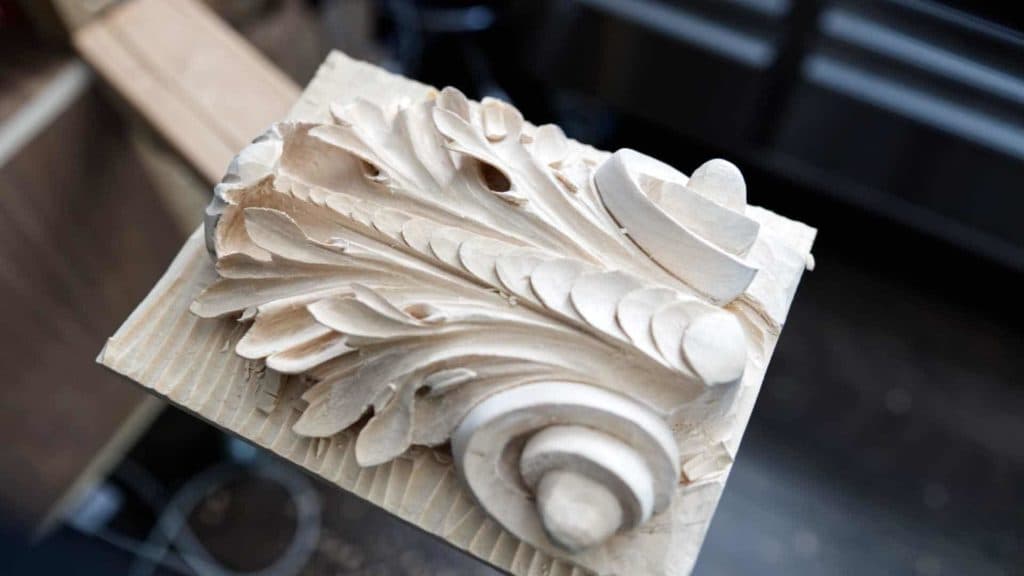
Alexander Grabovetskiy, woodcarver, School of Woodcarving · Published 2019
What is sweep on a wood carving gouge?
Quick answer: Sweep is the curvature of a carving gouge, how curved its steel is. A number one is a flat chisel, a number three is almost flat but not flat, and a number nine is close to a true half round. From number 11 the sides run straight up into a U, and that tool is a veiner.
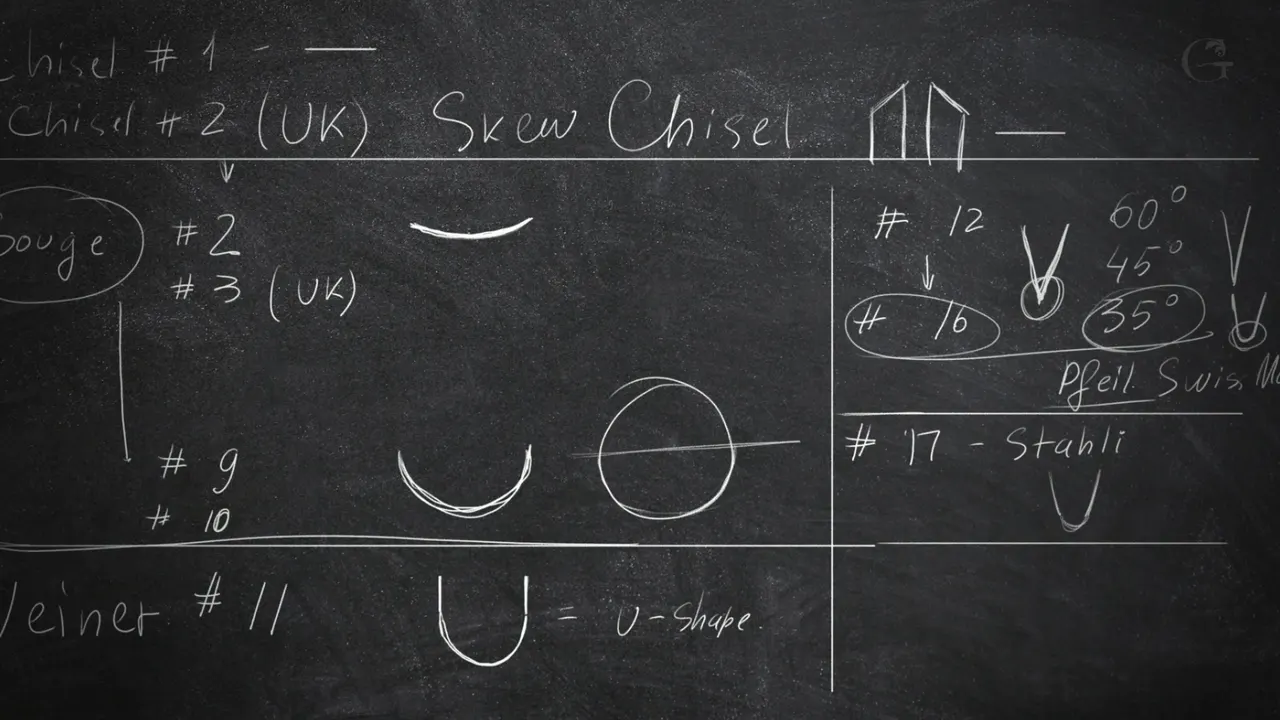
Sweep on a wood carving gouge is its curvature, how curved the gouge is. That's how I put it in lesson 16 of my Roman acanthus course, with a number three in my hand. In number three it's almost flat, but it's not flat. That little curve is the sweep, and the number on the tool is how we read it.
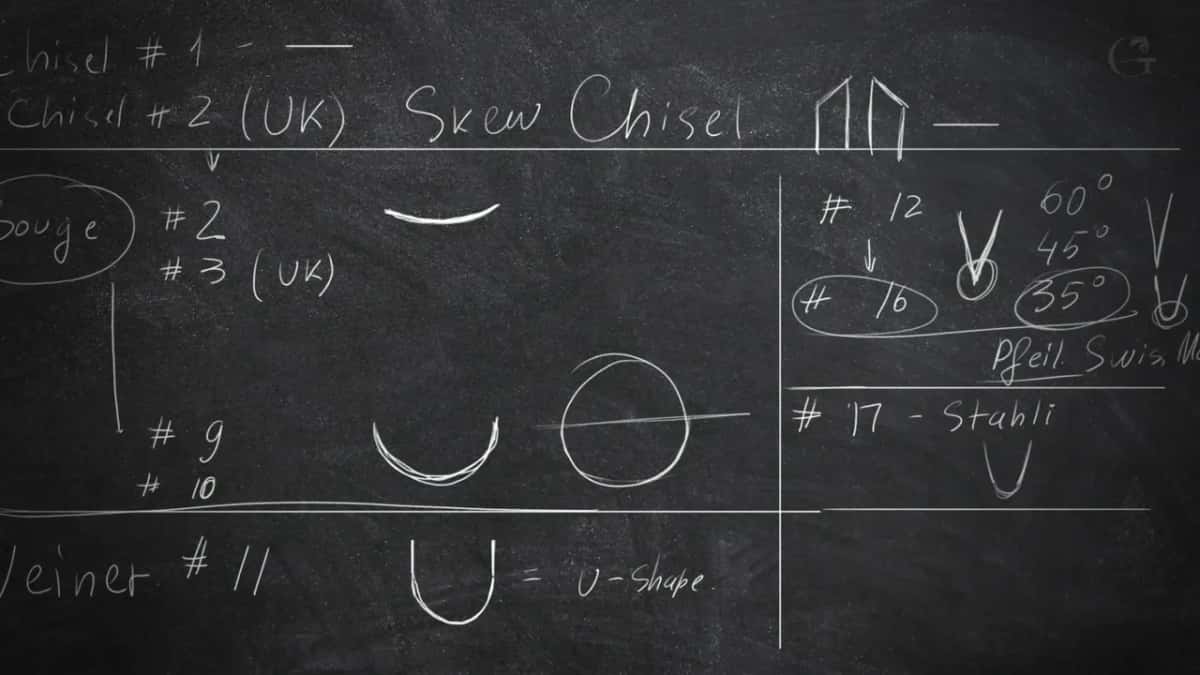
Ever picked up a gouge, seen a number on it, and had no idea what it meant? Ever grabbed a 3 when the job wanted a 9? Then read the numbers once, in order, the way I wrote them on the board for this lesson.
Sweep numbers from 1 to 17 on one board
- Sweep is curvature, and it's a professional term.
- Just the 1 counts as a chisel, and it's absolutely flat.
- The UK calls a number two a skew chisel, while a German or Swiss made two is already a gouge.
- Gouges usually stop at 9, nearly half a circle. Some makers also make a 10.
- Veiners start at 11 and look like a U.
- Numbers 12 to about 16 are V tools, and a 17 is a V tool with a bigger gouge at the bottom.
What does sweep mean on a carving gouge?
It means curvature, how curved my gouge is. That's a professional term, sweeps, and for this lesson I went to the board to explain it.
Some people in the wood carving world call all the tools gouges or chisels. That's not necessarily true. Pretty much only number one is a chisel, and it's absolutely flat.
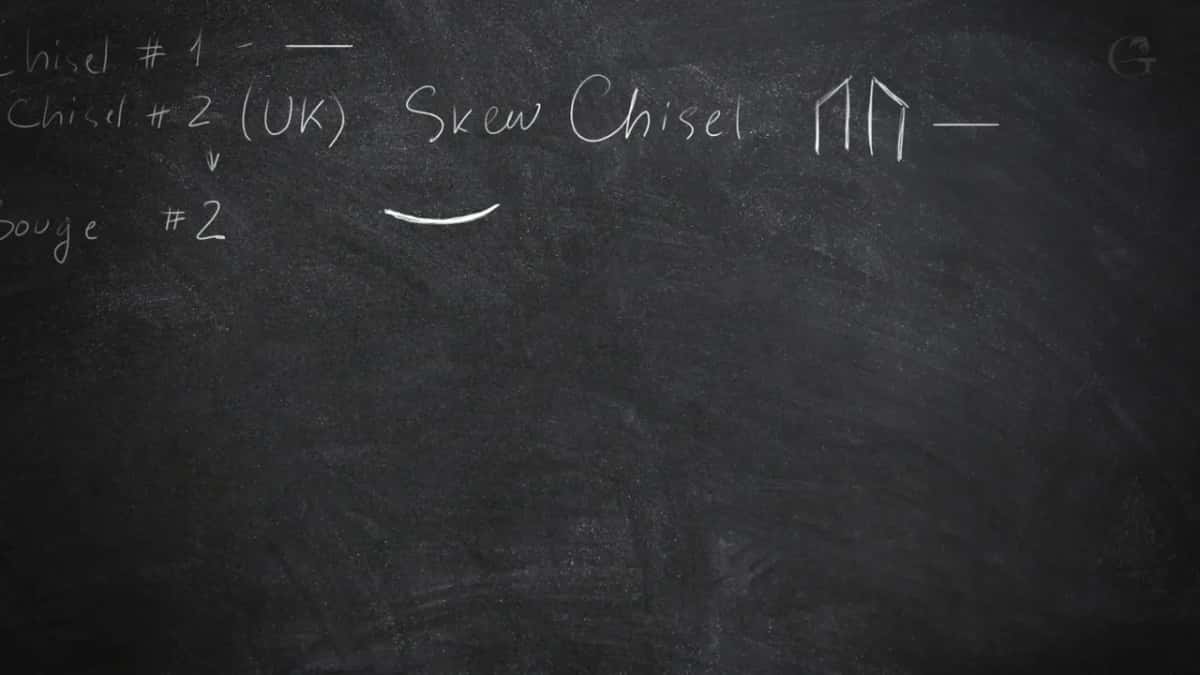
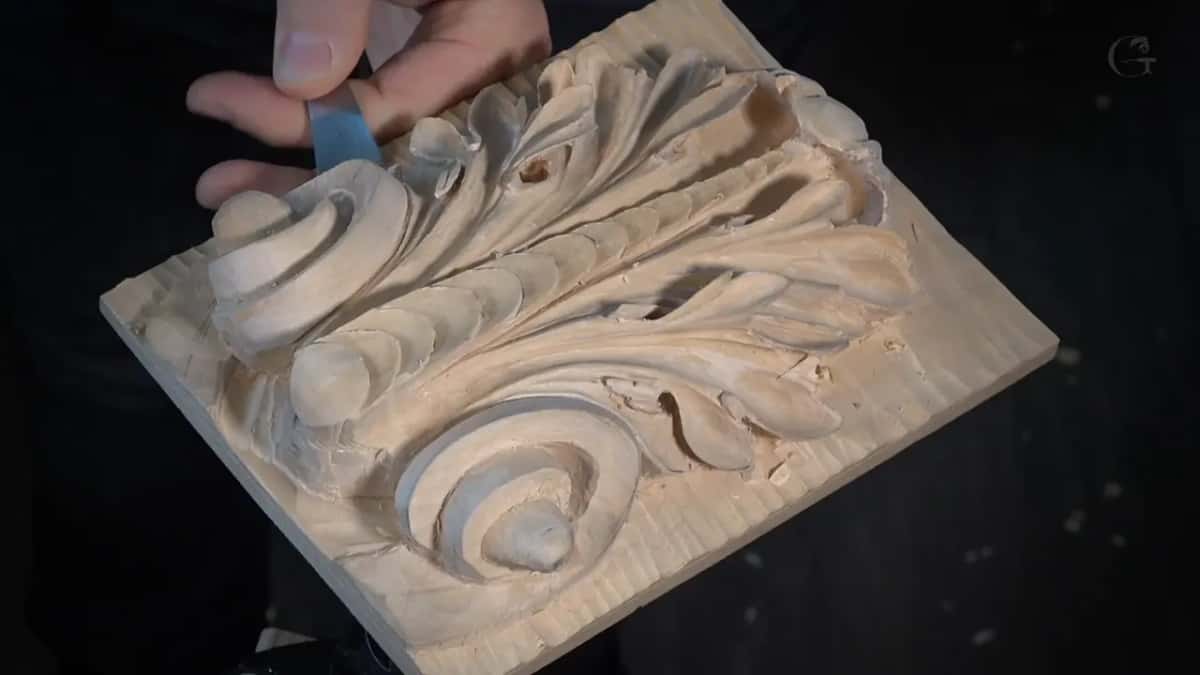
Right before that, I had picked up a number three, about 20 millimeters (3/4 in) wide, from Ashley Iles, to clean the background of this relief. That small bend in the steel, I said, is the curvature itself.
Is a number 2 a chisel or a gouge?
Depends where it was made.
In the UK there is such a thing as a chisel number two. That's a skew chisel, and it can slant one way or the opposite way, but its sweep is still really, really flat.
In Europe, say on a German or a Swiss made tool, a number two is already a gouge with a slight curvature. I drew it bigger on the board than it is, because it's nearly flat. But it already has some radius, or a sweep, as we call it. When I chalked that word up, I said I hoped I spelled it correctly, and I wiped it off just in case.
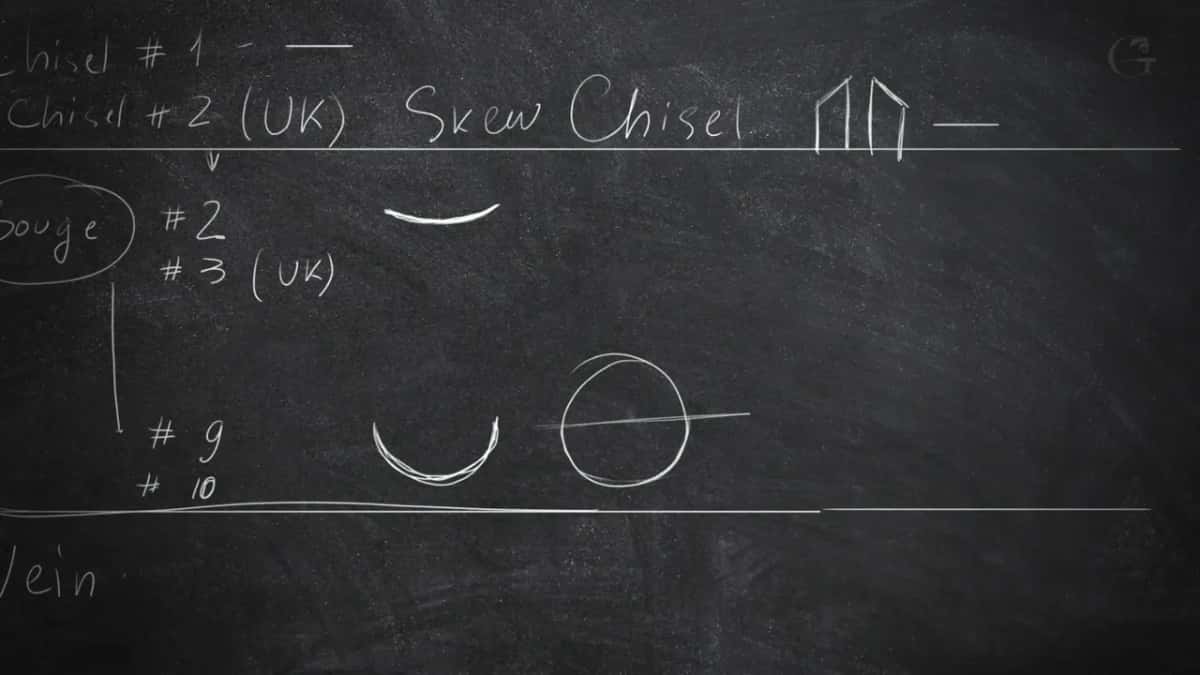
So in Europe the gouges begin at number two, and in the UK they begin at number three. Later, cleaning the ground, I said you could use a number two if you like European tools. A back bend packs even more into its stamp, and I read one of those, a 28/6, in lesson 8.
Where does a gouge stop and a veiner begin?
After number nine.
Gouges usually run up to number nine, and some manufacturers make a number 10 gouge too. Number nine is almost a true half round. It's like half of a circle: draw a circle, and the nine is exactly half of it.
To show what I mean by a gouge, I said, take a number nine, place it on a board, and rotate it all the way. It makes a perfect round. That is a gouge.
After number nine come the veiners, and they start with number 11. A veiner looks like half a round, but it's extended all the way up, like a U shape. There's more on the number 11 veiner in lesson 15.
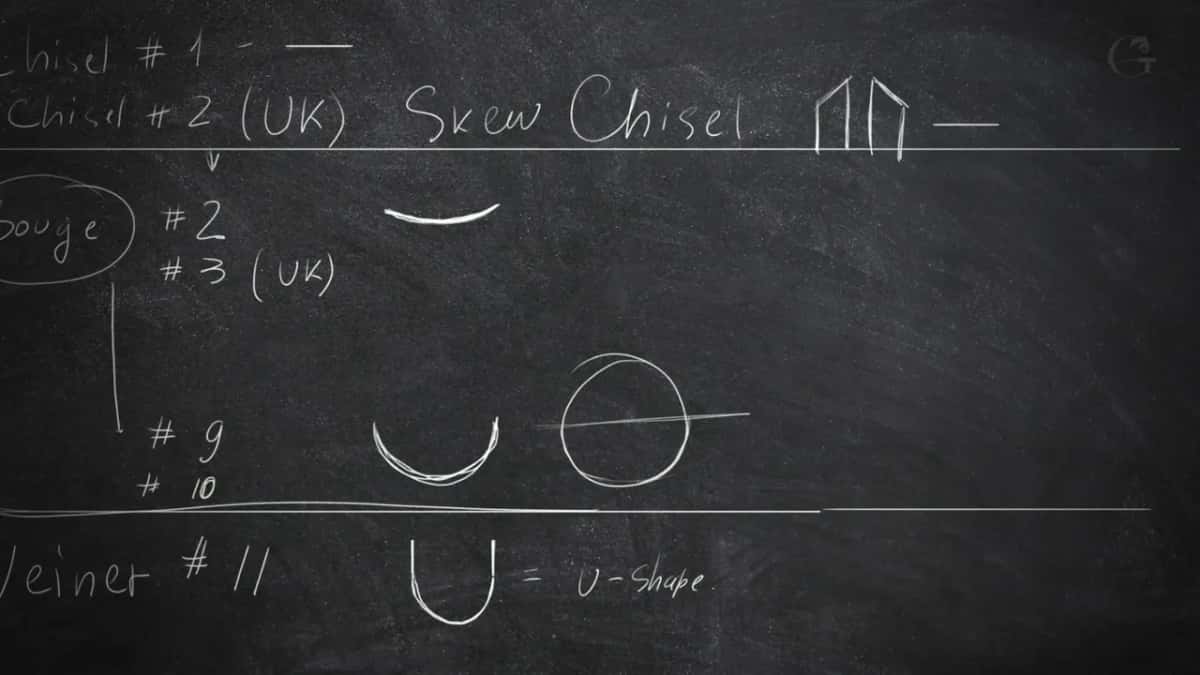
I like the number 11 a lot. Part 3 is where I took a one millimeter one, Swiss made, to clean a rough line, and a half millimeter one from a German brand for even smaller separations. It gives a round look inside. The eye can't really see it, but for the light and the shadow it makes sense. That half millimeter size is the subject of lesson 14.
Which numbers are V tools?
Number 12 till about number 16. They come in different angles: 60 degrees, 45, or 35. I really like that 35 degree one, my number 16, Swiss made, and on the board I wrote Pfeil next to it.
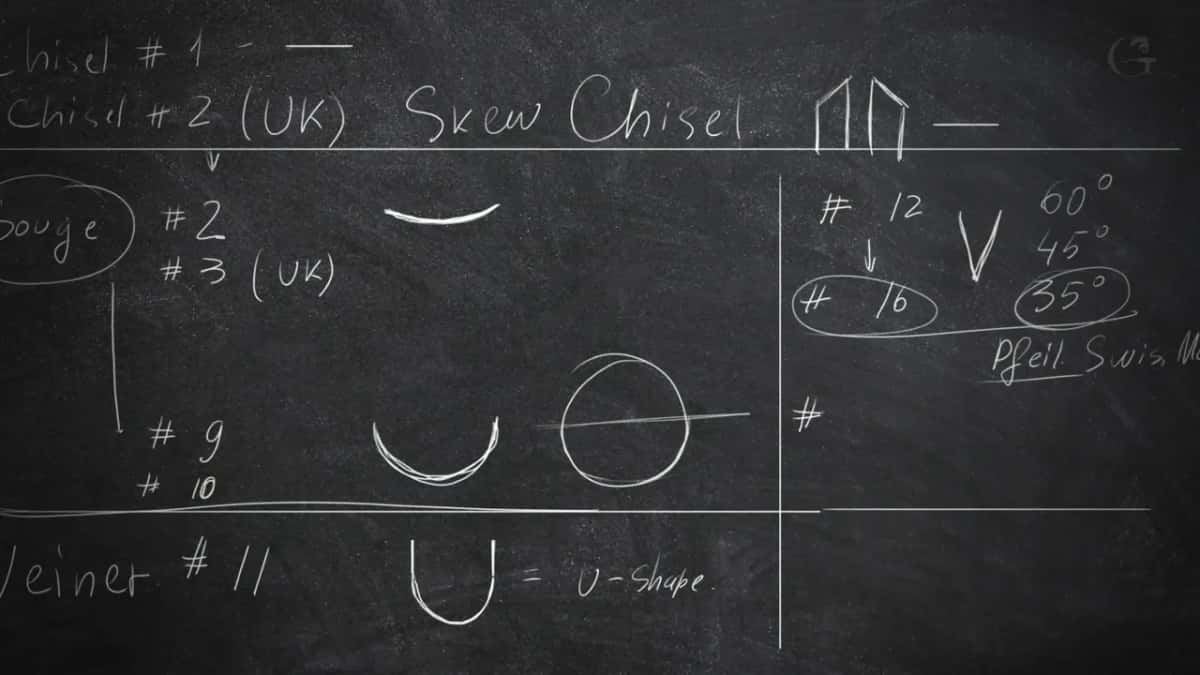
Number 17 is also considered a V tool, but it's called something different. You have to understand there's no such thing as a really sharp edge V tool. It's a chisel, another chisel, and a small gouge in the bottom. The 17 is the same, only with a slightly bigger gouge part right on the bottom.
From number 18 and up there are specialty tools. I said we'd talk about those someday, and I went back to the leaf.
| Number and name | What I said about it on camera | Its profile | Where it worked on this leaf |
|---|---|---|---|
| One, a chisel | Pretty much the only chisel, absolutely flat | Flat edge | Three and one-eighth inches, high spots |
| Two, UK, Europe | Skew chisel in UK, gouge in Europe | Almost flat | Fine on the ground, European tools |
| Three, nearly flat | Not quite flat, and that's the sweep | Slight curve | Shaving the facets off the ground |
| Nine, half round | Nearly a circle split right in two | Half circle | Taking the background down before three |
| Eleven, a veiner | A U, the half round carried up | U shape | One millimeter cleanup, half millimeter separations |
| Twelve to sixteen | Angled at 60, 45 or 35 degrees | V shape | My 16 could take the undercuts |
| Seventeen, also V | Chisel, chisel, and a bigger gouge underneath | Rounded V | Extreme undercuts, on one flat side |
| Twenty-three, Swiss made | A wall and a bottom, 90 degrees | Square corner | A 4 millimeter one, the step |
Does every brand mean the same curve by a number?
Not always, and I said so more than once.
I carved part of this leaf using a French number four, 10 millimeters or 3/8 of an inch. That number four, I said, is equal to a number three by Pfeil, Swiss made. The leaf's first hollows came from a number nine of near 10 millimeters, back in lesson 6.
Later in the lesson I picked up that French four again, and I said in reality it's flatter, just like a number three or even less than that. A 2.5, I would say.
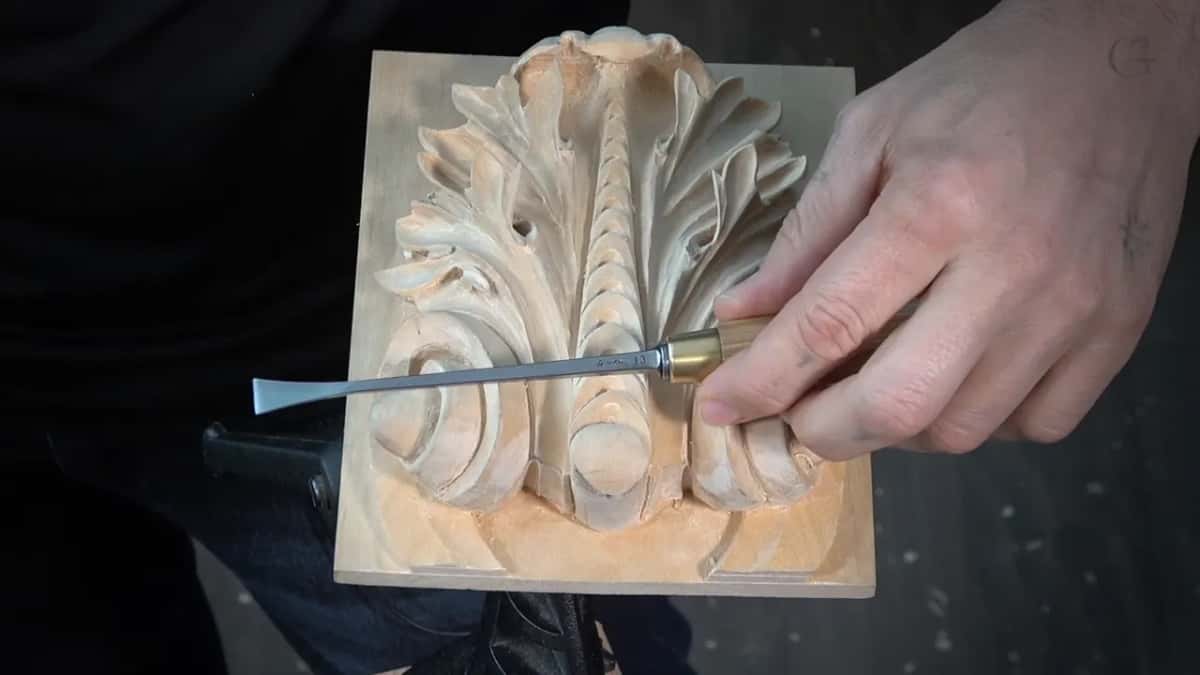
The width on a tool can drift too. I had a number eight of roughly 10 millimeters, and I said that's not necessarily true. They can mark 10 millimeters, but it could be only 9, and it doesn't matter if it's machine made or handmade.
My Swiss made number 11 at 3 millimeters is called one-eighth of an inch. It doesn't look like an eighth. It's actually bigger.
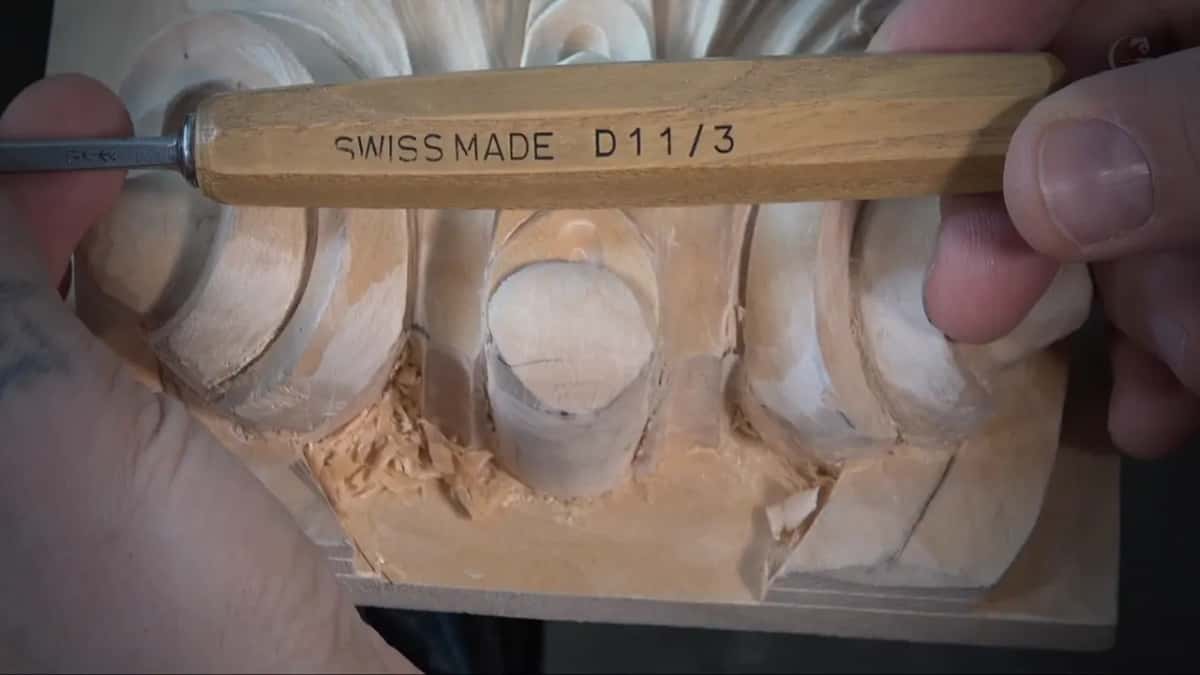
And not all tool manufacturers mark the size at all. So when I'm saying approximately, that's the reason.
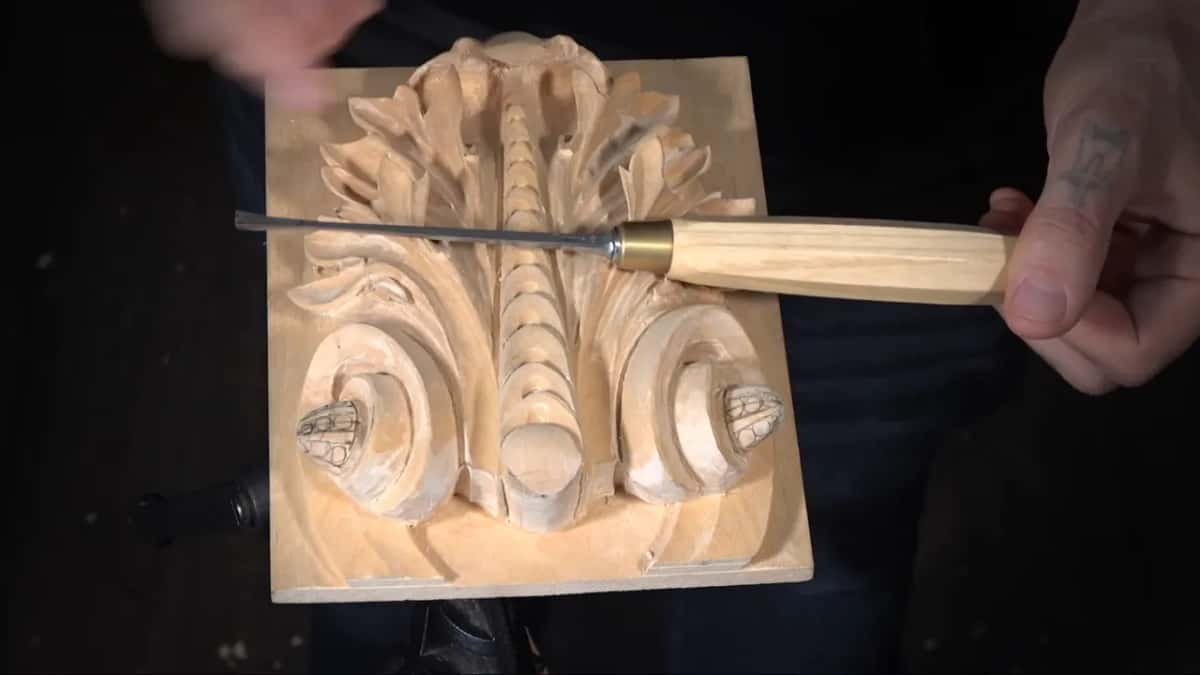
I had two number sevens for the beads in the last part, a French one at six millimeters and a Swiss made one at four, and there's almost no difference between them. I'd say one of them is about five millimeters, and the other is really four. Either of them will work. The French one has a fishtail, the other is straight, and that's the only real difference.
Which sweep cleans a carved background?
Nine first, then three.
The nine gives me the ability to remove a lot more material at once, so I should not start with the three. Back in part 1 I took the ground down with a 10 mm (3/8 inch) nine, then a bigger one, twice the size, at 20 mm or three-quarters of an inch. Then the three came in, in part 2, and left an almost planed surface, almost like I'd used a router.
Even with a flatter, smaller tool like that three, you still have to be slicing. You don't just push. On camera I exaggerate the movement so you can see it, but when I'm carving you almost can't detect it.
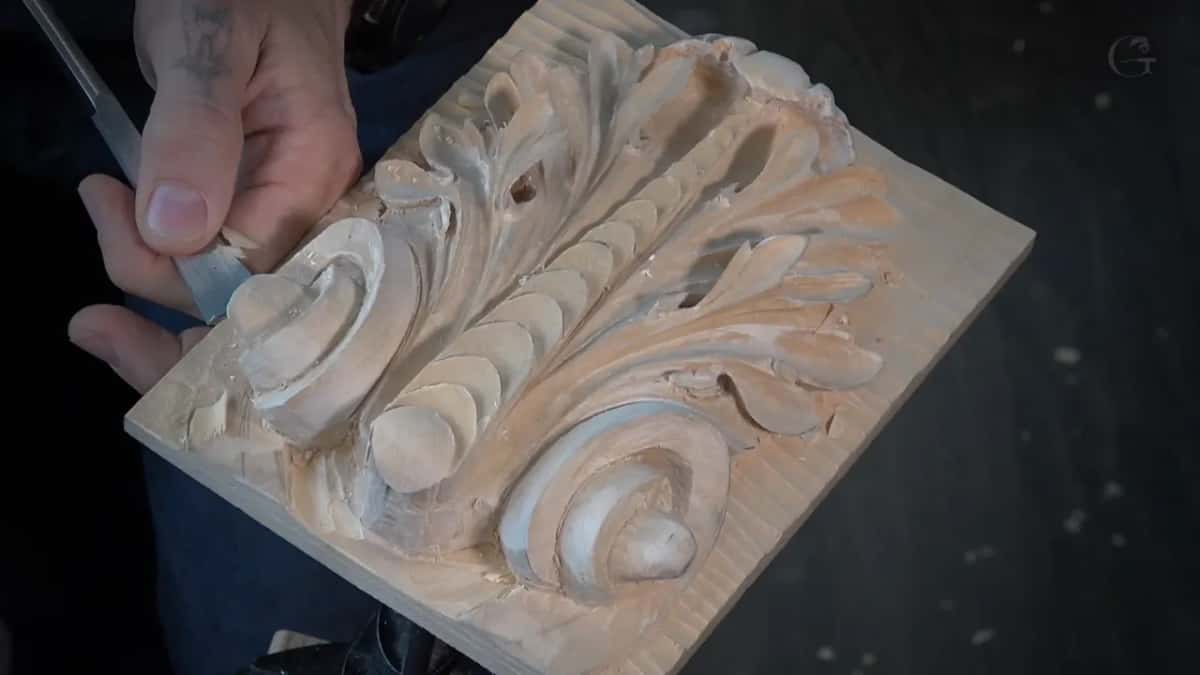
Pay attention to my finger under the piece of wood. I use it as support, as leverage, and I control the tool with my fingers. My setup is two vices, so I can attack from different points, and that carver vice is by Veritas.
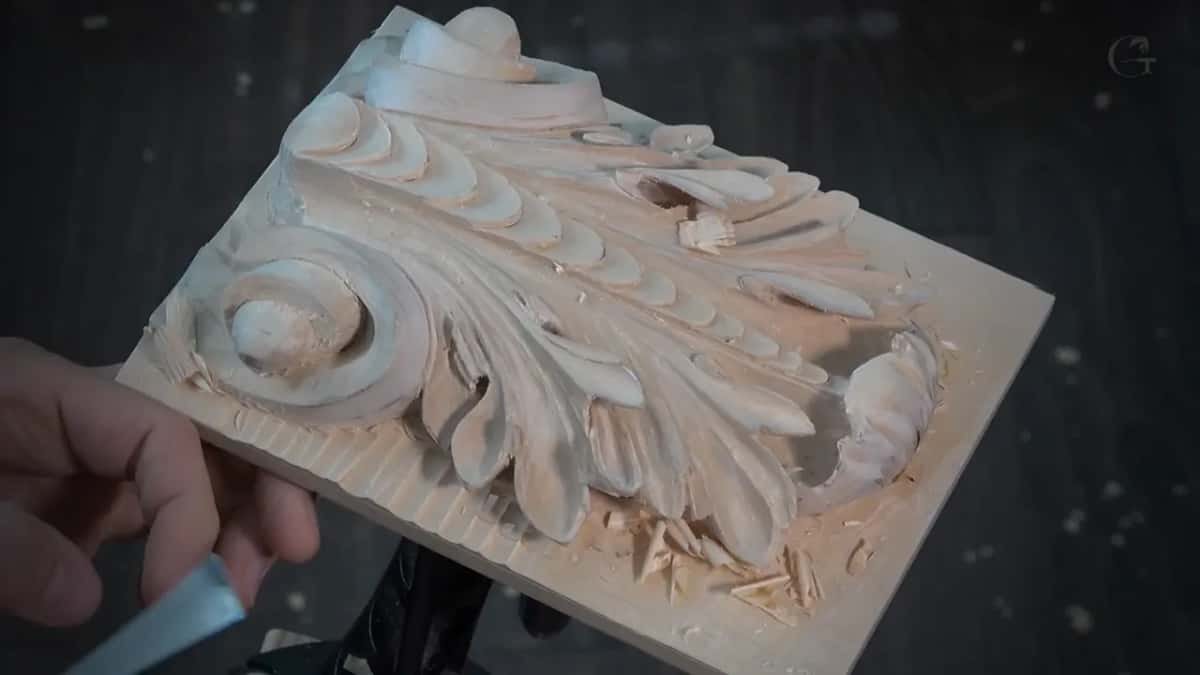
There's a specialty tool made just for this job, a grounding tool, and I believe it's by Ashley Iles. It's also about a number three sweep. I have that one, and I also have a two and a half background removing tool, about an inch and a half (38 mm) wide. Not quite a two, and not quite a number three.
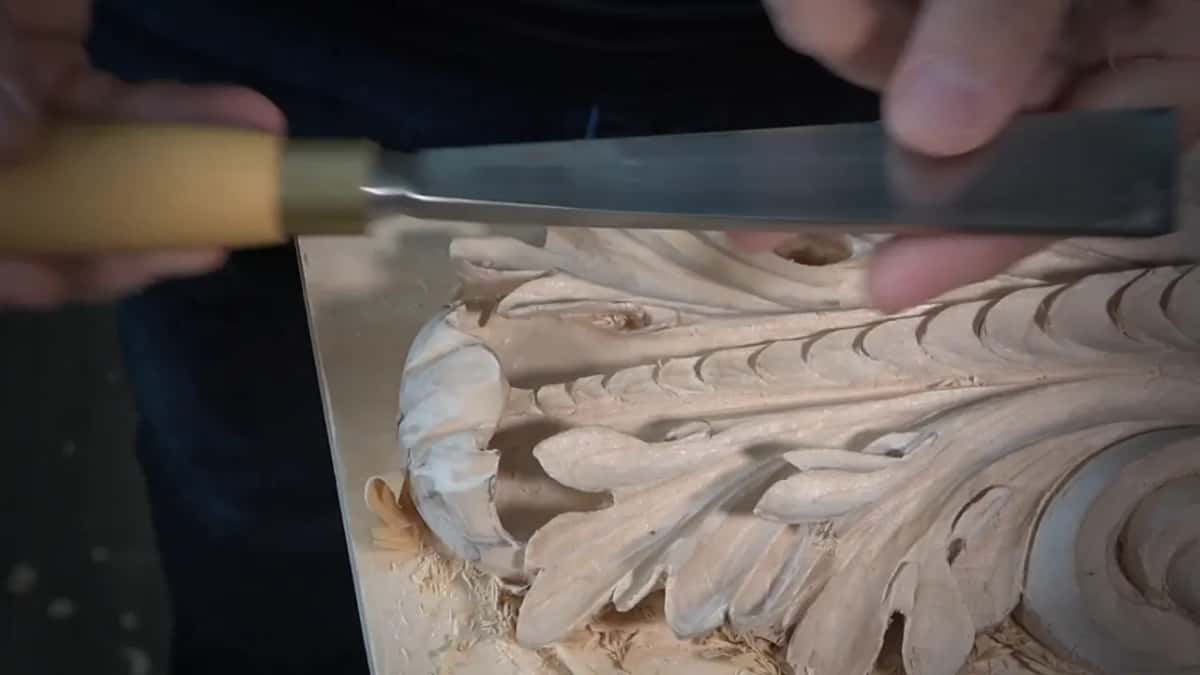
Then I showed a really big one, a number one at three and one-eighth inches (about 79 mm). With a tool like that you pick all the high spots, and you can make the ground so even that people wouldn't believe it's done by hand. You don't have to do that. For me a number three will be sufficient, since I'm pretty sure most of you don't have all the specialty tools.
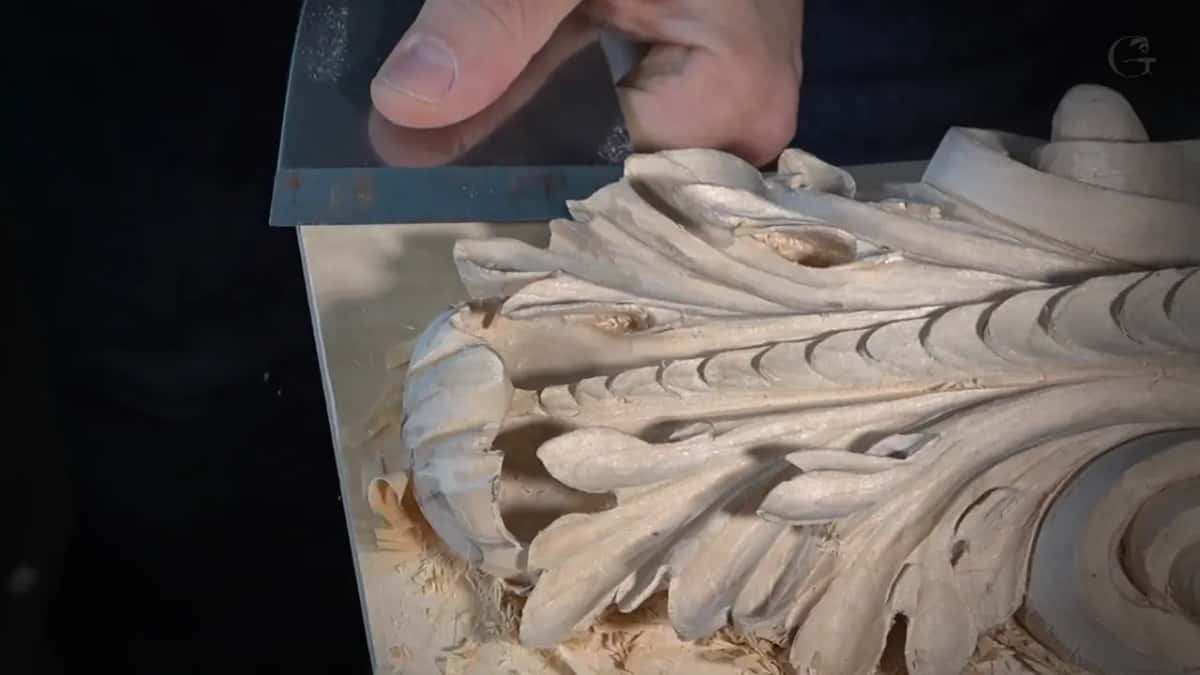
And a rough ground is fine too. A lot of people like that look, with all the marks left, and personally I think it's looking okay.
Why does a bigger gouge carve faster?
I live in the state of Florida. If I fly to Chicago, it takes about three hours. By car it would take me 24 hours, and walking would take multiple days.
A big tool is flying. The same number three at half that size is driving, and a quarter-inch (6 mm) three is walking. You'll still get the result, but it's going to take you so long. So I use bigger tools most of the time, when I can.
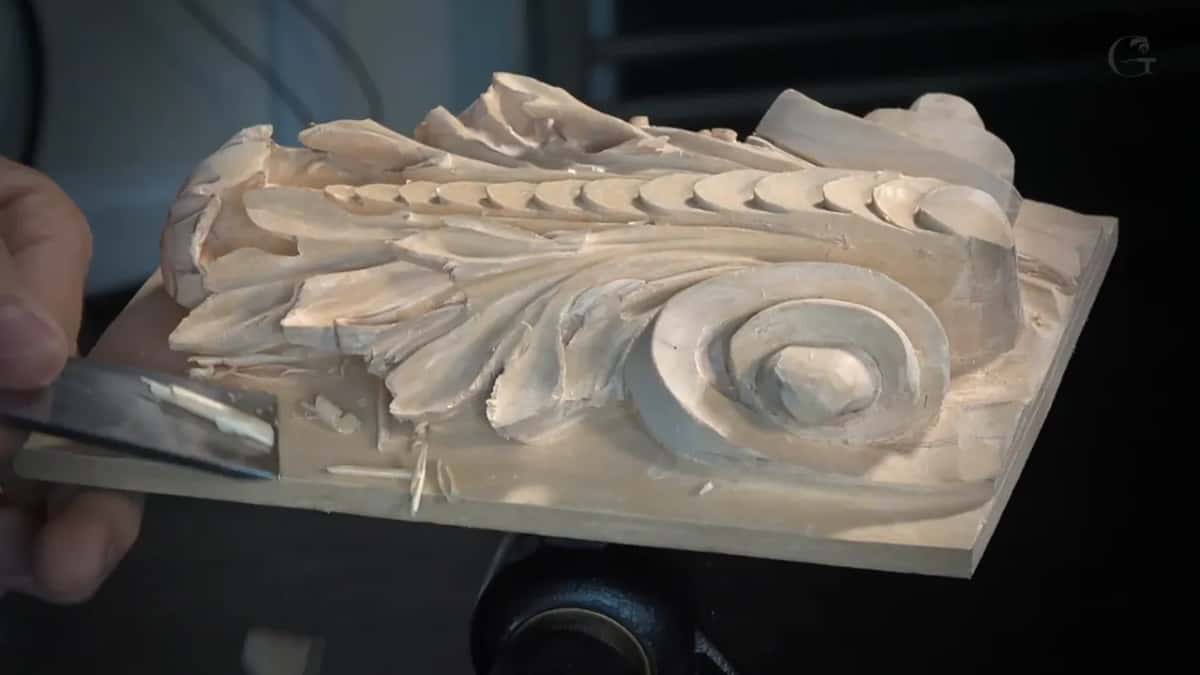
A big tool also lets me use just one corner of it, one tiny corner, or the whole width when I need it. I said the same thing about the fingernails in part 1: a big gouge is always quicker.
I know I've said this in another lesson, and I'm repeating myself. That's okay. My father said to me that repetition is the mother of knowledge.
Why use a number 17 for undercutting?
It doesn't leave a sharp point.
On all my carvings I really like deep undercutting, extreme undercutting. I could use the number 16 for that. Here I took the 17, a quarter inch (6 mm) one, and placed it on one of its chisel sides, the flat side.
Undercut with a V tool and the point inside looks kind of sharp. With the 17 it's a little round on the inside, and that gives a softer look. Well, I use both, and the number 16 is also my favorite.
Don't force it. Let the tool do the work. Be careful not to hit the side right next to it, or you can damage it, so it's better to stop right before you hit that. For the tight spots there's a smaller 17, three millimeters, an eighth of an inch.
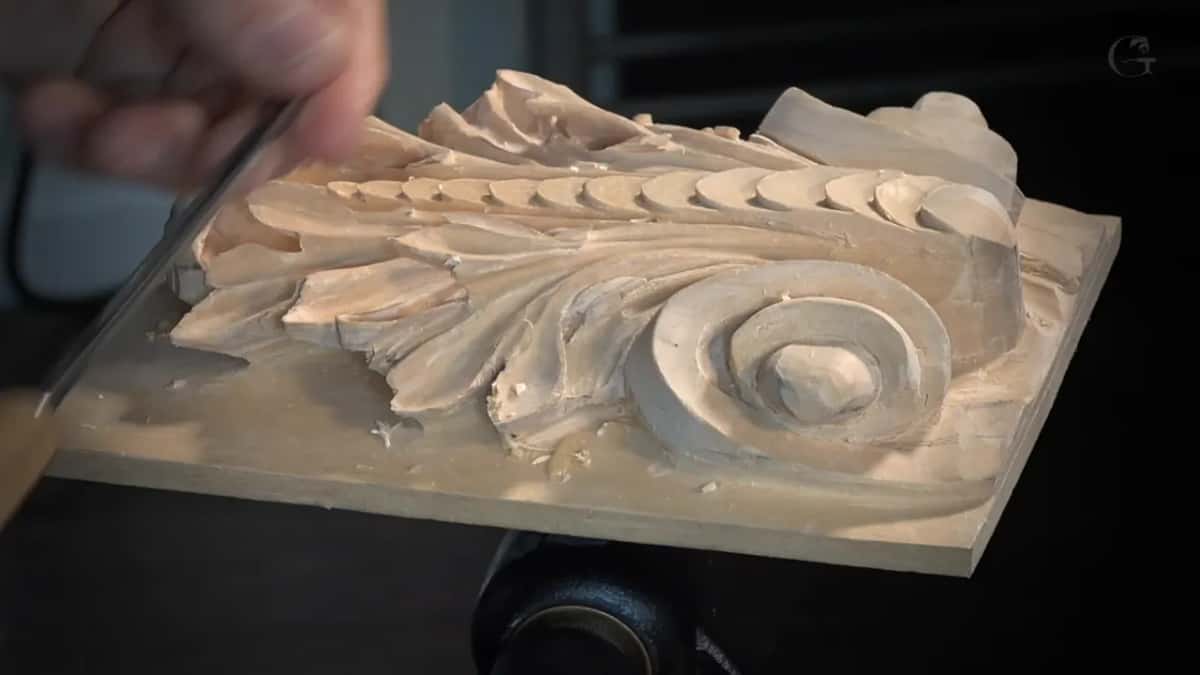
Partway through, my 17 needed buffing on a felt wheel, and after that it worked much better and cleaner. Keeping an edge like that has a whole course of its own. Undercutting this deep belongs near the end of a carving, and lesson 9 goes into why.
Some people don't like extreme undercutting, and nothing's wrong with that. On historical pieces, I said, people often didn't go that deep. It wasn't by design. It was just quicker, because everyone wants to get paid. I have that tendency too, to rush it on a client's project because I want to get paid as well, but it's better not to rush it.
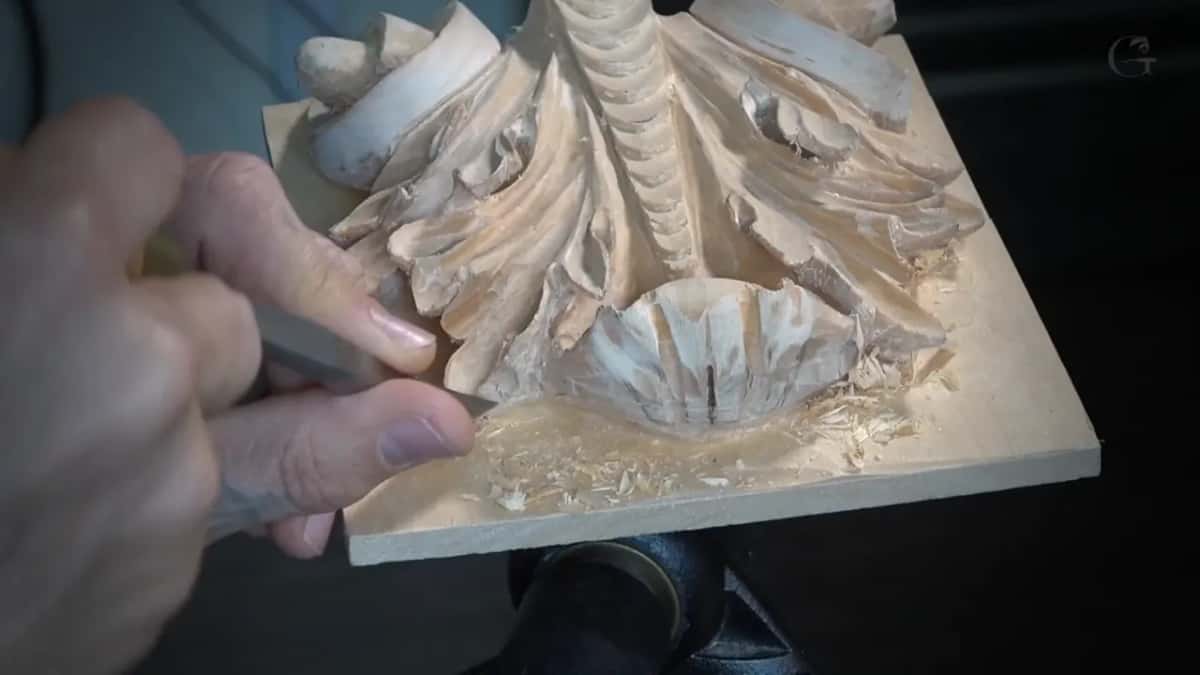
If you'd asked me how they did it in ancient times, I said they did not have any V tools at all. They had gouges. Used on the inside, a number 11 gives the same clean finish and smooth transition, and so does a small number nine, a little more than 3 millimeters (1/8 in). The same operation can be done with different tools.
In a Greek or Russian Orthodox church, I said, there are a lot of acanthus carvings, and in ancient times they were gold leafed to look as rich as possible. They didn't gold leaf the bare wood. They covered the carving with red clay first, and nowadays we're using gesso. You really need that smooth transition in a corner for the gold to stick.
Which other sweeps carved this leaf?
These are the ones I named on camera, part by part. The first gouge of the whole leaf, back in lesson 2, was a big number eight, one inch (25 mm), for setting in.
- Around the fingernails I made a relief cut using a number eight, about an eighth of an inch (3 mm), going about 1/16 inch (1.5 mm) deep. You could do it with just any V tool.
- The fingernails themselves took a number six at 14 millimeters (about 1/2 in), set straight down, and closer to the end a smaller six from Ashley Iles, close to 10 mm (three-eighths).
- To round one part I turned a number seven of about three-quarters of an inch (20 mm) upside down.
- The square step came from a Swiss made number 23 at 4 millimeters. It has a wall and a bottom, so it makes a 90 degree corner by itself.
- The beads in the last part took a number seven. The French fishtail let me use just its corners, and to prove the point I did the same with the 4 millimeter Swiss one.
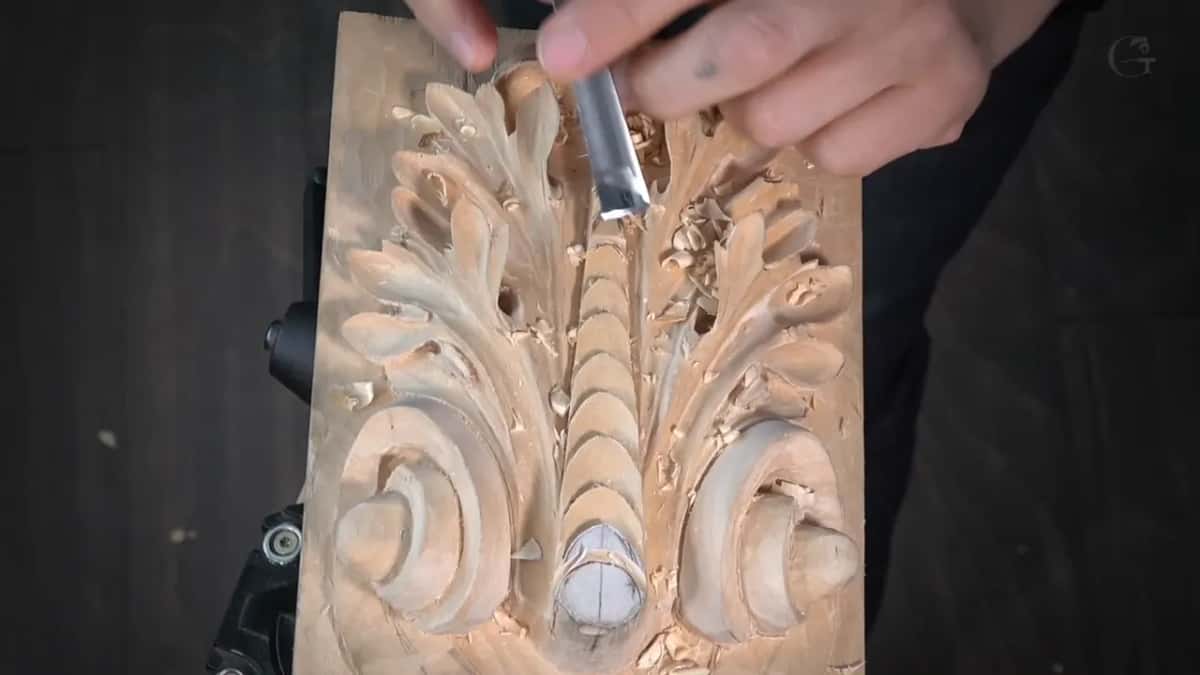
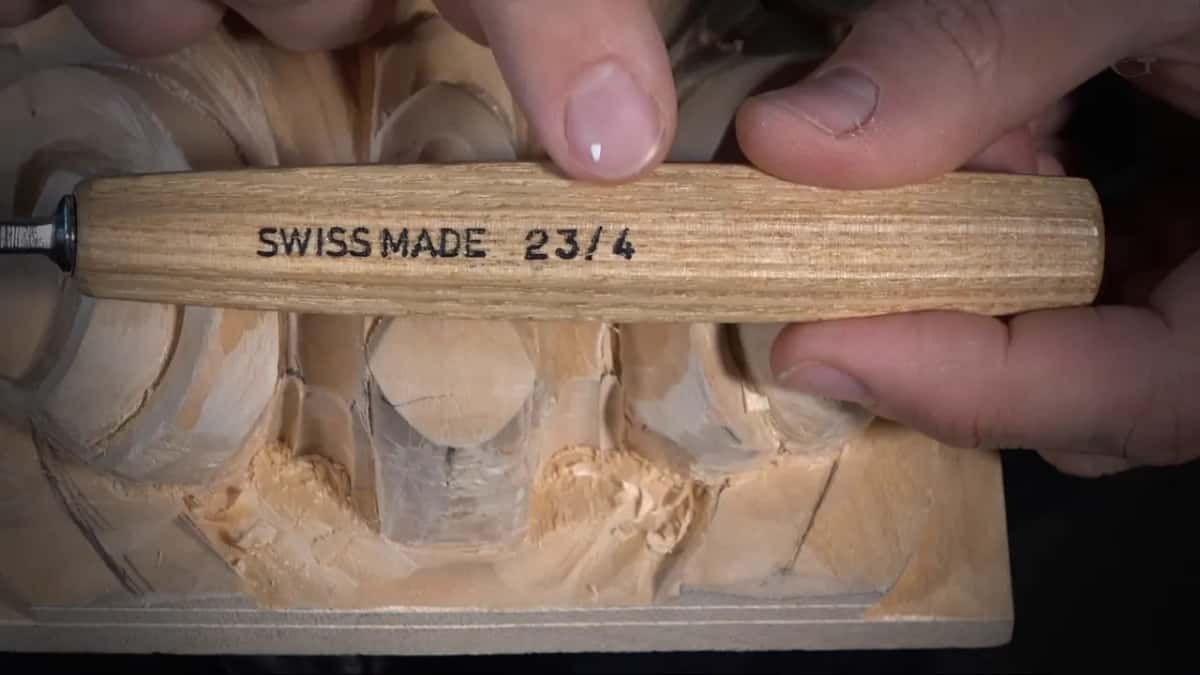
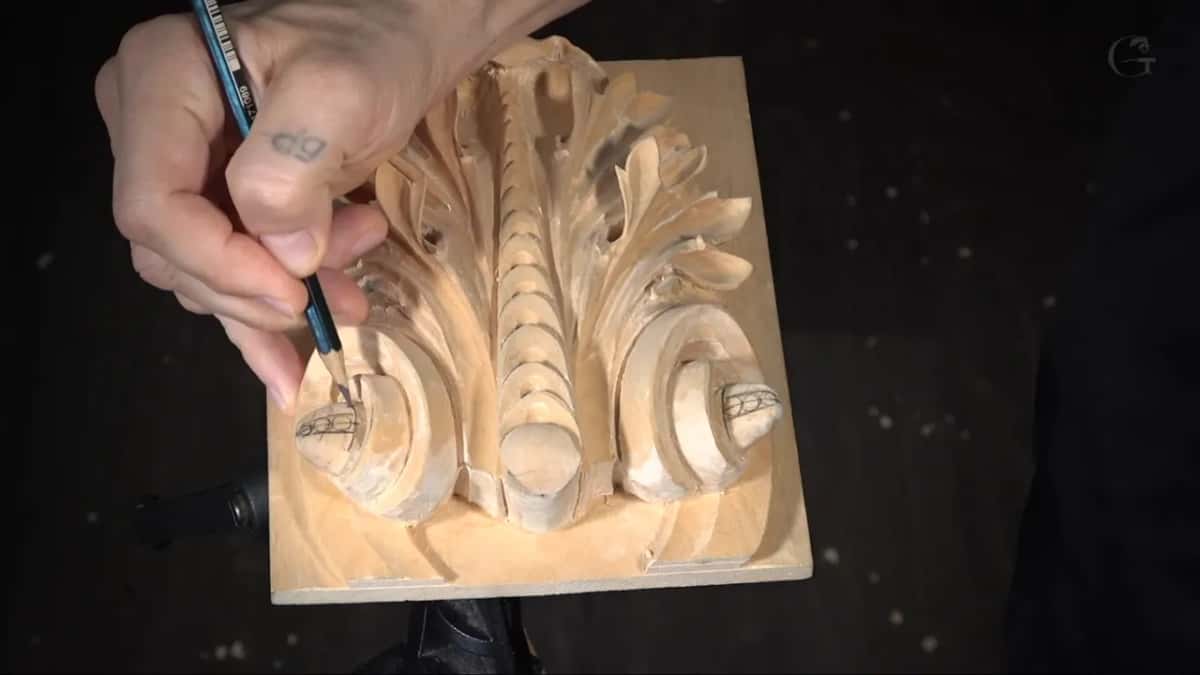
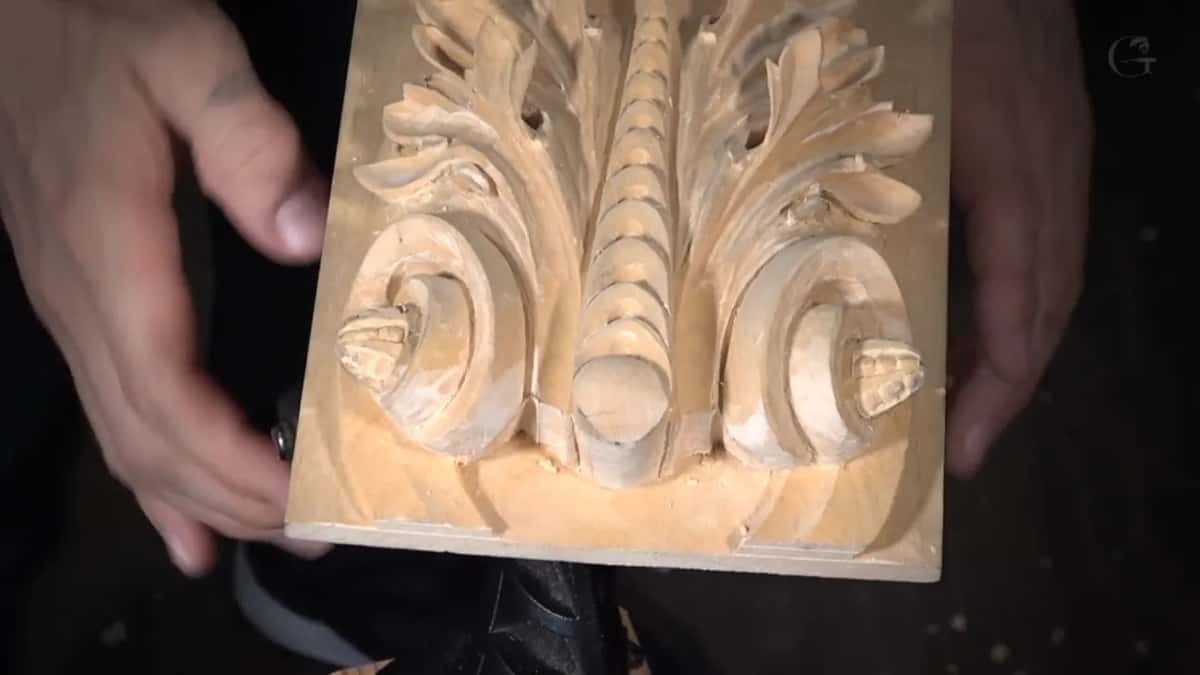
By the end of part 6 the acanthus leaf was finished, at least as a project. I know there's not a lot of carvers who still do the Roman style. But you can use it on corbels for a kitchen, on a kitchen hood, or on a mantel, and there's no limit to what you can take it to.
Would you like to watch the whole board go up and then see each of those sweeps at work on a real leaf? Tuition opens every lesson of the Roman acanthus leaf course, and there's a whole course on carving tools if you want them one by one. Not sure where to begin? Start here.
How it's done
- Take the bulk off with a nine. Lower the ground using a number nine before anything else, because it moves far more material at once than a three does. Mine were 10 and 20 mm.
- Switch to a flatter three. Shave only the high ridges, now with a three about 20 mm wide, until the facets are gone.
- Keep every stroke a slice. Slice even with small tools. Just pushing straight in is not going to be good.
- Find support for one hand. Whenever you can, rest a hand on the work. Holding the tool in the air gives you far less control.
- Clear the corner with a 17. Lay a number 17 down on a flat side and run it where leaf and ground meet, so all that junk comes out.
- Stop short of the next part. Let the tool do the work, and stop just before you hit the part beside it so you don't damage it.
Frequently asked questions
Is a lower sweep number flatter?
Up to number nine, yes. The 1 is absolutely flat, the 3 has just a little curve, and the 9 comes near a half round, about half of a circle. From 11 on you're into veiners and V tools, which work another way.
What sweep number is a veiner?
Eleven is where veiners start. Think of a half round with its sides carried straight up, a U shape. On this leaf I used a one millimeter number 11 to clean a rough line and a half millimeter one for smaller separations between parts.
Do all brands use the same sweep numbers?
Not exactly. My French number four, 10 mm wide, works like a number three by Pfeil, maybe even like a 2.5. Widths drift as well, so a tool marked 10 millimeters can turn out to be 9, machine made or handmade.
What to carve next