
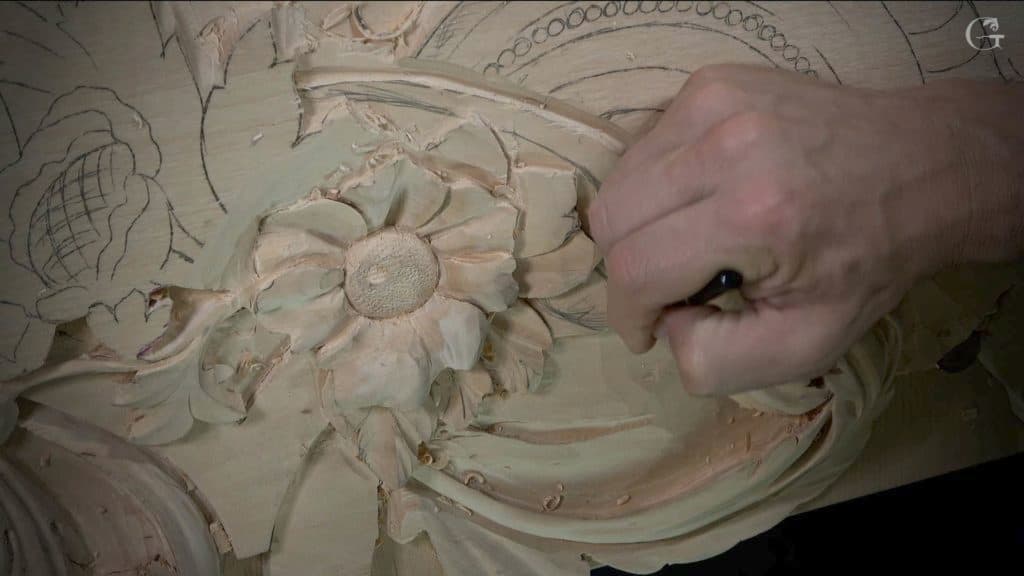
Alexander Grabovetskiy, woodcarver, School of Woodcarving · Published 2021
Should you walk around your carving or turn it?
Quick answer: Walking around a carving is how you take the tool to a line's better side when the piece stays put. I did it in lesson 119 of the Venice Room, saying the other side was the better one to attack from. On smaller work, turning the piece does that too.
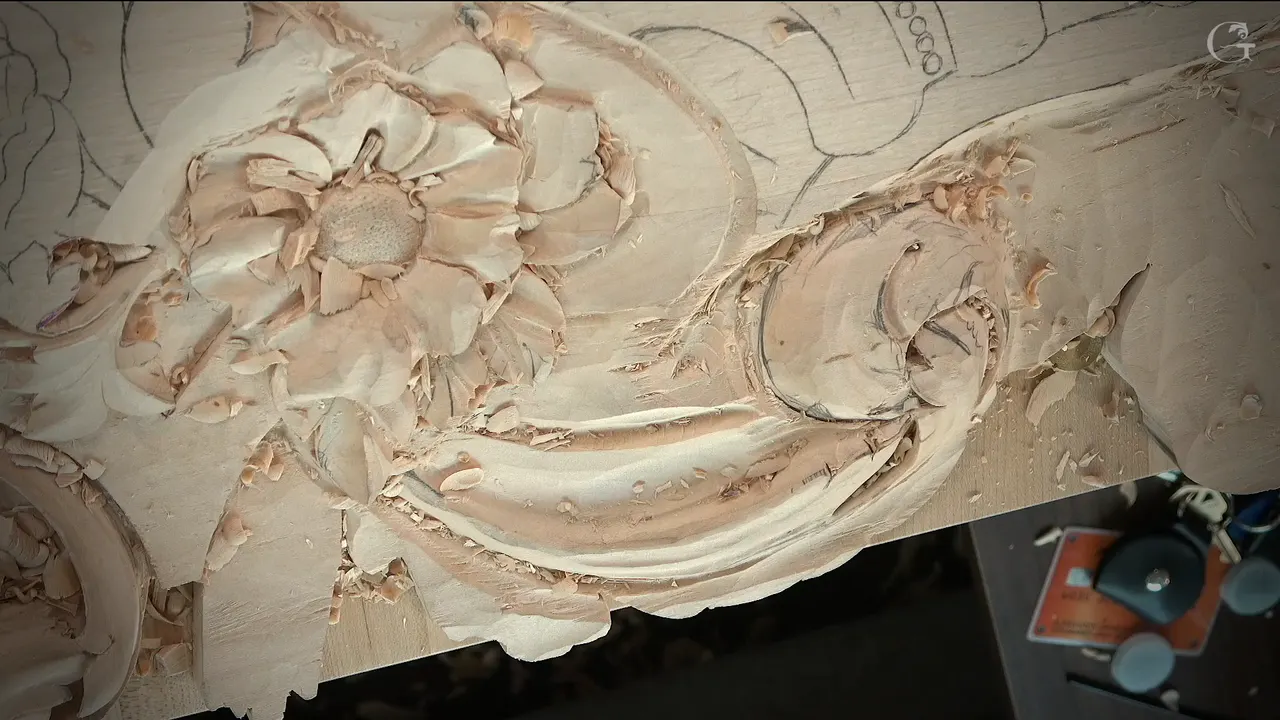
Walking around a carving means you move yourself, not the wood, until the tool can reach a line from its good side. With a smaller piece you can turn the work instead, or turn a rotating workbench, and get to the same place. In lesson 119 of the Venice Room there was one line of an acanthus in front of me and a number 11 in my hand, and the other side was the better side to attack it from. "I think I have to walk around," I said. "That's going to be better for me to attack from this side."
Have you ever leaned across a table to grab something on the far side? Did your arm go stiff at the end of the reach, and your hand lose its feel for what it was holding? A gouge held out that far is the same arm with a sharp edge on it. In this lesson the answer was to go around to the other side, and below I'll show you where I do that and where I refuse to.
You already know the tool has a good side and a bad side on almost every line. By the end of this page you'll know when I walk, when I turn the work, and the one reason I will never skip the walk to save time.
Walking or turning, in five lines
A number 11 in lesson 119 needed the far side of an acanthus line, and I walked around to get there.
Turning a smaller piece or walking round it is smarter, I said in workshop 57. Safer, I should say.
Another lesson has me offering to rotate my workbench, then choosing to walk anyway.
Some huge pieces can't be turned or walked around, and then I work from the one spot where I stand with my hand planted.
A minute saved by staying put is worth it only while the work is still safe.
What does lesson 119 show about walking around?
You see one hollow attacked from several directions, and later one real walk to the far side, both times using a number 11 veiner.
The first comes after the main movement is done. What was left, I said, was lots of cleanup and undercut, "which is nothing exciting." I took the number 11 then and went at the hollow "from different points of view" to get my excavation deep. One approach, then another. "Just like that," I said. The cleaning job that followed, I said, would happen off camera.

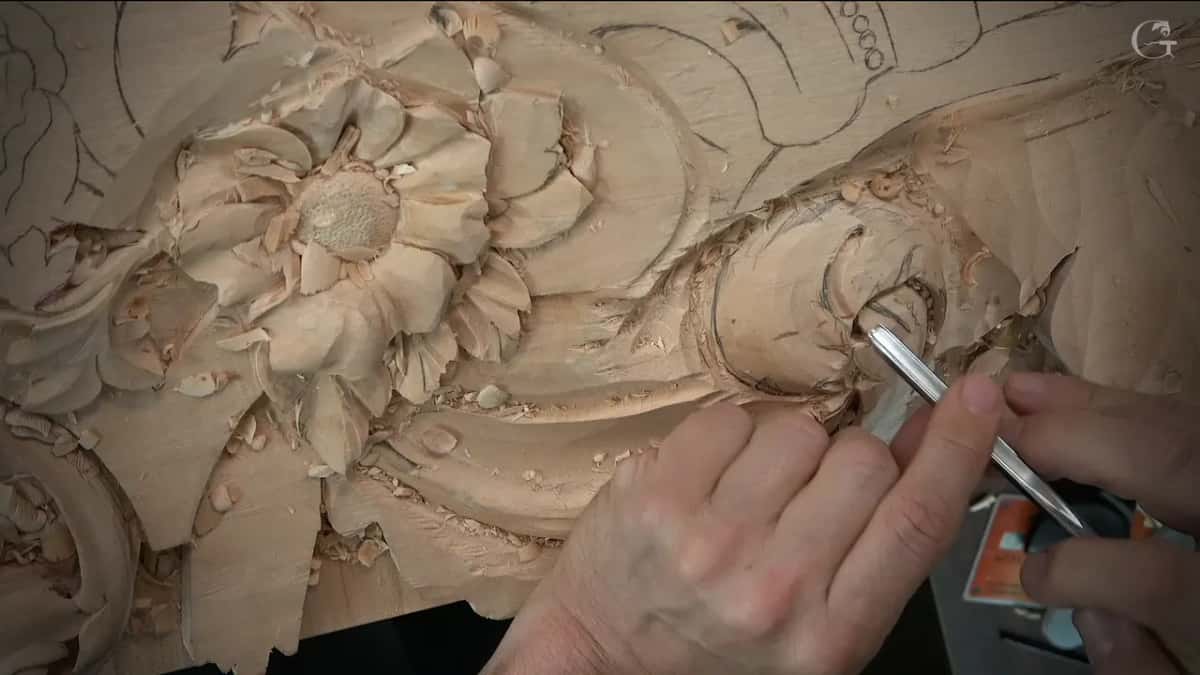
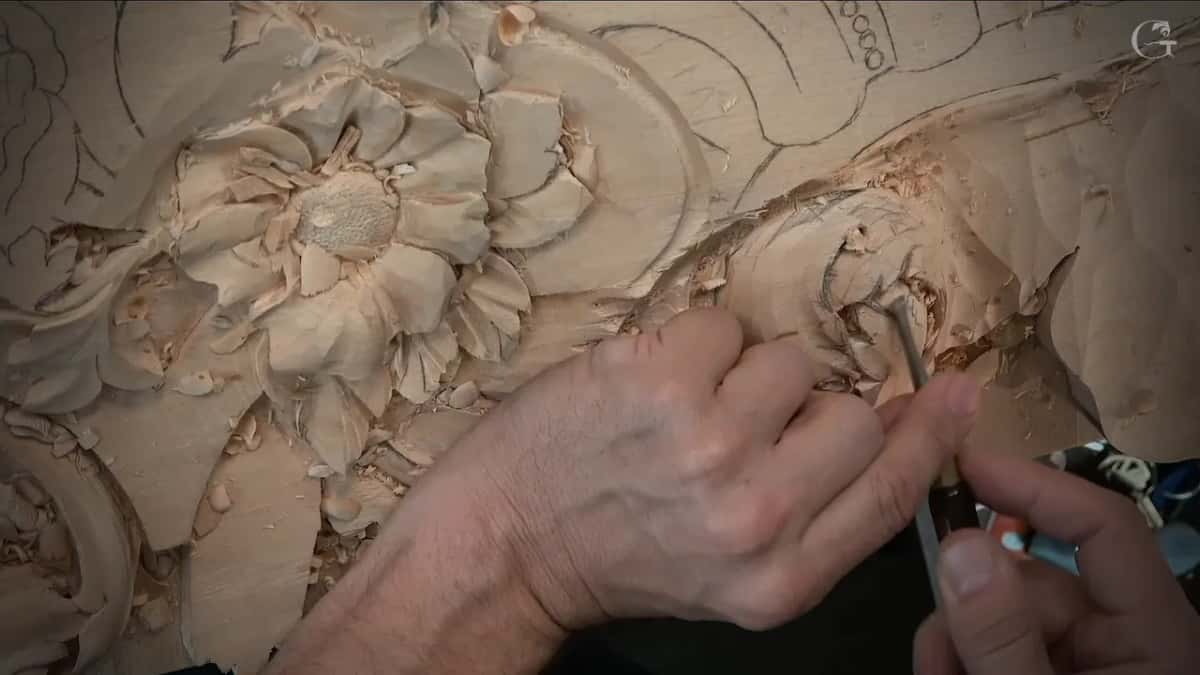
The second one is the walk to the far side, and it's the one this page is named for. I was working one line, and yes, I took number 11 again, "of course." That's when I said I needed to walk around, since attacking it from the other side would suit me better. It meant going against the grain there, and I said it would still be a lot more convenient; grain has its own page, how to carve against the grain without tearing the wood.

After that I stopped talking for a while and worked. When I spoke again it was this: "Again, I have to make the decision really what I want to see." You can see it in the frames from that stretch. The veiner runs along the curve from a new direction, and my hand now enters on the right of the picture.
The pencil work around that same flower, where I sketch a simple acanthus movement, is on the page about whether every small detail needs carving all the way.
What does it mean to attack a line from another side?
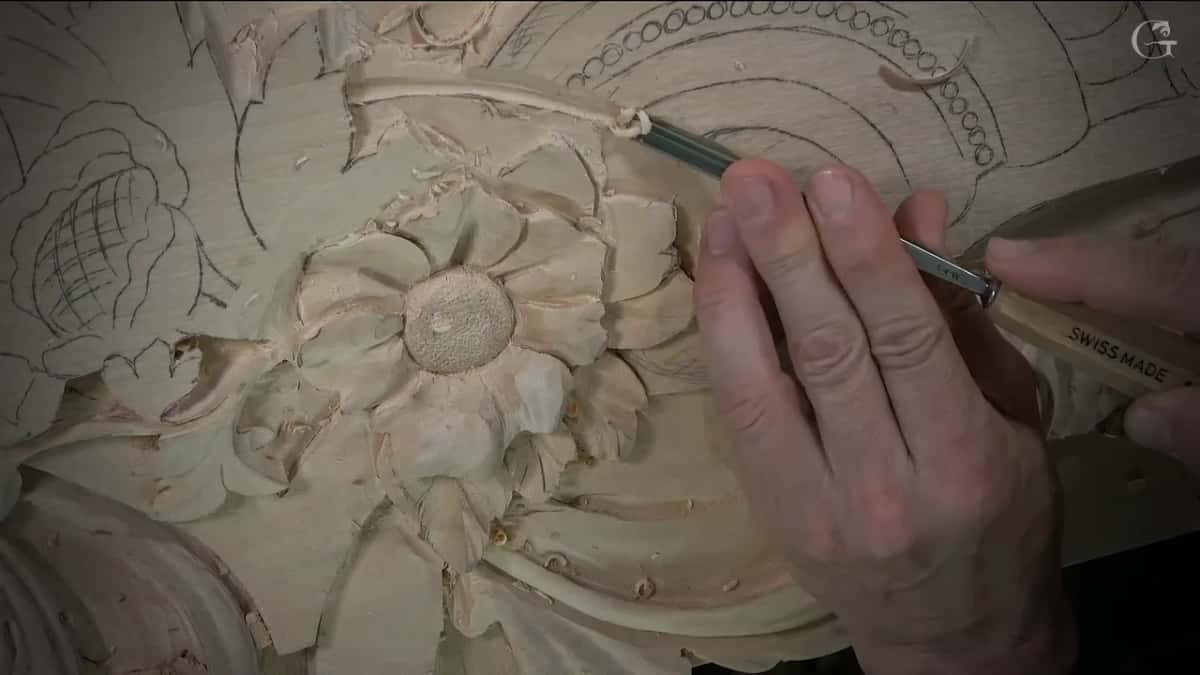
When I say attack, I mean the moment the edge goes into the wood, and the side is simply where your body stands while it happens.
Back in lesson 119 I said I would take the number 11 "and attack from different points of view." For the floral panel it was "I have to attack that from the right position." And in the Hashemi flowers course I talked about "how you attack your piece, what hand you're using." The word stays the same in all three. What changes is the side.
Why is walking around safer than reaching?
Walking is the safer choice, and on lesson 10 of Carving Floral and Molding for the Panel I said it in three words: "It's always safer."
Let me tell you a story. On that panel of flowers and moldings the wood sloped downhill from my line. My tool was really sharp, and I was able to do it from where I stood, I said, with absolutely no problem. But it was not the safest way, and there was no way to dig like that with any comfort. Really, I said, I have to walk around, or in my case just rotate my workbench and come at it from the opposite side. In the end I picked walking.
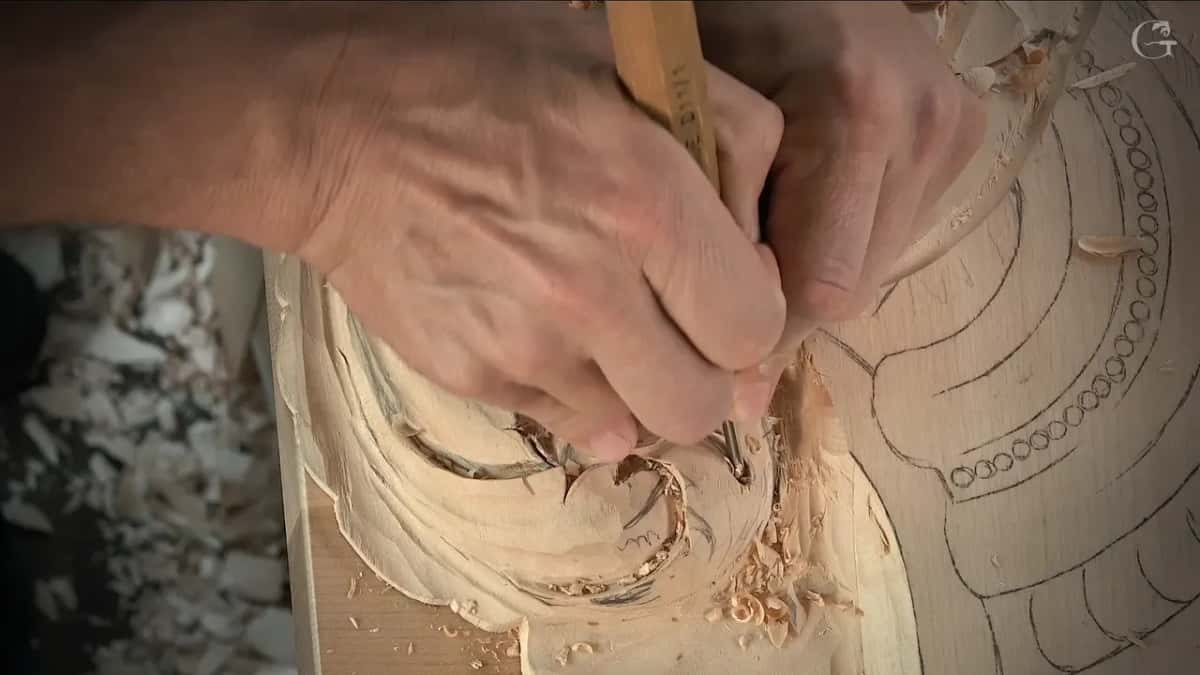
In lesson 5 of that same course I'm holding a number 6, going little by little, without forcing. "I'm going to walk around, okay?" Then, I said, the tool goes straight down again, all around the shape, with no lean. Leaning it there, I said, would be a big mistake.
By lesson 13 of the floral panel I still hadn't cleaned everything, and I asked you to please forgive me. I went round after that and worked from the far side. Little bites. Really, really small bites. A little later I walked around again, and I still didn't go all the way to the line. It was safer to stay a little away, about one millimeter (0.04 in) or so.
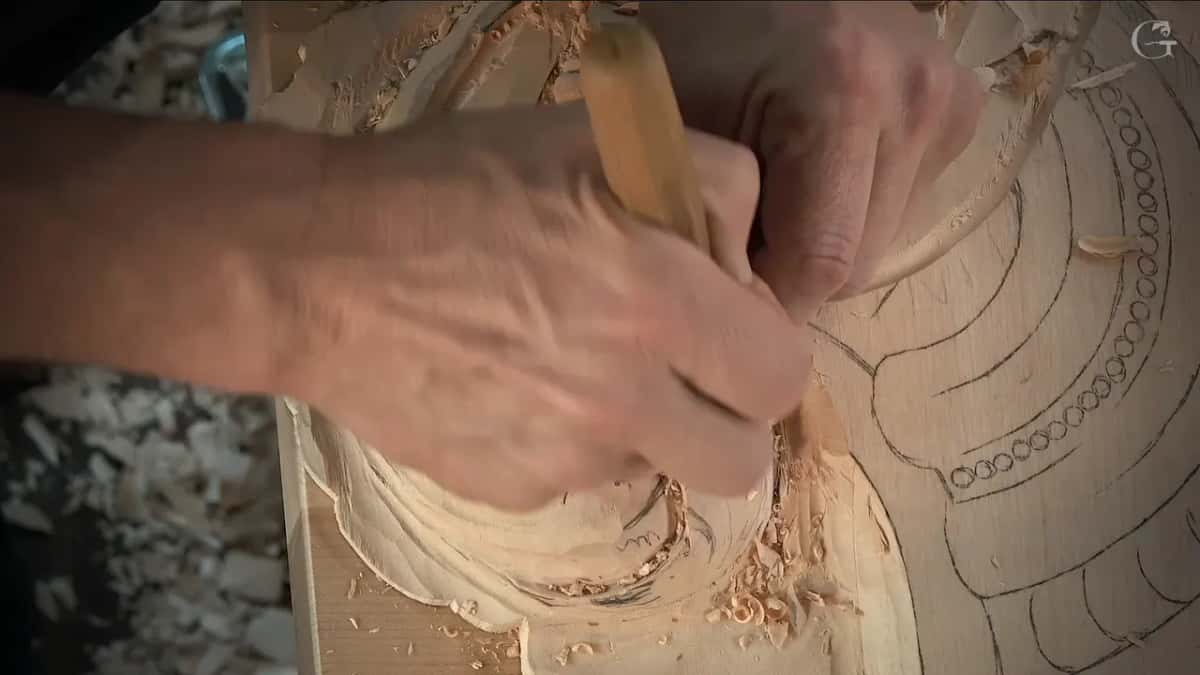
With Acanthus over Moldings, lesson 5, I had a number 11 of 15 mm (about 9/16 in) and was going carefully, and the grain was the reason to move. My words were that I really had to go around and come at it from that side instead.
The advice on the Byzantine acanthus, lesson 5, a leaf from Byzantine ornament, was plain. Don't think you stab once and a beautiful shape appears. "Take your time, okay? And walk around."
I'm going to be honest with you about the camera, too. During lesson 2 of the floral panel I told you I had to attack a spot from the proper position, and in the same breath admitted it's not always convenient for me to walk around, because I'd rather not cover the camera.
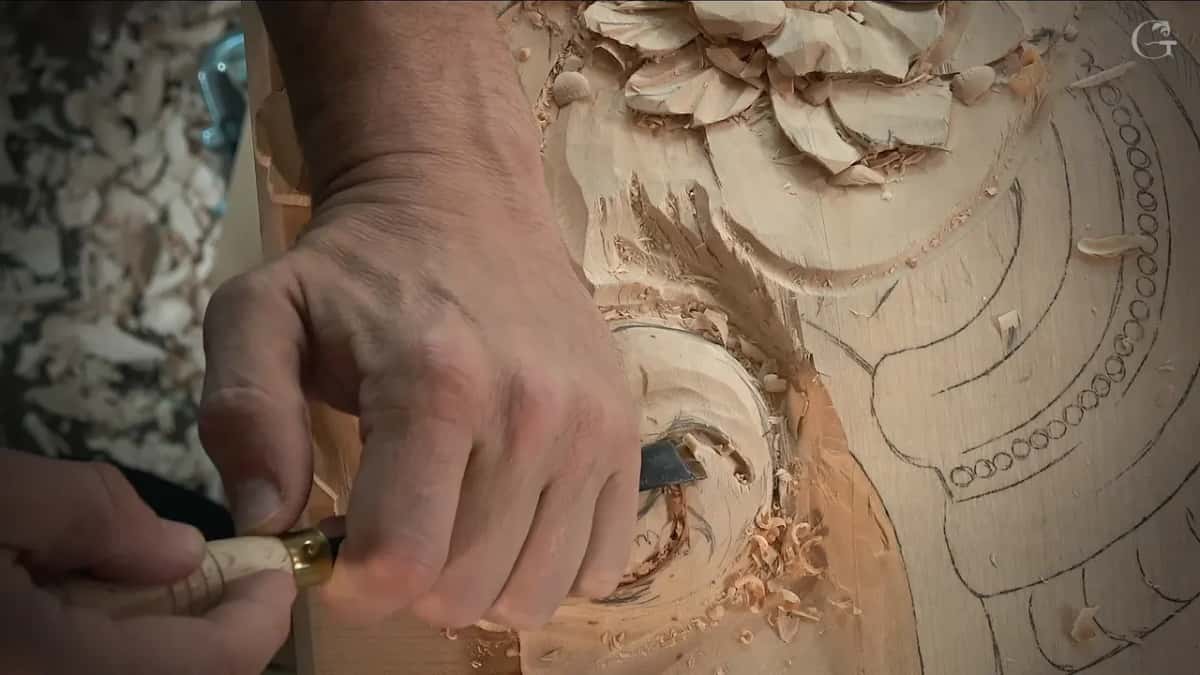
When is a rotating workbench the better answer?
A bench that rotates is the better answer on a piece small enough to move, which is what I meant in workshop 57 by a smaller scale carving.
My first furniture panel design lesson shows the setup. There are different vises and different carver's devices, I said, but get the idea. Get the surface you want to work on and screw it in place. In my case I drilled 20 millimeter holes, "three-quarter of an inch, if you are in USA," and used just clamps to hold the work piece. "And I can walk around and rotate and use it. It's a beautiful thing."
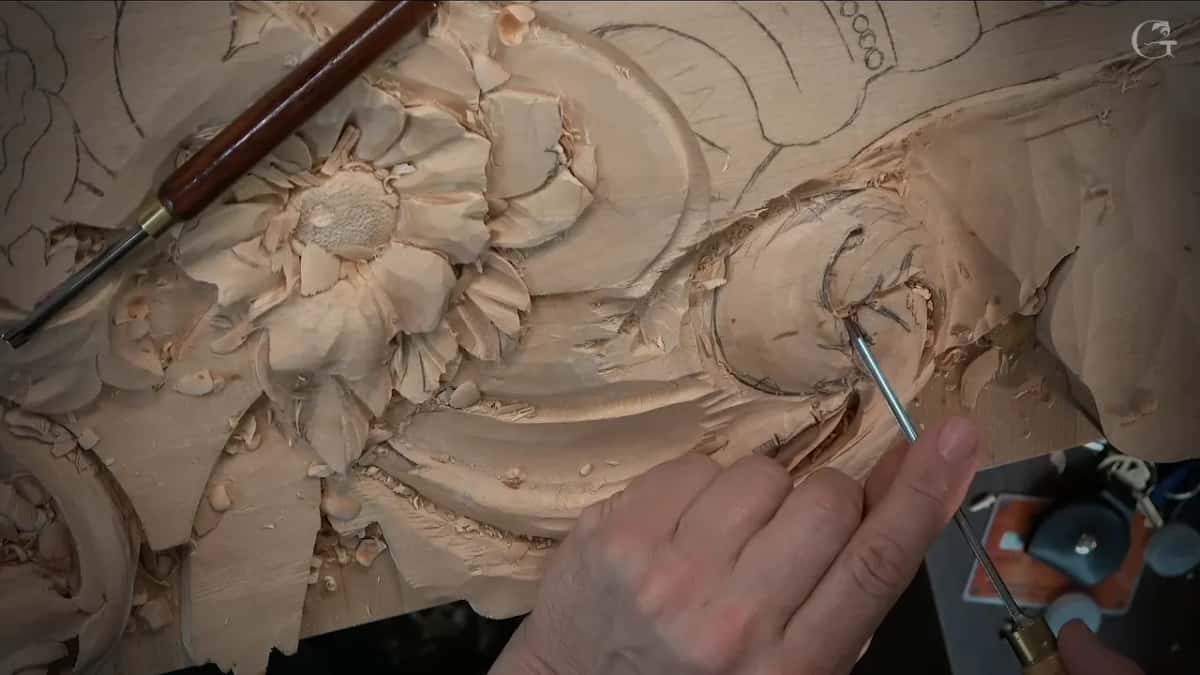
Over on Hashemi flowers, lesson 47, I was using a tool backward, my hand on the back side of it, pointing back at me. There were a couple of ways I could approach it, I said. I could rotate my piece and come in from another side. "And it's okay with a piece like that."
A small piece like that gives you more than one choice, and the bench can do some of the turning for you. Turn the wood, or turn the bench, or walk. How I lay out my tools on that workbench is a separate question, and work bench organization answers it.
What do you do when a piece is too big to turn?
You attack from one point, the spot where you're standing, and your technique grows out of that.
Right after the small-piece line in that same Hashemi lesson, I said it straight. "But sometimes I have to work on huge pieces, on the big ones, and I really can't walk around, and I can't rotate." I stay where I am. That's how the different techniques come, naturally: how you attack your piece, and what hand you're using.
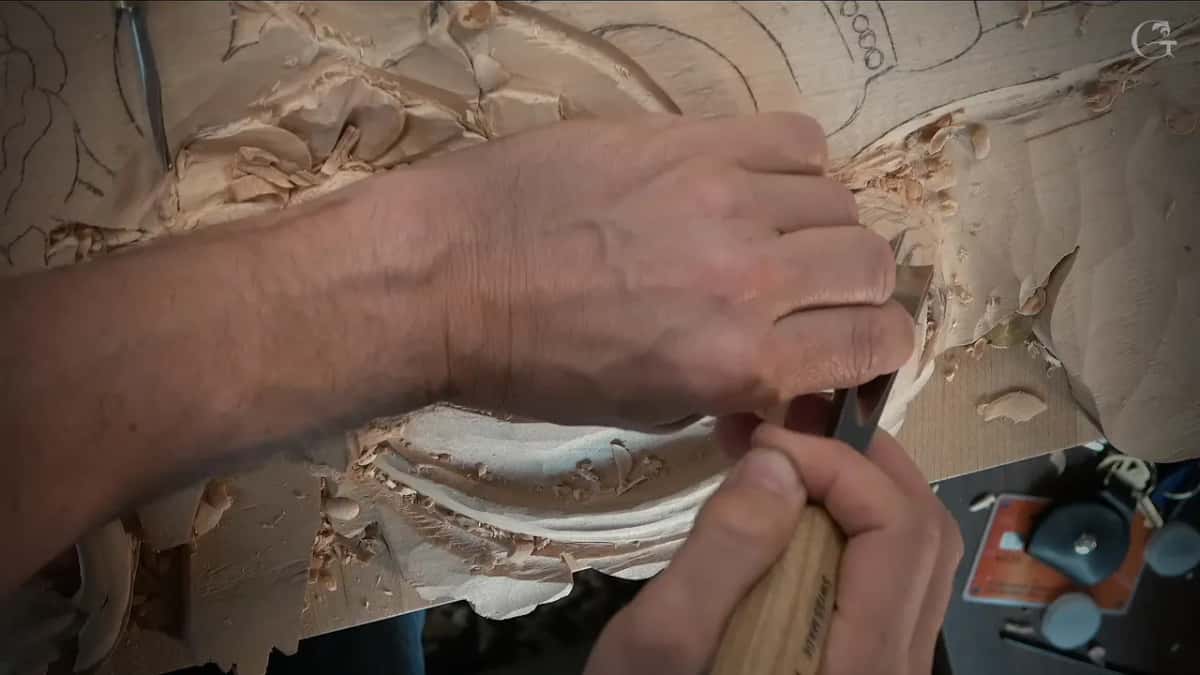
Workshop 53 of the Venice Room is that exact case. That particular project could not rotate, and I could not walk around my bench either, or I'd lose too much time. "And I really don't want to lose time," I said, twice. I stayed on my side instead and took the skew chisel to blend it a little better, one way and then the other.
Holding a board that big is its own problem, and a carving too big for a vise covers it.

Is saving a minute worth skipping the walk?
Only while the work stays safe. The moment safety is in question, the minute is not worth saving, and I said exactly that in workshop 57 of the Venice Room.
There I was working as "a cranker, okay, or leverager," my hand placed really solidly on the wood. The tool was coming toward me, and I told you that's a little bit dangerous, but on that spot it was the only way I could excavate. For a smaller scale carving, I said, rotating the piece or going around to attack from the opposite direction would be smarter. Safer, I should say.
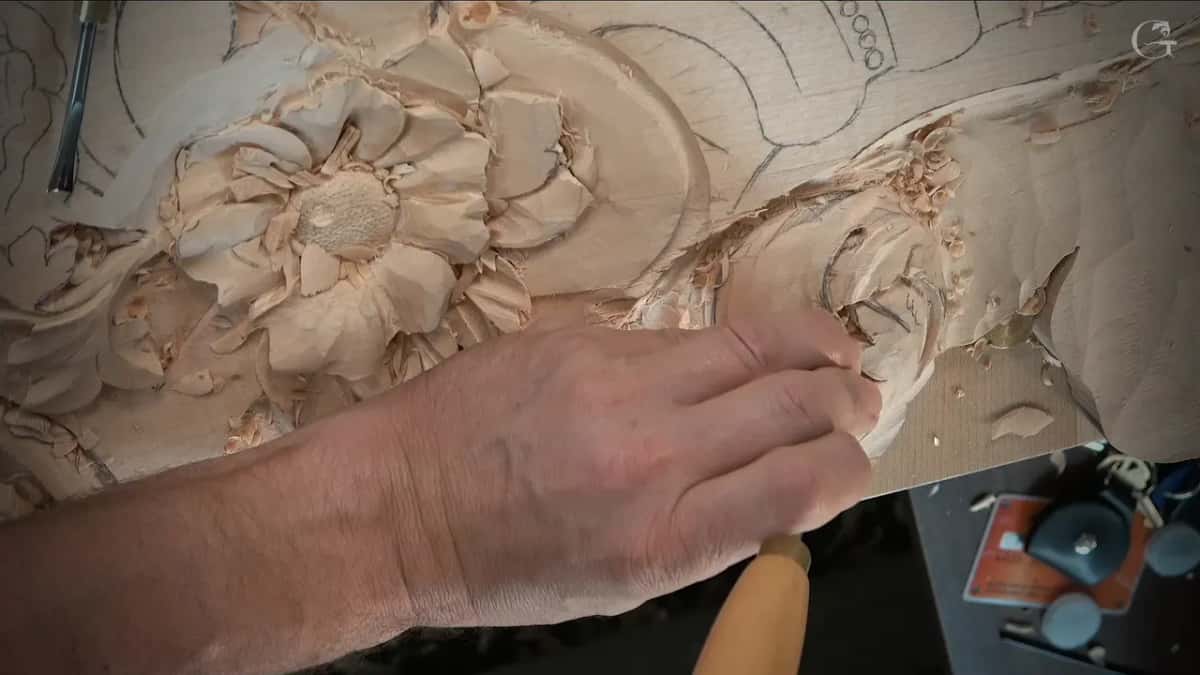
But that was a huge piece, and walking around it would take too much time. I have a kind of deadline, not a real one, just the day I want the work finished, and if I can save a minute, I'd rather save it. Only if it's still safe. If it's a safety concern, no, I'm not going to save a minute.
What lets me stay put there is a skill I already developed, controlling the tool without cutting myself. I almost never cut myself anymore. It used to be that I cut myself a lot of times, sometimes more than once in one day.
Carving toward yourself has its own page, can you carve toward yourself, so I won't repeat it here.

Where did I walk, and where did I stay?
Here are six of those cases side by side, lesson by lesson, with the reason I gave on camera.
| Lesson | Reason | Choice |
|---|---|---|
| Lesson 119, this one | A line needed the tool from there | Walked around |
| Venice Room workshop 57 | Huge piece, and walking costs me time | Stayed put |
| Workshop 53, same room | That particular project could not rotate there | Blended instead |
| Hashemi flowers lesson 47 | A piece that could rotate, I said | Rotation fine |
| Floral panel, lesson 10 | The wood sloped downhill from my line | Chose walking |
| Floral panel, lesson 13 | I walked around to the opposite side | Tiny bites |
Look down the last column and you'll see it isn't one rule. It's a choice made fresh at each line, based on the size of the piece, the time, and whether my hands are safe.
What else will you see in lesson 119?
You'll see the other half of the lesson, which is shadow and blending, done with the same patience.
"It's all about the shadow and light," I said near the start. Shadow comes first, with a number 11 of 5 mm (3/16 in) going deeper, then smaller ones after it, "only for the shadow's sake." The pillar page for this course explains why a hole right through the panel reads darker than any groove. Then comes a separation that throws up "lots of chunk," and I don't worry about it, because I can always clean it. A 15 mm (about 9/16 in) number 11 makes one concave, then another on the other side.

Before those concaves you'll hear me decide things out loud. I decided out loud that it would be a pipe, and then I wondered whether the middle needed another separation going underneath. "Maybe I don't need anything," I said, and a moment later said it again.
And just before the first concave I said I hoped it showed really well on the camera, "or on the screen, I should say."
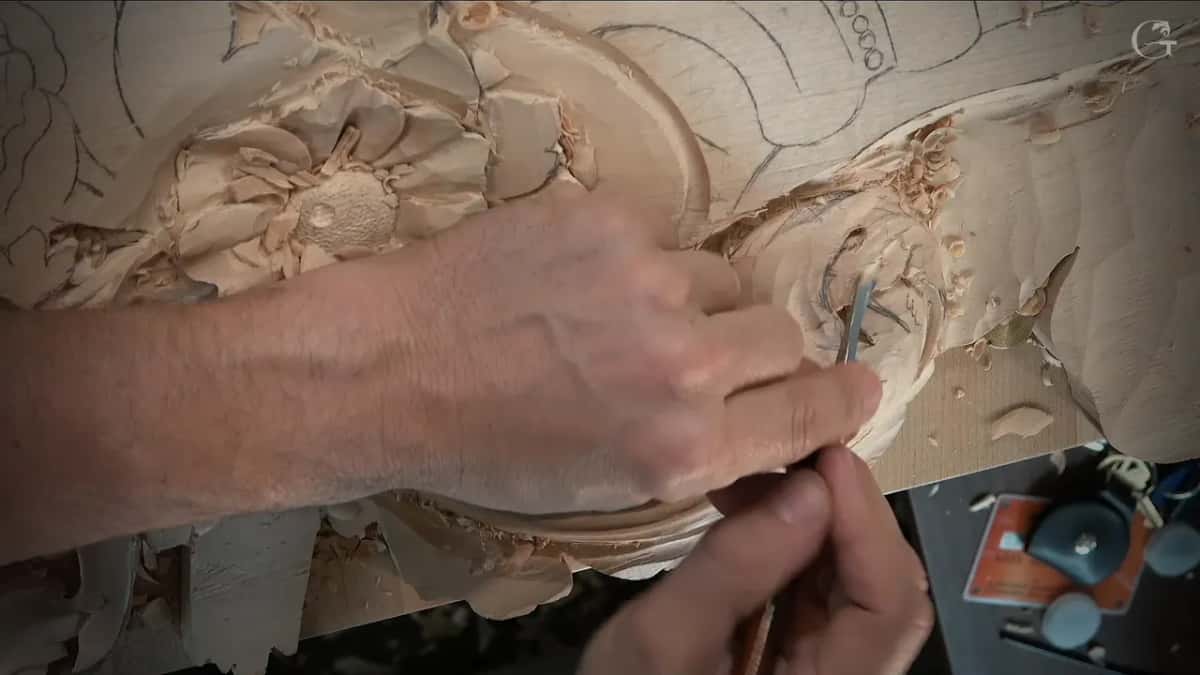
The last part opens with "Now it's all about blending." "Just blend everything," I said, and refine the separations that still need it. Later I reach for a number seven, stop, and take a number five, because it would be better in that case. "I don't want to rush anything," I said. "Really important for me not to rush it." The lesson sits in Advanced Carving: Venice Room (Part 10), workshops 110 to 121, right after lesson 118, and full access to the school opens the whole room, every workshop of it.
Have you ever turned a piece of carved wood in your hands just to look at it? Did you look from more than one side? Then you've already started what lesson 119 is about.
How it's done
- Find the better side. Lesson 119 had a line that was better attacked from the far side.
- Clamp the work down. Screw the surface in place and clamp the piece, the way my furniture panel was held.
- Walk, or turn the bench. Go around it on foot, or rotate the workbench if yours turns.
- Go little by little. Small bites, and no forcing, the way I went at the floral panel.
- Keep a small margin. About 1 mm (0.04 in) off the line is safer for now.
- Stay put only when safe. A minute saved is fine on a huge piece, as long as your hands are safe.
Frequently asked questions
Can you always walk around a big carving?
Big work often won't let you. On one project of flowers I said on camera that I really can't walk around the huge ones or rotate them, and I attack from just the one point where I'm standing. Different ways of attacking come naturally from that, including which hand does the job.
Is turning the piece better than walking around it?
Either works on smaller carvings. Workshop 57 of the room had me calling a rotation or a walk the smarter move, and then correcting the word to safer. Another course had me offering to turn my workbench before I went around on foot.
How do you hold a carving so you can walk around it?
Clamps did it for me on the furniture panel. I drilled holes of 20 millimeters, which I gave as three-quarter of an inch for people in the USA, and clamped the work piece down. It could rotate, and I could walk around it.
What to carve next