
Alexander Grabovetskiy, woodcarver, School of Woodcarving · Published 2021
How do you convert carving gouge sizes from millimeters to inches?
Quick answer: Gouge width conversion is division by 25.4, since an inch holds exactly 25.4 mm. A 10 mm gouge comes to about 0.39 inch, which I call three eighths on camera, and a 6 mm one is close to a quarter. I round aloud and often say whether the tool runs a little bigger or smaller.
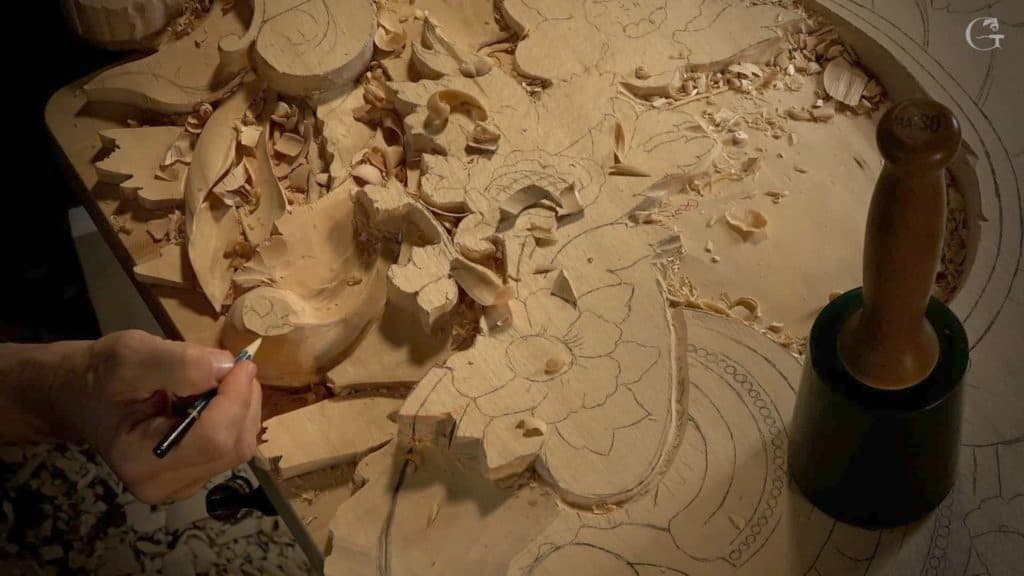
Gouge size conversion is one division, the width of the edge in millimeters over 25.4, because an inch is exactly 25.4 millimeters. That is the whole arithmetic. At the bench I do it another way, out loud and in round numbers, and in workshop 111 of the Venice Room I did it five times while I carved the acanthus that frames the flowers. So this page is a carving gouge size chart made from one real workshop, with my spoken figure set beside the exact one.
Have you ever measured something with a ruler? Did one edge say inches while the other said centimeters? A carving tool lives on both edges of that ruler at once, and a beginner has to work out which edge a lesson is reading from. The steel stays the same. Only the name changes, and one lesson may call a gouge 10 millimeters while the next calls the very same tool 3/8 of an inch.
By the end you will be able to read every width on my bench in either system, and you will know how far my round numbers sit from the real ones.

What the numbers come to
All of it rests on one number, 25.4, the millimeters in one inch.
In workshop 111 I called a 10 mm number 9 three eighths, and a true 3/8 is 9.525 mm.
My 6 mm Auriou got called a quarter inch. A real quarter is 6.35 mm.
For a 4 mm veiner I said a millimeter more than an eighth and a millimeter less than 3/16, when each gap is closer to 0.8 mm.
Millimeters on a gouge give width, while the sweep number is another measure with a chart of its own.
A stamp and the real edge can disagree, and I say so on camera when I see it.

What does the millimeter number on a gouge tell you?
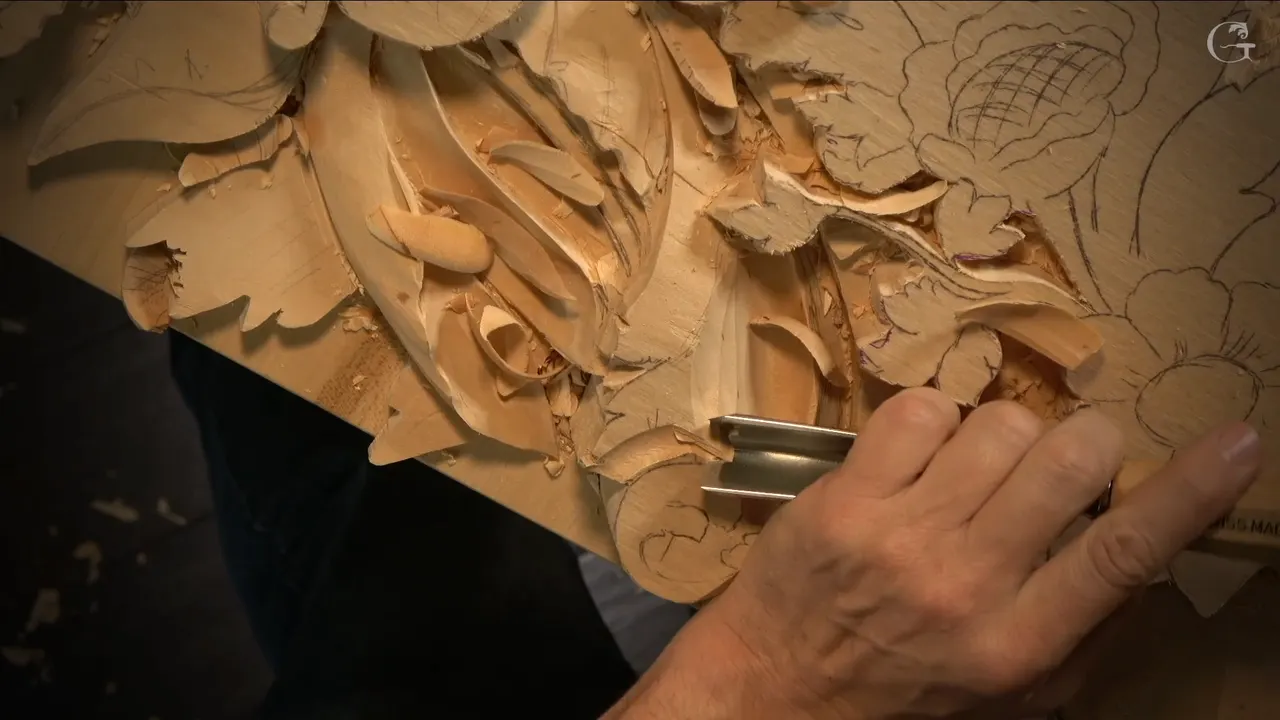
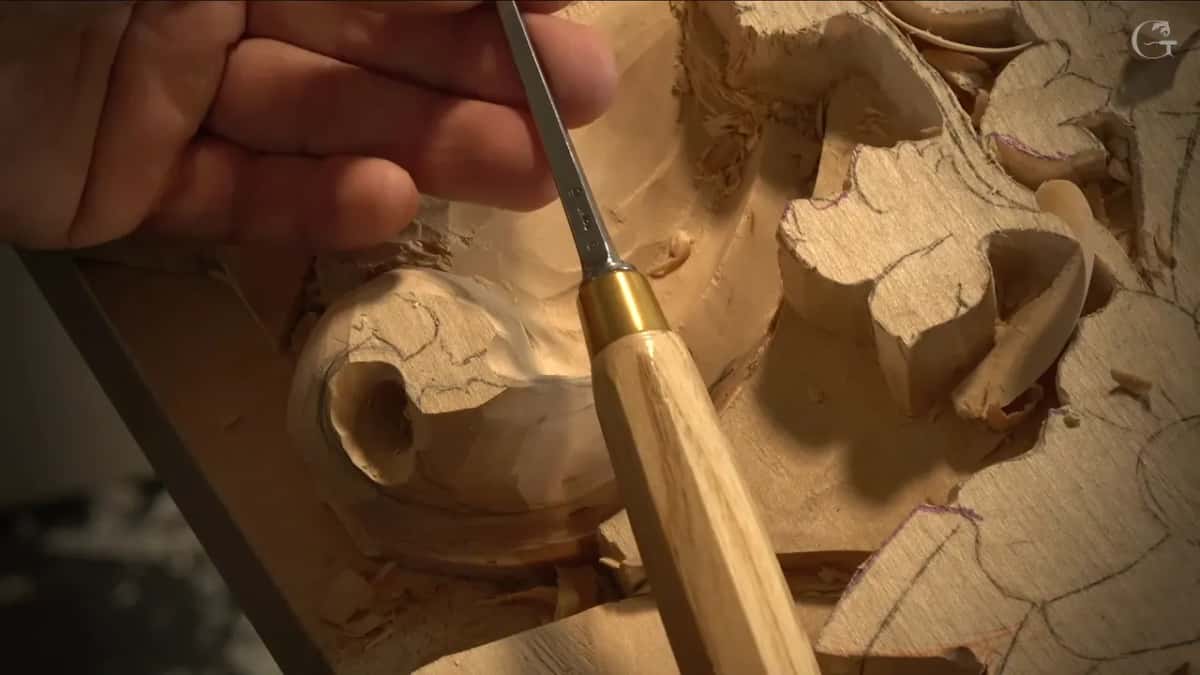
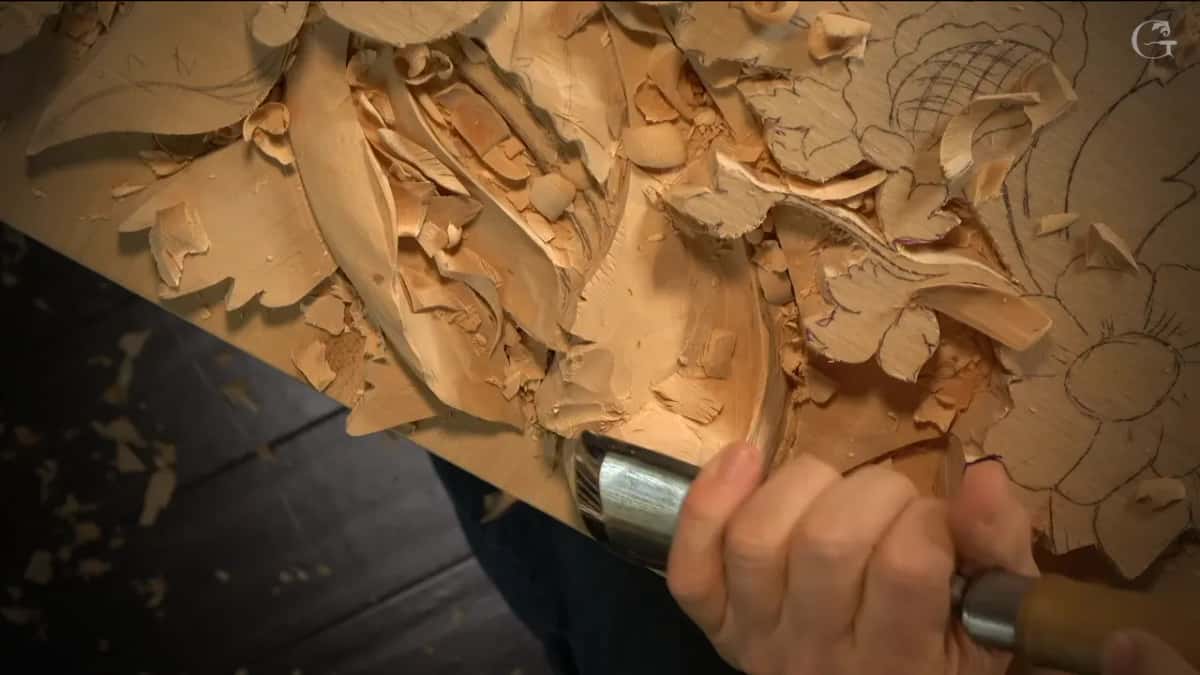
Width, measured straight across the edge between its two corners. On the tool in my hand before the first plug, that number was 10, and in the same breath I added three eighths. Its handle is stamped SWISS MADE 9F/10, and the 10 after the slash is the millimeters.
The sweep number is a separate measure with a chart of its own, and I worked through that chart in workshop 54 of the same room. This page stays with width. What I carved with that 10 mm number 9, a plug cut all the way through the panel, is on the page for Part 10, so here I only care what I called the tool.

Which widths did I name in workshop 111?
Most of the tools I picked up that day got a size out loud, and a few did not. This workshop sits between workshop 110 and workshop 112 in Part 10. It opens on an acanthus that is only a frame around the flowers, and I said so, though I was still going to spend some time on it.
About 10 mm (3/8 in) away from the wall line I went in with a number 11 veiner. Maybe 20 millimeters, I said. That comes to a little over three quarters of an inch, and I never gave an inch figure for it. A bigger one would work too, I said, if I wanted it.
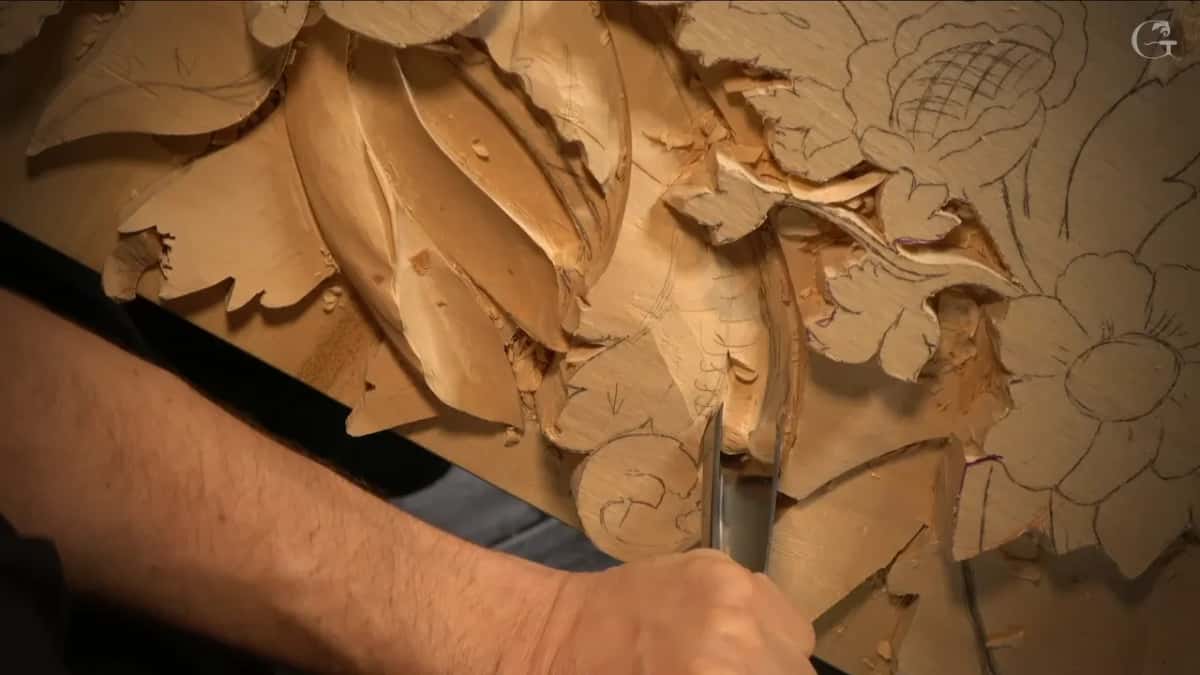
Next came my skew chisel, the big one, one inch, which comes to 25.4 on the dot. It is one of my favorite tools. It blended the curve nicely.

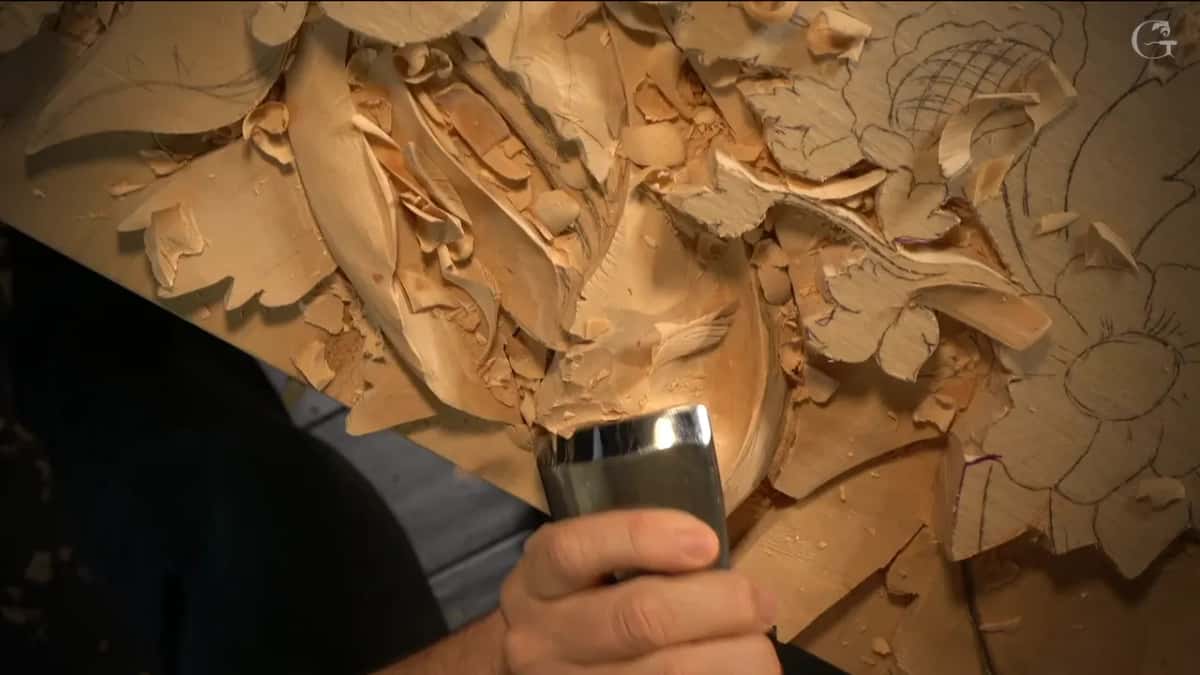
A big number 7 rounded the head of the acanthus after that. I named no size for it, and later I named none for the number 3 either.
The next line got a shadow spot, and the sizes came fast. First a number 11 at 7 mm, little bigger than a quarter of an inch, I said, and maybe a little too big. I jumped to 4 mm and described it as not quite 3/16 of an inch, a millimeter less than 3/16 and a millimeter more than one eighth. I think that is good, I told you, at least as a starting point.
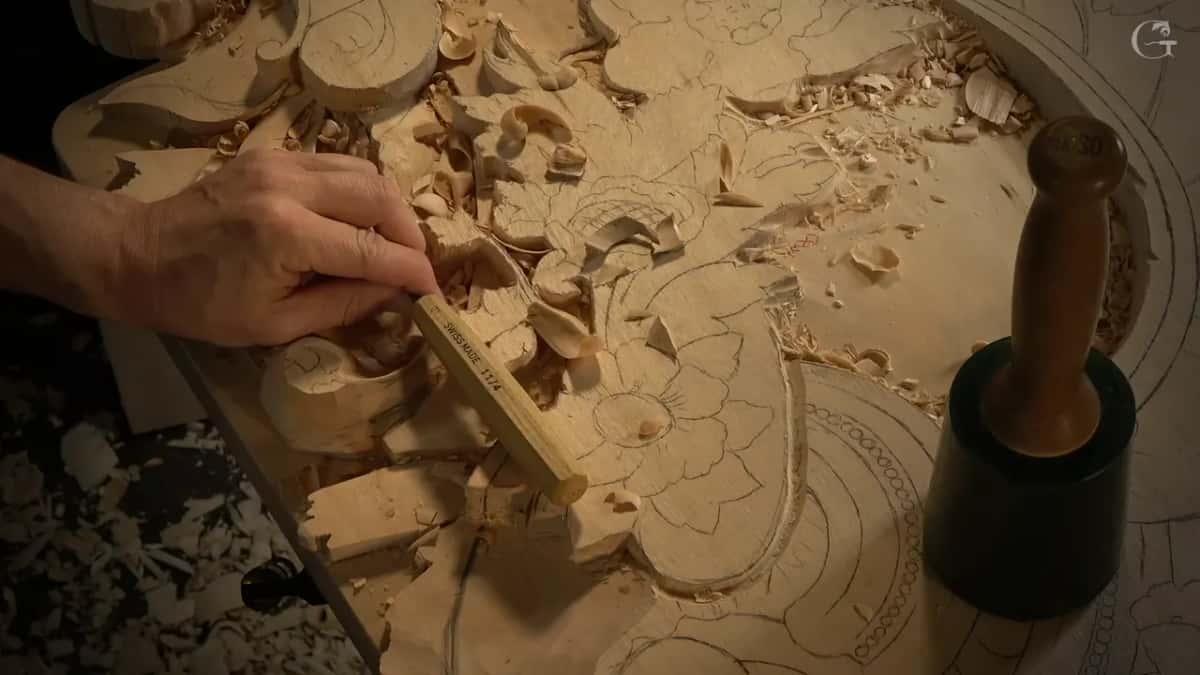
A 2 mm number 11 finished that line. I said let's say two millimeters, number 11 of course. That is about 0.08 of an inch, and afterward the number 3 smoothed the roughness left along that movement.
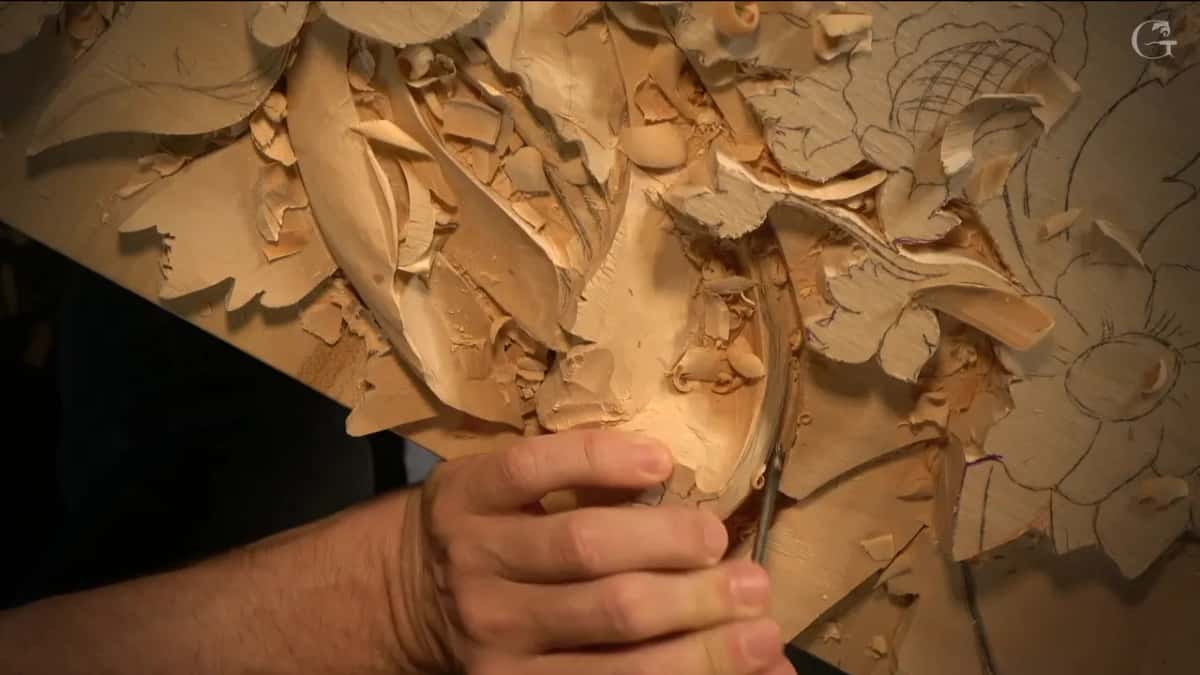
The plug came next. A number 9, with 10 millimeters and 3/8 inch named in one sentence and a mallet behind it. I thought it would be a sufficient tool, and probably I could go even bigger. Deep in the hole I took a quarter inch number 9, six millimeters in this case, made by Auriou, a French brand.
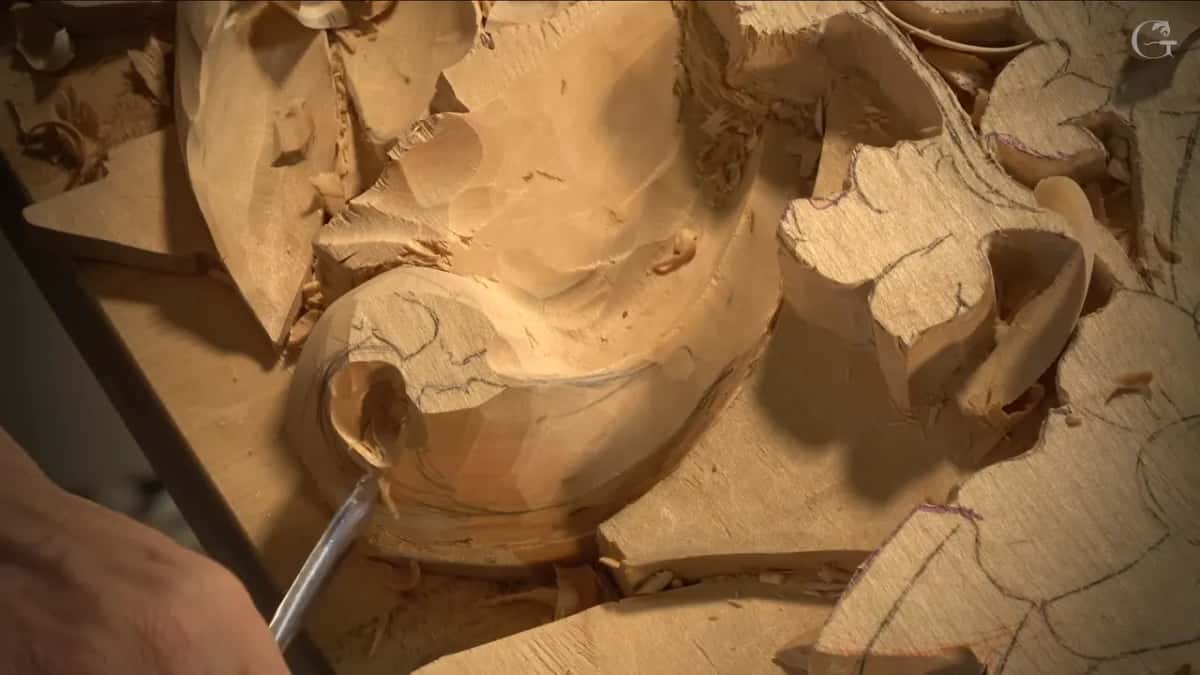
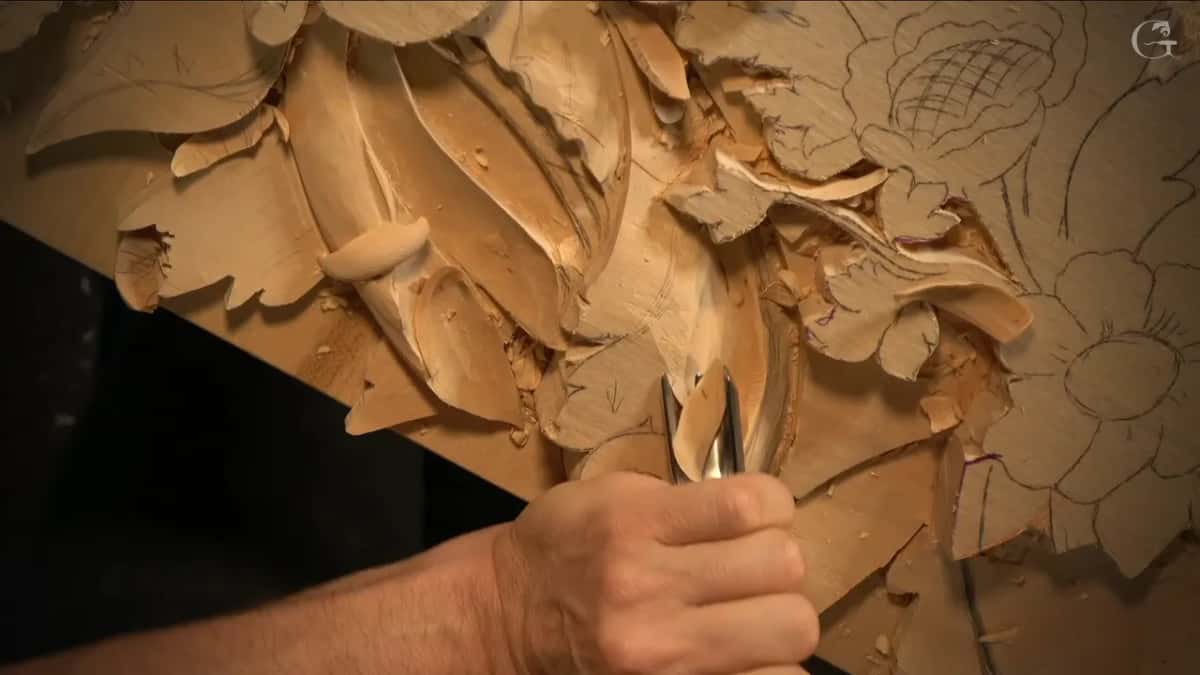
The final veiner of the day was 4 mm again, a bit over 1/8 inch, working a part I had moved under the acanthus so it would stay stable. Its handle reads SWISS MADE 11/4, the same 4 I said out loud. You could use 3 millimeters or 5, I said right then, and it would still create the same idea. I also mentioned a long bent, a small number 11, for an excavation later, and gave that one no size.
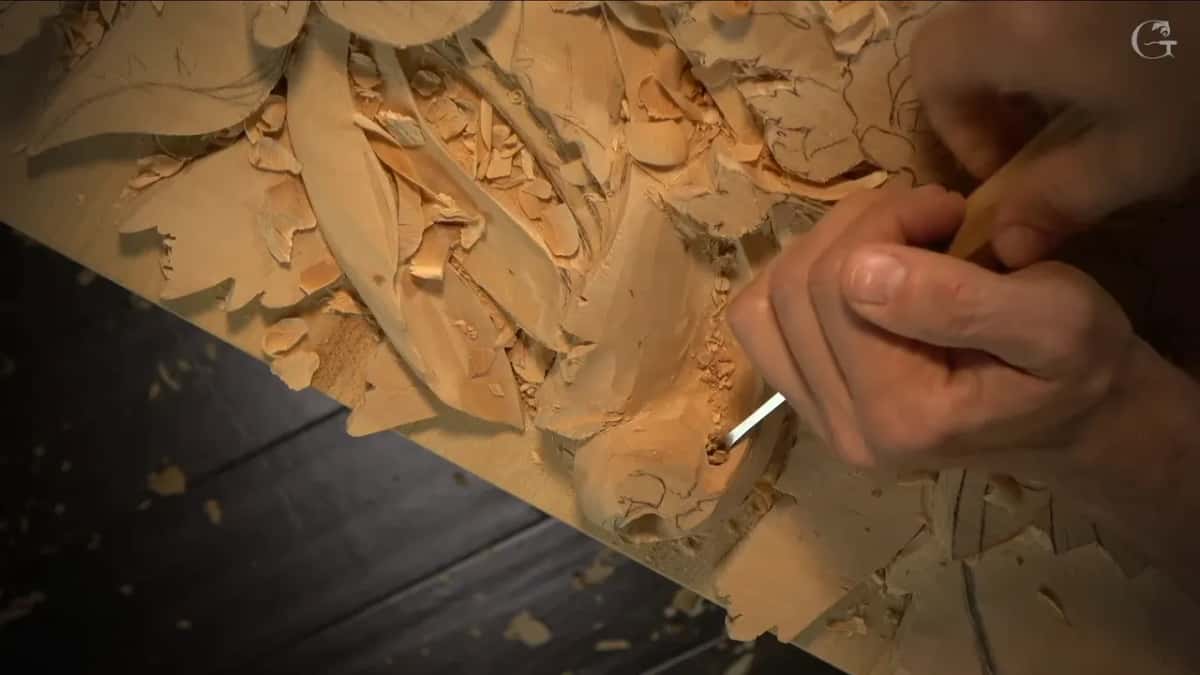
A carving gouge size chart from one workshop
Here is every width from workshop 111 that I sized out loud. The middle column is what came out of my mouth. The last column is plain arithmetic, dividing by 25.4, so you can see where my round figure sits.
| Tool | Spoken | Arithmetic |
|---|---|---|
| Big concave veiner | Maybe twenty millimeters, and no inch given | 0.787 inch |
| One-inch skew chisel | One inch, one of my favorite tools | 25.4 mm |
| First plug gouge | Ten millimeters, three eighths of an inch | 0.394 inch |
| French Auriou gouge | A quarter inch, six millimeters this time | 0.236 inch |
| Shadow line veiner | Seven, which I put over a quarter | 0.276 inch |
| Smaller shadow veiner | Four, roughly a millimeter past an eighth | 0.157 inch |
| Smallest shadow veiner | Two millimeters, and I named no fraction | 0.079 inch |
| Veiner under acanthus | Four again, a bit over an eighth | 0.157 inch |
Look at the first plug gouge. Three eighths of an inch is 9.525 mm, so my 10 mm tool is a hair under half a millimeter wider than the fraction I gave it. The Auriou goes the other way, about a third of a millimeter narrower than a true quarter inch.
The rest check out the same way. Twenty millimeters, the one I never put in inches, is 0.787 of an inch, a little past the 0.75 of a true three quarters. Seven millimeters runs 0.65 mm past a quarter inch. My 4 mm sits 0.76 mm under 3/16 and 0.83 mm over 1/8, and I rounded both gaps to a millimeter.
Which fractions keep coming back in my lessons?
Eight of them, going by the lessons on this page, and each one has an exact twin in millimeters.
A sixteenth is 1.5875 mm, which I round to 1.5.
An eighth, 3.175 mm, is my three.
Three sixteenths come to 4.7625 mm, just under five, and in workshop 111 I placed my 4 mm between it and an eighth.
A quarter is 6.35 mm, my six.
Three eighths is 9.525 millimeters, which I round up to ten.
Five eighths is 15.875 mm, and I said sixteen for it in the first part of the Venice Room.
Three quarters, 19.05 mm, sits near 19 or 20 when I say it.
An inch comes to 25.4 millimeters.
Those eight carry almost every size I named on this page, in either system.
How far off are my round numbers?
About a millimeter at most between the two systems, in the lessons I checked for this page, and often I say which way the fraction leans. In Venice Room workshop 49 I had a 15 mm in my hand and said I could go even bigger, to 18 millimeters. I called that a little less than three quarters, but really close. Three quarters of an inch works out to 19.05, so 18 sits about a millimeter under.
The furniture panel gave me another one in workshop 21. A 2 mm Swiss made back bent was, as I put it, a little bigger than a 16th of an inch, if you like imperial. A sixteenth is 1.5875 mm, and 2 mm clears it by about 0.4.
I did the long form in workshop 17 of that same panel, for one shallow area a 16th of an inch deep. My first figure was about 1.5 millimeters. Then I corrected myself and gave the full figure, 1.5875 millimeters, just to be precise.
And in a talk about mastery I admitted where my rounded figures come from. When I tell students to dig about a quarter inch, six millimeters, it does not mean I planned that figure ahead of time. I see the depth first. The number comes after, as the carving develops.
Why do I give every size in both systems?
My students live all over the world, and many of them grew up without inches. I explained it in the first part of the Venice Room, in workshop 3, right after I had moved the design approximately an eighth of an inch, about three millimeters. When I name a tool as 5/8 of an inch and 16 millimeters, it is not to show off.
In some countries in Europe people have no idea what an inch is, or what 5/8 and 3/8 mean, because they use only metric. People in the UK can use both with no problem. In Eastern Europe, unless it is a specialty like plumbing, nobody uses imperial at all. I have to be fair to everyone. Otherwise I would just say big gouge, small gouge.
That same day I named one number 7 both ways without stopping: one inch, by the way, 25 millimeters.
In workshop 56 I told the story of a student from the United States. Of course he was from there, I said, because people from other countries did not say that. He asked why I bother with all that millimeters and metric stuff, since nobody knows about it. You're wrong, I told him. Pretty much all over the world, people don't know inches, and most of them still use centimeters, meters and millimeters.
I owned up to the other side too. Sometimes I forget, and a 1.5 millimeter tool goes by without its 1/16 of an inch. The mastery talk is where I said I don't even know how many countries my students come from right now.
Where I grew up, and why I still lean toward imperial, is a story I told on the Roman acanthus, next to how to read a Swiss stamp.
Is a 10 mm gouge always 10 mm wide?
Mine was not, the day I carved the seventh workshop of the Venice Room. I had a number 8 in my hand and called it 10 millimeters, or 3/8 in. A moment later I corrected it. It was actually a bit wider than 3/8, I said, maybe about 11 millimeters or so.
The furniture panel has the opposite case. A tiny long bent number one from workshop 16 should have been 1.5 millimeters, but it was smaller than that and felt almost like 1 mil. Then I remembered why. I had reshaped it myself and made it smaller, just to get into spaces like that one.
A Dockyard number 8 in workshop 93 of the Venice Room went the same direction. I called it an eighth of an inch, then said it was actually a little smaller, just like 3/32, not really two millimeters but about two and a half. A true 3/32 is 2.38 mm, so my estimate landed close.
Each time I said what the edge in my hand really was, next to what the tool claimed.
The same two systems on boards and depths
The habit follows me off the gouge. The plate with butterflies started as a board about 3/4 of an inch thick, which means about 19 or 20 millimeters if you live in a country with metric instead of imperial. Exactly, 3/4 of an inch comes to 19.05 millimeters.
For the Hashemi flowers I took an 8/4 piece, approximately two inches, one inch and 15/16 after I planed it. It stood about 13 inches tall and 7.25 inches wide. Converted, that came to about 184 millimeters wide and about 330 tall.
The lily box had one section set three eighths below the main surface, and I said it again as 10 millimeters, for those of you who like millimeters better.
Even my router plane gets both. During workshop 15 of the furniture panel I talked myself up to a 1/8 inch blade, three millimeters, and mentioned that Veritas sells its blades in metric and in imperial, if you prefer metric.
Have you ever read a fraction off a ruler? Could you count off 25 small marks? Then you already hold the whole chart in your head, and the only thing left is to hear me say both numbers while the tool is working.
Every lesson named on this page opens with full access to the school.
How it's done
- Read the width off the tool. Take the millimeter figure from the tool itself, the way I named the number 9 before the first plug, 10 mm.
- Work it out exactly when it matters. Take inches times 25.4. I did the long form on camera and got 1.5875 millimeters for a sixteenth of an inch.
- Say the nearest fraction. Name the closest fraction and add which way it leans. Seven millimeters became a little over a quarter.
- Give both numbers. Say the width in both systems, since my students grew up with different rulers in many countries.
- Look at the real edge. Check the edge you are holding against what the tool is called, the way I corrected myself about a number 8 and put it closer to 11 millimeters.
Frequently asked questions
How many millimeters are in one inch?
The figure is 25.4 exactly, fixed by an international agreement in 1959, and any carving tool width converts with it. I round at the bench, so my number 9 gouge, 10 mm, became three eighths in workshop 111.
Is a 6 mm gouge the same as a quarter inch gouge?
Close, though not equal. A true quarter inch measures 6.35 millimeters, about a third of a millimeter wider than 6. During workshop 111 the 6 mm Auriou number 9 went by as a quarter inch, and I kept working the plug.
Why does a carver give both metric and imperial sizes?
Students watch from many countries. Some places in Europe have no idea what 5/8 or 3/8 means, while in the UK both work, so I give both to be fair to everyone, instead of just saying big gouge, small gouge.
What to carve next