

Alexander Grabovetskiy, woodcarver, School of Woodcarving · Published 2023
How do woodcarvers estimate how long a carving will take?
Quick answer: A carving estimate is a range rather than a date. Some days on my Venice panel go fast, and some spots refuse to move for a whole day, so a carving cannot be counted the way you count cabinets in a kitchen. I quote a range, lean to the safe side, and still find it hard.
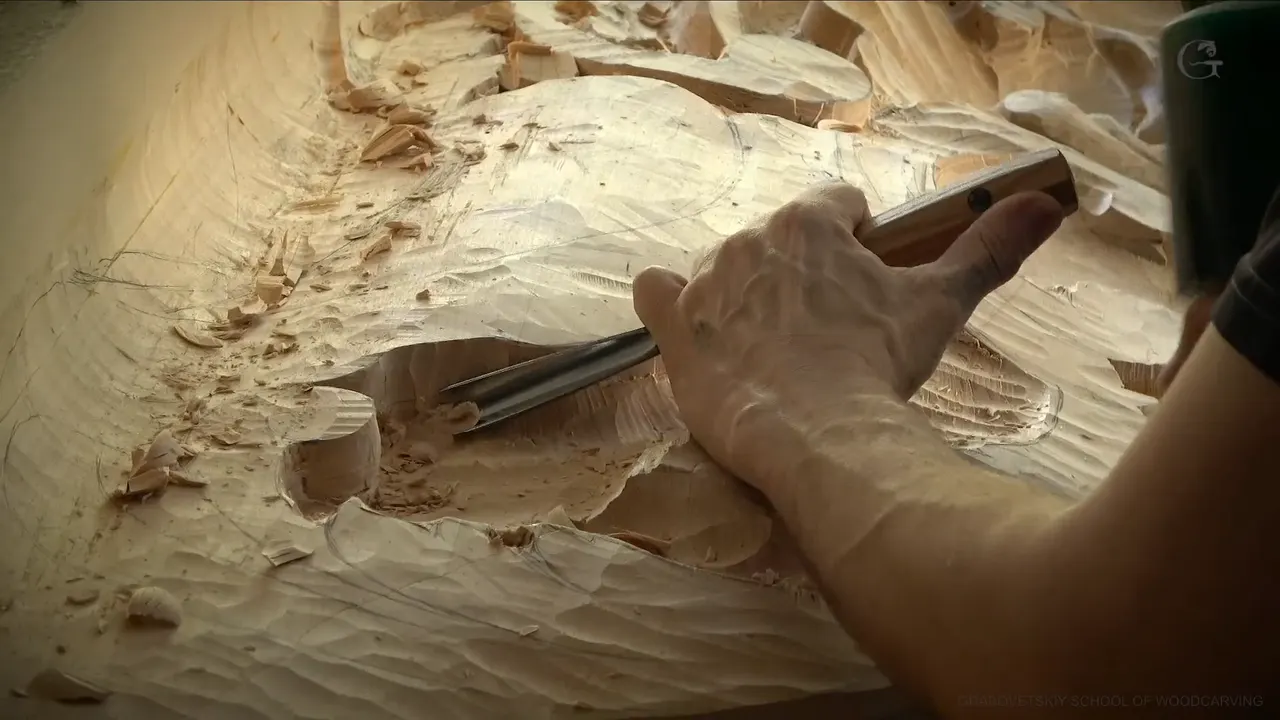
A carving estimate is a range with a safe side built in, because hand carving does not move at one steady speed. Some days I work like Speedy Gonzales. On other days one spot will not let me past it for the whole day. Viewers asked me in the comments how long this Venice panel was going to take. That is always the hardest question for me.
Would you like to know why a carver gives you a range and not a date? Do you want the answer of a man who used to build kitchens? Then come to my bench for workshop 3 of the Venice room, where I answered that comment out loud.
It's a fair question, and my customers ask it. You deserve the plain answer and not the one that sounds good on the phone. So I'll show you what goes into my range, why my old kitchen jobs were easy to estimate and carving is not, and which jobs I send away.
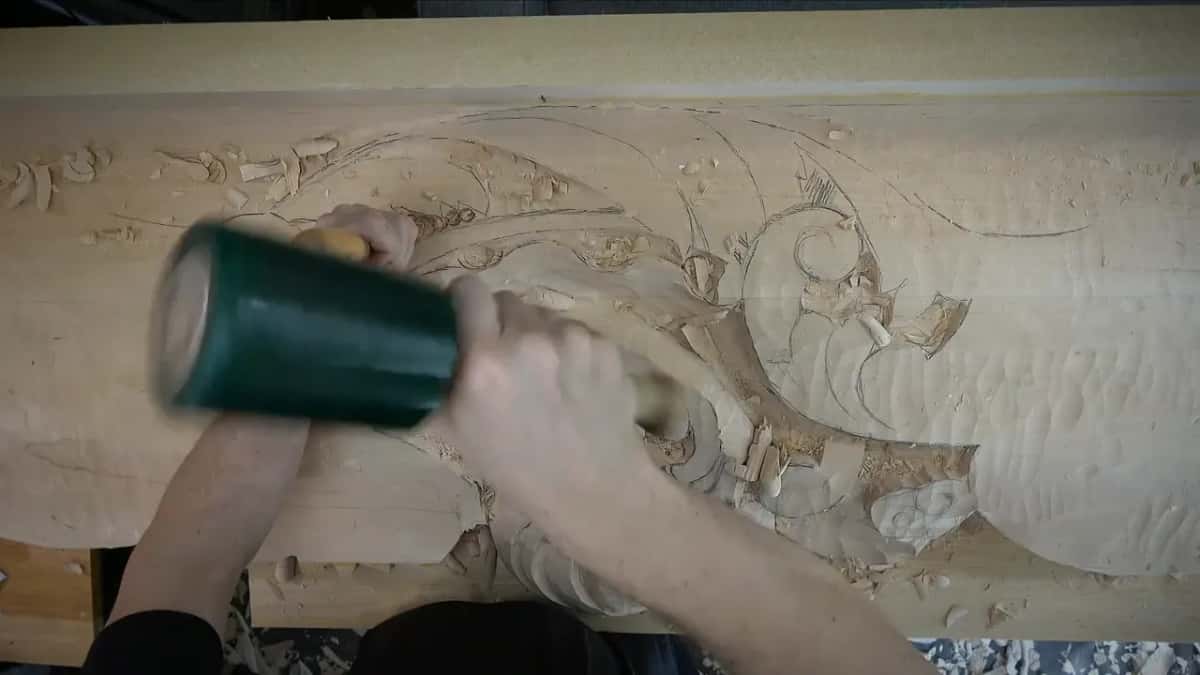
What I weigh before I set a range
A range, set on the safe side.
My kitchen jobs could be counted cabinet by cabinet, and a carving cannot.
Fast stretches and stuck spots both show up on the same board.
Some architects and designers want a carving done in four weeks, and I turn those jobs down.
A deadline that pushes too hard costs you the details.
Gouges that fit, flowers made apart and relief cuts at the corners all buy time back.
Why can a kitchen be estimated when a carving cannot?
A kitchen breaks down into jobs you have timed before, and I know that from my own hands, because I used to build kitchens and furniture. You know how long it takes to build a cabinet. You know how long it takes to put on all the hardware and install the kitchen, and when the countertop is going to come in. Add it up and you won't miss the mark.
I came to America and had a framing carpenter job by the Monday after I landed. Later I ran my own woodworking firm in Michigan and Indiana. Then some master friends told me, "Thousands of people can build cabinets. Very few can carve like you." I sold my Felder machinery and went to carving full time.
Carving gives you no such list. Some trouble only shows itself once the gouge is already in the wood.
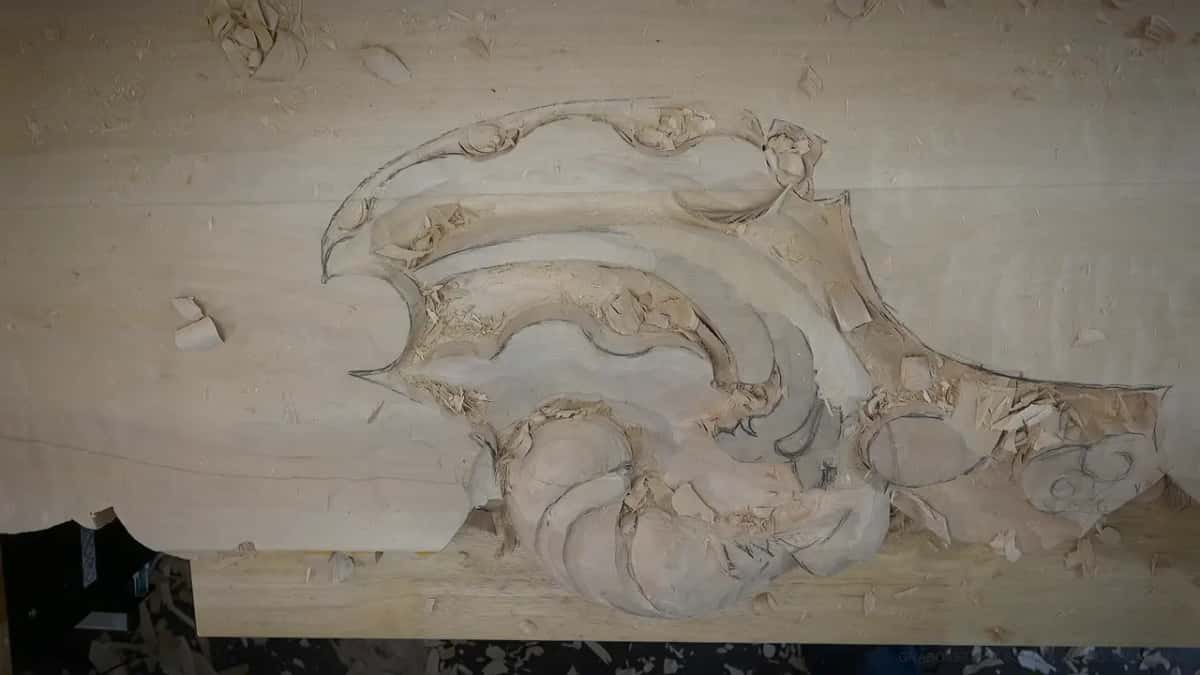
Fast days and stuck days on one board
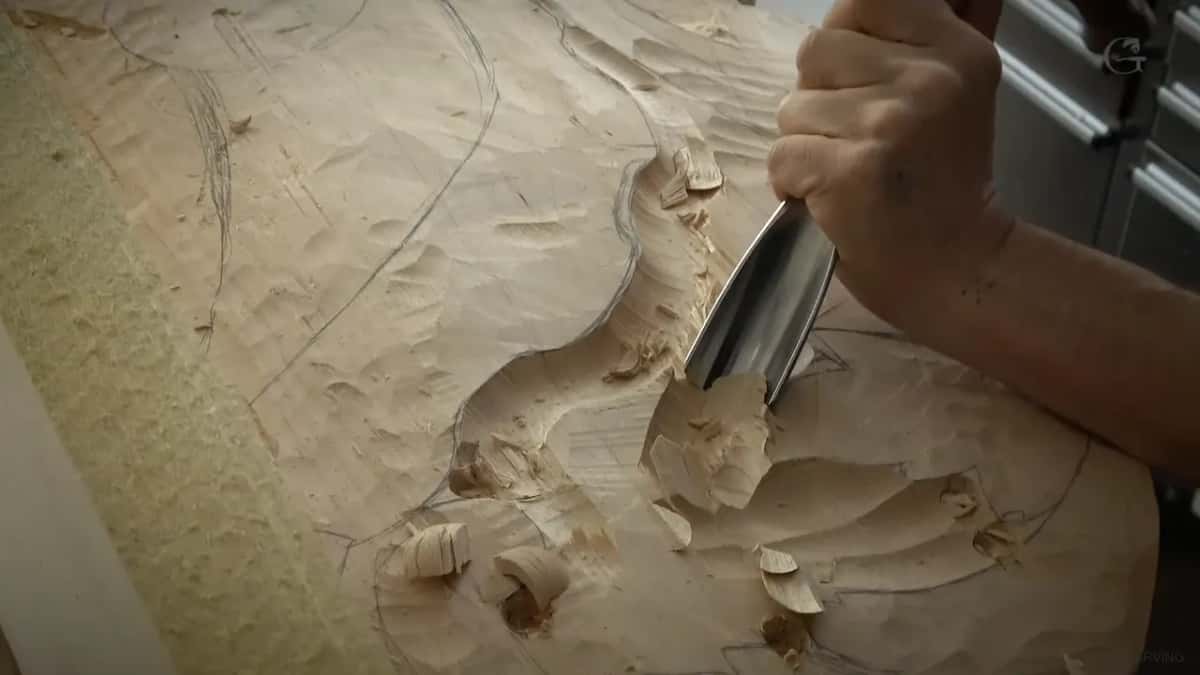
Sometimes you work like Speedy Gonzales and make a lot of progress. In other spots the wood gives you so much trouble that you can't move past that place for the whole day.
Workshop 3 has both moods in it. Late in part 8 I said, "I think it's good progress." A stretch of chopping in part 7 ended with me saying, "Oh, it's a mess." Then I looked at the shell, which workshop 5 carves properly, and said it was not how I wanted to see it, and one section had to go down quite a bit more. That kind of change is not in any quote. I only saw it when I got there.
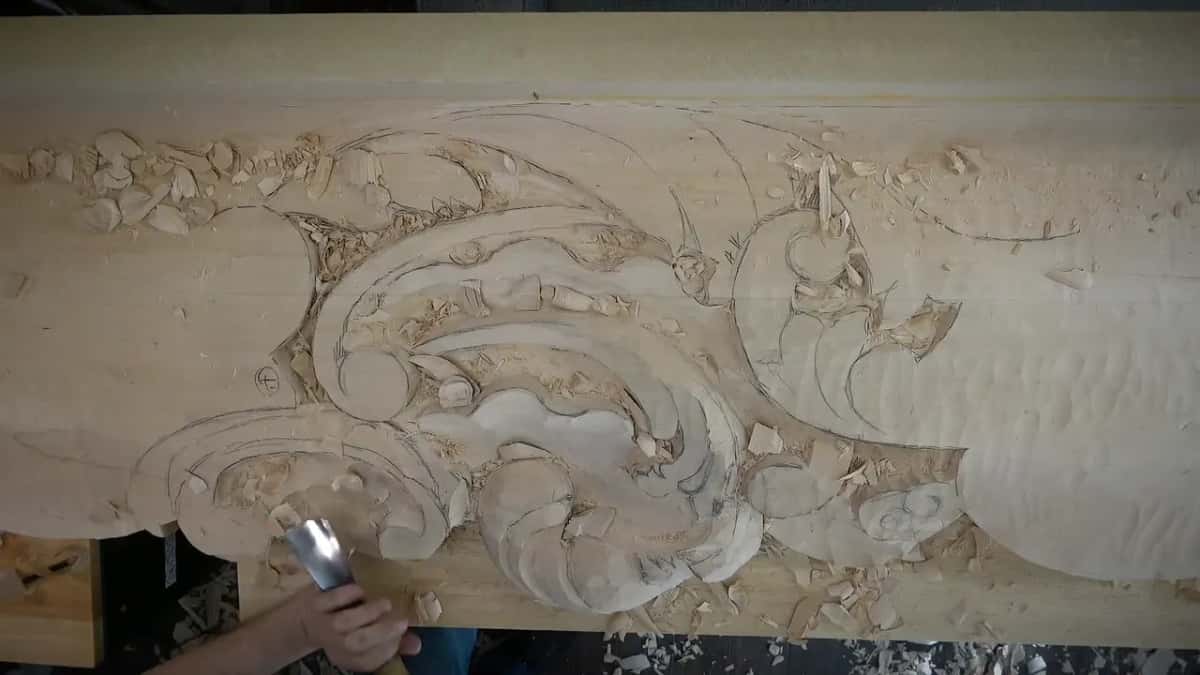
Listen to the small talk in this workshop and you hear the same thing. During part 9 I didn't like a line and couldn't say why, so I made my cut first and figured it out after. Later in that same part a movement was not flowing, and it had to go upward, right onto the ceiling.

And there are the little things. Once, in part 1, I grabbed the wrong sheet of the paper pattern. I had to look for my pencil in part 2. Part 7 had me picking up charcoal when what I needed was a pencil, and I said so out loud. None of that goes in anybody's quote either.
Big pieces like this are a workout, too. I told the camera I don't know how many calories I'm burning, but it's really good cardio. Lose fat and create something.
Why I give a range and stay on the safe side
When a customer asks me for a deadline, I usually give a range and try to stay on the safe side. I'm going to be honest with you. It's almost impossible, even then.
On this job other people wait on me, which makes the range matter even more. The framing in that room is built to my design, and the framers don't start until my board is done. I told that part of the story on the page for the first twelve workshops.
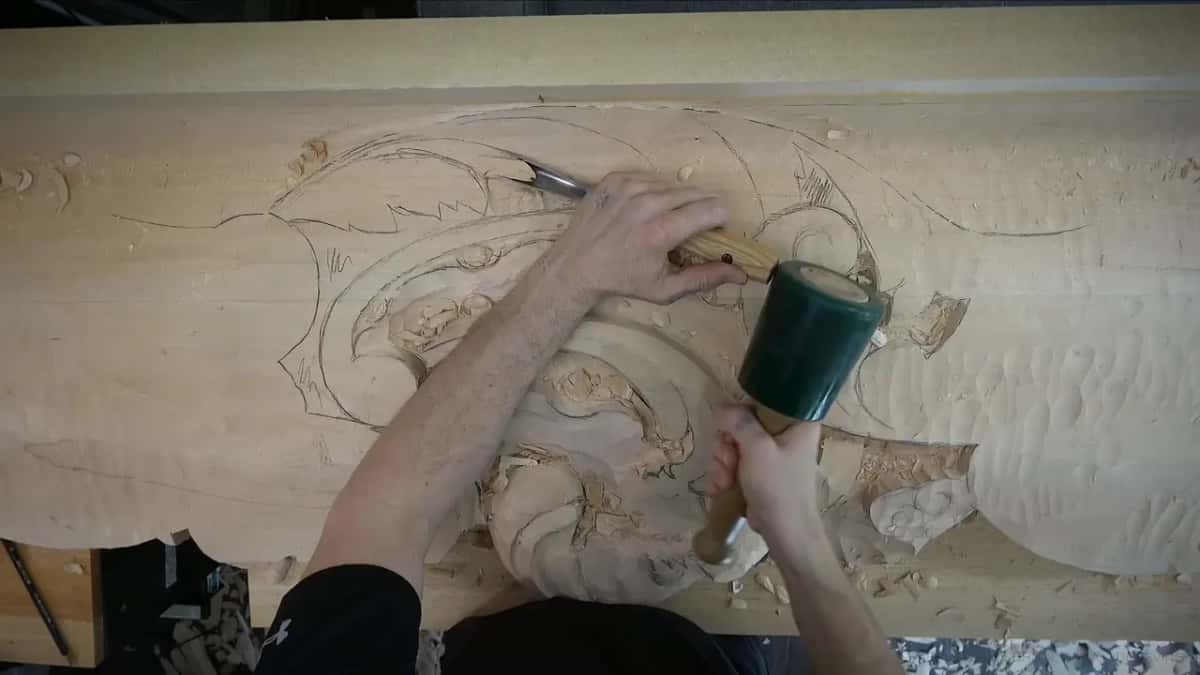
Even the depth gets decided at the bench. Part 10 is where I said I would go about an inch and a quarter (32 mm) deep, and that I was not going to measure it. I eyeball it. It could change, depending on whether I like it, and I might go deeper or lower the upper layer. In part 11 I showed another way, because a clean cut straight down, cleaned out, gives me a really good idea of my depth. Changes like that fill workshop 2, and that page covers them.

Checking takes time as well. In part 2 I said double-check, then triple check, before I moved a line a little. Near the end of part 9 I went over the whole layout again, because I really don't want to miss anything. A customer never sees that time, and it still belongs in the range.

Which jobs do I turn away?
Carvings on a four week clock, from some architects and designers who don't get that this is manual work. I'm turning some work out, and I just can't take some people. Don't get me wrong. I'm not turning people away. I'm turning away the ones who treat a hand carving like a machine job, when every bit of it is labor intense.
When they send a job over for an estimate, they sometimes say, "Well, we've got only a month or four weeks to do that." I wish I could answer, "Well, go ahead and do it, or find somebody else who is able to." Hand work like this is not the same as other trades. How finished a commission has to be is a separate talk, and a Hashemi flowers workshop has it.
Can a CNC machine make the date for you?
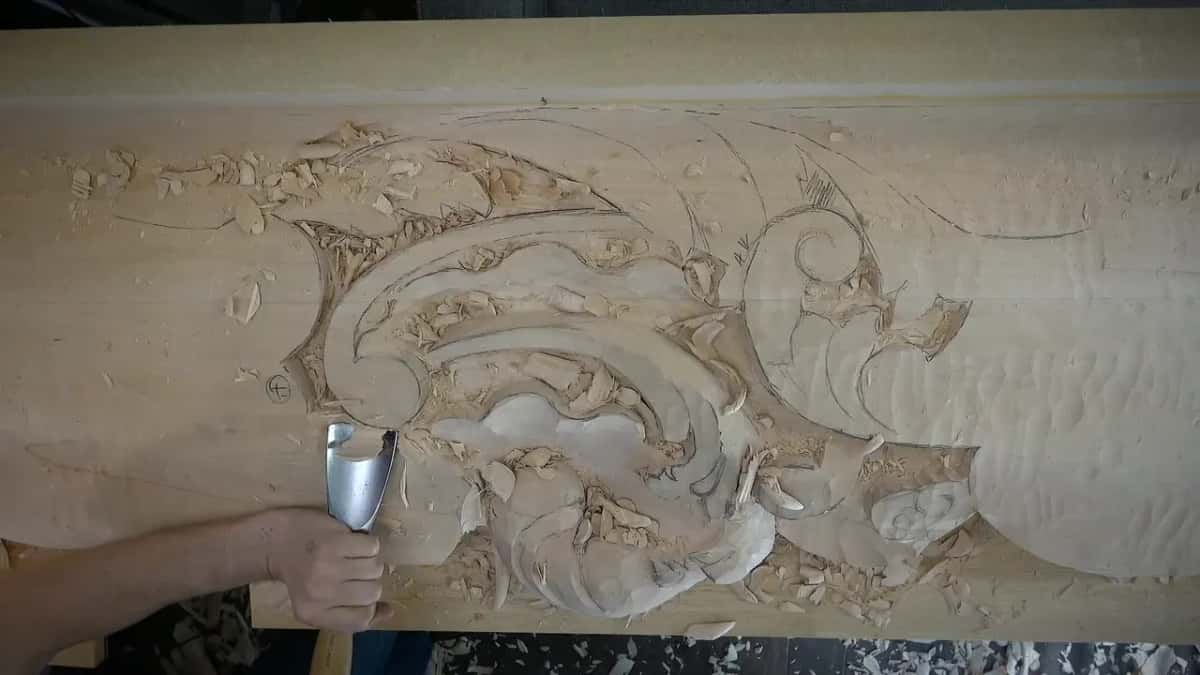
Hardly, and nothing on this panel is carved by one. Hand carving is not machine work, where you set the panel on a CNC and let it run. Even that way is a lot of work. A job like this on a CNC still takes a lot of hours.
So the range I give counts hand work, chop by chop, and that is almost impossible to count ahead of time. That is why it leans to the safe side.

What does a tight deadline cost you?
It costs you quality, and most of all the details. The idea of a deadline is probably everywhere now, in every country, but it wasn't like that a few years ago. I would say it grew mainly in the United States, where it's always go, go, go, get it done, get it done. The problem with that is you lose quality. It's really hard to keep that pace and not lose it.
I said you can't concentrate, and then I took it back. You still can. You just stop paying attention to the details.
That's a different question from speed. I wrote about working speed in another Hashemi flowers workshop, where the point is attention while your hands move. An estimate is the promise you make before the first chip comes off. And the years it takes to become a master are a third clock, while this page is about one job.

Where I buy time back on this panel
I can't make the stuck days shorter. I can make the rest of the job quicker, and workshop 3 shows four ways I do it.
First, I designed this panel around the gouges I own. You see me pick up my number seven, 3 1/8 in (80 mm), again and again, and that is on purpose. When I was designing it I had that tool in mind, so I could do the job quickly and efficiently. It doesn't mean you can't do it with other tools. But a tool that fits the job perfectly really speeds up the process. I also start big. A number nine, 35 mm (1 3/8 in), goes in first, because as I said in part 10, the bigger the tool, the quicker the job. Whether that always holds is a question a furniture panel workshop takes apart.
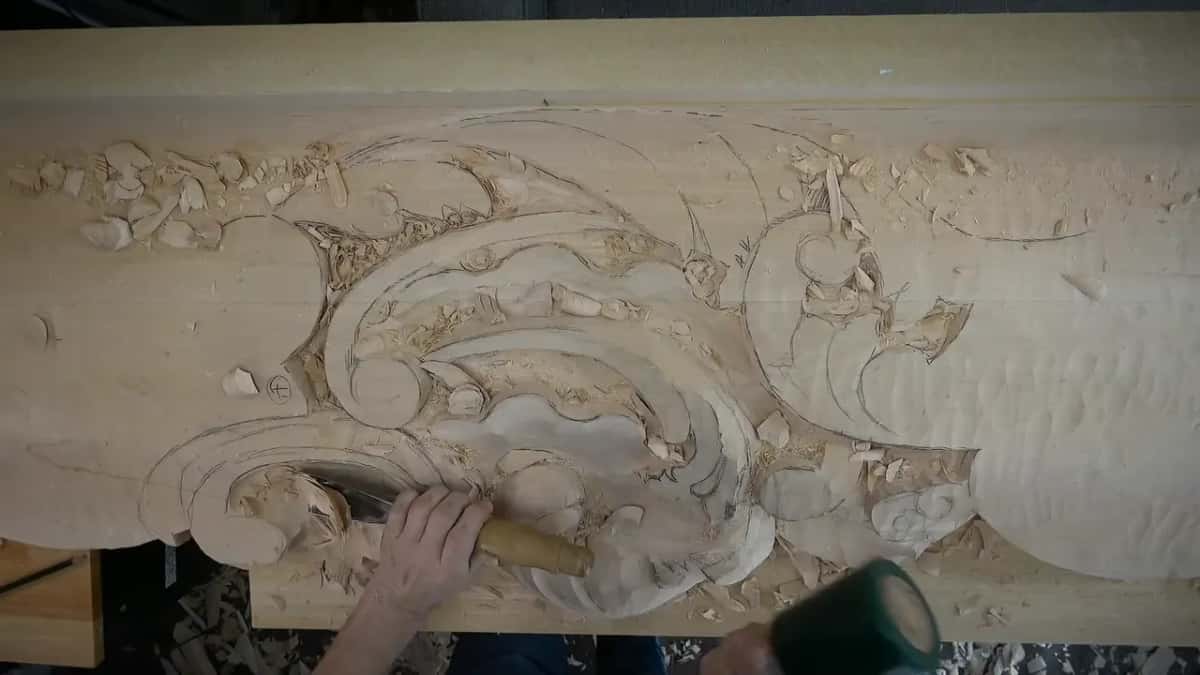
You'll also notice I name every gouge twice, in inches and in millimeters. I don't do it to show off. People watch from all over the world. In some European countries people don't use inches at all, and in Eastern Europe only a specialty like plumbing does. In the UK you can use both with no problem. I have to be fair to everyone. Otherwise I would just say big gouge, small gouge.
Second, the flowers. This project will have quite a few flowers. Some of you miss the Grinling Gibbons project, and I pointed at it on camera. This one is going to be even more complicated, design-wise, and about the same to carve. It's just the flowers.
I thought about carving the first layer of leaves from the same wood, because some of them sit right on top. Then I decided to make all the flowers as a separate layer and save myself some time, because those leaves take time. Where a flower goes, I leave a gluing point and a dowel point. If you miss that style too, there is a Grinling Gibbons class in Maine on the site.
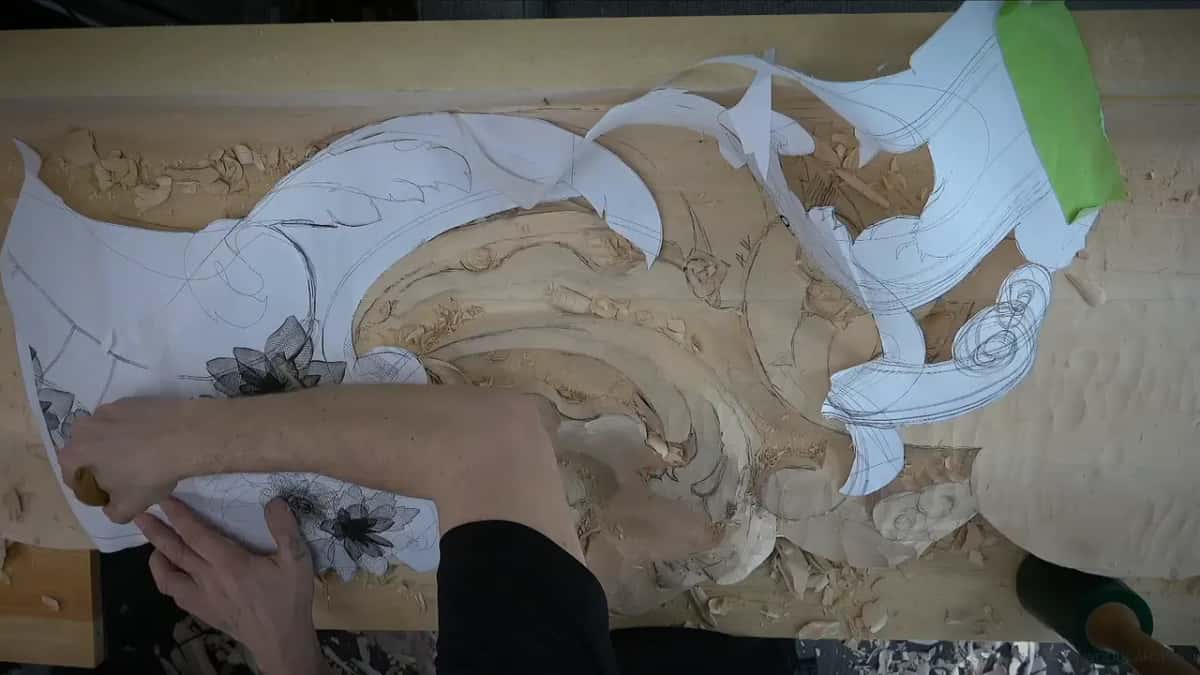
Third, relief cuts. In every corner shaped like a triangle, I take a number nine, 16 mm (5/8 in), make a rotation cut, go deep, and take the plugs out before the big gouge goes in. The plug cut has its own page if you want the how. Let me tell you a story.
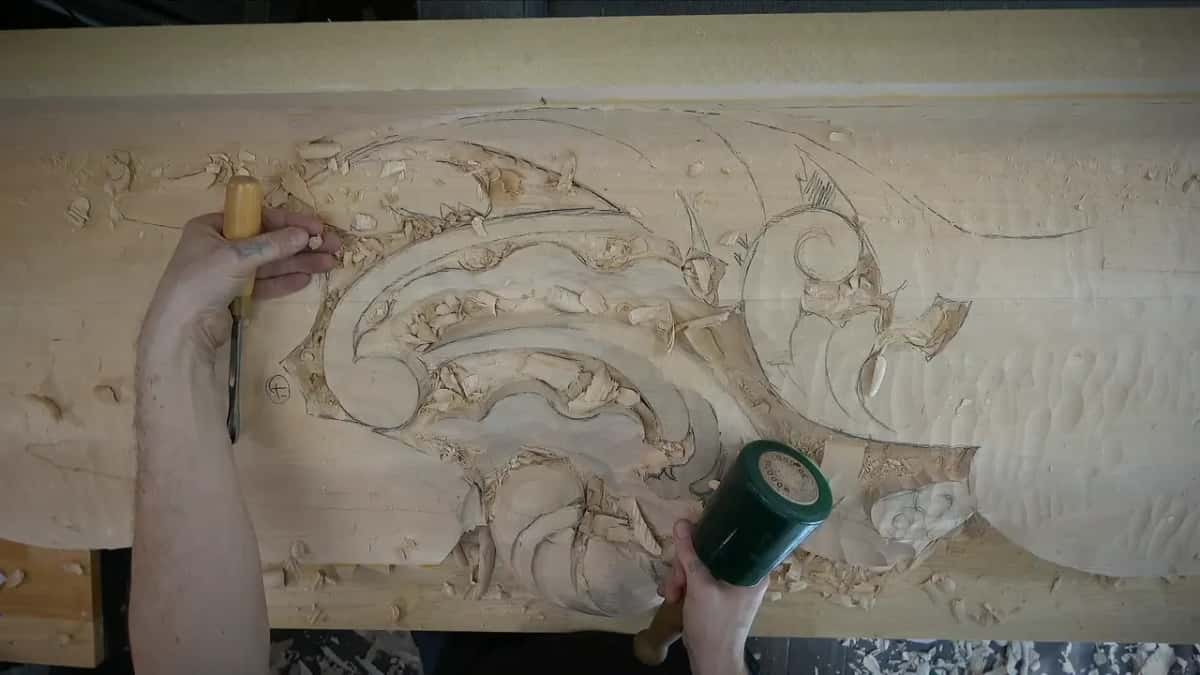
I was teaching a class in person in Tampa. Really nice people, and some of them came from all over. I tried to explain the idea, and one of the guys said, "Well, I'm carving for a long time already, so I never did it. I never had any problem." Guess what happened? He decided not to do it that way, and he messed up his carving.
It was fixable. It's not like it was ruined. But why would you fix something you can avoid at the beginning? A fix is time nobody put in the range.
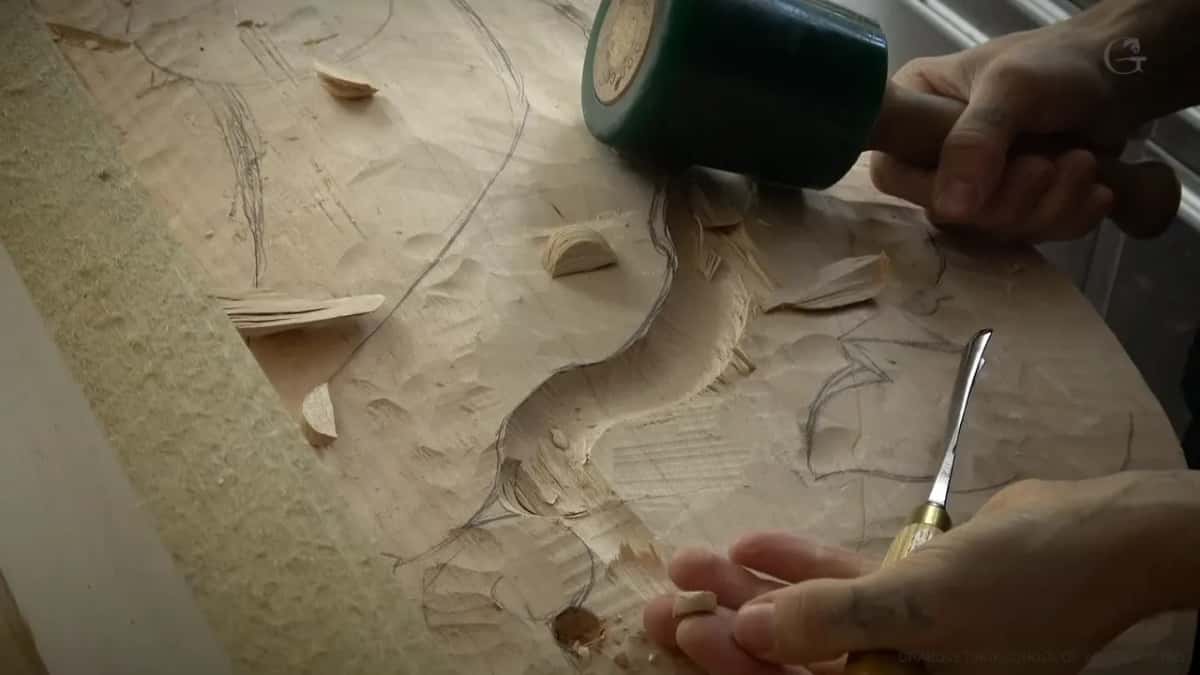
Fourth, I don't polish what is going to disappear. When a spoon gouge was a little too small in part 6, I said it was okay, because most of that wood will be gone anyway.
Here is how those four choices, and two things I can't control, sit against the range.
| Factor | Detail | Effect | Range |
|---|---|---|---|
| Gouges that fit | My number seven fits the curve perfectly | Saves time | I drew the panel around it |
| Flowers carved apart | Glued and doweled on later, second layer | Shorter job | Those leaves take time to carve |
| Relief cuts first | Rotation cuts in each triangle, then deeper | Avoids repairs | The Tampa student skipped this step |
| Polishing left alone | Most of that wood is gone later | Saves effort | A small spoon gouge was fine |
| A rethought shell | One section had to drop even more | Adds time | I only saw it once there |
| A stubborn spot | Some places refuse to move all day | Stops progress | The whole day can go there |
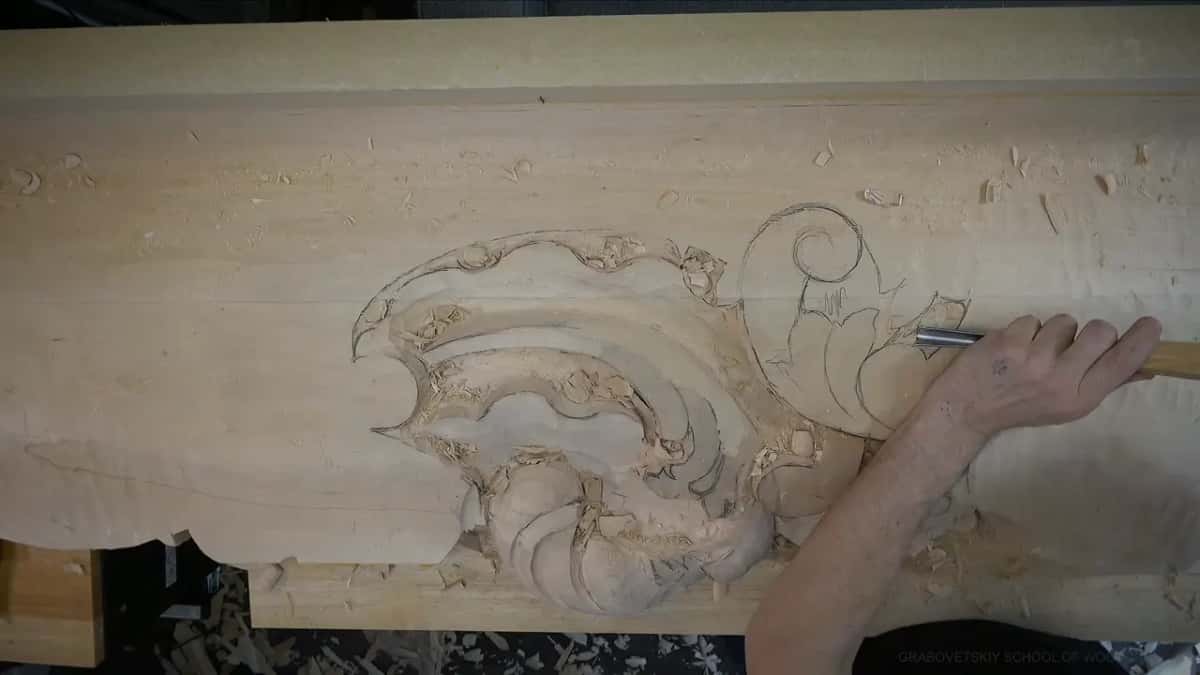
Can you use a range on your own carvings?
Every promise works the same way at home. If you are carving a gift for somebody's birthday, give yourself a range instead of a day, and start early enough that the late end still makes it. You will meet a spot that refuses to move. It still happens to me, on a board like this one.
And if someone asks you for a carving on a machine shop's clock, it's fine to say no. I do.
Where workshop 3 sits in the room
Have you ever been asked when something would be ready? Would a straight answer have helped? Then watch me give one at the bench.
Workshop 3 is the one where I roughed out the left side of the center, made relief cuts at every triangle and talked about deadlines at the end. It sits between workshop 2 and workshop 4, with workshop 1 at the start of the room and workshop 6 a little further on. All of it is inside the tuition, and so is Venice room part 2, workshops 13 to 25. Come and watch a range get tested on a real board.
How it's done
- Draw the job around your own gouges. When you design, keep the tools already on your bench in mind. A gouge that matches the shape you drew makes quick work of it.
- Decide which pieces get carved on their own. Flowers and small leaves can be made apart and fixed on later with glue and a dowel. Leaves carved in place take a long while.
- Relieve the tight corners first. Find every triangle in the layout and turn a round plug out of it with a deep gouge before the heavy chopping starts.
- Quote a spread of dates. Name the earliest and latest you can honestly see, then lean late. The stuck spots are coming, and you do not know where.
- Send back a clock built for machines. A big hand carving on a four week deadline is a job to hand back. Rushed hand work skips the small things.
Frequently asked questions
Can a woodcarver give you an exact finish date?
A spread of dates is the honest limit, with room left for trouble. Hand carving runs fast on some days and stalls on others, and the slow places only show up once you are carving. I lean late on purpose, because on my Venice job the framers wait for the carving.
Is carving harder to schedule than cabinet work?
Much harder, in my experience. When I built kitchens and furniture, every stage had a known length, right up to the day the countertop arrived. Carving has fast stretches and stubborn places, and nothing tells you in advance which one you are about to meet.
Why do some carvers turn down big commissions?
I turn down the ones that come with a four week clock from architects or designers who see hand carving as machine work. I am not turning people away, only the ones who do not get how labor intense this is. A rushed carving loses its details.
What to carve next