
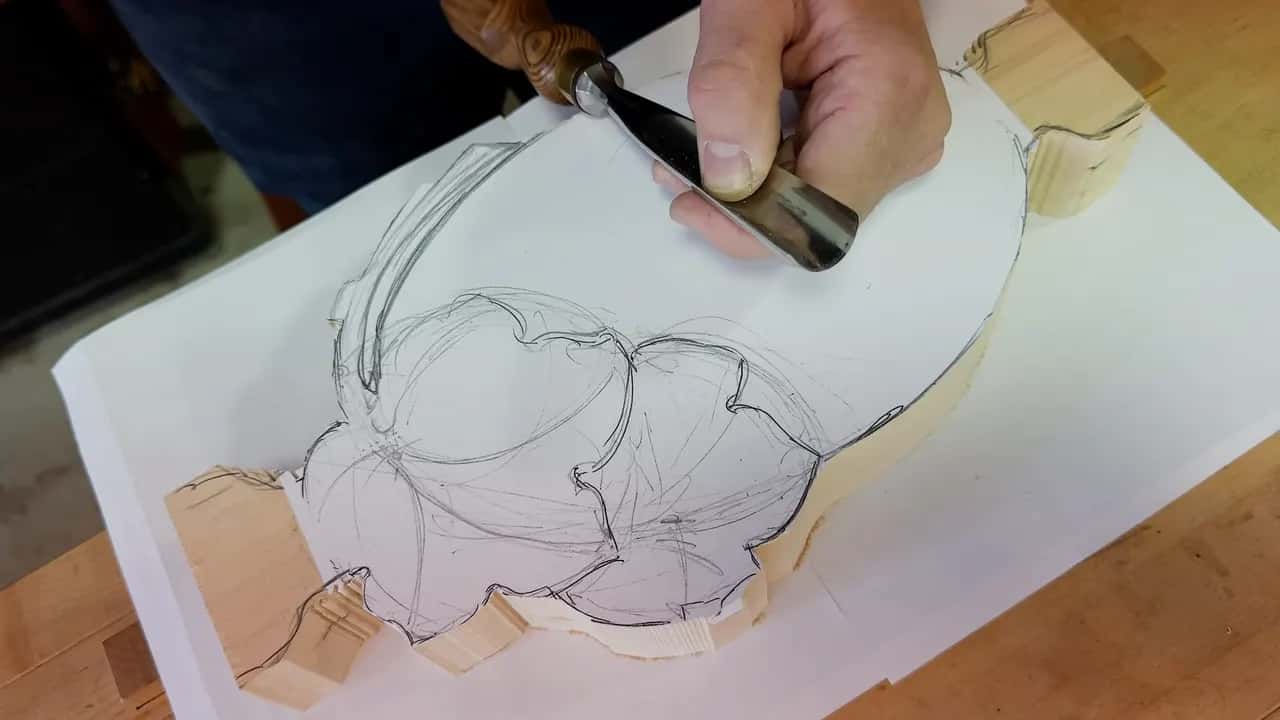
November 16, 2022 · Updated August 15, 2026
By Alexander Grabovetskiy — Master Woodcarver · Founder, School of Wood Carving · 9 min read
Will wood carving lessons online teach how to carve wood, honestly
Key Takeaways
- A lens sits six inches from the blade. In a room you stand four feet back, behind somebody's head.
- Replay is the real advantage. Rotation takes a third of a second and vanishes at full speed.
- Pressure is what a screen cannot send. Watch the chip instead, since a correct one curls and a forced one crumbles.
- Record your own hands for two minutes. It is uncomfortable and it is the fastest correction available.
- Polished courses where nothing goes wrong are courses where nothing was taught.
Wood carving lessons online will teach you to carve wood, and for tool angle, grain reading and sharpening they beat a live class, because you can replay a pass forty times. What video cannot do is put a hand on your wrist when you press too hard. That part you have to solve yourself.
I have taught both ways for years, and I am not going to pretend the answer is simple. A camera gives you things a room never can. A room gives you one thing no camera has ever given anybody.
So here is the honest split: what online lessons genuinely teach, where they leave a hole, and the three habits that close that hole. My students carve panels I am proud to photograph, and almost none of them have ever stood in my shop. Some of them found me through Woodworkers Institute and had never met a carver in person.

Can you really learn wood carving from video?
Yes, and thousands of people already have. Carving is a visual craft with a small vocabulary of movements, and a camera set six inches from the blade shows those movements better than standing behind somebody.
Think about what you can actually see in a workshop. You are one of twelve people, four feet away, looking at the back of a head. The teacher demonstrates once, in real time, and if you blinked you missed it. Filmed properly, that same pass runs at a quarter speed with the lens where nobody's eye could ever go.

In the Byzantine acanthus lesson I told the class flatly, "again, you don't see that in the slow motion, but every cut I do, I make a rotation". That rotation is the whole technique. It takes a third of a second in the hand, and in a room nobody catches it.
What does a camera teach better than a classroom?
Anything that happens too fast or too small. Rotation, bevel angle, how a corner of the blade enters, the exact moment the chip lifts.
| The thing taught | How well a camera actually carries it | In person | What I do about the gap |
|---|---|---|---|
| Tool angle and rotation | Better on camera, because slow motion shows it | Hard to see | I film the same pass from three separate angles |
| Grain reading | Fine once you know what matters | Instant, because somebody says stop and turn the board now | Repeated on camera |
| How hard to press and when to stop | Almost impossible to convey | A teacher puts a hand on yours and you feel it immediately | In person classes |
| How to sharpen a V tool | Genuinely good | Also good, but you only get to watch once | Video wins here |
The pressure row is the honest weakness and I will not talk around it. There is no way to transmit through a screen how much force belongs behind a gouge in walnut. What I can do is film the chip, because a correct chip curls and a forced one crumbles, and once you have seen a hundred correct chips your hand starts aiming for that.

Where do online carving lessons fall down?
Feedback, and nothing else comes close. Nobody is standing behind you saying stop, your bevel is riding, turn the board.
The camera has its own blind spots too, and I run into them constantly. On one Venice room lesson I said out loud what every filming carver deals with: "unfortunately, you don't see that close enough. And if I'm going to bring my camera closer, so my head is going to be in the camera." The tool, the wood and my own skull are competing for the same six inches of space.

So a good online school has to compensate deliberately, with several camera angles on the hard passes and slow motion wherever the movement outruns the eye. It also needs a way for a student to send a photograph of a stuck panel and get a real answer back. That last part is what most video libraries never build.
How do you replace the teacher over your shoulder?
Three habits, and they work. Students who do all three progress about as fast as my in person classes, and I have watched enough of both to say that with a straight face.

Step 1, film your hands for two minutes
Prop a phone on a stack of books beside the bench and record yourself carving. Watch it that evening. You will spot the two hands on the handle, the bevel riding high, the board you should have turned. Watching yourself work is uncomfortable, and it is the fastest correction available.
Step 2, carve alongside the video, not after it
Pause every pass. Do the pass. Rewind and compare your surface with mine. People who watch a whole lesson and then go to the bench have already lost half of it, because the detail that mattered was in the second you were not thinking about.
Step 3, photograph the piece under a raking lamp
One lamp, low, from the side, then look at the photograph rather than the carving. A photograph flattens the piece into shadow and shape, which is exactly how a stranger will see it. Every lump you have been forgiving in person shows up instantly.

Step 4, send the photograph to somebody who knows
This is the piece a video library alone will never give you. Ask in the school forum, ask me, ask any carver whose work you respect. One sentence back from somebody who has carved that shape a hundred times will save you three weeks.
Step 5, repeat the same project before moving on
The second attempt is where the lesson lands, and nobody wants to hear that. It stays true anyway. My Modern Acanthus students who carve the leaf twice end up two levels above the ones who carve it once and move on.
What separates a good online carving school from a bad one?
Whether a real carver made it, and whether the failures are left in. A course where nothing ever goes wrong taught nothing.
My mistakes stay in the footage. So does the honest answer on difficulty. When a gouge tears a lobe I stop, explain exactly what I did wrong, and then fix it while the camera runs. A beginner needs the repair far more than the perfect pass, because the beginner is going to make that exact error on Thursday evening and panic.

Lesson length should match real work rather than a trailer. A relief panel takes nine hours, and a course covering it in twenty minutes skipped the nine hours where the learning lived. Tools should be named with numbers and millimeters. One project shot end to end beats clips of five different pieces. There is a longer checklist in how to tell a good beginner class, and in what a camera can and cannot teach.
Do you need to be near a school to learn carving?
No. For most of my students the nearest serious carving teacher is several hundred miles away, which settled the question before they ever wrote to me.
That was the whole reason I started filming. Somebody in rural Montana or in a small town in Ireland has no realistic path into ornamental carving otherwise, and the tradition itself is thin enough that it needs everyone it can get. When the closest class is 500 miles away goes into that properly.

I still teach in a room every summer at the Marc Adams School of Woodworking, and I would not give that up. But a week in Indiana once a year is not a training. The training is the four evenings a week you put in at home, and that only happens if the lessons are on your bench when you have the hour free.
Which project should you start with online?
A leaf on a flat board, then a rosette. One clear shape, one background, one shadow, so you can tell whether it worked.
Do not start with a course that opens on a finished cathedral panel, however good it looks on the sales page. What you want is the shortest loop between doing a thing and seeing whether you did it right. First Cuts for Beginners and the Bird of Paradise cutting board are both built as that loop.
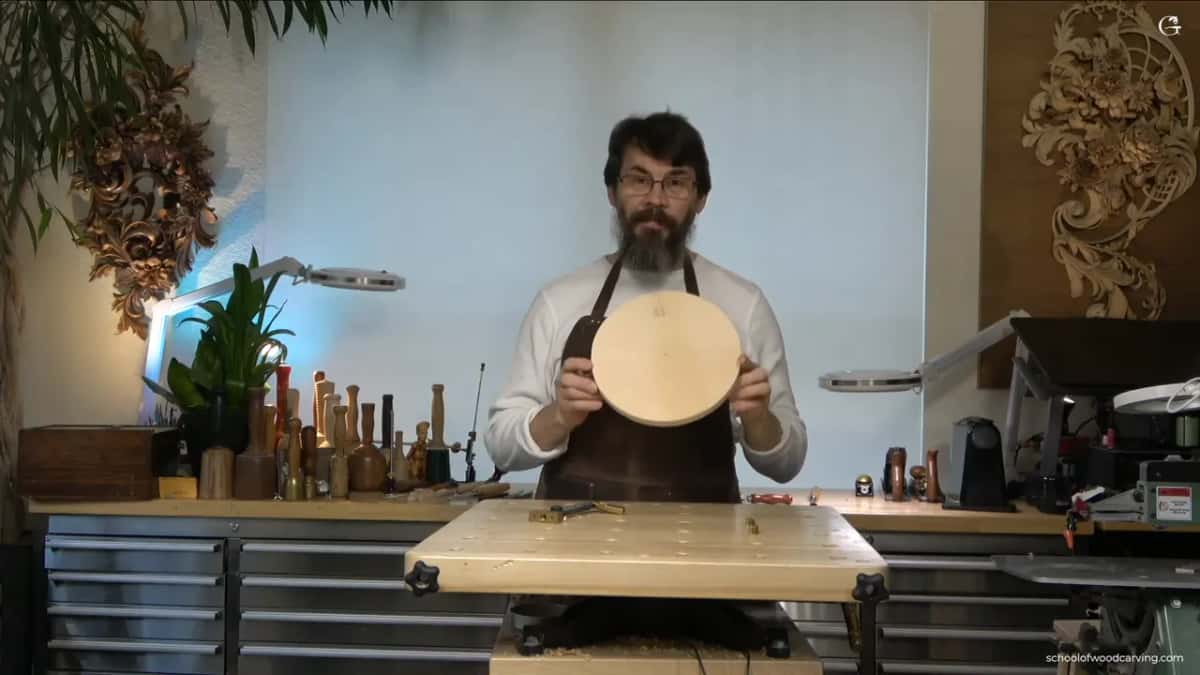
Get the material right before the first lesson. One American basswood board, a knife, four gouges, a strop. Where to buy them and which numbers matter is in the tool set post, Pfeil being the brand I reach for most, and the basics covers grain and safety before you ever press play. Woodcraft, Highland Woodworking and Lee Valley all ship the lot.
What can you actually carve after a year of online lessons?
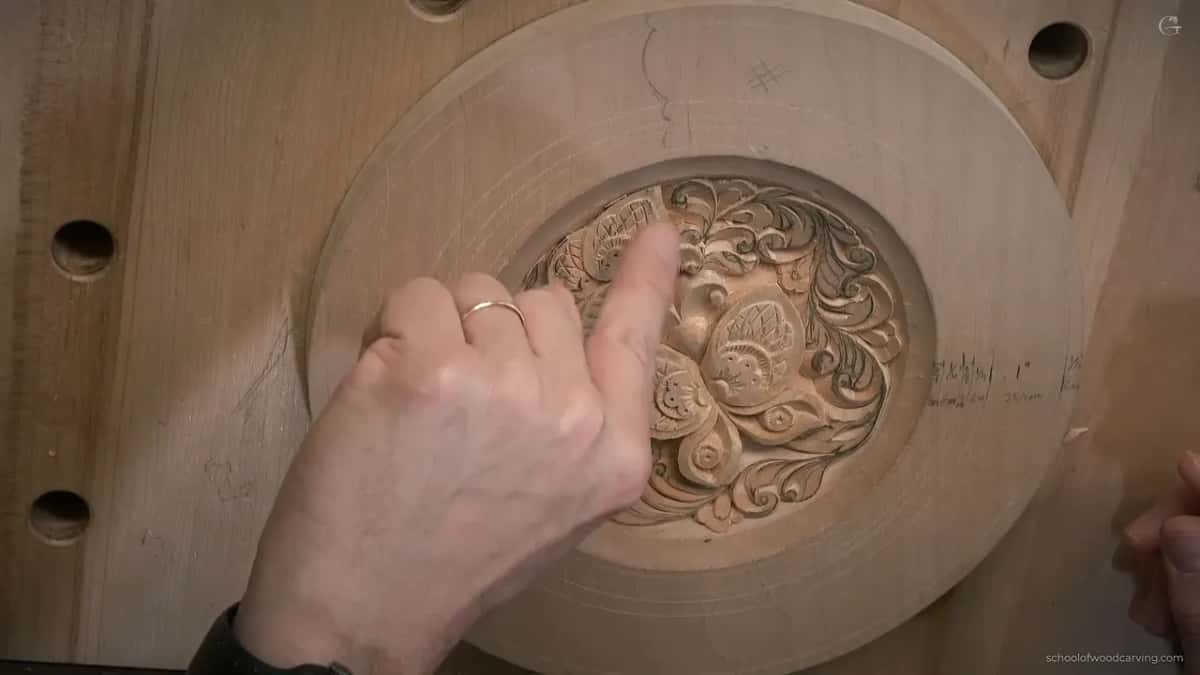
An acanthus panel with real undercut shadow. That is not a promise, it is what I see coming back from students who work four evenings a week.
They send me photographs of trays, rosettes, door panels, a lectern, a cradle for a first grandchild. One student in Australia carved a full acanthus frieze for his own dining room and has never been in the same hemisphere as me.

What none of them got in a year is speed. Speed comes from the fifth repetition of the same shape, and there is no video, no room and no teacher who can hand it to you. The craft is old, the tradition is unforgiving about that, and every carver from Grinling Gibbons down paid the same price in hours.


You are reading this at night, after work, with an hour you could spend either way. The lessons will be there tomorrow and so will the screen. Shall we carve?
Frequently asked questions
Are online carving lessons good enough for a total beginner?
Yes, provided the course starts at a bare board and not at a finished piece. Beginners need the boring parts filmed, especially sharpening and grain direction, since those are what decide whether anything else works.
How much time a week do online lessons need?
Four evenings of an hour each will move you steadily along. Hands lose the feel between sessions, so frequency beats total hours by a wide margin. Twenty minutes a day works.
What equipment do I need at home to follow along?
A knife, four gouges, a strop and a basswood board. A bench helps but a board clamped to a kitchen table works fine for a first year. Nothing else is needed until the panels get large.
Can video teach sharpening properly?
Better than a live class in my experience. Sharpening is close work at a fixed angle, which is exactly what a lens carries well, and you can rewatch the same bevel pass until your hands copy it.
Will I get feedback on my own carving?
Only if the school provides it. A video library with no route to a real answer leaves you guessing. Photograph your work under a side lamp and send it, because that photograph shows problems your eye forgives.
Is in person still worth it if I already study online?
Very much so, once a year if you can manage it. A week in a room fixes pressure and posture faster than anything on a screen, and then you go home and do the actual training on your own bench.