

Alexander Grabovetskiy, woodcarver, School of Woodcarving · Published 2022
Can a CNC machine do what a hand carver does?
Quick answer: A CNC is a computer-run cutter that handles part of the work, but it falls short of what a carver with years at the bench can do, so I call it really limited. CNC is familiar to me from shop work. One man online even wrote that a nicely done piece of mine had to be CNC.
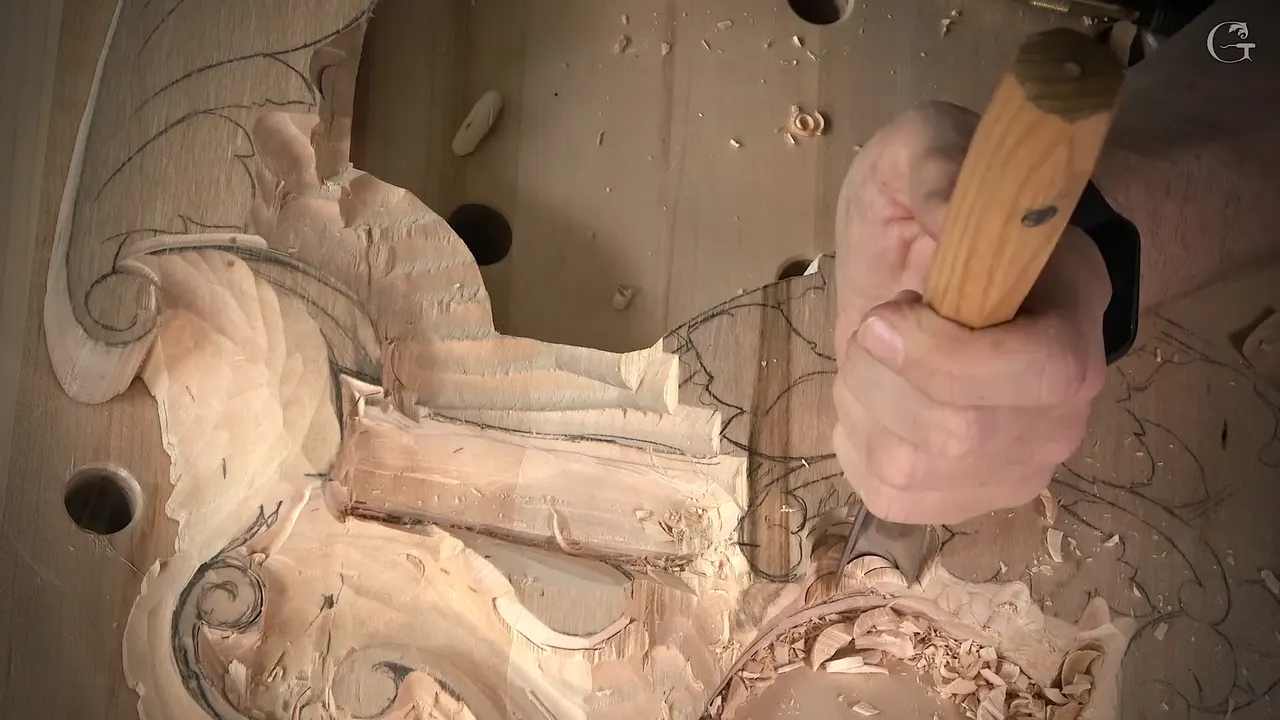
A CNC machine is a computer-run cutter that can do part of what a carver does, but not to the level an experienced wood carver can reach, so it is really limited. That is my whole answer on hand carved vs machine carved, and I said it in a livestream about shadows. I used to work in a shop, and I had a shop with a CNC, so this is not a guess from the outside.
Have you ever stood in front of a carving and wondered if a person made it? Did you wonder how anyone could tell? I carve with hand tools, and I have worked with the machine too, so you get both sides of it from somebody at the bench.

I'm going to be honest with you about how this page is put together. My own lesson here, lesson 154 of the Venice Room, is three short parts of about seven minutes each, some twenty-two minutes in all, and it leads. In it I work along a molding with an acanthus and a shell beside it. The CNC story comes from another course, a carved apron for a dining table, and the line about limits comes from a livestream. Two shorter lines come from a flower course and an acanthus course, and one from a rosette. Lesson 154 itself never says the word CNC. Each borrowed line is named where it came from, with a link, so you can go and hear me say it.
What this page comes down to
In a livestream I called a CNC really limited, set beside an experienced carver.
My CNC knowledge comes from shop work, and I still carve by hand.
A man online once wrote that a nicely done piece of mine was impossible by hand, so it must have been CNC.
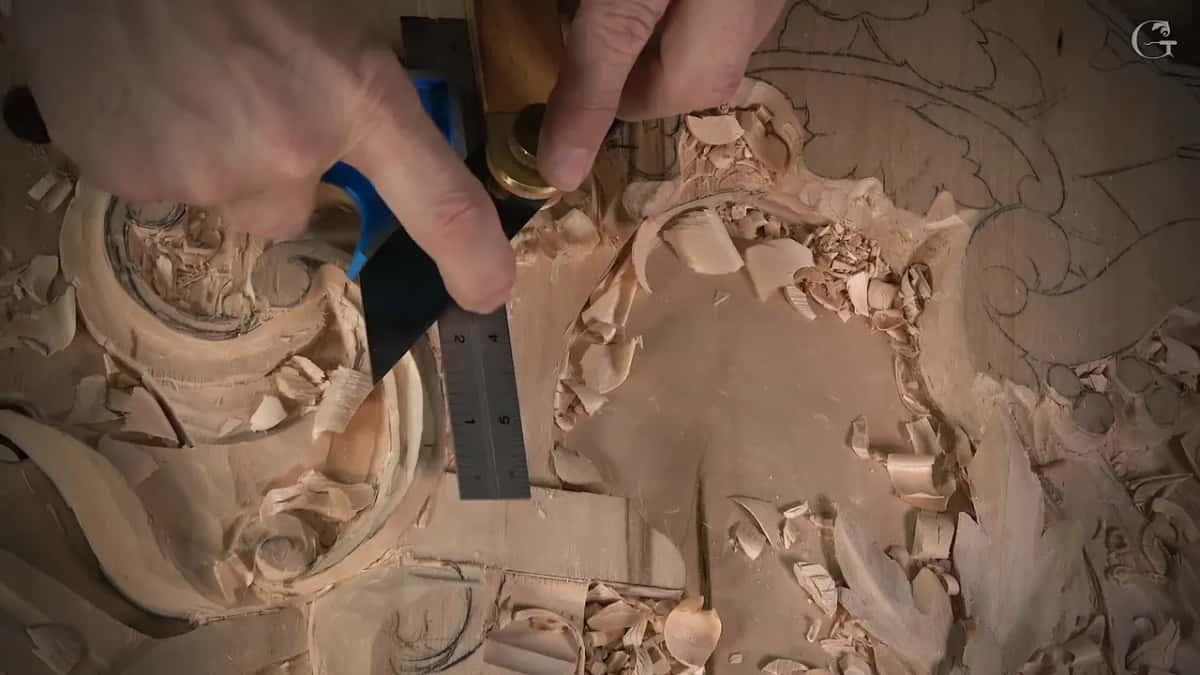
In lesson 154 a jigsaw had made one edge, and a jigsaw is not always accurate, so the line went back on with a pencil.
Plain pencil lines are fine, and the work stays hand carved.
What did I do by hand in lesson 154?
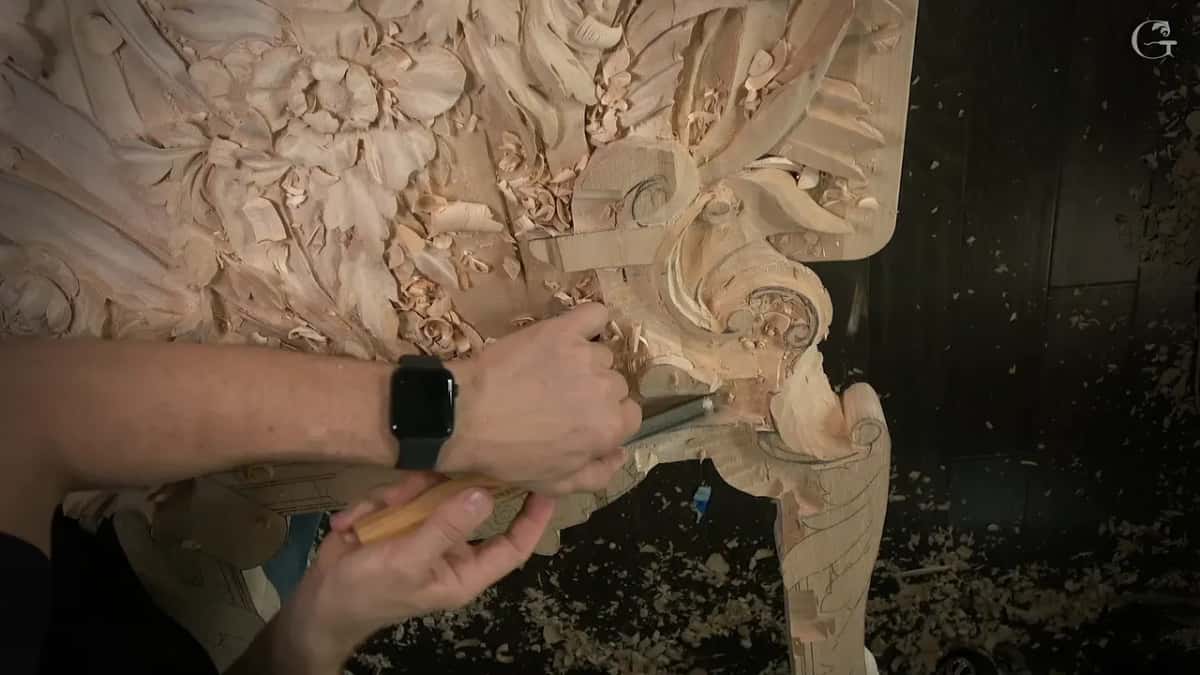
I took one section of a Venetian panel down beside a molding, a little at a time, and kept putting my line back where the waste had worn it.
Part one opens with a tool that is good for furniture making. That's a good tool to use sometimes, I said, and I would still hide the mark it left, so you are not going to see that I used it. A moment later I stopped to check if I had messed up. I hoped I had not, and I had not. About a sixteenth of an inch, 1.5 mm, was still left there, and that was good.
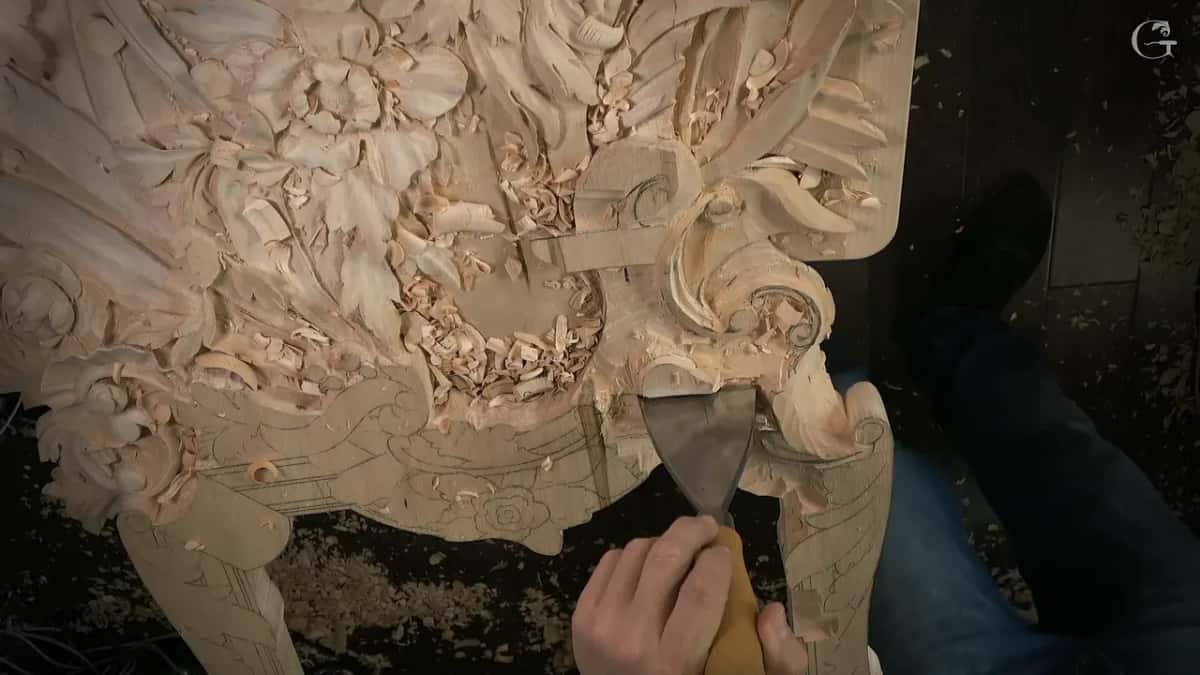
Next came the line. I put it back, somewhere right here and somewhere right there, and before I had carved anything yet, I set a preliminary line along it with my big number 1. I checked that line with calipers too, and the page on calipers already tells that part. I could have taken a 3 mm next, but I only chopped a little from the side of the canvas with a number 2, upside down, because it doesn't have to be that big there. Then the normal way, and upside down again.
After that I took the number 1 again, the single bevel, and I was really careful how I came at it. I set it to recreate that line. You can watch all the waste fly out. A 3 mm went right along the side after it, and halfway through I said a 2 mm might even be a good idea, so I went and got one. A big number 3 put the wall back straight down on the line. Near the end of part one the piece was loose and vibrating, so I refastened it more solidly with a clamp in place, and I could go much deeper after that.
What came down in part two?
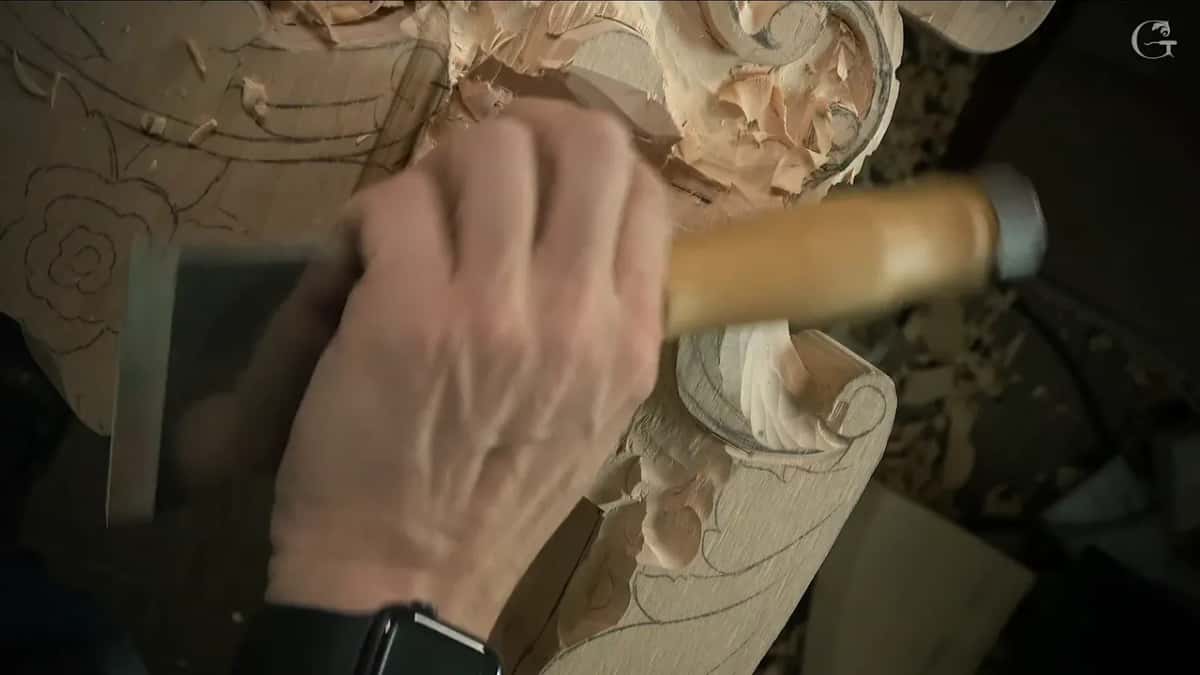
Part two starts with the mess. I got a 3 mm, a number 11, and cleaned all that mess out, maybe with a 2 mm again. That part is going to go all the way here, I said. It looks a little messy, but it's okay. Then I redrew the boundary of this acanthus, and I had to clean up that section a little.
One whole section came down to the level beside it, but only after a check. A molding had to be exposed in that spot, and a shell was coming as well, only a partial shell, one that goes underneath a flower. I did not want to lose that shell. First I had to outline that little detail, and before anything came down I double-checked where my shell was going, in case I had made a mistake. I had not, and everything was good.
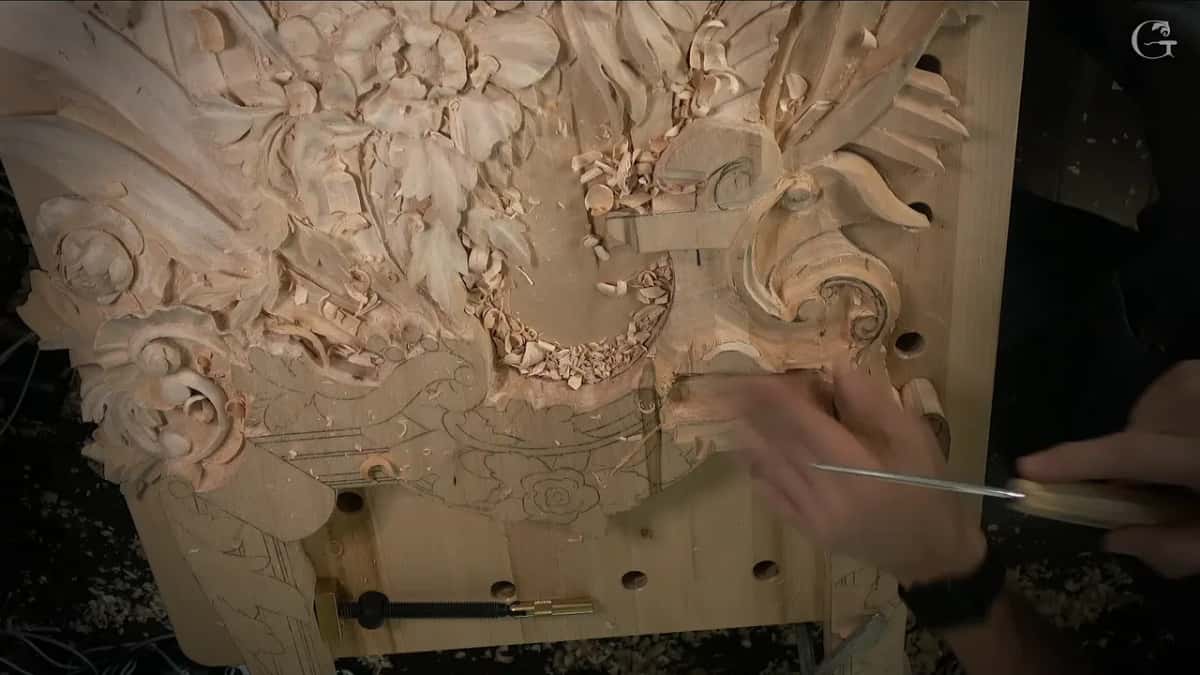
Lowering that whole section to the level beside it came next, to make a better canvas for myself. The easiest way to do it was a bunch of straight-down chops with a number 9, about a quarter inch, 6 mm, deep at the beginning. I stopped to check once more. The molding goes below, so I was safe to bring the whole section down. Remember, I said, I'm working on a live project, and I can't redo that.
Little by little I came to my depth. I was about an eighth of an inch above it, 3 mm, I would say. Don't want to overdo it. Next I double-checked what I had been thinking about another section, and it also had to go all the way down.
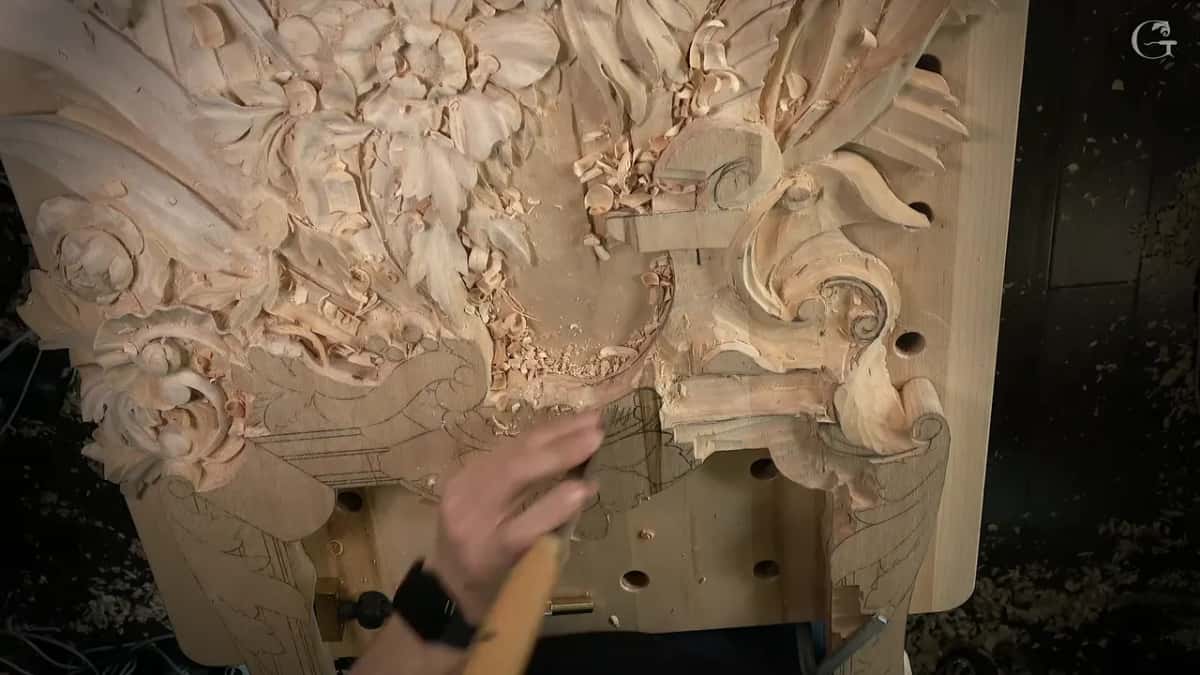
I redrew the line around it, a one-inch line, and I said it is easy to make a mistake there, but I really don't want to make mistakes. A pass across the grain brought it closer to the design. A bigger number 2, maybe about 35 mm, close to 1 3/8 in, cleaned it while I stayed about 3 mm above my high spot. A smaller number 2 outlined my acanthus a little better after that. I hope you see it, I said.
How far did each step go?
Small amounts, measured in sixteenths and eighths of an inch, and here is where each one sits in the three parts.
Moment in the lesson | What I did there by hand | How much |
|---|---|---|
Early in part one | looked to see if I had messed up, and I had not | 1/16 in still there |
Four minutes into part one | worked the side, then swapped for a smaller one | 3 mm, then 2 |
Part two, two minutes in | chopped straight down, over and over, using the 9 | roughly 1/4 in at first |
Just before minute four | stopped to look at how much was left before going any lower | 1/8 in above, I would say |
Six minutes into part two | cleaned the section over with a bigger number 2, near 35 mm | 3 mm over my high spot |
Is it still hand carved if a jigsaw made the edge?
I agree with what I wrote about starting a big architectural panel, where the carving is all by hand, while the outline is not carving. Lesson 154 has a small example of it.
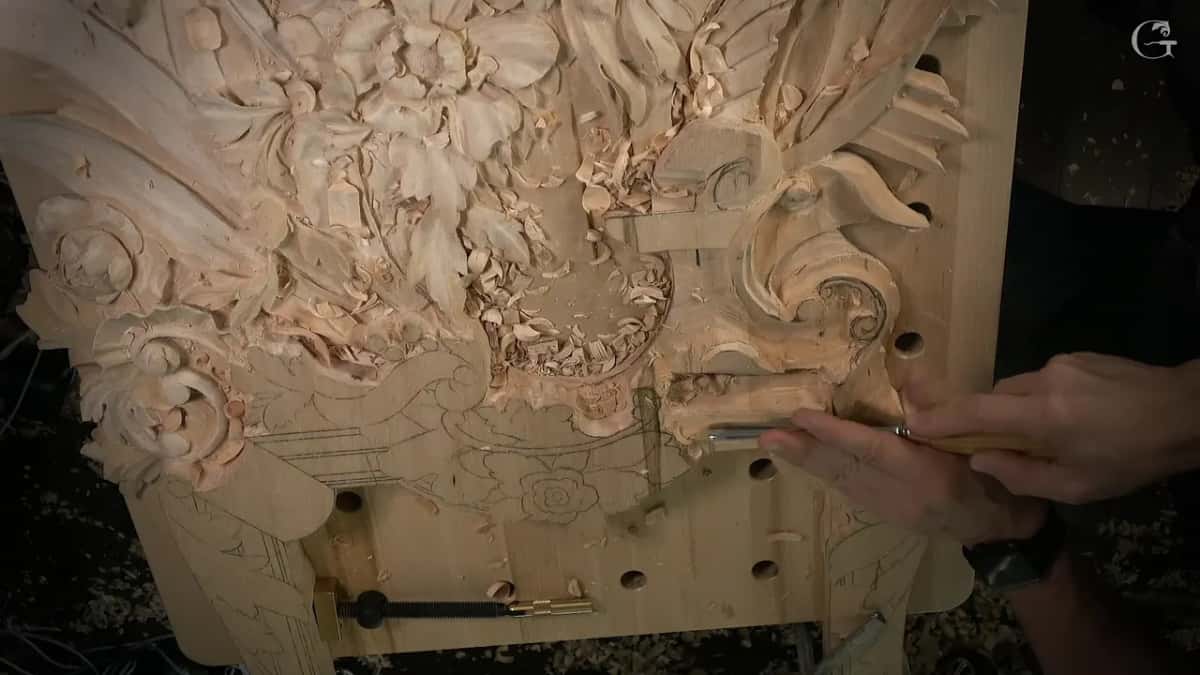
In part three I wanted to extend a line along an edge. I had used just a jigsaw there, and a jigsaw is not always accurate. So I put the line on with the pencil, and I also hit straight down on it, so that I knew my distance. At least it helps me measure. Then I needed a sharp pencil to start some of the divisions.

A marking knife would be a lot more accurate, I said, if you have one. But that's okay. It's still going to be hand carved, and you won't be able to see those lines anyway once they are carved out. Or use whatever you have in your shop. Any tool will work pretty much, as long as you get really close to nice straight lines.
I have used a machine on a molding myself and said so on camera: around the Venetian Flowers Rosette it was just a normal Roman ogee, I used a router, and I cheated a little bit because I needed to finish that project.
What else happened in part three?
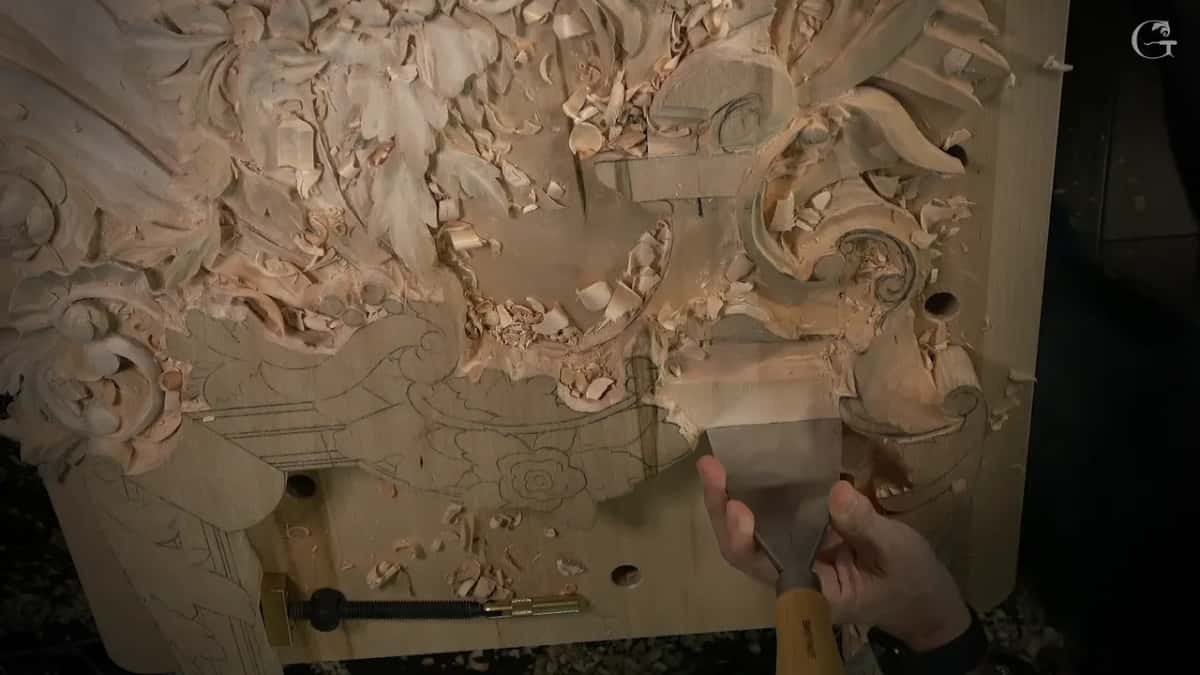
I was ready to clean that stuff pretty much to the final line. Then comes a miter, a 45-45, and the way I set that angle without a gauge is told on the course page for Part 13, so I will not tell it twice. I'm pretty sure I got that really accurate, I said, and that was my 45.
I could not place it right on the line, so I eyeballed it as close as possible, looking from above, to catch the line. On the video you probably see a gap, because the camera sits a little off and not straight down. I look at it straight down. So there will be a point, one going this direction, then another point, and so on. Easy enough, I said.
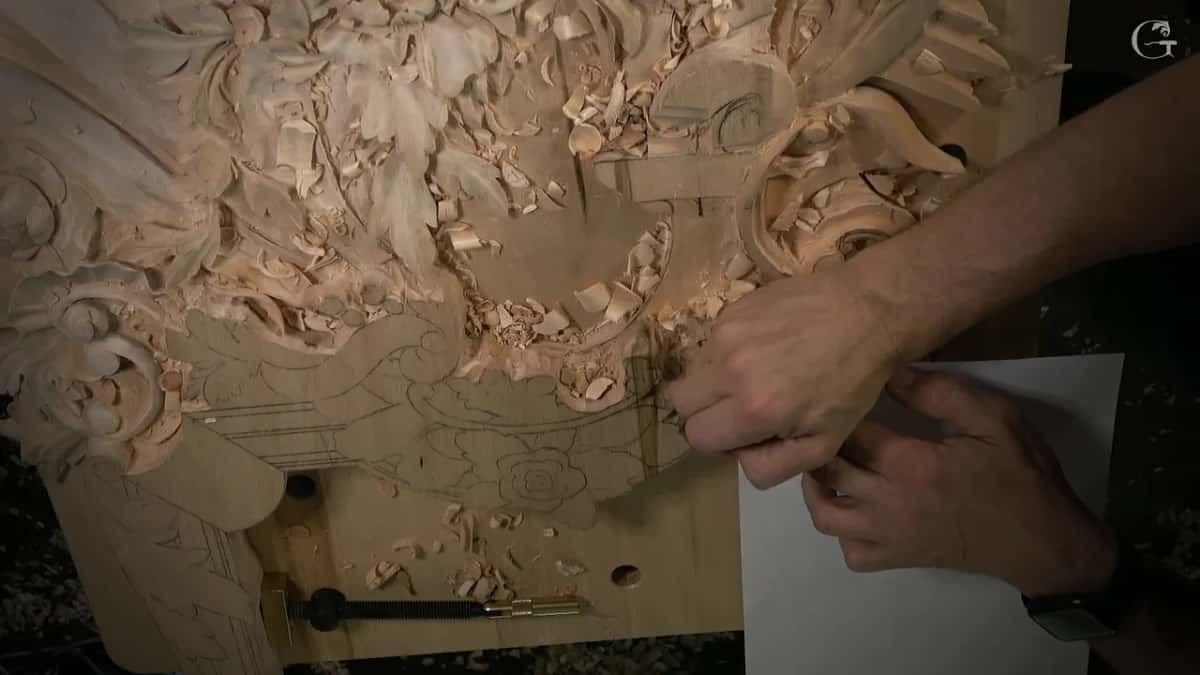
That was enough for me, though I could, of course, continue the line. Near the end I said I could probably just scribe it if I need to, to follow the edge. That is the last thing in the lesson. The only machine I named anywhere in it was that jigsaw.
What did one man online say about my carving?
He said it was impossible, so I must have done it by a CNC. That story is from workshop 9 of Carving Dining Table Apron. A few years ago I had a post on one of the Russian social networks, Odnoklassniki, a name that means classmates, and the piece was really nicely done. One guy just wrote, "Oh, it's impossible, you did it by a CNC, you can't do that by hand."
There's no way a CNC can do that. I know CNC. I used to work in a shop, and I had a shop with the CNC, and the CNC can't do it, absolutely can't.
And I passed on what one guy said about his own CNC. When it sees the woodcarver work with his hands, he said, the CNC just runs to the corner, sits quietly, and weeps, because there's absolutely no CNC that can do what you can do with your hands.
But the man who wrote on my post tried to just be smart. "Oh, I'm doing that every day on CNC," he said. "That's CNC. Try to do it by hand." And I know I'm doing it by hand.
I told him that if you don't like something, you don't have to say something. You really don't have to say anything if you don't like it. Just walk away.

Hand carved vs machine carved, as I said it in a livestream
People would argue with me. They say CNC machines can do much quicker. My answer was in the April 2020 livestream on creating shadows. CNC machines actually really limit it. Yes, some of them can do some of the stuff, but not to the level of what an experienced wood carver is able to do. So a CNC is really limited. Really limited.
I said much the same while carving two berries with a V tool in Hashemi Flowers 24: there are CNC machines, computerized routers, but they are limited, still not able to do what you are with your hands.
And in the fifth Corinthian acanthus lesson, the one on undercutting, I said that when you see marks, a human hand did it, not the machine.

Power tools in general are a different question, and my answer to that one is on the livestream page, dust and all. Underneath, a CNC router is a router with a computer steering it. What I can give you is what I said, as a carver who has had one in the shop. I put no price and no hour count on any of it here, because I would only be guessing.
Two neighbours of this question have their own homes. Whether a hand plane counts as cheating is on the Greek acroterion page, and the whole apron course, workshop by workshop, starts on its own page.
Where can you watch the whole lesson?
Inside the school, all three parts of lesson 154 play in full, chips and all. It sits in Venice Room Part 13, workshops 144 to 155, the stretch of this room where the molding work happens, between lesson 153 and lesson 155. Tuition opens it. The plans page shows the cost, monthly or annual, renewed automatically until you stop it.

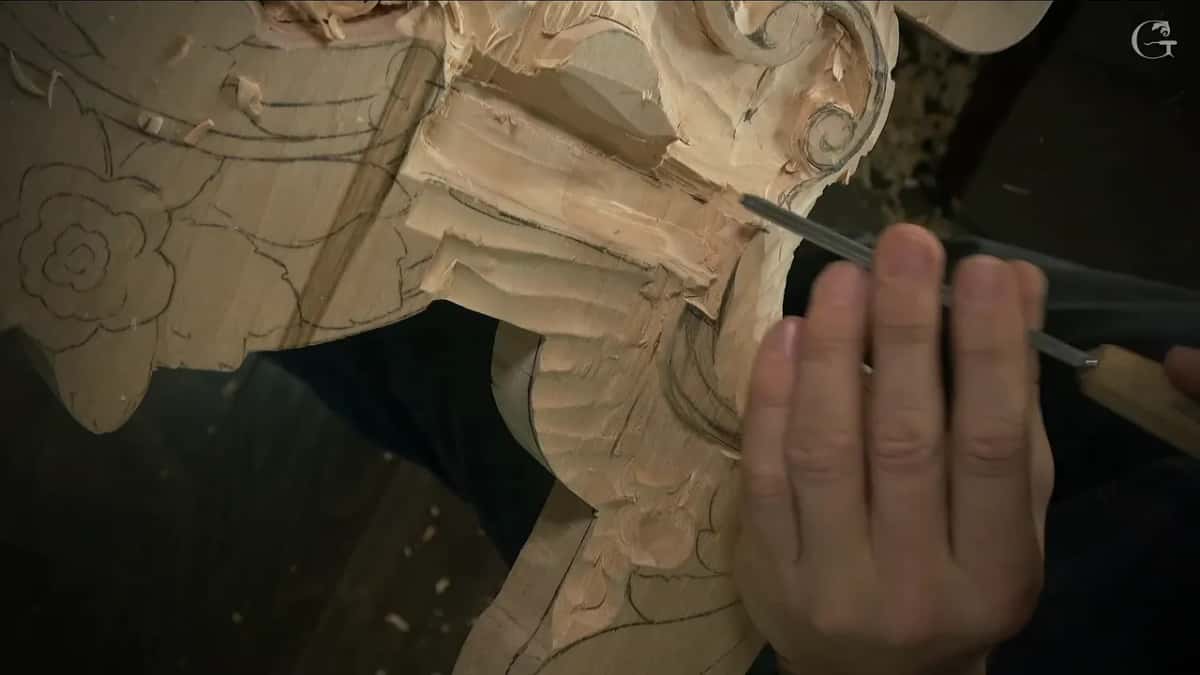
Do you have a pencil? And one gouge, even a plain one? Then you have what part three of lesson 154 starts its divisions with, a line on the wood carving itself.
How it's done
- Check what is left. Look before you go on. In lesson 154 I still had about 1.5 mm, a sixteenth of an inch, and that was good.
- Put the line back. Re-establish your line, then recreate it with a single bevel number 1, and the waste flies out.
- Find what sits below. Before lowering anything, double-check where the shell and the molding will go, so you don't lose them.
- Chop down a little at a time. Chop straight down with the number 9, again and again, only about 6 mm, 1/4 in, deep at the beginning.
- Stop above the depth. Come down little by little and stop at about 3 mm, 1/8 in, above it.
- Mark with what you own. Put the next lines on with a sharp pencil. Any tool from your shop works if the lines come out nice and straight.
Frequently asked questions
Have you ever worked with a CNC yourself?
Yes. I know CNC, there was one in my shop once. I said so in a Dining Table Apron workshop when I told the story of a comment on one of my posts. The comment said the piece was impossible to do by hand, so it must be CNC. I told him he does not need to speak up about something he dislikes.
Who said a CNC weeps when it sees a woodcarver?
A man talking about his own machine said it, and I passed it on in an apron workshop. His CNC, he said, cannot do what a woodcarver does with his hands, so it goes off and cries when it watches one at work.
What can a CNC do in wood carving?
Part of the work, in my words from a livestream on shadows, though short of what an experienced carver can do. People argue with me that the machine is much quicker. CNC machines really limit it, I said, and I called the machine really limited twice.
What to carve next