
July 20, 2021 · Updated August 15, 2026
By Alexander Grabovetskiy — Master Woodcarver · Founder, School of Wood Carving · 9 min read
Woodcarving class in person at Marc Adams School of Woodworking
Key Takeaways
- Five days in a room with somebody watching your grip fixes what video cannot reach.
- The school sits in farmland, so rent a car.
- Gibbons work is a stack of four separate carvings fitted one above the other.
- Photograph the piece every single evening, then lay the five shots side by side when you get home.
- Arrive already able to sharpen properly.
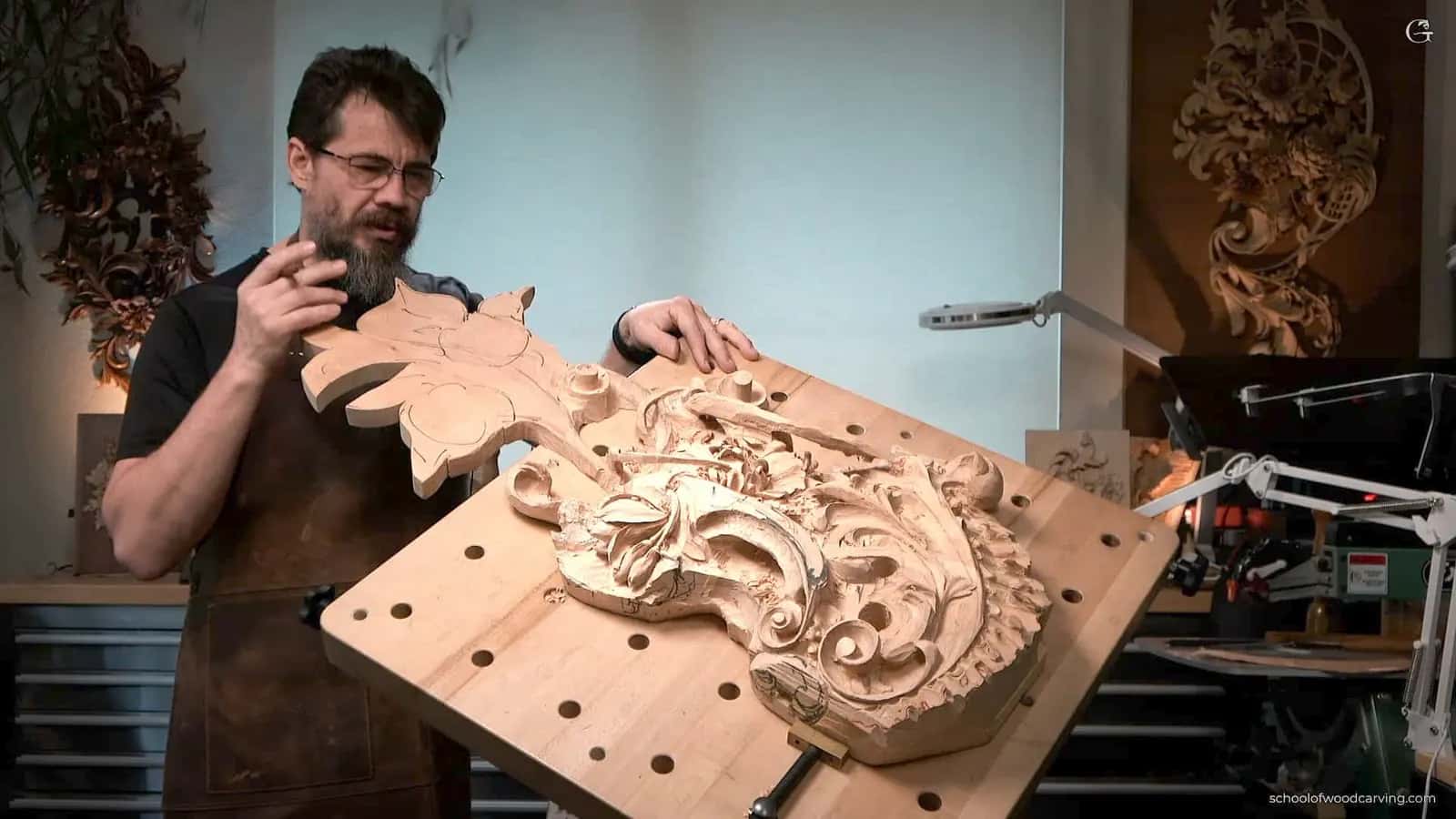
A woodcarving class in person is five days at a bench with a teacher standing behind you. I run mine at the Marc Adams School of Woodworking in Franklin, Indiana, and we never repeat a project. The last one was Grinling Gibbons style, four layers deep, carved in limewood.
I just came back from Marc Adams. I teach in several schools and each one has its own character, but that address in Indiana means something to me personally, because I lived in this state for nine years. Not near the school. Up north, in a small town called Goshen, about three hours above Indianapolis.
Cornfields. Flat land as far as you can see. You would never guess one of the best woodworking schools in North America sits down there in the middle of it.

A room like this one is the whole argument for coming in person.
Where is the Marc Adams School of Woodworking?
Franklin, Indiana, south of Indianapolis. The address on the school's own site is 5504 East 500 North, and their calendar of full week programs runs most of the year. Franklin is the seat of Johnson County, twenty five thousand people at the 2020 count, so plan on driving.
Fly into Indianapolis and rent a car. That is what most of my students do, and several of them share the drive.
What makes this school different from the others?
The people, and that goes for both sides of the bench. Some of the best woodworkers alive teach there. The students who sign up are not tire kickers either. They have already burned a weekend on YouTube and decided they want somebody watching their hands.
Several classes run at once under one roof. Nobody advertises that part. You break for lunch and end up beside a man who has spent thirty years turning bowls. My classes are carving only, so that cross traffic is where I learn things.

My collection grows one week at a time, and I have never once used this one.
There is a tradition now. When I teach carving there, one of the turners makes me a mallet on his lathe. This time it was John Beaver, whose wave bowls you have probably seen even if the name is new. It sits on the shelf with the others.
What did we carve this year?
A panel in the Grinling Gibbons style, taken from one of his frames. Every year is a different project. I have taught there for several years now and I have never repeated one, partly for the returning students and partly because repeating myself makes me a worse teacher.
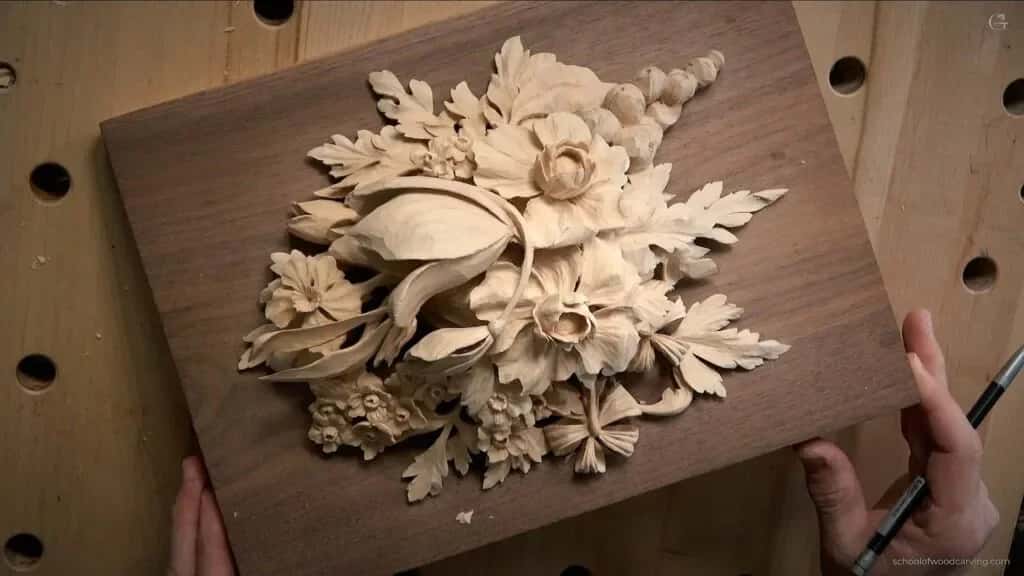
The kind of spray we were after, standing off its ground board.
My first thought was that a week is not much time. Can a room full of people carve something genuinely hard and still finish inside five days? Gibbons work is never one carving. It is a stack of them, built up and fitted together.
We used four layers on this piece. Each layer is carved on its own, then fitted and mounted onto the one below, which means you are running four small projects at once and thinking about how they will read together long before they meet.

The second layer, still just a red marked blank, sitting where it will live.
Who was Grinling Gibbons?
A Dutch born carver who became the most famous woodcarver in English history. Born in Rotterdam in April 1648, he built his career in England, dropping cascades of fruit, flowers and cherub faces into stately homes, and pushing the whole craft forward while he did it.
People have called him the British Bernini. The writer William Aglionby, who was alive at the time, called him the Michelangelo of Wood. He was no joiner and no carpenter. A carver, which is a different animal.
We carved in the same wood he used, and David Esterly, who spent his life on that work, put it better than I can.
But limewood is a patrician medium that, treated correctly, really will be an obedient servant.
David Esterly, The Lost Carving
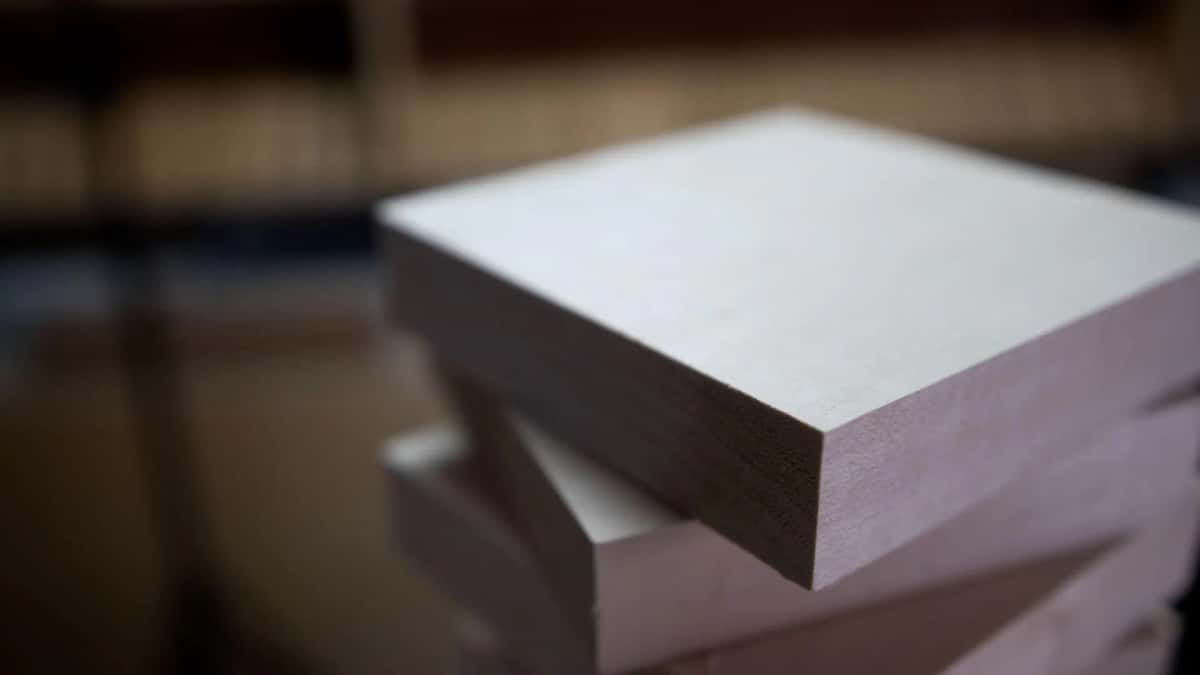
Squared, planed and waiting for layout. Pale and quiet and forgiving, which is why he used it.
Lime, or Tilia, is the same family as the American basswood most of you already carve. If you want the full argument about species, I put it in a separate piece on carving wood, and there is a companion on what walnut does instead.
Is a week long class better than learning online?
They fix different problems, and I built my school because most people cannot do the first one. A week at a bench corrects your hands. Video corrects your knowledge. You need both, and the order matters less than people think.
| What you get | A week at the bench in Indiana | Lessons at your home |
|---|---|---|
| Somebody standing behind you correcting the grip itself | Corrected inside the first hour | Never, unless you film your hands and study it |
| Seeing the same move done twice | One pass | Watch that minute forty times over |
| Cost beyond tuition | Flights, rental car, hotel, week off | Nothing extra |
| Carvers within arm's reach | The whole room, and whoever is turning next door | A comment thread only |
My honest advice is to learn the fundamentals at home where mistakes cost nothing, then spend the travel money on a week once you can already sharpen. Students who arrive with a working edge get about double out of the same five days.
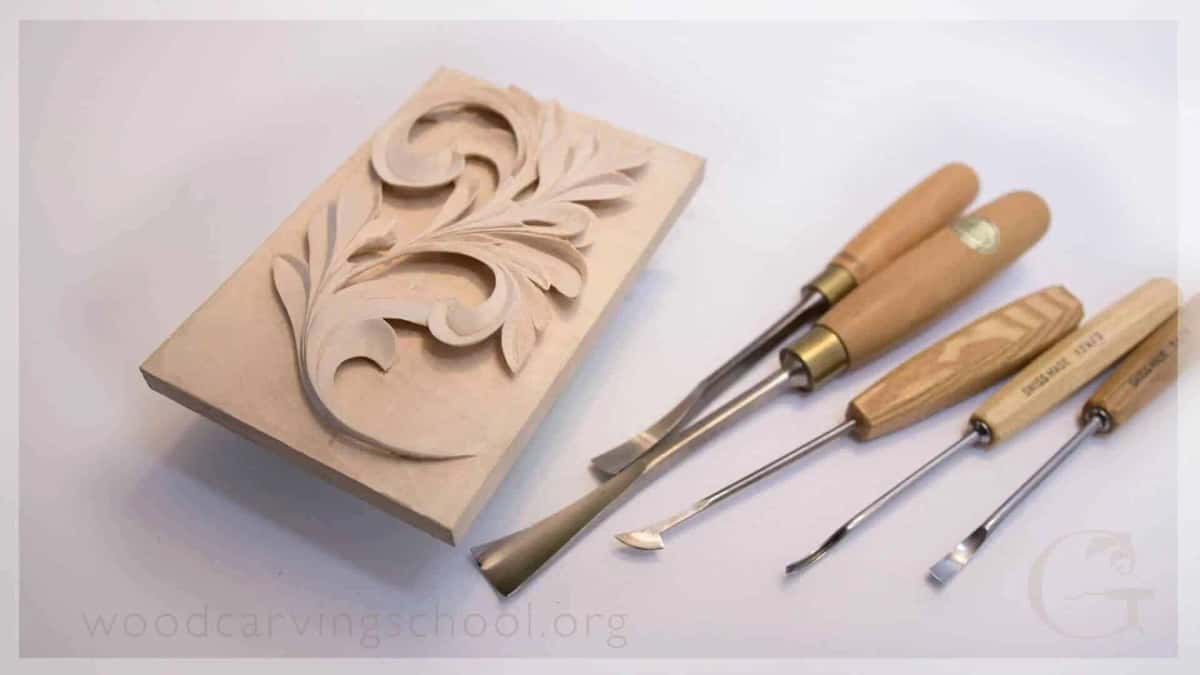
Four tools did most of this leaf. Not forty.
How do you finish a Gibbons panel in five days?
By deciding what to cut before anybody picks up a gouge. Here is the order we ran that week, and it is the same order I would give you at home.
Step 1, take the design apart
Look at the original and work out how many layers it needs. Trace each layer separately. This is the hour that decides whether the week ends in a finished piece or in a pile of parts.

Half of it still pencil and half of it already gone, and that line keeps moving every day of the week.
Step 2, sharpen before day one
Bring tools that are ready. A class is not the place to learn grinding, and the students who arrive with dull steel spend Monday fixing what they should have fixed at home. Read what a beginner actually needs before you buy anything.
Step 3, carve the bottom layer first
Work from the back forward. The deepest layer sets every level above it, and getting it wrong on Tuesday means recarving on Thursday.
Step 4, rough all the small pieces together
Batch the work. Rough out every leaf and flower for a layer in one sitting instead of finishing them one at a time, because your hand keeps the same rhythm and the parts come out as a family.

A fishtail gets into a corner where a straight tool would wedge.
Step 5, model, then fit
Shape each piece properly before you think about mounting it. Then dry fit the whole stack and look at it from across the room, which is where you find the leaf that fights its neighbor.

One student, one scroll, and most of a Wednesday gone into it.
Step 6, undercut for shadow, and stop
The last hours are for shadow. Thin the edges that catch light and leave the rest. Nearly every ruined piece I have seen in a class died on Friday afternoon from one cut too many.

Where a good week ends up, with every single hollow in it doing a job.
What should you bring to a carving class?
Sharp tools, a mallet you like, and a strop you actually use. Marc Adams supplies the bench space, the clamps and the machines. What it cannot supply is the familiar edge already living in your own hand.
Beyond that, bring reading glasses if you own them, and a camera. Photograph it every evening. You will learn more from four photos in a row than from anything I say standing over you, and it settles the arguments you have with yourself later.

Sawing out a blank, which takes two minutes and saves two hours.
Here is a look at how these classes actually run, filmed at the school.

Not everyone can travel. That is the reason my school exists at all.
If Indiana is a long way from you, the same method sits inside the online school, starting with sharpening, then acanthus, and eventually designing a panel of your own. Plenty of my in person students carry on there between classes, and my notes on picking a class apply either way. Access renews automatically every 12 months and you can stop it from your account page.
Frequently asked questions
Do I need experience to take a carving class in person?
For my week at Marc Adams, some. You should be able to sharpen a gouge and have carved a few finished pieces. A total beginner will spend the week fighting the tool instead of the design, which is a waste of a plane ticket.
What tools do I bring to the class?
Your own carving tools, a mallet, and a strop with compound on it. Bring what you actually use. Six sharp gouges you know will beat forty you have never once touched.
How long is the class and what does it cost?
Full week programs run five days. Tuition and the current calendar live on the Marc Adams site rather than mine, and both change year to year, so check there rather than trusting a number in a blog post.
What project will we carve?
A different piece every year. Past weeks have covered Gibbons style foliage, acanthus panels and more. Returning students are the reason for that, and I announce the piece ahead of the season.
Where do students stay during the week?
Most stay in Franklin itself, and some drive down from Indianapolis every morning. They keep a list of nearby options, and students often split a rental car from the airport.
Can I learn the same material without traveling?
Most of it, yes. The design work, the sharpening and the carving sequence all transfer to video, and that is what the online school is. What does not transfer is somebody catching your wrist angle in the first ten minutes.