
June 27, 2024 · Updated August 15, 2026
By Alexander Grabovetskiy — Master Woodcarver · Founder, School of Wood Carving · 12 min read
Why wood carving is so popular, and what keeps people at the bench
Key Takeaways
- One knife and one proper board is the whole barrier. The rest is patience.
- Lime and basswood behave under a blade, and framing lumber will ruin the edge and the evening both.
- Sore hands are never the reason. People quit because a blunt tool tore the wood and they decided the fault was theirs.
- A router can repeat a pattern all night, and it still cannot reach behind a petal.
- Value keeps climbing for one plain reason. Almost nobody is left who can do this by hand.
Wood carving is the craft of taking hand tools to a solid block and removing everything that is not the shape you want. I think it stays popular because it hands you back a real object at the end of the evening. Screens give you nothing to hold.
Most people who write to me start the same way. They say they have been watching carving videos for months and they still have not touched a piece of basswood, because they are waiting to be sure it is worth it. Let me answer that plainly, and I am not going to sell you anything in the first paragraph. Here is what draws people in, what stops about half of them by week three, and the one thing that keeps the rest carving for thirty years.

Three leaves and a row of notches. That is a whole first evening, and it is enough.
Why is wood carving so popular right now?
Wood carving is popular because it sits among the few things left where your hands make the whole object, and nobody can tell you that you did it wrong if it is beautiful.
I have carved for over forty years and I still watch people pick up a knife for the first time and go quiet. Something changes in the room. You stop checking your phone because you physically cannot, both hands are busy.
There is a second reason and it is less romantic. The tools are cheap to start and the rules have not changed. This trade takes the same tools it did two thousand years ago, the same setup, the same thinking. What I teach is not a new method. The old one still works, which is why a Grinling Gibbons panel from the 1670s still stops people in a hallway.
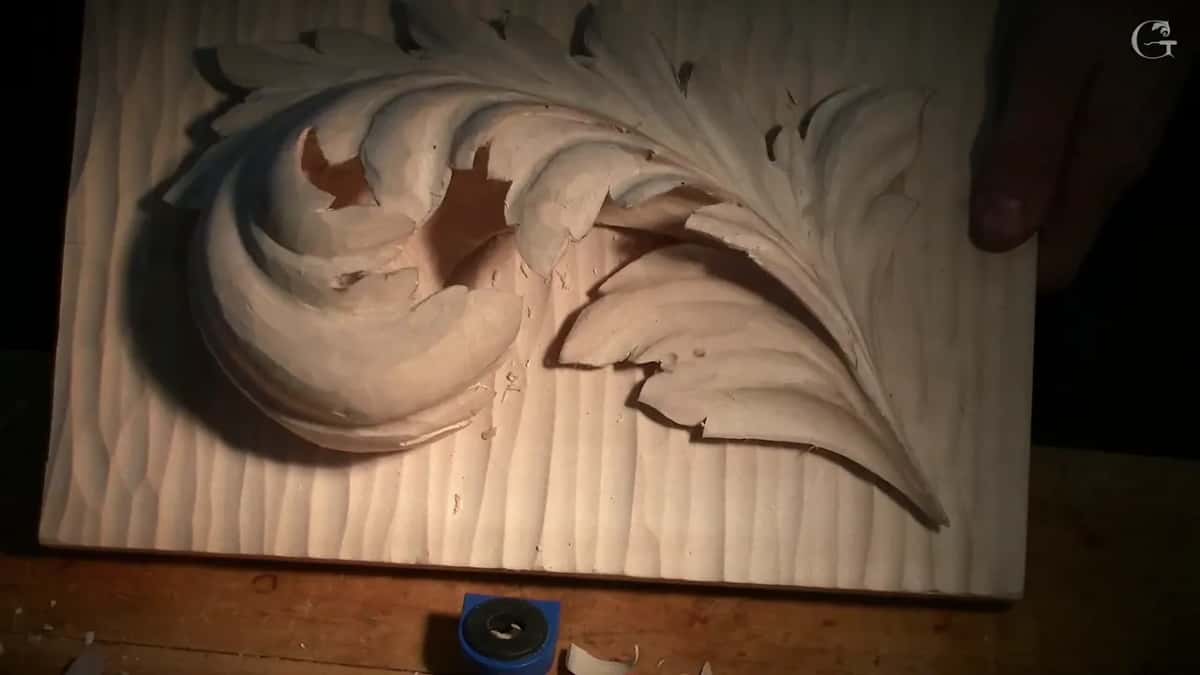
A third reason I only understood after I started teaching. Carving in wood puts you in the three-dimensional world. Drawing and painting stay flat. When you carve you have to hold the whole form in your head and take material away to reach it, and so many people in their sixties and seventies come to it and tell me their head feels sharper. I am not a doctor. What I can give you is what I see in class.
Is wood carving actually relaxing?
Peaceful, yes, and here is where that stops. On camera I have said that carving is among the most peaceful professions I know, and I meant it. I carve all day, every day, and it is peaceful.
But I also carve for a living, and that creates a lot of tension. A deadline sits behind me. A client is waiting. The peace is real and the pressure is real, and both of them live at the same bench.
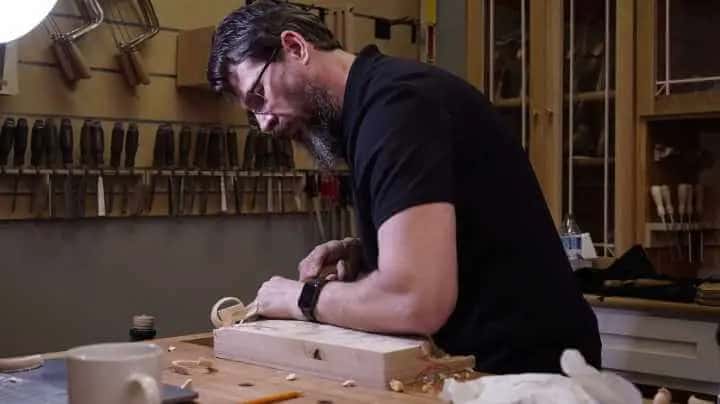
For you, carving as a hobby, the pressure is not there yet. What you get instead is a strange kind of quiet. Not the quiet of doing nothing. This is the quiet of a job that takes all of you, so nothing else can get in. A viewer of mine put it better than I can. He typed into a livestream chat, "Carving is my meditation until I break something." Truth, in one line.
What does it cost to start carving?
Less than people think for the tools, and more than people think for the wood. You do not need a set. You need one knife and one piece of proper wood, and you can begin this weekend.
I carved a whole coffered ceiling using a single blade. That was 1998 or 1999, a job where I designed the ceiling itself for my client, and I built the design around one cheap blade so the work would move. About a month, all the sides of it, one knife, my own hand. The blade was a cheap number 12, the same kind of Pfeil I still reach for.

A number 7, fourteen millimeters. The sweep of the tool has to match the curve you drew, or you fight it all evening.
The wood is where people go wrong. They grab a construction two by four because it is sitting in the garage. Carve a 2x4 and you will get so frustrated, and you will kill your tools doing it. Get real American basswood, which is Tilia americana, or European limewood. It costs money, and I am not going to pretend otherwise, because you have to be real about this part and the wood is what nobody warns you about. My longer piece on what makes basswood the standard has the grain reasons.
Can a machine just do this instead?
A machine roughs out a shape, and then it stops. A CNC router is a wonderful thing for repeat work, and a 3D printer will give you a form overnight. Neither one can undercut. And no machine leaves the ridges and tool marks that catch light and make an acanthus leaf look alive from across a room.

Here is how I see the choices, and this is my own judgement, not a lab test.
| Way of making | How long before you see a result | Real limit | The thing you end up holding |
|---|---|---|---|
| Carving a basswood panel by hand with gouges | Weeks of quiet evenings | Slow, and there is no honest way around that | One carved panel |
| A photograph of the same ornament | One afternoon | It stays flat however good the light | A print, not depth |
| A 3D printer laying down plastic in the shop | Fast, once somebody modelled it | No marks | Shape without ridges that catch the light |
| CNC router work | Quick to run, slow to program first | It cannot undercut anything | Even ornament, and every copy identical |
| Knife work on a small shape, one blade only | One evening | Depth arrives slowly, layer by layer | Your first crooked leaf |

Photography sits in that table on purpose, because I have made this comparison in class. A photographer can find a beautiful location and take a beautiful picture, and that is real art. Good photography sells for real money. But the carver takes far longer for the same scene, and if the carver is good, the carved version sells for more than the photograph. Time and rarity are the whole difference.
How do I try carving this week without wasting money?
Buy one knife, buy one board, and carve the same small shape three times. The whole plan, and it costs less than a night out.
Step 1, buy one knife instead of a set
A boxed set of forty-eight tools looks generous and it is a trap. You will use six of them and the other forty-two will go brown in a drawer. One good blade teaches you more.
Step 2, get real basswood, not a 2x4
Ask for basswood or limewood by name at a lumber yard or from a carving supplier. A piece the size of a paperback is plenty. Lee Valley carries blanks.
Step 3, draw the shape before you touch the wood
Design comes first, always. Not decoration on paper, but the layout of the space, where the lines turn and how they repeat. My own teacher spent months on this before he let me near a leaf.

Step 4, learn to strop on the first evening
Sharpening is the hardest skill in this craft and it takes years. Nobody wants to hear that. Learn the strop now anyway, because a dull edge crushes the fibers instead of slicing them, and you feel it in your shoulder before you see it in the wood.

Step 5, carve the same leaf three times
The first shows you where the grain gives out. Greed ruins number two, every time. And the third attempt is usually the one that ends up on somebody's shelf.

What stops people in the first month?
A dull tool and a flat drawing, in that order. Almost nobody quits because carving is too hard on the hands. They quit because the tool tears the wood, and they think the tearing is their fault.
The edge is what failed, not you. My longer piece on learning to carve puts the real difficulty in two places only, sharpening and drawing. The rest is repetition you will get through.

The second thing is patience, in the old sense of that word. Scripture says the man who built the Ark of the Covenant was filled with wisdom, knowledge and understanding. I would add patience, because you will spend a long time working one small area, and there is no way to hurry it. It builds your character whether you asked it to or not.
What keeps people carving after the first year?
The work gets harder, and that turns out to be the reason people stay. This surprises everybody, including me.
Once the tearing stops and the edge behaves, carving stops being a fight and becomes a question. Where does the light land. Why does this leaf look flat when the drawing was good. How do I make one lobe pass behind another so the eye believes it. Those questions do not run out. My grandfather gave me my first chisel when I was six, and I took it straight to a brick to carve a face and ruined the tool completely. I am still asking them.

There is also the plain fact of what you end up owning. Somebody carves a board, and a year later it is on a wall in his daughter's kitchen. That does not happen with a spreadsheet. For relief projects that finish fast, I keep a list of small carvings you can finish with one blade.
Raining here today. I can hear it on the shop roof.
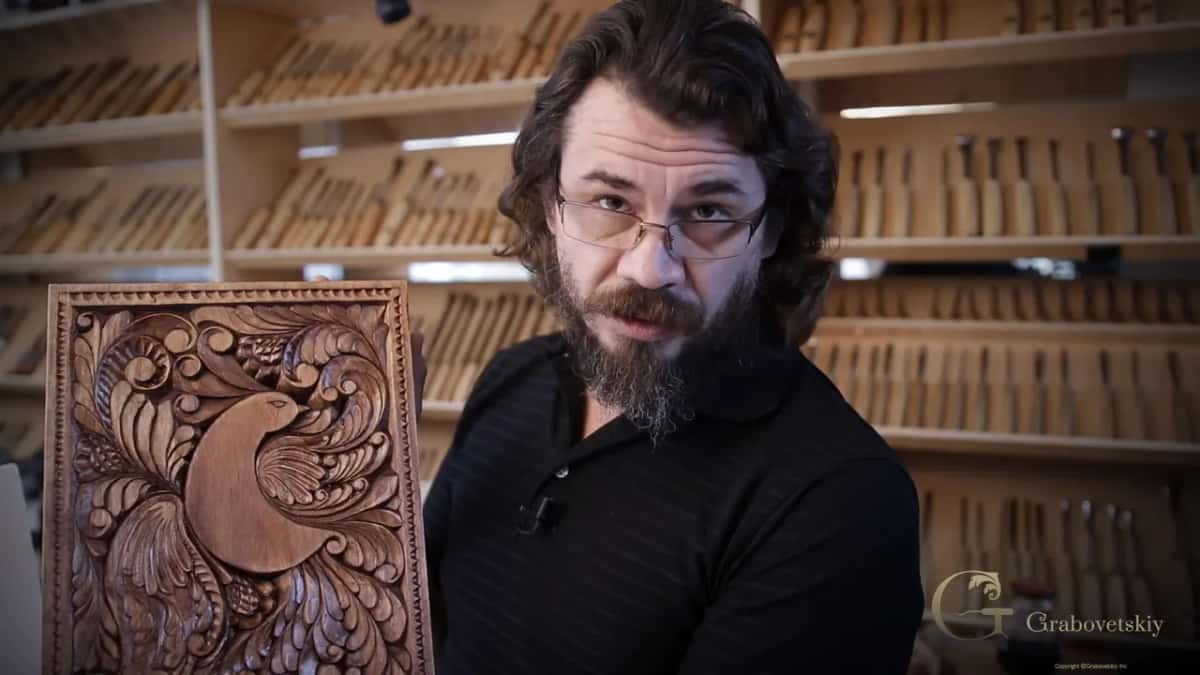
A board stained dark, with the bird running right across the face of it.
Who actually takes up carving?
Everybody, teenagers through to men in their nineties, and that age spread is the most surprising thing about my classes. My students start at fourteen and go past ninety.
Woodworkers come because they can already build a cabinet and they are tired of the door looking like everybody else's door. That was my own route, honestly. I built custom homes for about nine years and ran a kitchen and bathroom cabinet shop with people working for me, and I kept taking carving commissions on the side. Adding one carved detail to a hood made a kitchen easier to sell, because nobody else could supply it.

Then a man who runs one of the biggest woodworking companies in the world walked into my shop one day. He said, why don't you just concentrate on wood carving. There are a lot of companies who can do cabinetry and a lot of builders, but not too many people left in the world who can actually carve. I said, yeah, why don't I do that. I switched to carving full time and never went back.

Scarcity is the honest reason this craft is having a moment, not nostalgia. Fewer and fewer hands can do it, and the work those hands make is worth more every year. To see whether the money side is real, I went through it in a separate piece on carving for a living.
Where should a beginner actually start?
Start with one small relief carving and somebody to show you how. Relief is the kindest place to begin because the wood stays flat on the bench and you only chase depth, not shape in the round.
My beginner course walks through the grips and the two ways people ruin an edge in the first week. It sits here: Beginner in Carving. When tools are what is stopping you, All About Tools for Wood Carving covers what to buy and what to skip, and the knife article is free to read. My commissioned studio work sits at grabovetskiy.com.

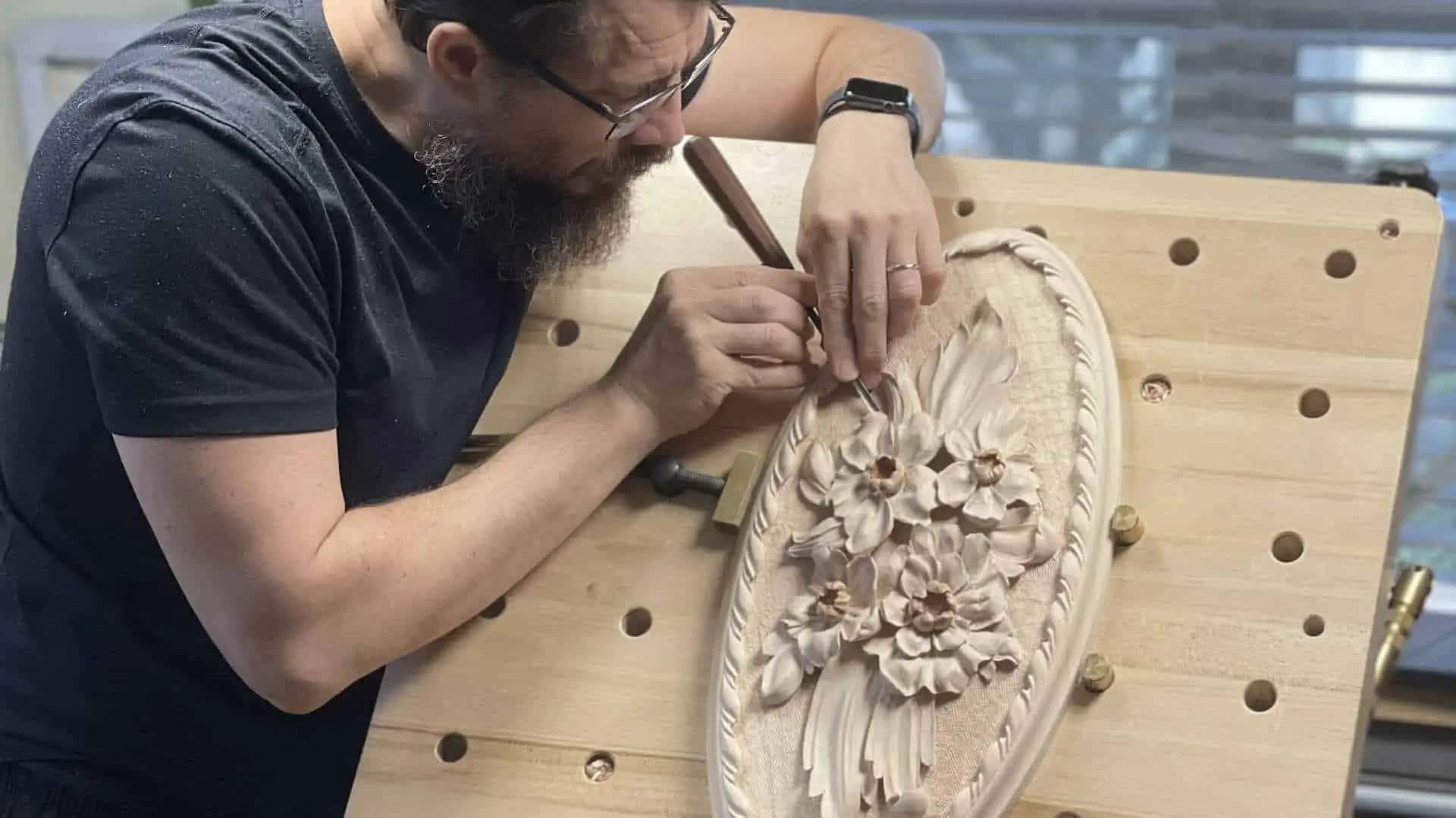
A rosette clamped flat while the background comes down around it.
Watch me talk about the school for six minutes if you want to see the room and the tool wall before you decide.
The whole library sits at the course catalog, and there are over three thousand lessons in it now. Tuition is Yearly Access at $200, which renews automatically every 12 months until you cancel, or Monthly Access at $25, which renews automatically every month. Part of what you pay goes to orphans and widows through the school, which is a 501(c)(3) non-profit.

You have been watching for months. The basswood costs less than the videos you already bought.
Frequently asked questions
How hard is wood carving for a complete beginner?
Beginners get the hand movements within a few evenings. What takes real time is sharpening and drawing, and those two are where nearly everybody stalls, so put your effort there first.
What is the best wood for a first carving?
American basswood, or European limewood outside the States. Both are soft and even in texture, and both forgive a wrong angle. Keep away from construction pine, which tears badly and dulls an edge fast.
How many tools do I need to begin?
One knife will carry you through your first several projects. I carved an entire coffered ceiling with a single blade in the late nineties. Add gouges later, when a specific curve in your drawing asks for one.
Can I learn wood carving from online lessons?
You can, and thousands of people do. You need a course filmed from the carver's side of the bench rather than across it. Watching the hand angle, frame by frame, is most of the lesson you are paying for.
How long before I carve something worth keeping?
Most people keep their third piece. The first two teach you where the grain gives out and how greedy you get with depth, and by the third attempt at the same leaf your hand already knows the shape without being told.
Can older hands still carve?
Older hands do well at this, because sharp tools do the work and you supply direction rather than force. My oldest students are in their nineties. When grip is the problem, a mallet takes the strain off the wrist.