
August 5, 2024 · Updated August 15, 2026
By Alexander Grabovetskiy — Master Woodcarver · Founder, School of Wood Carving · 10 min read
How to make money from wood carving, and how much
Key Takeaways
- Two numbers decide everything, the hours a piece really eats and how many of them you have to make.
- Carving rarely carries the invoice. It makes the cabinet, the table or the room impossible to buy anywhere else.
- Quote the finished job. Hourly rates fine you every time your hand gets quicker.
- A one blade design finished a whole ceiling in a month, and paid, because the drawing was built around the tool.
- Machines set the floor under hand work, never a ceiling over it. None can reach behind a leaf.
Wood carving money is real, and it almost never arrives the way beginners picture it. You make money from wood carving mostly by attaching carved work to something bigger that somebody already wants to buy. Selling carvings one at a time to strangers is the slowest road on the map.
I am not going to give you a dollar figure. Anybody who hands you one has either never taken a paid order or is guessing to keep you reading, and you would be right to close the tab. What I can give you is how the money actually behaves in this trade, taken from forty years of paid work, a cabinet shop I used to run, and one order for fifteen rosettes that taught me more about pricing than any book.

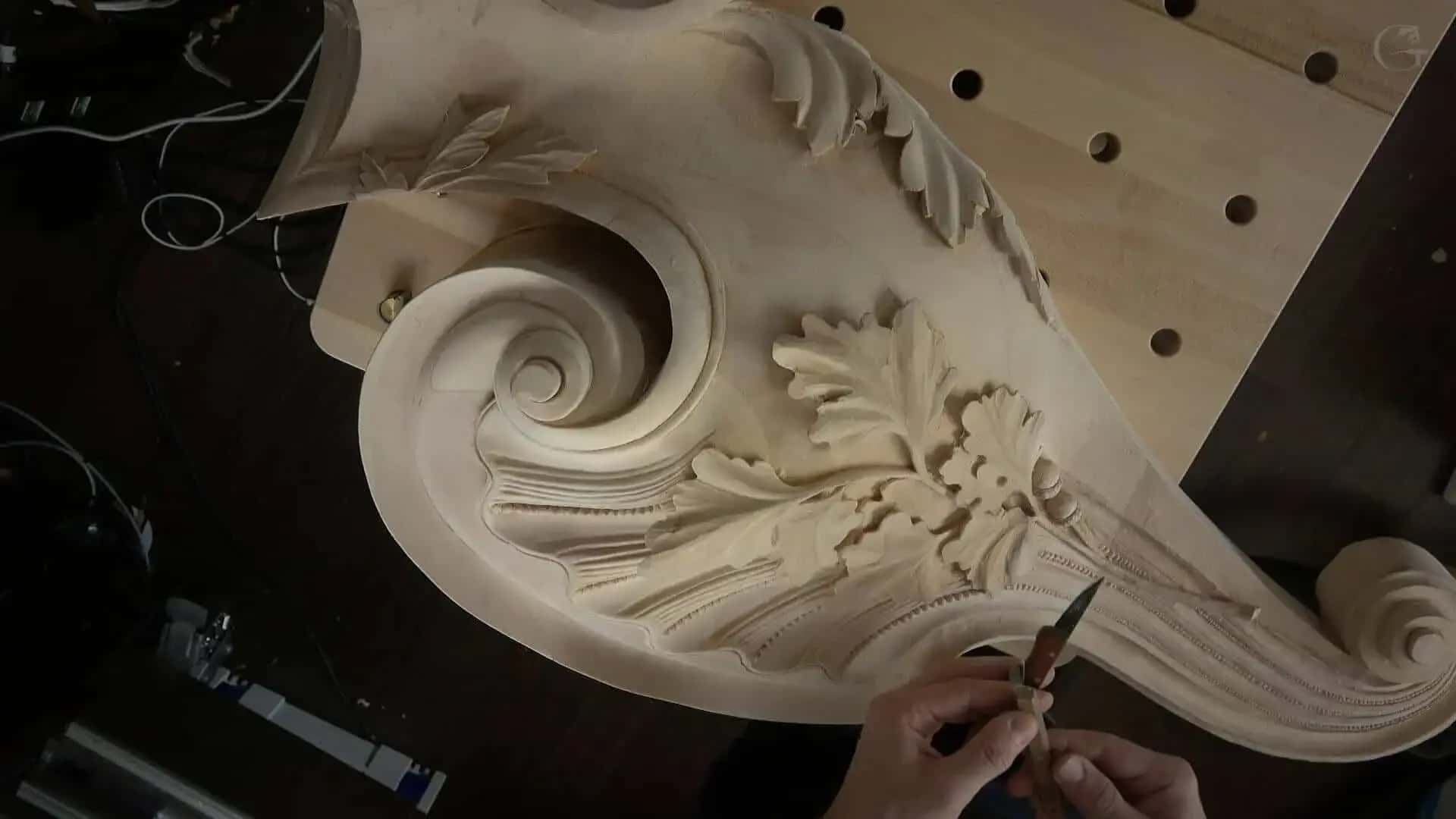
Every real order starts like this. Somebody wants a thing, and they hand you a picture of it.
How much money can you actually make carving wood?
It comes down to two things, time and volume, and everything else is a story people tell.
I had a preconceived idea about this myself, and I was wrong for years. My first college had nothing to do with carving, because I did not think you could earn a living from it. Carving is a slow trade. Slow means time, and time means you have to know how much you actually spend on a piece before you can charge for it.

One tendril, no wider than a sixteenth of an inch. Guess how long that took and you will guess wrong.
It turned out to be an excellent way to earn a living, which surprised me more than it will surprise you. Not because carving sells easily. Because if you can do something other people cannot, and offer it where they cannot find it anywhere else, the price stops being an argument.
Where does the money actually come from?
From what the carving does to the price of something else. This is the part almost nobody tells beginners, and it is the whole reason I stayed solvent.
I had a business for a long time doing kitchen design and custom cabinetry. That market is brutal. There are a lot of manufacturers and they offer a far cheaper product than anything I could build by hand. Then I started adding hand-carved detail to a hood, or a corner, or an inlay of grapes or an acanthus leaf, and the whole conversation changed.
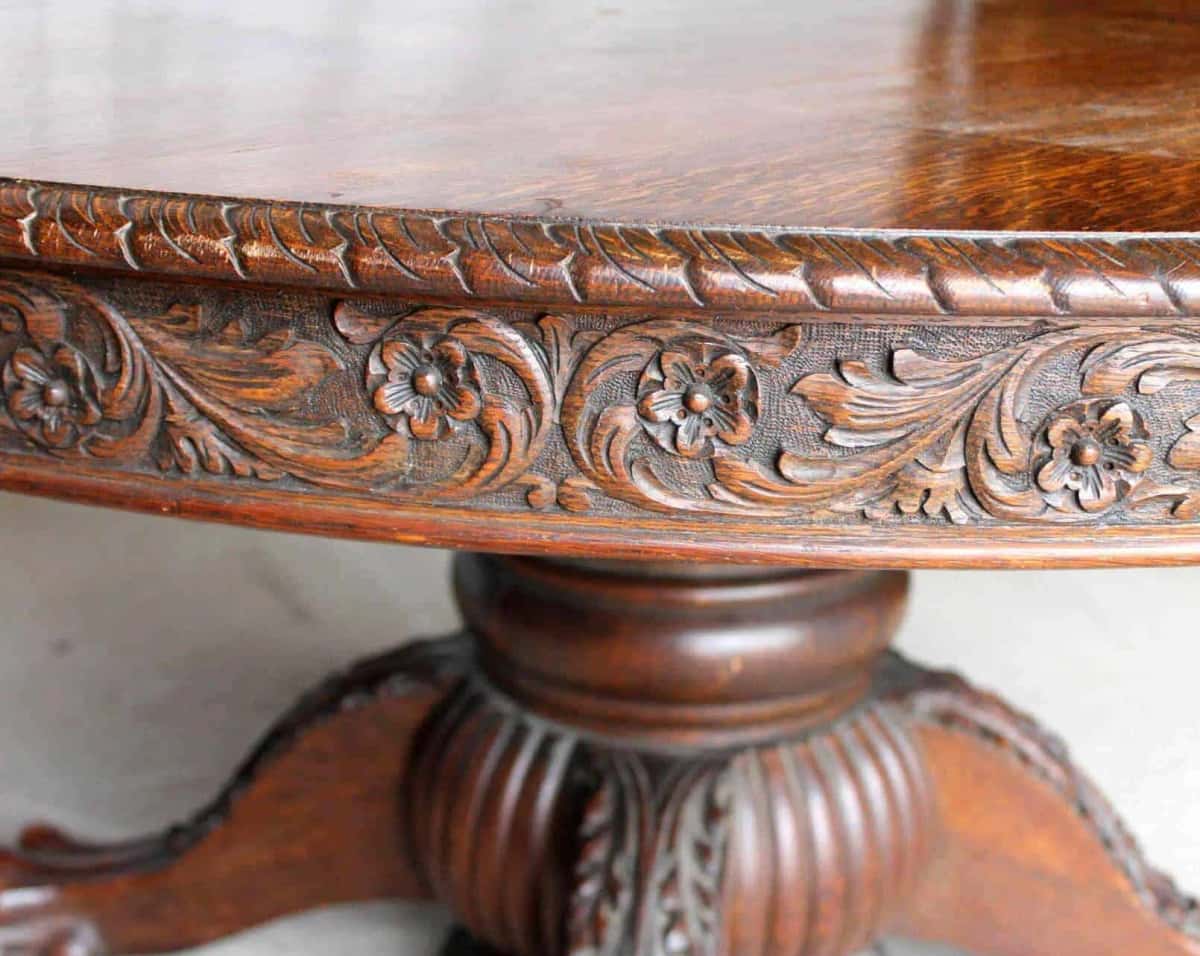
It became easier to sell the cabinetry. Not because the carving was priced high on its own, but because nobody else could supply it. The carving was the reason the customer chose me and not the cheaper shop, and the cabinets carried the invoice.
So the honest first question is not what a carving sells for. It is what you already sell, or could sell, that a carving would make impossible to copy. Furniture makers, cabinet shops, stair builders, restorers, all of them sit on this and most never notice.

What does a real carving order look like?
Repetitive, specified, and nothing like the piece you would carve for pleasure.
One order I took was fifteen rosettes in an antique style. No original piece to copy, just a photograph. Five and three eighths inches square, one inch thick, background one eighth deep. I made sixteen blocks, because the sixteenth is insurance and it costs almost nothing.

That is what paid work is. Fifteen of the same thing, all matching, all to somebody else's drawing, held to a standard nobody will praise you for hitting and everybody will notice you missing. Pleasure comes later, on your own bench, when nobody is waiting.

How do I price a carving job without guessing?
Carve one, time it honestly, and then multiply from the average rather than from that first slow attempt. Most carvers price the piece they imagine, then work the piece that actually exists.
Step 1, carve one sample and time it
Make the first piece properly and write down the real hours, including the drawing, the sharpening and the mess you cleaned up afterwards. Not the hours you wish it had taken, and not the hours you told somebody it took.
Step 2, count the volume, not the piece
Fifteen rosettes is not fifteen times one rosette. The second is faster than the first and the tenth is faster again, so the average is what you quote from.

Step 3, price the design separately
When you draw the ornament yourself, that is work, and it is the work the client cannot get anywhere. I designed a whole ceiling for a client once before a single chip came off it.
Step 4, add the wood and the finish
Proper basswood, which is Tilia americana, is not cheap, and neither is the time spent finishing. Both go on the quote as their own lines so nobody feels ambushed.
Step 5, quote the job, never the hour
Rates by the hour punish you for getting faster, which is the one thing you spend your whole life doing. Quote the finished job instead.

Which route to money actually suits you?
There are five real ones and they demand completely different lives. Here is how they look from where I sit, after trying most of them.
| Way to earn | What the customer is really paying for | Main risk | Who this route actually suits best |
|---|---|---|---|
| Carving added onto the furniture you already build | Something nobody else supplies | You still have to run the woodworking business underneath | Woodworkers with customers |
| One off commissions for private clients | Your name | Long gaps between jobs, and slow payment | Carvers with a portfolio |
| Production runs of the same ornament, fifteen or twenty | Speed you have already earned | Sheer boredom | Anybody who can hold one standard steadily |
| Teaching other carvers | The forty years sitting behind your hands | It eats bench time | People who can explain themselves clearly |
| Restoration work on somebody else's broken antique carving piece | Rare skill | Matching a dead man's hand exactly | Only very patient carvers |
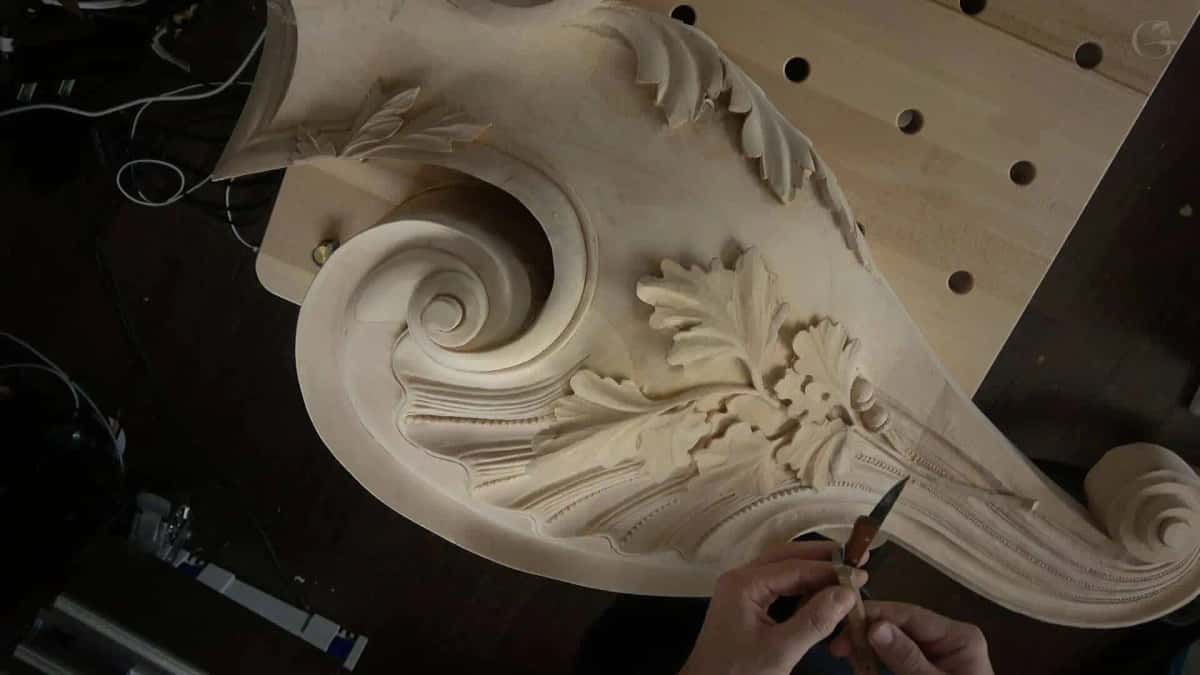
Restoration deserves a warning all of its own, because it is the single route on that list where being good at carving is not enough by itself. Matching an eighteenth century hand is harder than carving something new, because your own taste keeps trying to improve the thing and you are not allowed to.
Why can one knife earn more than fifty tools?
The job you design is the job you get paid for. Tools do not earn. Decisions do.
Back in 1998 or 1999 I had a coffered ceiling to do. I designed that ceiling myself for the client, and I designed it deliberately as a one knife project, so every carved side could be worked with a single cheap Pfeil blade. The whole thing took me about a month, all the sides, one knife and my hand. It paid.

I did fireplace mantels the same way afterwards. It does not look cheap, either. Design for the tool you own and the speed follows, and speed is the only lever a hand carver has that a machine cannot copy.
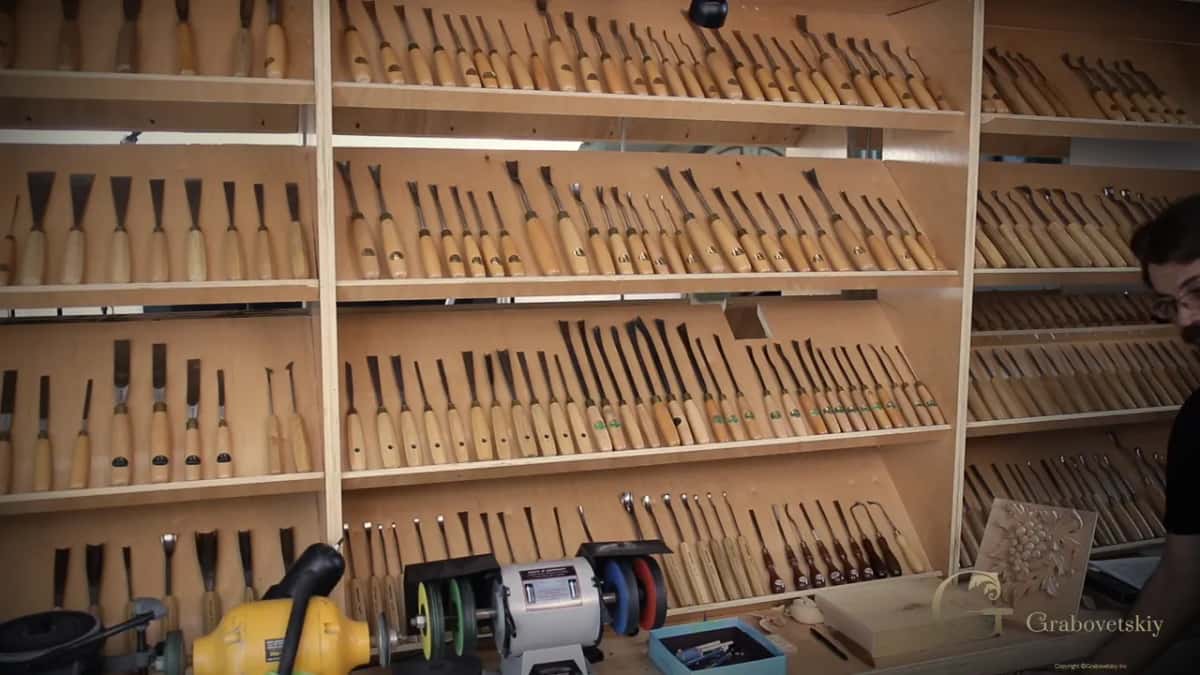
Gouges collected over decades, shelf on shelf. Almost none of them were bought at the start.
Buy tools as jobs demand them, which is what All About Tools for Wood Carving is really about. A shelf like this is the result of paid work, never the entry fee for it, and I have written about the one knife I hand every beginner if you want the specific blade.
What makes hand carving worth more every year?
Fewer people can do hand carving at all. That is the entire economic story, and it is getting stronger, not weaker.
A man who runs one of the biggest woodworking companies in the world came into my shop one day. He told me to concentrate on carving, because there are plenty of companies who can do cabinetry and plenty of builders, but not many people left in the world who can actually carve. I switched to carving full time after that conversation.

A CNC router handles repetition beautifully and it still cannot undercut, so the machine sets a floor under your prices rather than a ceiling over them. Compare that to photography. A photographer finds a location and takes a beautiful picture, and good photography sells for serious money, but there are many good photographers. Far fewer hands can carve the same scene, and when the carver is good the carved version sells for more.

Should I quit my job to carve full time?
Not yet, and probably not the way you are imagining it. I ran custom home building for about nine years and a cabinet shop with employees while I carved on commission on the side. The carving grew inside a business that was already feeding my family.
Start where you already have customers. If you have none, the fastest honest path is to get good enough that somebody asks, and that takes the time it takes. I went through the timing question in how long it takes to learn, and the wider question of whether this is possible at all in making money from carving.

Also, and I mean this kindly. If money is your biggest problem right now, this is probably not the right hobby to fix it. Get a pencil and paper and draw, because that is free, and come back to the wood when the pressure is off.

The skills that pay are the ones almost nobody practises. Drawing your own ornament, sharpening properly, and holding one standard across fifteen identical pieces. My antique rosette course follows that fifteen-piece order, starting at the photograph and ending with fifteen matching rosettes, and the panel design course is where the drawing gets taught. Beginners belong in Beginner in Carving first.

Here is me talking about how a furniture carving job gets approached from the start.
The full library sits in the course catalog, more than three thousand lessons. Tuition is Yearly Access at $200, which renews automatically every 12 months until you cancel, or Monthly Access at $25, renewing automatically every month. The school is a 501(c)(3) non-profit, and part of what you pay supports orphans and widows. My commissioned work is at grabovetskiy.com.
Nobody pays for carving. They pay for the thing they cannot get anywhere else.
Frequently asked questions
Can you make a full time living as a carver?
Some of us do, and most got there sideways rather than by selling carvings to strangers. I built mine on top of a cabinet business that already had customers. Expect the carving to grow inside something else before it stands alone.
How do you price a carved piece?
Carve one sample, write down the real hours including drawing and sharpening, then quote the whole job rather than an hourly rate. Quoting the piece protects you, and then every hour you save is yours instead of the client's.
What kind of carving sells best?
Work that solves a problem somebody already has. A carved apron on a table being built, a matching piece for a damaged antique, an ornament for a room that has to look period correct. Decorative pieces made on spec sell slowest.
Do I need expensive tools to earn from carving?
No. I carved an entire coffered ceiling with one cheap knife because I designed the job around that blade. Buy tools as jobs demand them, since a full tool wall is the result of paid work rather than the price of entry.
Is wood carving still profitable with CNC machines around?
More so, in my experience. A router repeats an ornament perfectly and it cannot reach behind a leaf, so machine work sets the floor and hand work sits above it. Scarcity of skill is what keeps the value climbing.
How long before carving earns anything?
Longer than you want, and it depends entirely on what you already sell. A cabinetmaker can charge for carved detail within a year. Somebody starting from nothing usually needs several years and a portfolio before anyone asks.