
Alexander Grabovetskiy, woodcarver, School of Woodcarving · Published 2017
Part of Carving Antique Style Rosette

The full video lesson is inside the school.
Alexander Grabovetskiy, woodcarver, School of Woodcarving · Published 2017
Quick answer: A leaf reads as curved when its rim is left standing and everything inside gets hollowed away. The bright line runs round the outline, shadow gathers in the middle, and the board stops looking flat. Romanesque carvers worked to the same convention.
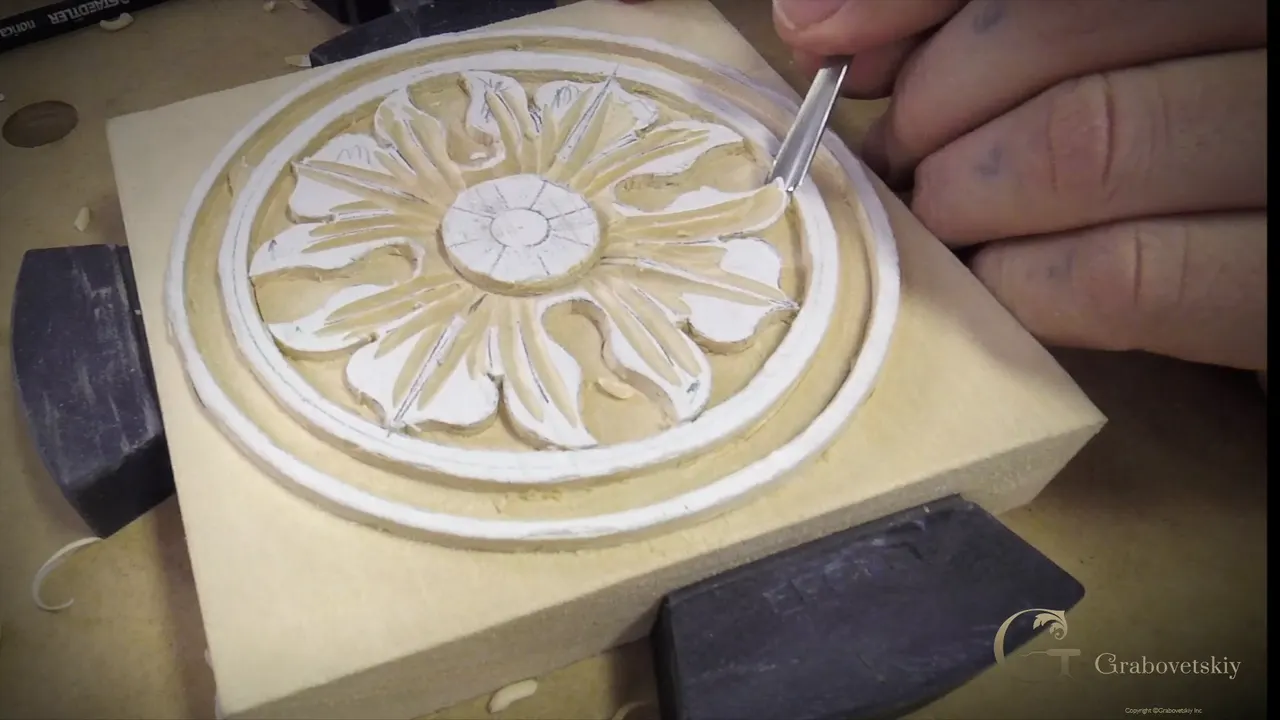
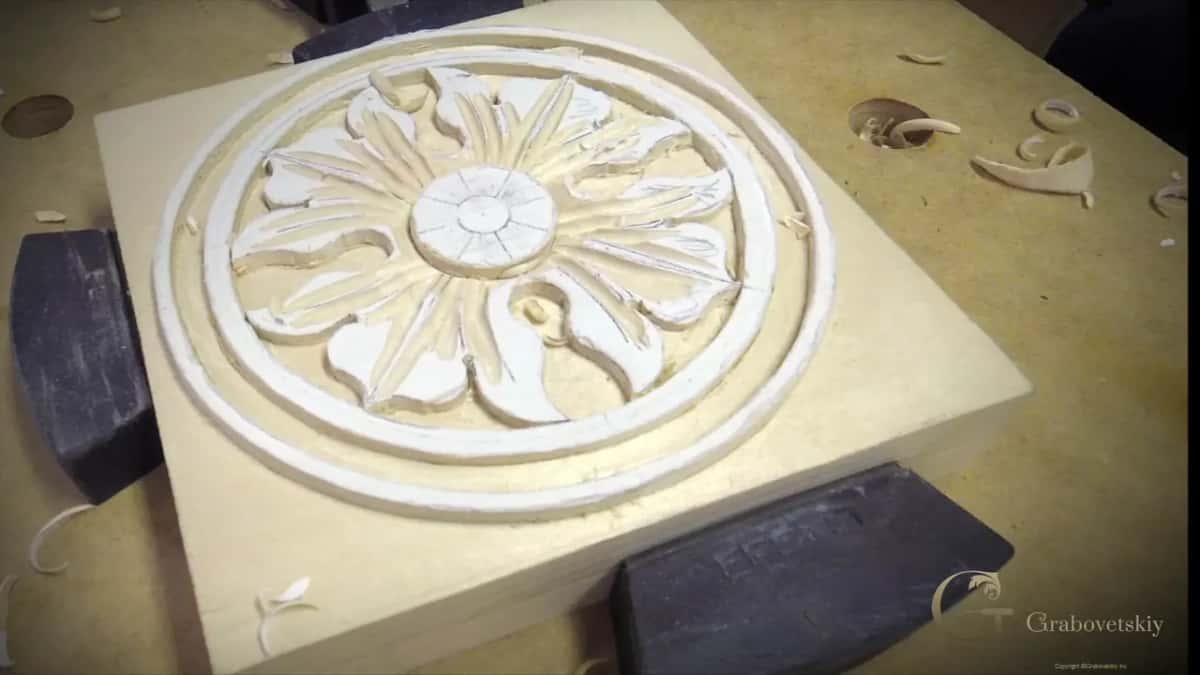
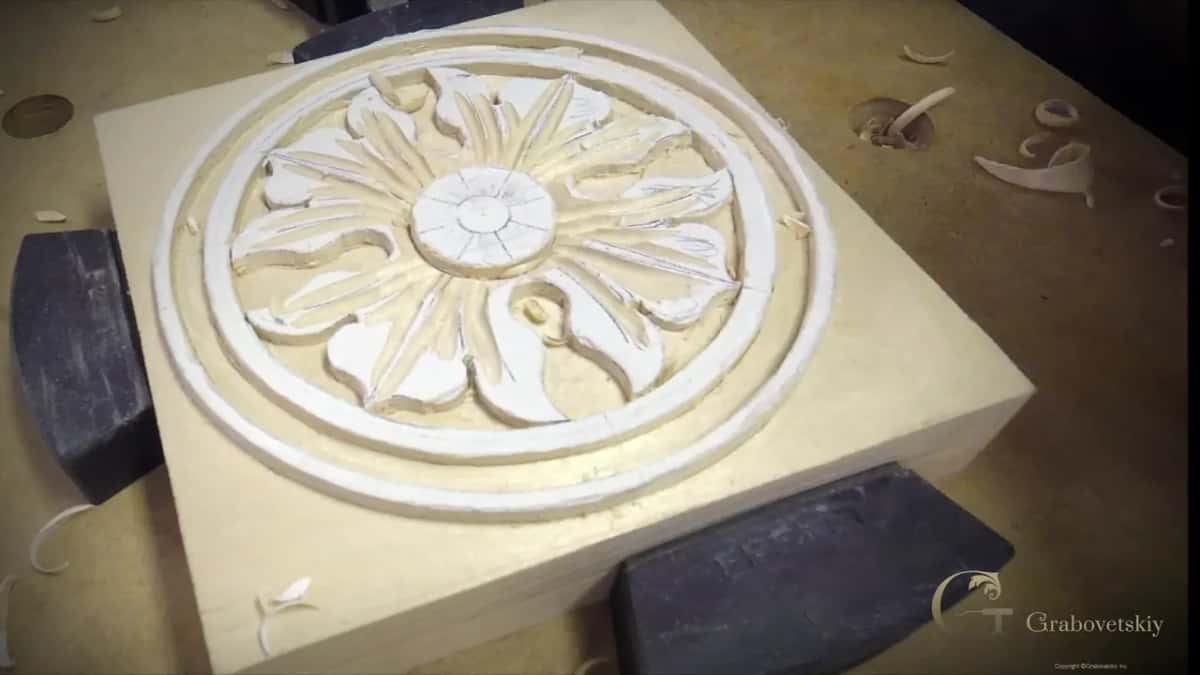
A carved leaf keeps its outer line high on purpose. Everything inside it gets hollowed away while that rim is left untouched, so the leaf reads as a curved surface rather than a flat one. Old work did this too, and for the same reason.
Carved a leaf that looks right in outline and dead flat in the light? Hollowed out the middle and lost the crisp rim at the same time? There is an order to this, and the edge is the part you protect the whole way through.
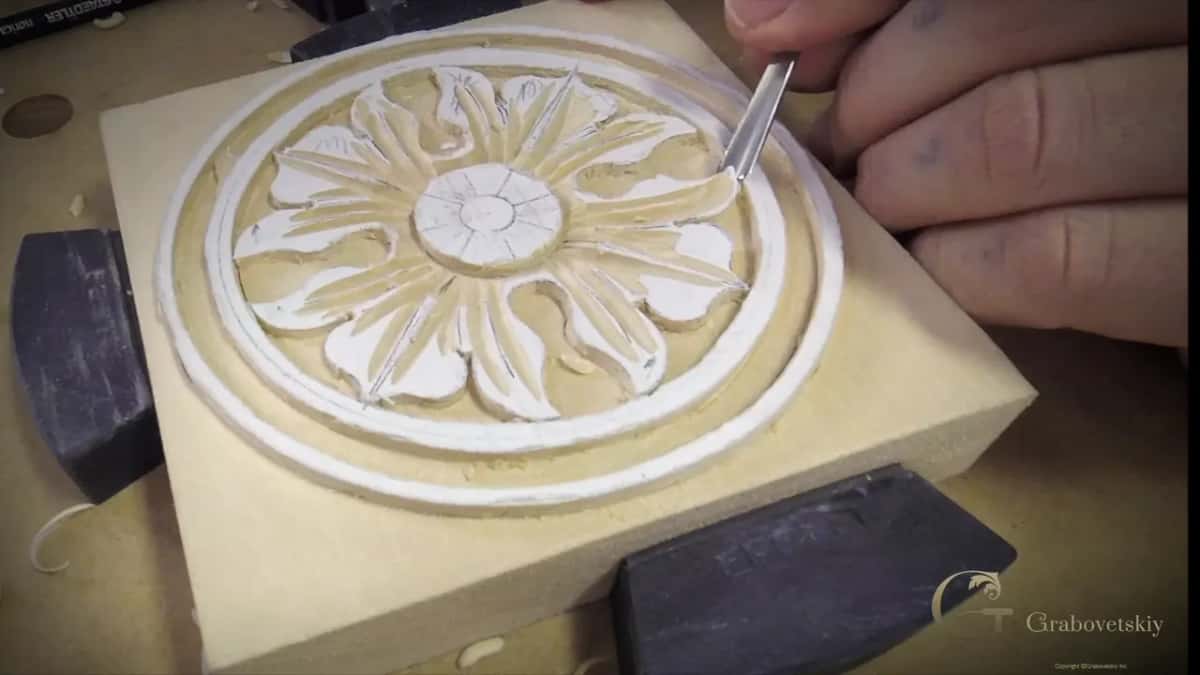
Light needs somewhere to sit. A leaf hollowed from its rim inward catches a bright line all round its outline and holds shadow in the middle, which is what makes a flat board look as though something is growing out of it.
Old work did it deliberately. Romanesque carvers in stone and in wood both left the outer edge of a leaf higher than the section behind it, and once you have seen that convention you cannot walk past a medieval capital without checking whether it is there.
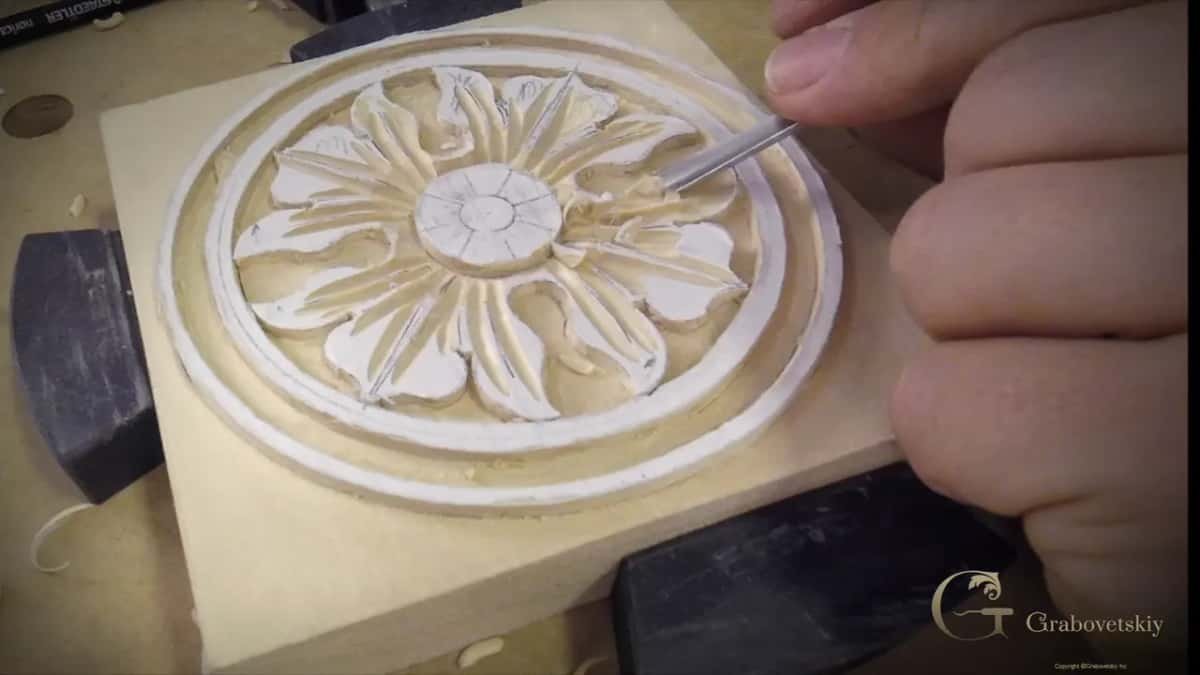
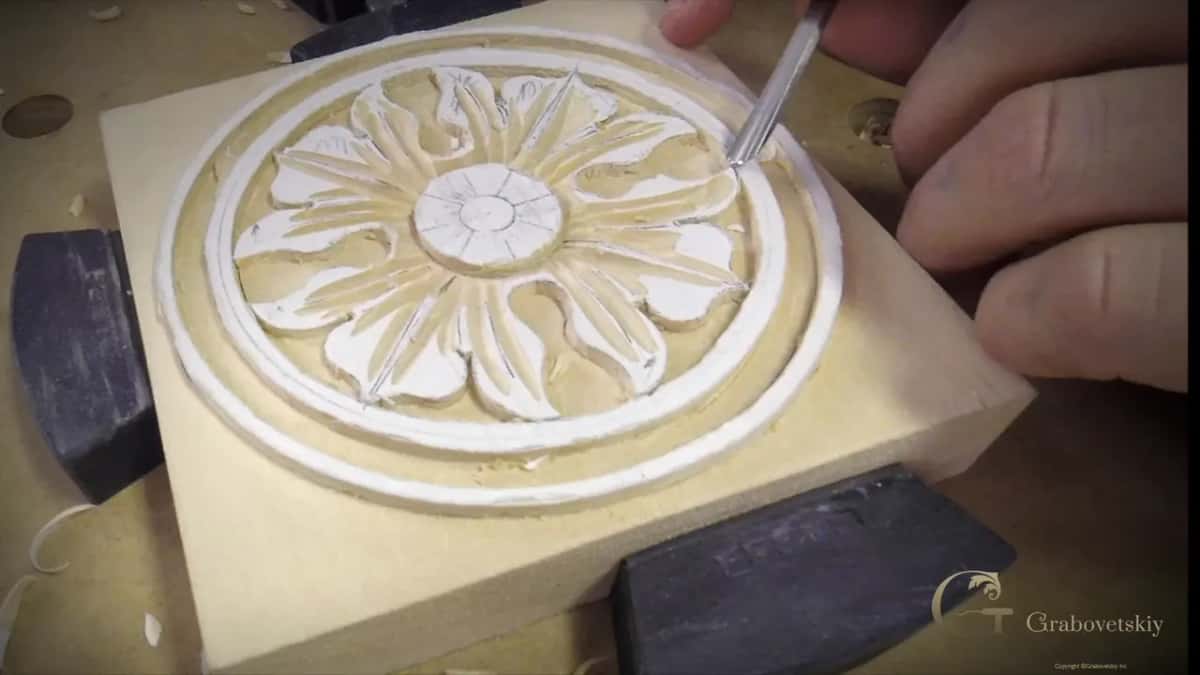
My method is simply to work inward. Begin at that rim, cutting away from it toward the middle, and keep coming back until there is a shallow concave sitting inside a crisp outline that has never been touched.

Paper tells me where I am. I leave the glued pattern right at the edge for as long as possible, because the moment that last white strip disappears I have cut into the line and there is no putting it back.
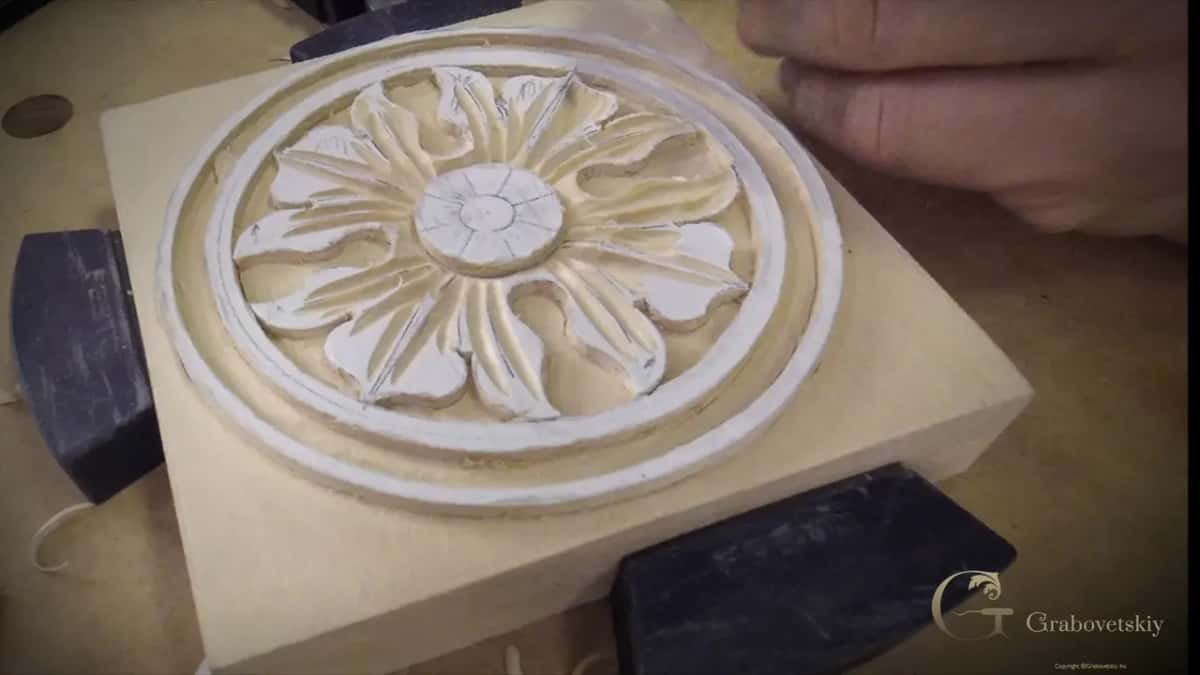
Depth of the concave is a judgement rather than a number. Too shallow and the leaf still reads flat, too deep and the rim you were protecting becomes a thin fin that will break off the first time the piece is handled. What I aim for is a hollow you can feel with a thumb and would struggle to measure, with the rim still carrying real wood behind it.
Sighting it is easier than describing it. Tip the piece until a lamp rakes across the face and the concave announces itself: a bright crescent along one side of every leaf, a soft dark one opposite. If both sides read the same weight, the hollow is not there yet.
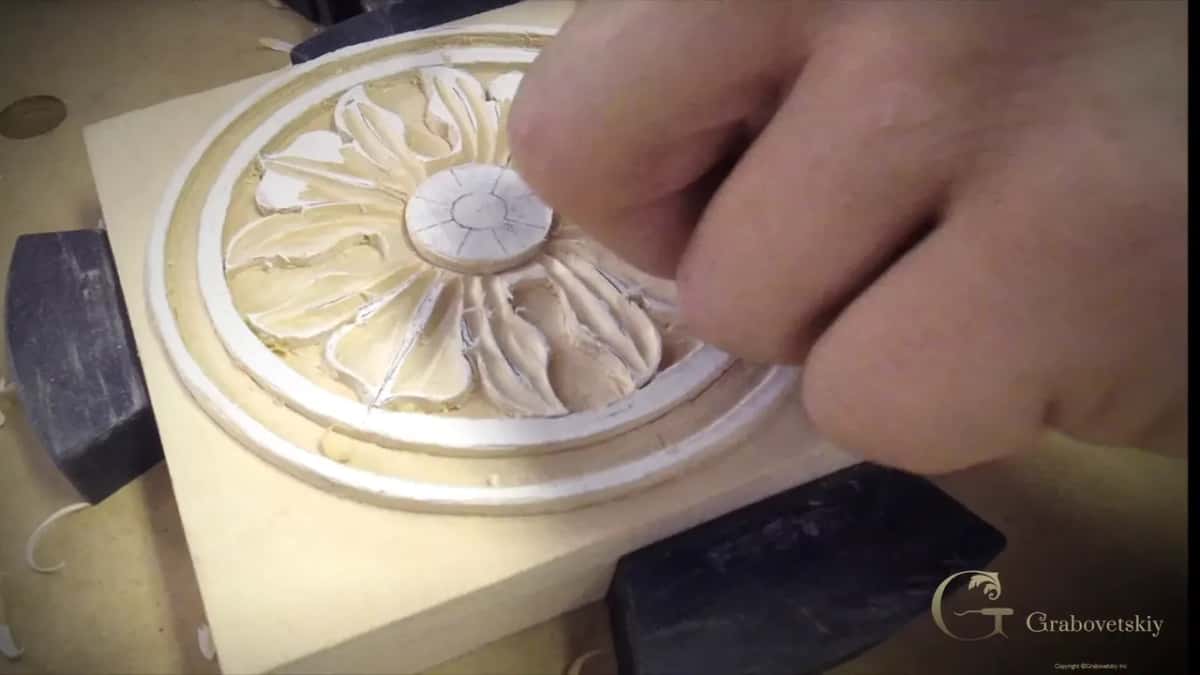
Rotate as you cut, too. The tool wants to arrive from four different directions on a shape this size, and turning the block is quicker and safer than contorting your wrist to reach the far side of a leaf that is two inches across.
A veiner, held in two fingers. Number 11 is the one on my bench for this, a small palm tool, and the U shaped channel it leaves is exactly what a pipe needs down either flank.
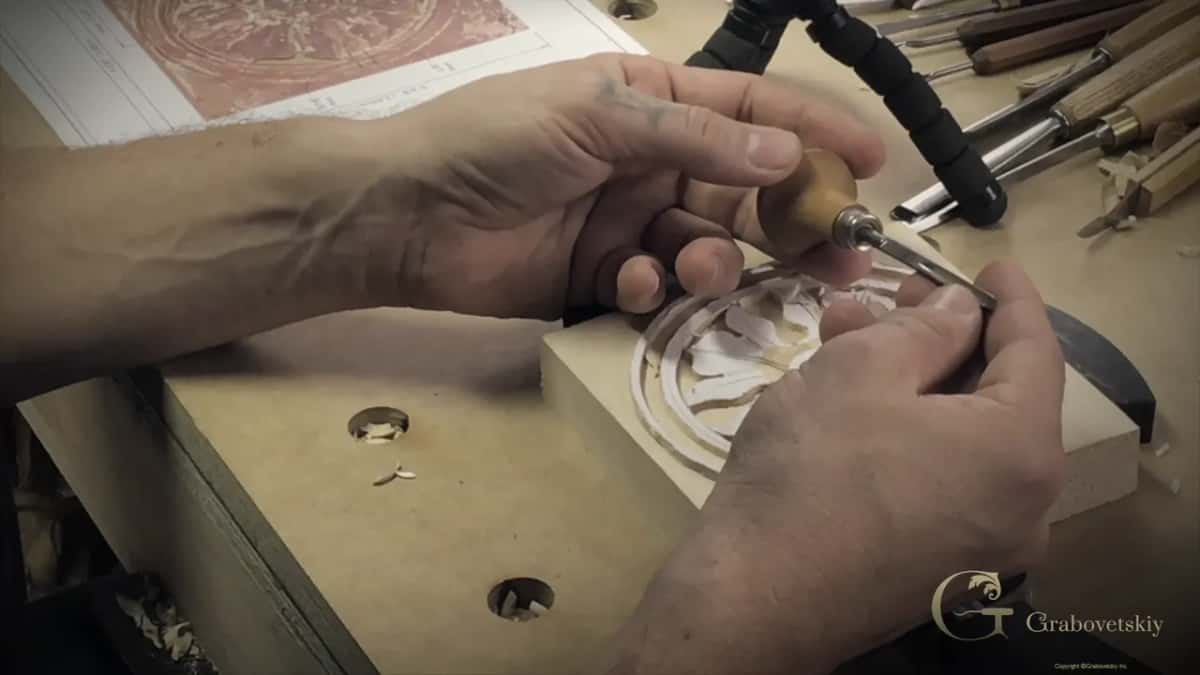
Alternatives exist in every direction. Nine, ten and eight all cut a usable channel, and a full length gouge works as well as a palm one provided it is genuinely small, something around three millimetres across the edge.
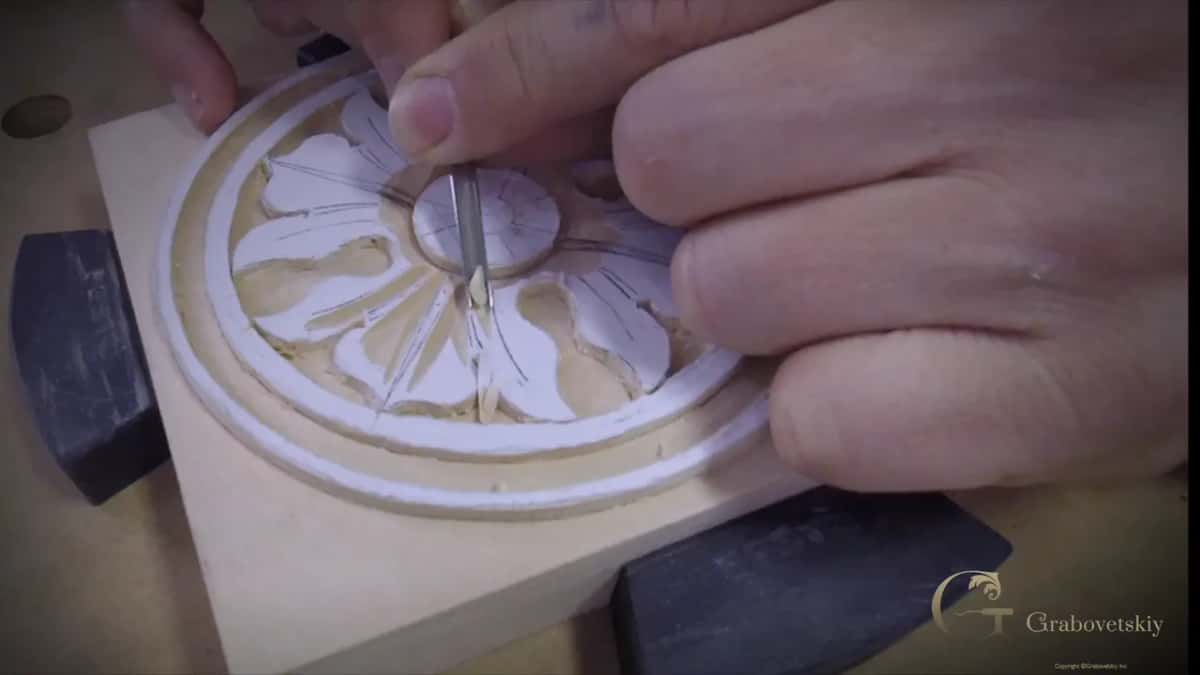
Grip is where the control comes from. Two fingers sit underneath supporting the blade, my left finger rides alongside holding the position, and the handle barely does anything except point the thing in roughly the right direction.

Keep the edge away from the wall. Lean on the tool while running a pipe and the gouge corner butts into the leaf beside it. That leaves a ding, which nobody wants and almost everybody eventually produces.

| The stage | What the tool is doing at that point | Depth | What it costs you to hurry this particular part of the job |
|---|---|---|---|
| Pipe sides | Number 11 veiner, one channel each side | Shallow, just enough | A pipe that sits flush with its neighbours instead of standing above them |
| Ridge softening | Number seven, dropping to a five in tight spots, taking the sharp crest off whatever the veiner left | Very light | Ridges stay |
| Hollowing the leaf, always beginning at the rim and travelling inward | Small dockyard gouge | A shallow concave | An edge cut into by accident, which cannot be built back up again |
| Flat sections | Number one, or just a knife | Level | Facets |
| Wherever grain turns | Whatever fits the shape, always taken downhill toward the clean face | As deep as the shape asks | Torn fibre on the face that was supposed to be the clean one |
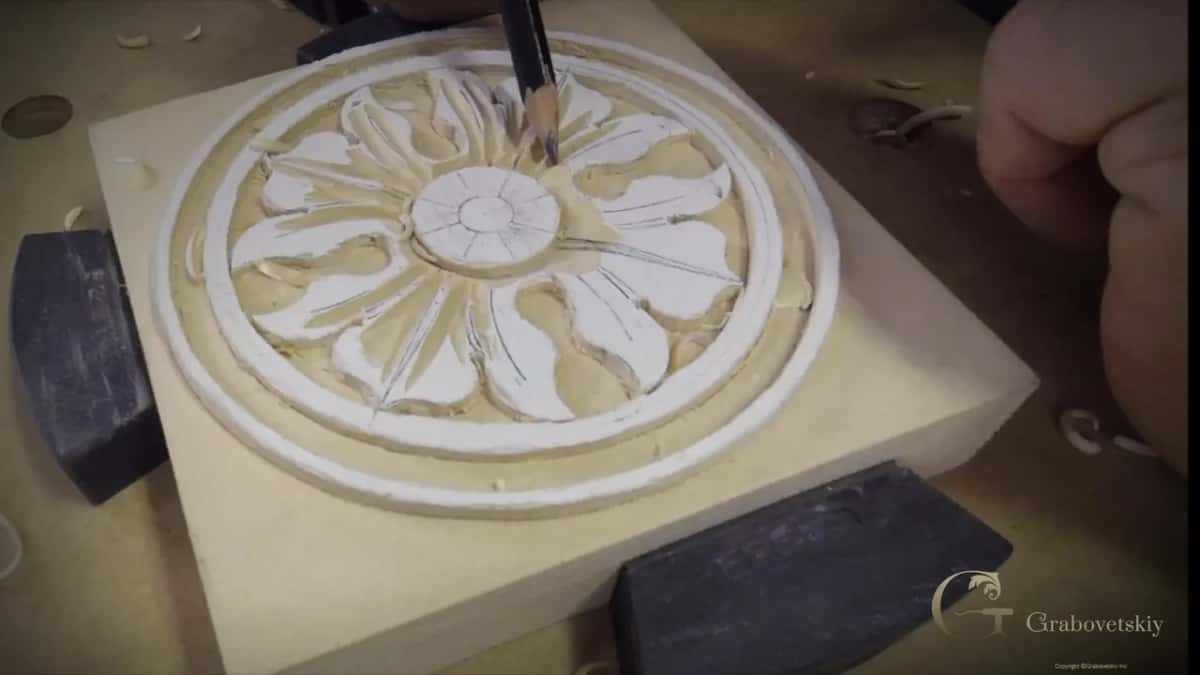
Time is what this stage really asks for. Each leaf is a small hollow taken in a dozen light passes rather than three heavy ones. On fifteen rosettes that arithmetic turns serious. Tools have to be sharp and the sequence settled before you start, not worked out as you go.
Nobody sees the hours afterwards. What they see is whether the light runs evenly round every leaf on the panel, and that verdict arrives in about a second from across a room.
Plain yellow wood glue, and almost nothing else matters. Most of that paper is going to be carved away within the hour anyway, so the glue is doing a temporary job and can be as humble as you like.

One kind to avoid, though. Glues that are thin enough to penetrate soak into the fibres rather than sitting on them, and wood that has drunk glue takes stain differently from wood that has not, so the ghost of your pattern turns up in the finish.

Yellow glue is thick enough to stay put. It sits on the surface, holds the paper for as long as the job needs, and comes away with the shavings without leaving anything behind in the timber.

Take the crest off, not the shape. Running a veiner along both flanks of a pipe leaves a sharp little ridge of paper and fibre standing where the two channels meet, and that has to go without the pipe going with it.

Something around a seven does it. A smaller seven if you own one, or drop to a five where that proves too broad for the space, taken lightly enough that you are shaving the ridge rather than recutting the pipe underneath it.
Sharpness decides how this goes. Halfway through mine stopped cutting cleanly, so it went to the strop, and the difference afterwards was immediate enough that I said so out loud on the recording.
Sandpaper cleans up the rest. Whatever paper survives in the corners comes off with a light rub at the very end, which is the one place in my work where abrasive gets anywhere near a carving.

Downhill, every time. Before cutting a concave into a section I work out which way the grain runs and which face has to come out clean, because those two facts together fix the direction the tool has to travel.

Think of the grain as a slope. Fibres rise toward one end of the cut and fall away at the other, and running downhill severs them, while going the other way lifts and tears them.
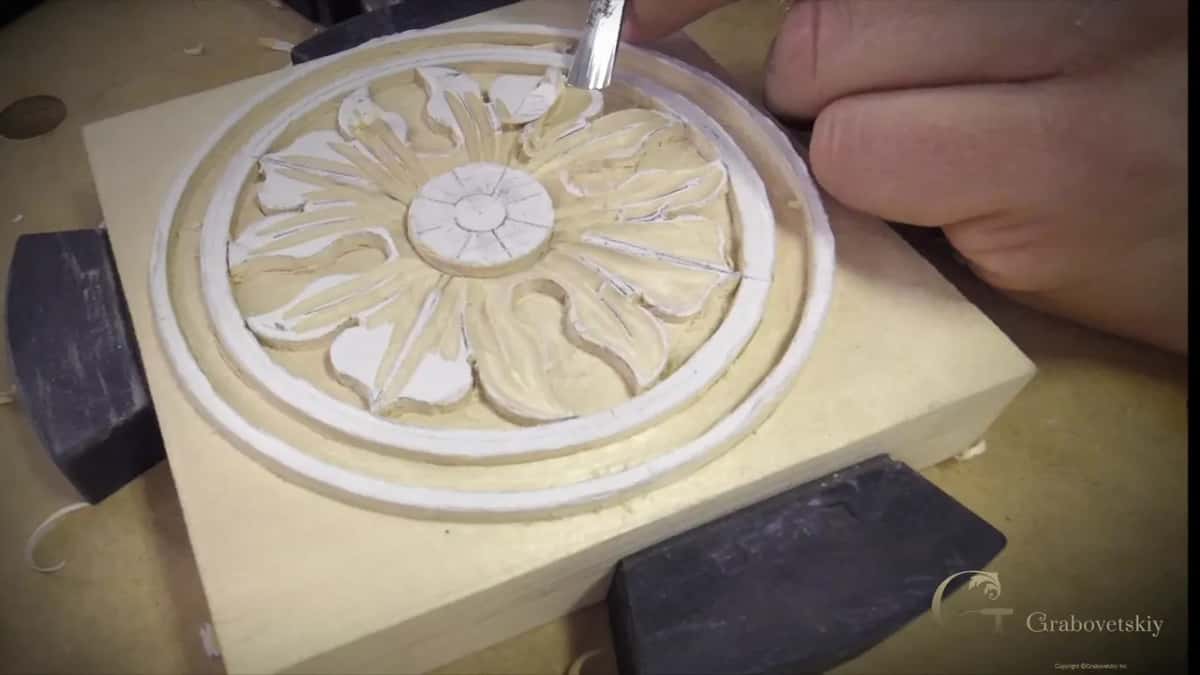
Both halves of a symmetrical shape get this treatment. The grain does not reverse just because the design is a mirror image, so one side of a leaf is cut in one direction and its twin in the other, which feels wrong and is correct.

Sweep the cut rather than driving it. I move the tool sideways through the wood as it goes forward, which shears the fibre instead of splitting it, and on limewood that is the difference between a surface that shines and one that needs work.

Audiobooks and university lectures, mostly. Quiet is the one thing I cannot work in, and carving has long stretches where the hands know exactly what they are doing and the mind is entirely unoccupied.

One whole course went by that way. I took an entire university programme while carving other projects, on tapes first and later on discs, because it seemed a waste to spend those hours only digging wood.
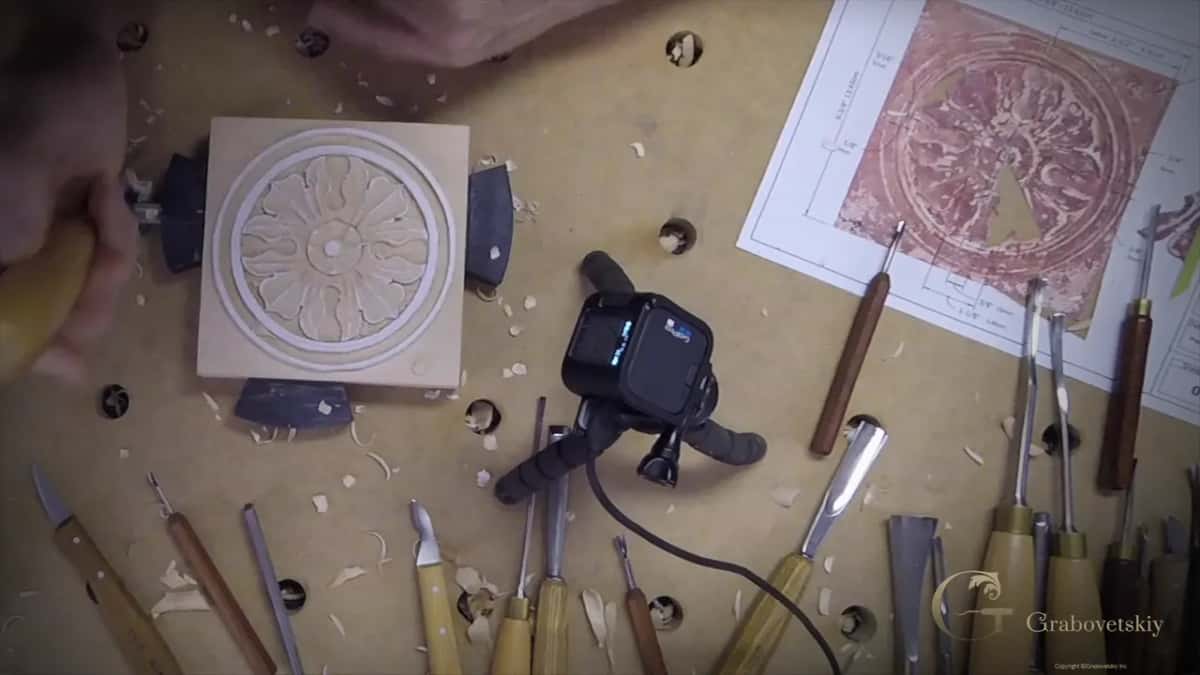
The work goes into automatic after a while. You are cutting and cutting, the piece is progressing perfectly well, and something has to fill your head or the day empties out. Audiobooks, lectures, teaching, anything with substance in it.
Time disappears when it works. I can get thoroughly lost in a session like that, which is one of the quiet pleasures of a trade where nobody is standing over you asking what you have finished.
A good deal wider than most people picture. Say Europe and almost everybody imagines Germany and France and stops there, when the continent runs a great deal further than its western half.
Eastern Europe has its own depth. The Czech Republic carries an ancient history and an ancient people, and the Slavic countries beside it, Poland, Ukraine and Russia, are every bit as European as anywhere with a cathedral in a guidebook.
I grew up in Russia, and it is different. Russia has a cultural background of its own, and mine was formed behind the iron wall, in the Soviet Union, when we simply could not talk to the rest of the world.
Whether that was good or bad I still cannot tell you cleanly. The regime was bad. The communists were bad. On the other side of it, people there learned how to survive, and that is not a small thing to be handed.
America looked entirely different to me because of it. I arrived and saw opportunity in every direction, and I went at it: no English worth speaking of, no newspapers, no American television, just work and more work. I built a business and employed people.
Five years in I read a newspaper and found out the economy had been bad the whole time. Nobody had told me. Zig Ziglar used to make a joke of exactly that, about why immigrants do so well in the United States, and the punchline is that an immigrant only learns the economy is terrible once he learns enough English to read about it.
Partly a joke and partly not. What you call a bad economy looks like a very good one to somebody who arrived with nothing and can see what is lying around unclaimed. Work. Look properly. Be unafraid of the place.
University presses carry it, far more than the craft shelf does. Plenty of books teach carving and very few cover its history properly, and the ones that do tend to come from places like Yale and Oxford rather than from woodworking publishers.
German carving has a good one. The title I go back to, as I name it on the recording, is Sculptors of Limewood, and it covers the tradition that produced all that fifteenth and sixteenth century church work in the timber I am cutting today.
For Grinling Gibbons there are older books. Printed in the nineteen fifties and sixties, still findable secondhand, and worth hunting because the people writing then had access to the work in a way that later authors did not.
The name I give is David Astley. He wrote a couple of volumes on Gibbons and he restored Gibbons' carving himself, which shows in what he writes, because a man who has repaired something knows things about it that no photograph will tell you.
Would you rather watch the veiner run down a pipe and the rim of a leaf stay standing while everything inside it comes away, at full speed with the camera over my shoulder? Shall we carve?
This is the fifth workshop in the antique rosette series, and tuition opens all six. Workshop one grounds the blank, workshop four set the eyes and freed the pipes, workshop six punches the background that matches the original, and sharpening is what put my seven back to work halfway through this session. The Gibbons class carries the history further, the tools course covers palm tools and veiners, and the Greek leaf uses the same high edge on a larger scale. Want me beside you? We teach in person, and a beginner starts here.
A standing rim catches light all round the outline while the hollow behind it holds shadow, so the eye reads a curved surface. Romanesque stone and wood carvers used the same convention centuries ago.
Plain yellow wood glue. It sits on the surface, holds long enough, and leaves nothing behind. Glues thin enough to penetrate soak into fibres and those patches take stain differently, so the pattern haunts the finish.
About three millimetres across the edge, numbered 11 for the U shaped channel. Palm tools give better control at that size, though a full length gouge does the same work in a steadier hand.
Downhill, from the high side of the fibres toward the low. Cutting that way severs them cleanly. Running uphill lifts and tears, and on a mirrored design the two halves therefore get cut in opposite directions.
Unwelcome and entirely normal. Lean on the tool and its corner eventually finds whatever sits alongside. Every carver of ornament has done this at some point, and the piece survives it perfectly well.
University press titles, more than craft books. Sculptors of Limewood covers the German tradition. For Grinling Gibbons, look to volumes printed in the 1950s and 1960s, among them those by David Astley, who restored Gibbons' carving himself.