October 2, 2024 · Updated August 26, 2026
By Alexander Grabovetskiy — Master Woodcarver · Founder, School of Wood Carving · 23 min read
What kind of wood should you use for Wood Carving?
The best wood for hand carving is basswood, which Europe sells as lime wood and Germany as linden. Students ask me what kind of wood sits on my rack, and I will name every one. Basswood first, always. Then walnut, which I really love. After those I love to carve cherry, and oak, especially brown oak out of England.
You sharpened everything, set the board down, and the wood fought you anyway. I know that afternoon. Some boards fight you even with a sharp edge. That part is the wood.

The plank before anything happens to it, no figure showing across the room.
Below is every wood I put under my gouges, how each one answers a sharp tool, and the ones to leave alone. I took my grandfather's chisel to a white brick at six years old and killed it completely. Been at this ever since.
- Basswood is the best wood to carve, and the reason is a grain you cannot see, not softness.
- Walnut comes second, and it forgives a bad pass in a way most woods do not.
- Oak is not one wood. English brown oak carves beautifully and white oak gives me splinters.
- My tools go dull faster on basswood than on oak, and I cannot explain it.
- Buy quarter sawn or rift cut, air dried when you can get it, and buy years early.
Why does one carving wood answer to four different names?
One tree carries a different name in almost every country, and all four names mean the same board. In America it is basswood. Ask for lime timber in England. Germans say linden, and back in Russia we called it lipa.
Latin gives you Tilia for the family. Portugal hears tilia, America hears American basswood, and both stand over one plank. Some cultures call it a tea tree, because linden flowers brew into a beautiful tea.

Rosette drawn on a small blank, knives around it.
I get really picky here. Basswood, limewood, linden wood, lipa. Same wood pretty much, so if a yard has none, say lime instead. Our wood guide page on basswood gives the plain data sheet, and the Wood Database entry gives the laboratory version.

Both hands at the eye of an acanthus scroll, with the pencil layout still visible on the untouched surface.
Even inside one country it is not one product. Eastern and western basswood differ a little. Tilman Riemenschneider left his limewood unpainted, the same species I carve, and you can go and look at it.
Is basswood a softwood or a hardwood?
Old European trade counted lime with the hardwoods and called pine the soft wood. I know how that sounds. The material is soft enough, but still stable.
Believe me, at least in old European culture, it was not considered a soft wood. It was considered a hardwood. A soft wood would be like a pine.
They call it soft wood, but it is not really soft. You would be surprised how nicely that timber keeps detail if people do not damage it. Of course you can damage anything, oak and walnut and cherry included. I really love this one.

Eighteen seconds later the outline is carved and chips lie everywhere.
Botany draws its line at the tree instead of at the timber. A hardwood comes from a broadleaf tree, a softwood comes from a conifer, and lime is broadleaf. Wood Database files basswood under hardwoods too, while filing eastern white pine under softwoods, and its page on hardwood anatomy explains the pores you will see in my pictures below.

Held against a plain wall, nothing behind it.
Grinling Gibbons brought the idea to England from old Europe, from Holland to be exact, and he called this the queen of all woods. German churches carved it widely in the 15th century and the 16th. Used 300 years ago, 400 years ago, 500 years ago, 600 years ago.
David Esterly wrote a book called The Lost Carving. He reached for exactly the same word when he described this wood.
The queen of carving woods, in all its pale glory.
English carvers put cheap work in pine, expensive work into oak, then limewood after the 17th century. My article on the best softwoods for a beginner to practice on stays on that narrower question, and the antique rosette workshop is where I say most of this with a blank in my hand.
So what kind of wood should a beginner buy first?
Buy basswood, and buy it for the grain you cannot see rather than for the softness. Yes, it is kind of soft. Plenty of other woods are soft too, so softness is not the main reason.
Look at a board and you see nothing. It does have a grain, but it is not visible, and that is good. Any type of curvature still looks really, really nice. Grainy timber steals the picture. This one is just a nice canvas. Beautiful and white. Not really white, but you get the point.

Overhead view of both hands steering a small V tool, and the wood still holds its detail.
Why do I love lime, basswood, linden wood, the same tree every time? The grain does not show, so nothing distracts my movements.
Some people say the best wood is a soft wood. My advice runs the other way. Be really careful with micro detail, and the board holds it, so long as you never press too much and never take passes you do not need.

Tipped on a ball vise, so thickness shows.
The United States has a store called Michaels, and they sell basswood planks. Woodcraft sells the same planks online. Then read what a beginner actually needs on the bench, because your board is one line on that list. First Cuts for Beginners starts you on this exact species.
A whole livestream went to this question, with the timber in my hands for most of it.
How does each wood behave under the gouge?
Every species answers an edge in its own way, and this table is the short list I work from. Design changes with the board, because I have to know the property of whatever sits in front of me.
| Wood | What it does at the edge | My verdict |
|---|---|---|
| Basswood, lime, linden, lipa | Grain is there and you cannot see it, so any curve still reads well | The best wood to carve. |
| Walnut | Harder than lime, and forgiving enough that a pass slightly off will not ruin the work | My second favorite, and I really love it. |
| Cherry | Holds detail really nicely, and a curly board carves differently | I love to carve cherry. |
| English brown oak | Softer than white American oak, and it carves beautifully | Just beautiful wood. |
| White oak | Crunchy, hands you splinters when you clear chips with bare fingers, though antique dry stock cuts like butter | I do not like it. |
| Red oak | Really hard, so a weak or long bevel gets dangerous | Also a really hard wood. |
| Butternut | Great under a gouge, and pronounced enough in the grain to show stripes on big movements | Really excellent, and I love butternut. |
| Mahogany | Kind under the tool, and true Indian stock goes dark under shellac with no stain | Really nice for carving. |
| Poplar | Carvable, a little harder, and it does not feel good | I highly suggest not to use poplar. |
| Maple | Carvable, and difficult | I would not recommend it. |
| Pine | Every bit of grain shows, and it distracts the eye | I do not like carving pine. |
| Heart pine | Broke a lot of my gouges, and no nail will go into it | Hard as a rock. |
| Olive wood | Oily inside, so glue will not stick as nicely as it sticks to other species | Absolutely different from the so called carvable woods. |
| Birch | Sits with oak, walnut and mahogany when I think about the design | Not that hard, still a little different. |
| Ebony | Dense, about as far as carvable goes | Possible, and dense. |

Oak, where those long open pore lines run straight on through the roughed leaves and flowers.
Laboratory people cover these two better than I can, at black walnut, black cherry, Juglans nigra and Prunus serotina.

Grey chalk over dark walnut.
Butternut is hard to buy now. Beautiful stuff, just hard to get in the United States nowadays. Pennsylvania, Ohio and Indiana still have it. Southern states, almost impossible. But I love butternut, and my only complaint is the grain, since big movements show too many stripes on a board that pronounced. Drop those movements and it turns great. Read its data page before ordering.

Heavily figured olive slab under a paper pattern, clamped down all round.
Mahogany earned its row on a real job, when a client told me his doors were solid all the way through. Really nice material for me. By the way, Chippendale used only mahogany on nearly all his furniture. Well, as far as I know, and I am not that accurate in that.
One word covers a crowd, though. Those doors held true Indian stock, not sapele and not modern mahogany. Indian is my favorite from the mahoganies. Well, not my favorite, favorite wood, just my favorite among mahoganies. Hundreds of types exist, and I should not say species, but anyway, sapele is one, Honduras another. Reading the separate pages for Honduran mahogany and sapele is how you stop getting sold one as the other.
Shellac settles it, since true Indian goes really dark with no stain. Those doors turned out to be veneer over yellow pine.
The same list from the punishment side sits in which woods are hard to carve, and our wood database keeps a page per species: red oak, yellow birch, Malaysian blackwood from the ebony genus.
Do hard woods really dull your tools faster?
My tools go dull faster on basswood than on oak, and I still cannot explain it. Carving oak, I walk to the sharpening station less often. Kind of a paradox, I guess.
For some reason basswood is a much softer wood. Well, you call it basswood, or you can call it limewood. Same thing. Softer, and yet my edges give up quicker on it. My teacher tried to explain me. I still did not get it.

Deep undercuts on a dark board, and the chalk worn off every high point.
Basswood does not look like abrasive wood. Some species really are, with something abrasive right inside the fibers. Nice and smooth, and the tools get dull quicker anyway. At least mine do. Maybe in your case it is not the case.

Waste coming off a figured slab as short chunky chips instead of long curls.
Plenty of people say the best board is a soft board and your tools should not get dull. Not necessarily truth. Soft it is, and your edges still go, really quickly sometimes. I sharpen multiple times daily.
Species does change the tool, though. Softer woods get as little bevel angle as possible, while oak takes a higher one, and a weak or long bevel there gets dangerous. Carving oak, I reach for a stronger tool. Short bevels go on hard stuff, and a really, really low bevel slices fibers with far less resistance.
Then comes the mallet. Oak is harder, so most likely you have to use one. You really have to. Brass suits hard boards, heavier and smaller, and mine runs two pounds, 32 ounces. See what a carving mallet is, whether you need one at all, the sharpening workshop and the sharpening page.
Which woods forgive a mistake, and which ones snap?
Walnut forgives, oak forgives more than people expect, and a crunchy species snaps the whole detail off. What I like about walnut is that it is somewhat forgiving. Sometimes you could go against the grain and nothing bad happens.
Keep an eye on the fibers anyway. Walnut is just not the same as other species. That one is really forgiving. Really forgiving.

Figure reading right across this lowered walnut ground.
Maybe that was a little too much for one pass. Fine. Hard to make mistake in this wood. I love this wood, I love walnut, I should say.
Forgiveness ends at pressure. Walnut runs harder than lime, although it is not as hard, but still harder. Press, and those fibers smush both ways, then pop back up at you later.
Oak surprises people. In one workshop I say plainly that this is oak and it is crunchy, my tool is not digging in, so breaking the rule gets easier. But not every wood is that forgivable as oak. That antique apron board was dry white oak. Cuts like butter.

Wide chisel starting into a narrow tan board, design still in pencil.
Crunchiness bites the other way too. Very dry fibers snap, so rotating a gouge around my center would take the centers right off. Never do anything in one pass. Work your way in little by little. You can hear that crunchy sound, and that is oak.

Close view of that same surface, where open pores run right under the pencil drawing of leaves.
I am not sure if I am supposed to say it that way, crunchy. For me, though, I think it is probably the best word I can find. It is a crunchiness of wood.
Splinters live in the same place. Be careful cleaning chips with your fingers, as I am doing there. Better to use a brush, because crunchy stock will hand a few over. I never got any splinter from basswood.

Torn slivers of waste sit all around the blade on a strongly striped board.
White oak will give you a few. That slab was more crunchy than oak. Really crunchy. Let me tell you, absolutely different from the so called carvable woods.

Very coarse open grain with short broken chips on top, which is what a board that breaks instead of slicing looks like.
Here is the price of getting that wrong. Crunchy species punish a careless pass, and taking too much at once snaps off the whole detail. Not chip it. Snap it off.

Chalked magnolias standing off a brown board, and a crunchy species would snap flowers like these off.
Fiber direction gets its own pages, at carving in the direction of the grain and handling several grain directions at once. What to do after a carving goes wrong sits in the mistakes article, and walnut gets a page of its own plus one more.
Which woods do I tell people to leave alone?
Poplar and maple are the two I steer people away from, and hard pine broke my gouges. Both are carvable. Almost anything is carvable, pretty much, and it is going to be difficult.
People think poplar is fine when the job gets painted. And I highly suggest not to use poplar, since it carves harder. Maybe that is my own opinion, though it does not feel good under the tool. Much better to use cherry or even oak. Maple I would not recommend either. Argue with me on paper at yellow poplar and hard maple.

Small block clamped on a paper joint, because olive is oily and glue struggles there.
Pine runs longer, and part of it is genuinely brutal. Heart pine held up the big manufacturing companies, the factories in United States in the 19th century. Hard as a rock. It took me a long time, and I broke lots of gouges carving it by hand. Almost impossible to drive a nail in.
Ordinary pine is a different objection. Pine carries a lot of grain movement, and pine is not a board I reach for, exactly because of that grain. Every line shows, and it distracts.

Narrow gouge on a small carved fruit between two fingers.
Olive I carved on purpose, for a whole course. Usually the glue does hold, but olive is different, and it will not stick as nice as poplar. Somewhat oily. You can feel that right inside of it. That olive lily box course is the whole experiment on camera.
Curly figure is its own hazard. Process changes with the board, and especially with curly grains. A few years back I had to make legs out of curly cherry. Exactly the same thing, and it carves differently.
Ebony is the far end. Carvable, of course. Almost any timber is, except the really rare and really impossible. To understand what dense does to your arm, read what the gravity of wood means and what Janka hardness means for a hand carver.
One species I praised without ranking. Somebody on a livestream mentioned Alaskan yellow cedar, and I told him cedar wood is great. Anybody chasing that has a separate page on cedar.
How do I pick the actual board after I have picked the species?
Species is half the answer, and how a board was sawn and dried is the other half. Best of the best is a quarter sawn. Quarter sawn material.
Closer to the center, tighter the rings, and a lot less movement later. So my choices when buying come down to two, either the quarter sawn boards or the rift cut ones.

Pencil arrows on the edge, marking which way the grain runs.
Step 1, ask the yard for quarter sawn or rift cut
Say those two words at the counter. Unique ones I keep back, French limewood, where you can still see the flames. Tiger limewood, sawn the right way.
Step 2, look for grey streaks before you look at the price
Washington State lumber is okay for other species. Problem is the rain, so water gets inside and roots pull coloration out of the earth. You see grey lines running through it.
Choosing basswood, I use South Carolina and North Carolina, because I almost never see those grey strikes. Wisconsin is good. Canadian is better still, with more forest, less pollution, really good lumber.

Curled chips heap up around deep scrolls, and the pencil layout is still on the smooth wood.
Look at my stock and it is actually perfect. No black marks and no streaks in it. Absolutely gorgeous, and I am not trying to save money there.
Step 3, choose air dried over kiln dried when you can
Two drying methods exist. Kiln dry is what manufacturers and lumber yards use. They have a big, big, big stove, to be simple, and they fry those boards. Dry it quickly, sell it quickly.
Second method is air dry, always my preferred one. Kiln dried moves a lot more. Nowadays the yard hands you kiln dry, and the trouble there is speed. Dry, yes, but pretty fresh yet, and timber has a tendency to adapt its environment. Wikipedia covers the industrial side at wood drying.

Paper pattern taped down, a dozen gouges waiting in a row.
Step 4, glue up two thin boards instead of paying for one thick one
You do not really have to buy thick stuff. Get four quarters material, three quarters of an inch, and just laminate together. Here you go, a thicker board, without spending thousands.
Watch one thing. Alter the direction of the grain, gluing the next board the opposite way somehow. Wood is like a bunch of drinking straws compacted together, and that is exactly what it is. Whether thicker wood is better for carving is a separate question.
Step 5, buy it years before the project
Basswood arrives at my shop years ahead of a project. Some boards have been sitting there over 10 years, some 20, or 24, 25 years. I have pieces 20 years old and 25 years old that show no movement.

A V tool standing in the groove it made.
Humidity in my shop stays low, since I do have a dehumidifier and I keep that at approximately 35 percent even though I live in Florida. Want laboratory numbers instead? They live in the USDA Forest Service Wood Handbook, its chapter on mechanical properties, the Wikipedia article on grain and the Wood Database article index. Drying has its own pages here, on drying wood before carving, how long that takes, and what makes a board warp and cup.
Where do you buy carving wood that a yard will actually sell you?
Go to a lumberyard that sells to furniture makers, not to a construction yard. Search for a hardwood lumberyard.
Walk into a construction yard and you leave empty handed. Unique material, and they do not sell it to construction companies.

Roughed flowers held under a red clamp, on the very board I have been calling crunchy.
Woodcraft will always ship, and it will be expensive. Amazon is another route. If somebody is selling planks there, find out what company it really is and contact them directly. No need to buy through the Amazon, and ask them for the discount.
Real yards come with a catch, the minimum. They cannot sell just one board. In my case that floor used to be 300 dollars. Right now it is up to 500. And the smaller piece you buy, the more expensive it gets. You spend less money, but it costs more.
Geography decides more than people like. Living in Florida, I really cannot find any basswood here. Australia and New Zealand have it worse. Students there order from European stores and ship it over. But jelutong, I think I am pronouncing that correctly, is another wood for carving.
My own stock arrives by the semi truck. Not a brag, just what a 500 dollar floor does to a man who carves for a living. Costing out year one? Try how expensive carving is as a hobby and what is needed to carve wood. Readers on the far side of the world have the best woods in Australia for a beginner.
Does the wood change what you can design on it?
It changes the design, and that is why I ask about a board before drawing a line. Somebody once asked whether I change designs depending on the type of timber. I do, absolutely.
Property first, drawing second. Working lime is nothing like the harder ones, oak, walnut, mahogany, birch even. Birch is not that hard, still a little different. Basswood is where I can pretty much design anything.

The ground has already been lowered flat around a design chalked out in grey.
An American black walnut is not too pronounced in the grain either. A European one shows every color variation, from really white and yellow through to really dark brown. On walnut I do not worry about design movements. Oak makes me mindful.

Thin knife on the chalked outline.
Two species in one piece is a real technique. Put oak or cherry behind the work. Gibbons used oak backgrounds all the time, lime for the carving itself.

Two woods in one panel, with a pale carved bouquet fixed onto a dark ground.
On one panel I chose walnut as the background. Common for Gibbons, who put brown oak behind the work, and that contrast exaggerates every excavated area. Our Gibbons class in Maine works in that tradition, and who teaches Gibbons style carving answers the question I get most.

Small tool sunk into the centre of a chalked flower.
Walnut charges you something on the way in. Parts of a board are called sap wood, a different color, more white. You do not have to throw that away. Up to 40 percent gets binned just because of sap wood.
Finish decides the last part, and paint work suits basswood fine. Furniture takes walnut, cherry, whatever you like. Fragile spots I reinforce with glue thinned down with water. On paint grade that is no problem. Under stain it would blotch. My pages on carving finishes and sealants and on applied carving or carving in the solid pick that up.
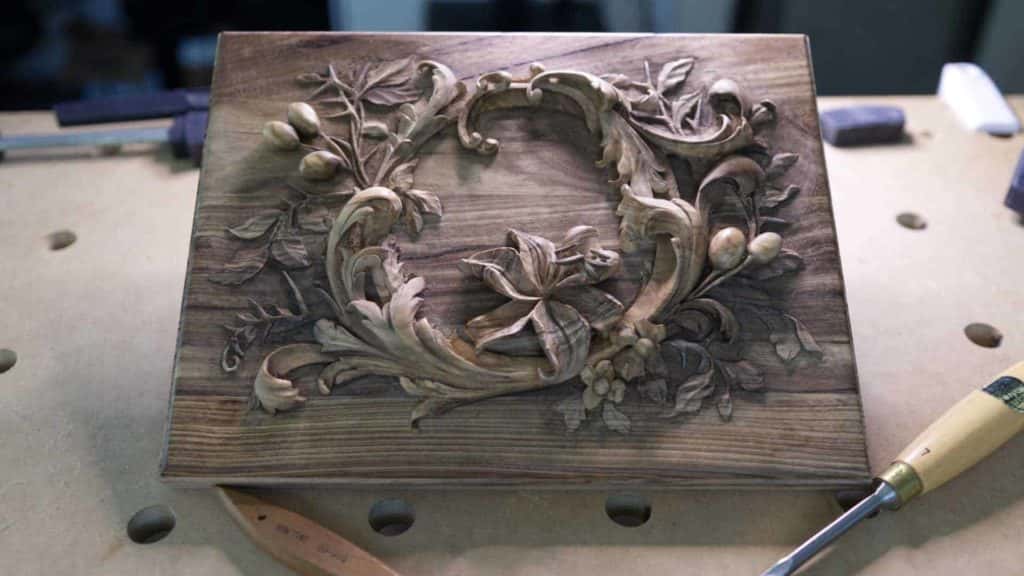
Lily relief on a dark board, grain lines running right through the flowers.
Then comes the day the fibers win anyway. Carving in Gibbons style, there is no such a thing as carve with the grain. Absolutely no. Only solution is sharp tools.
Once, in a lesson, I said long grain and short grain, then stopped myself. With the grain and against the grain, I am sorry. Am I correct? So one pass comes out clean and the other really rough. Sharp tools make that hardly matter, and you will not split it. Do not overcomplicate stuff. If it fights you, sharpen.
Your board is the first decision of the piece, and the cheapest to get right. How you know if a piece is good for carving is the practical test. Why grain matters is the theory. Why carving is worth taking up at all is the argument I would rather have first.
Every wood here lives in the school, with a board in my hands. The oak apron, the olive lily box, the walnut furniture panel, the basswood rosette, all of them. Walk the whole course list, or take yearly access to all of it. Tuition pays for the lessons and it also pays for orphans and widows, because that is what a non profit school is for. Want my own face first? My whole story sits on one page.
Frequently asked questions
Is basswood the same thing as lime wood?
Same tree, different name. America says basswood, England asks for lime timber, Germany says linden, Russia says lipa. The Latin word is Tilia. Some cultures call it a tea tree, because the flowers brew into good tea. Where a yard has none, lime is the word to use.
Which wood holds fine detail best?
Cherry and walnut hold it really nicely. Basswood manages too, provided you keep pressure off and skip passes nobody needs. Press walnut too hard and the smushed fibers rise again later, after everything already looks clean and finished on the bench.
Why do my gouges dull so fast on soft wood?
Mine do the same, and nobody ever gave me a straight answer. Basswood sends me to the stones more often than oak does, and even my own teacher could not make that clear. Some species carry abrasive inside the fibers. This one does not, and the edges still go dull.
Should I buy kiln dried or air dried boards?
Air dried, every time. A kiln is a big stove and it fries a board fast so it sells fast. Kiln dried stock shifts far more once you get it home. Air dried settles down, and that is why I hoard boards for years and years.
What is quarter sawn, and why do you ask for it?
Quarter sawn is the best of the best for me, with rift cut right beside it. Nearer the middle of a log, tighter the rings, less the board shifts later on. I buy one of those two and nothing else.
Can I carve oak as a beginner?
The best is basswood, especially if you want to start carving. Going to oak anyway? Ask which oak. The brown one out of England carves beautifully. White American is harder, it hands you splinters, and red is hard too. Work little by little, and keep a mallet close.